 Tap AAC
Core word of the week: 32 free plans with printables
A core word of the week means picking one useful word and using it everywhere for a week: at meals, in play, in the bath and on outings. Here are 32 weeks, in order. Each has ideas for modeling the word in everyday routines, a short example, and a one-page printable with a mini board and a note for home. A free planner helps you plan your own term.
Weeks 1 to 8: first words
-
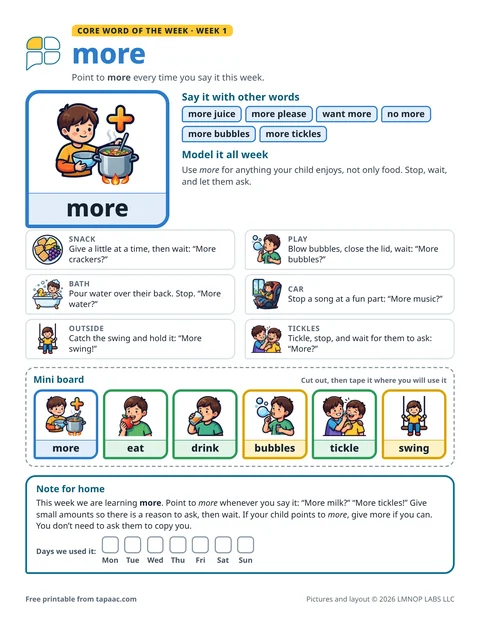
Week 1: more
Ask for more of anything fun: snacks, bubbles, tickles, songs.
-
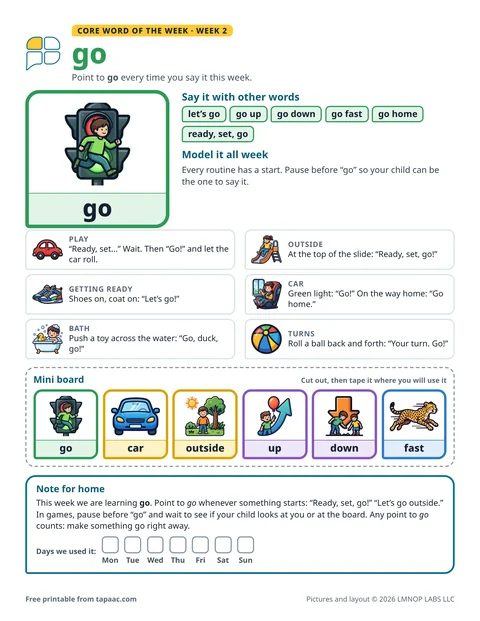
Week 2: go
Start the fun: ready, set, go! Cars, slides and walks.
-
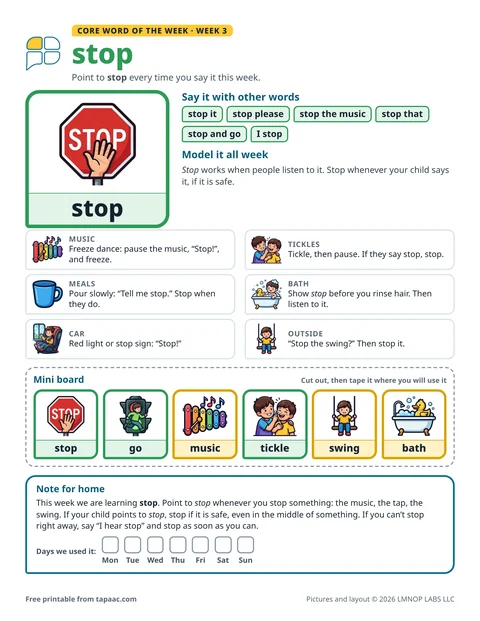
Week 3: stop
End what isn’t wanted, or freeze a game, and be listened to.
-
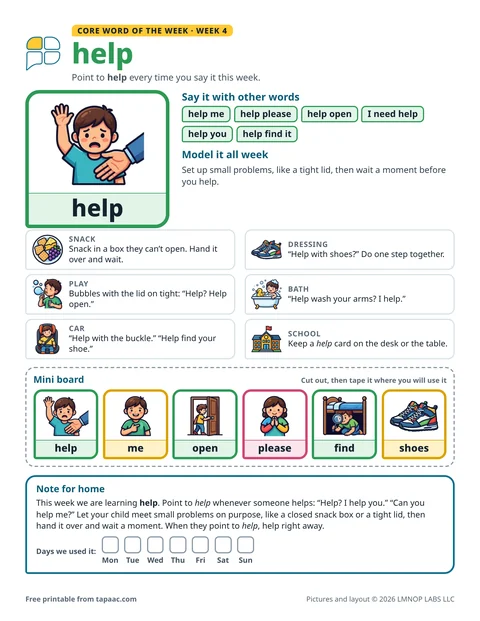
Week 4: help
Ask for help with lids, shoes, toys and hard work.
-
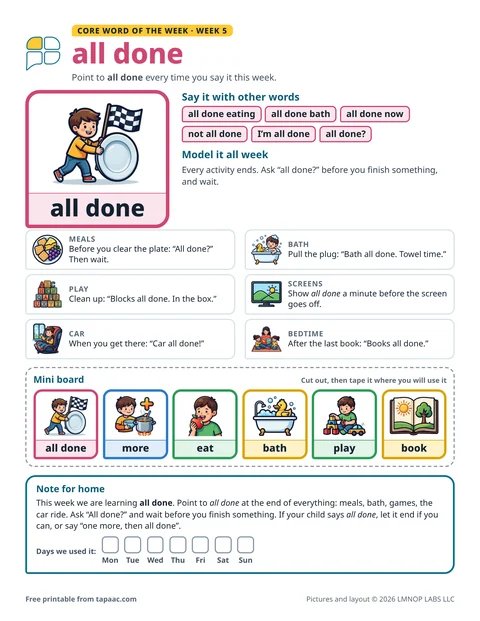
Week 5: all done
A calm way to end meals, baths, games and screen time.
-
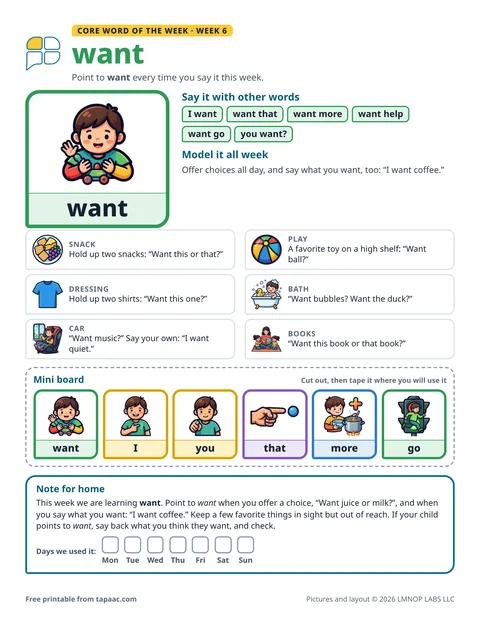
Week 6: want
Choices all day: want this or that? I want...
-
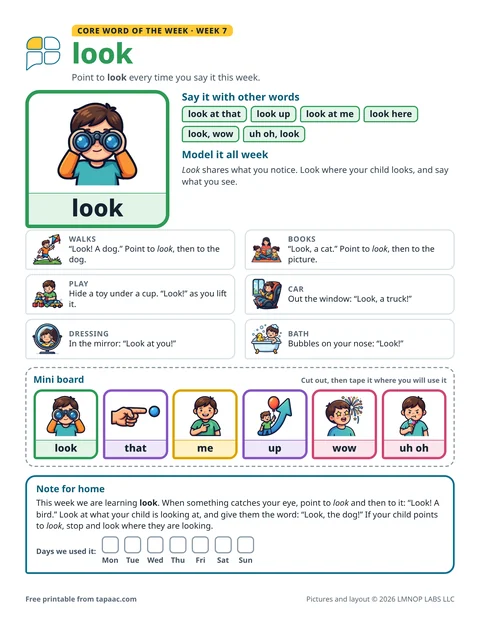
Week 7: look
Share what you notice: look, a dog! Look at me!
-
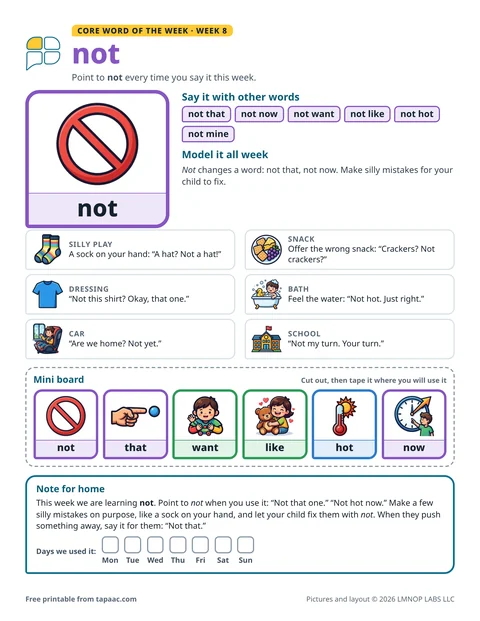
Week 8: not
Change a word: not that, not now, not hot. And fix silly mistakes.
Weeks 9 to 16: opinions, people and questions
-
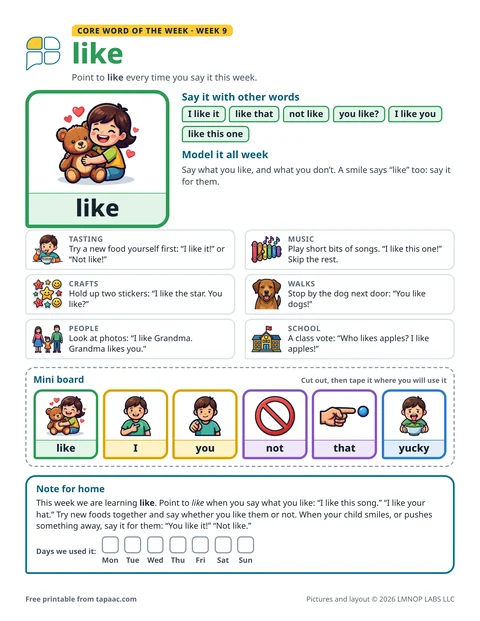
Week 9: like
Share opinions: I like it, not like, you like?
-
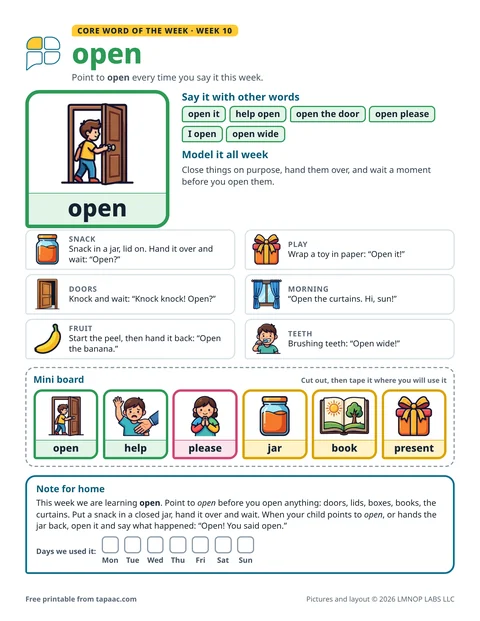
Week 10: open
Jars, presents, doors and books: open it!
-
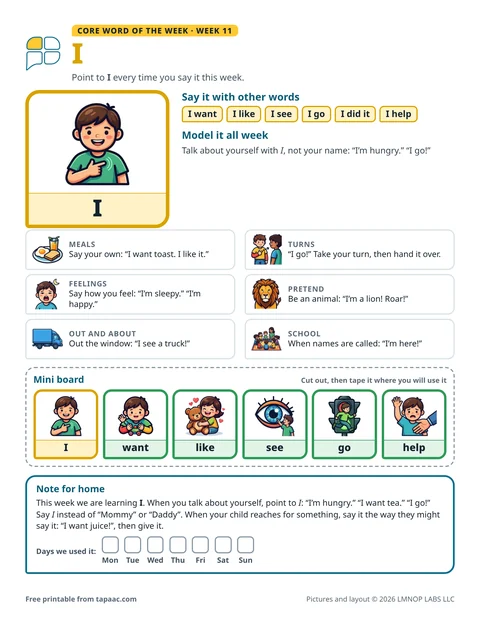
Week 11: I
Talk about yourself: I want, I like, I see.
-
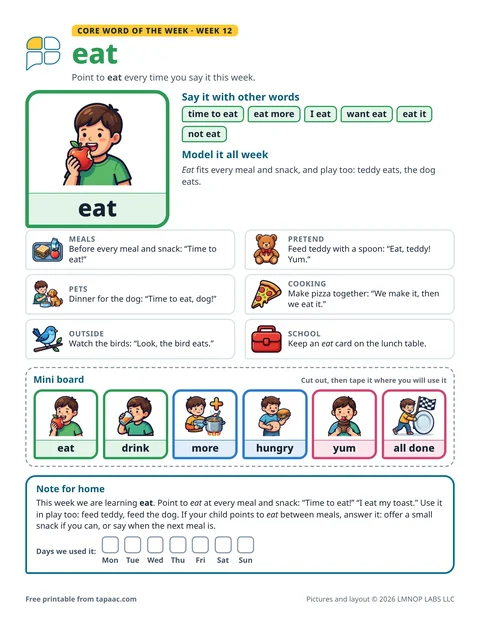
Week 12: eat
Meals, snacks, pretend play and pets: time to eat.
-
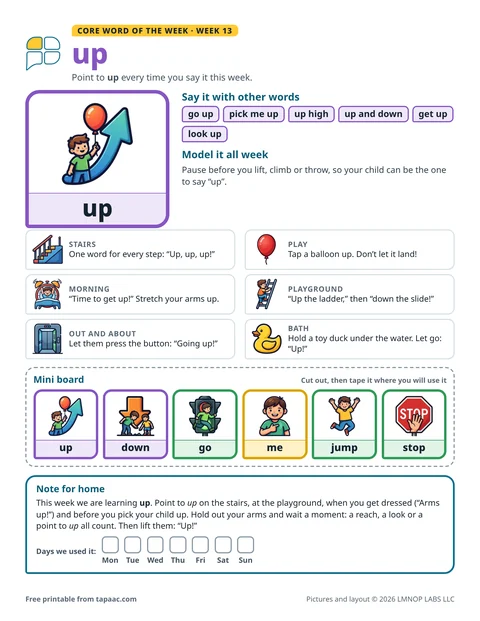
Week 13: up
Lifts, stairs, balloons and climbs: up, up, up!
-
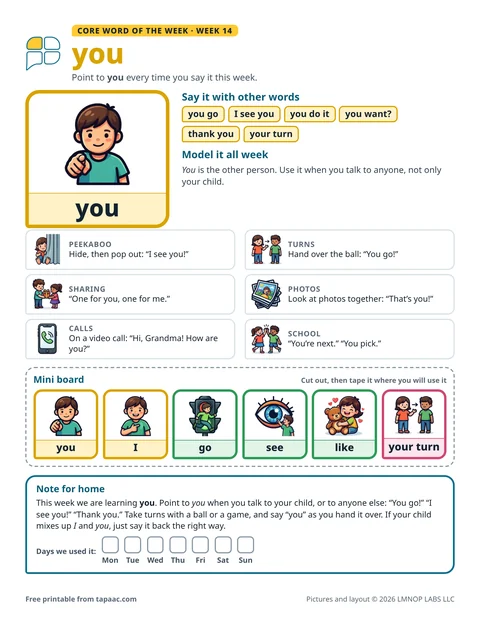
Week 14: you
Turns, peekaboo and sharing: you go, I see you.
-
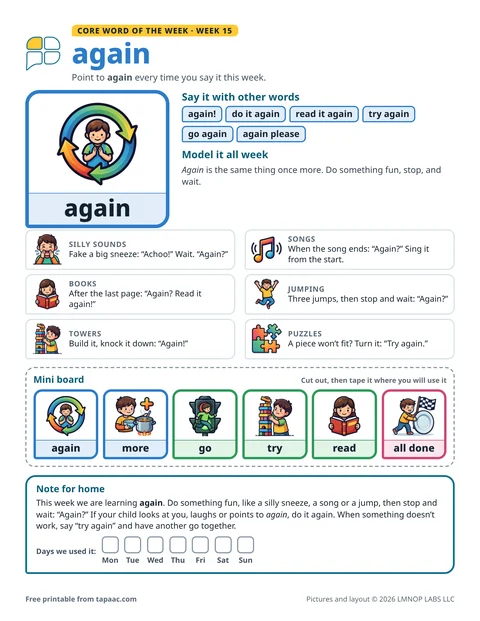
Week 15: again
Keep the fun going: again! And try again.
-
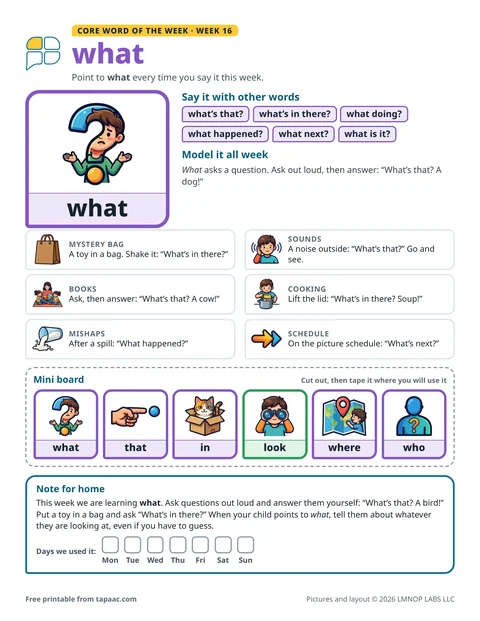
Week 16: what
Ask questions: what’s that? What’s in there?
Weeks 17 to 24: places, play, making and feelings
-
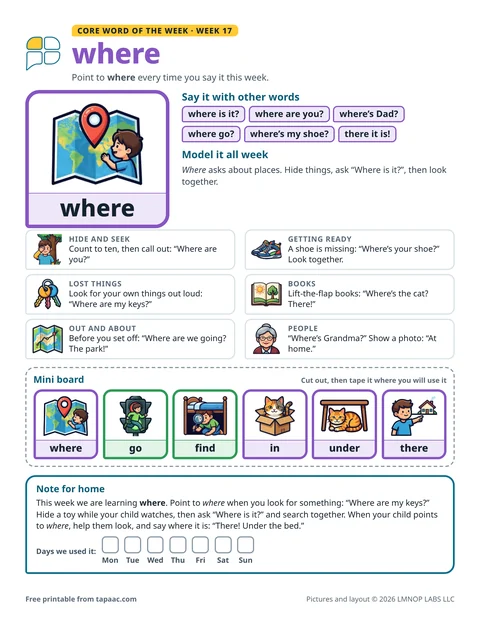
Week 17: where
Hide and seek, lost shoes and outings: where is it?
-
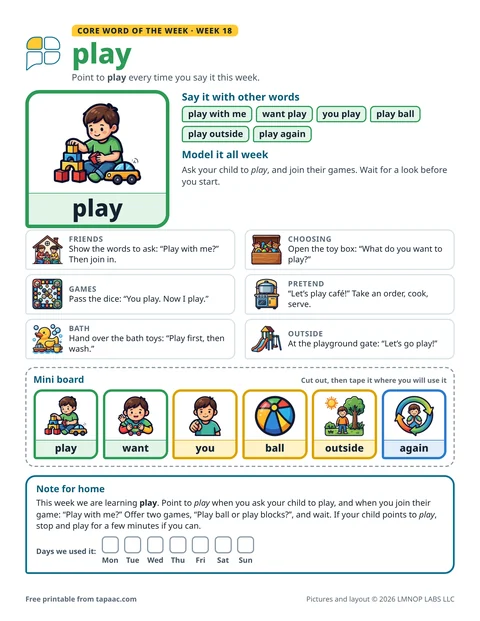
Week 18: play
Ask someone to join in: play with me, play ball.
-
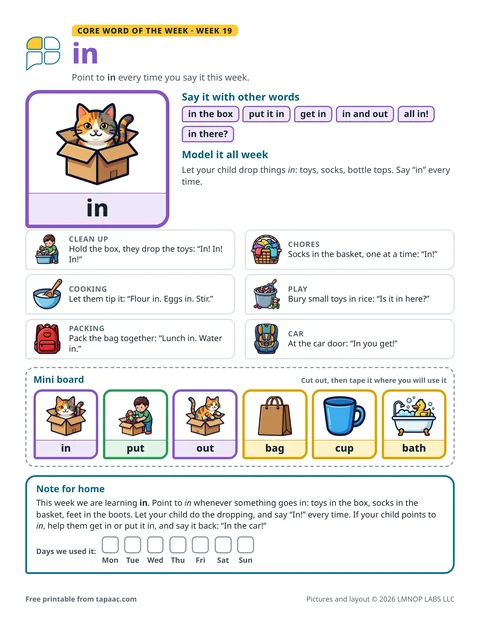
Week 19: in
Toys in the box, eggs in the bowl: in!
-
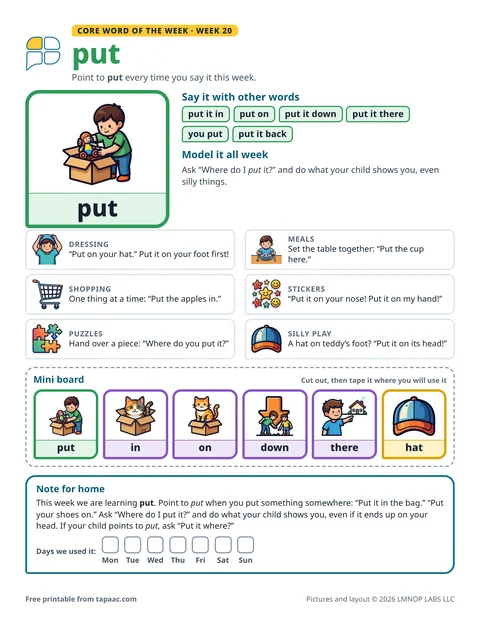
Week 20: put
Put it on, put it in, put it down. You’re the boss!
-
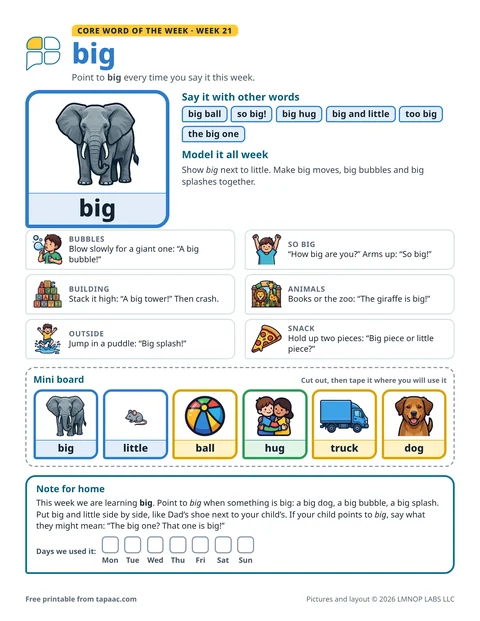
Week 21: big
Big bubbles, big towers, big hugs: so big!
-
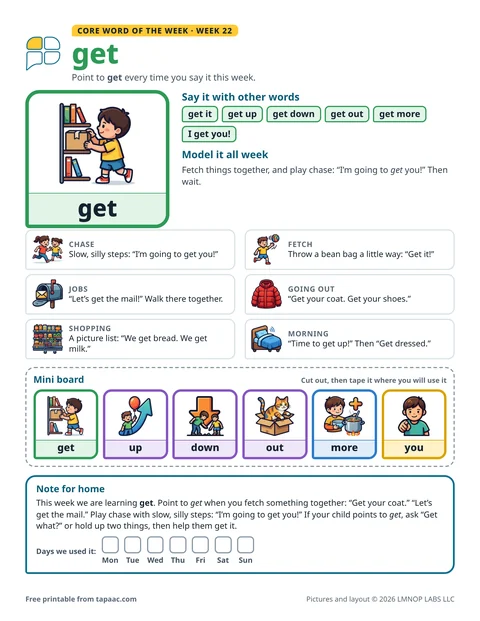
Week 22: get
Get it, get up, get down, and I’m going to get you!
-
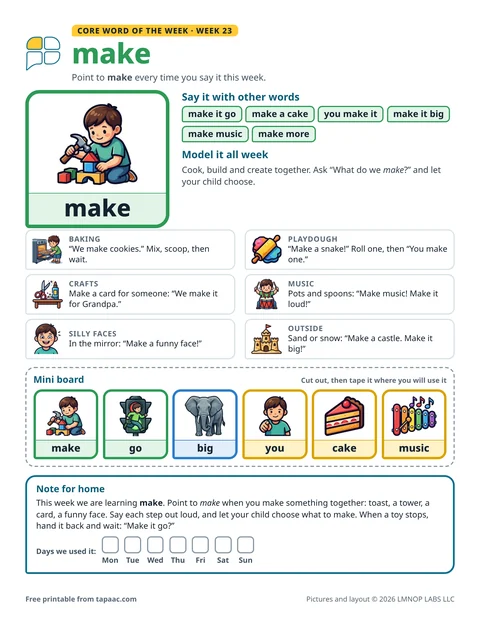
Week 23: make
Cook, build and create: make it, make it go.
-
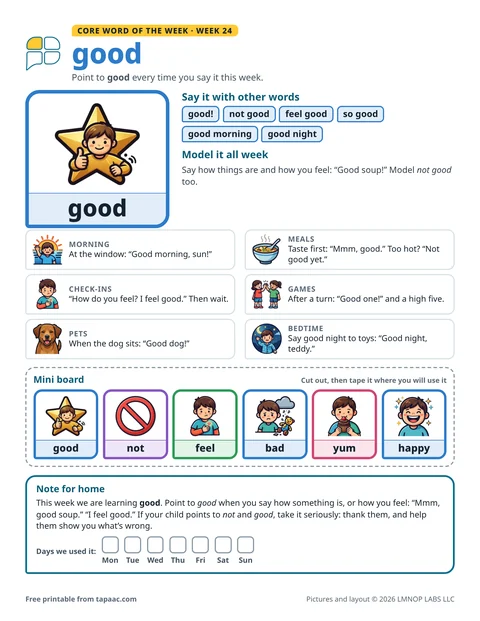
Week 24: good
How things are, and how you feel: good, not good.
Weeks 25 to 32: opposites, answers and doing things together
-
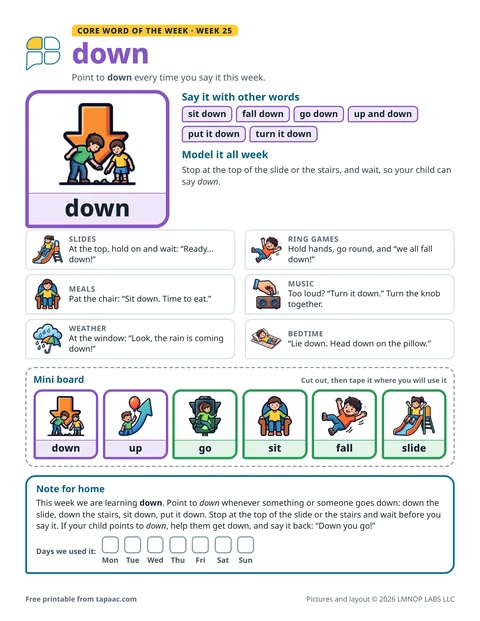
Week 25: down
Slides, stairs and “we all fall down”: the partner of up.
-
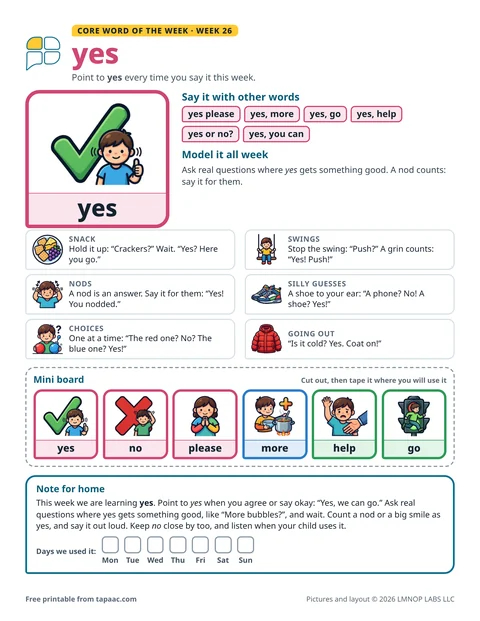
Week 26: yes
Agree, accept and answer: yes please, yes more.
-
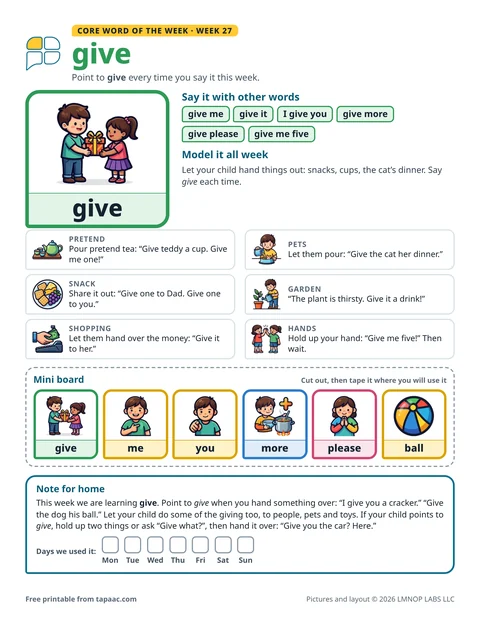
Week 27: give
Pass it on: give me, give you, give me five!
-
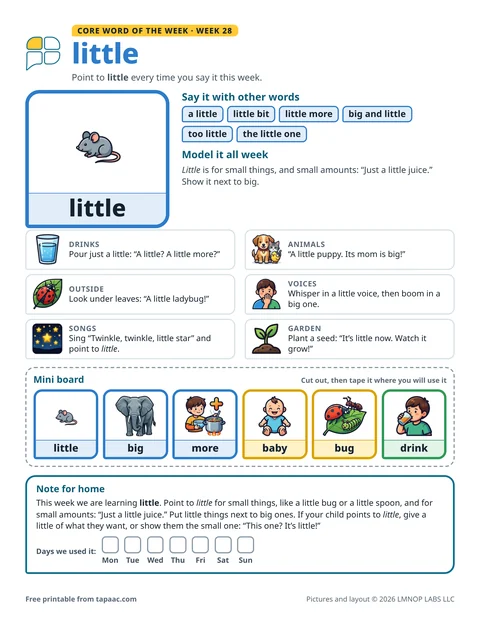
Week 28: little
Small things and small amounts: a little bit more.
-
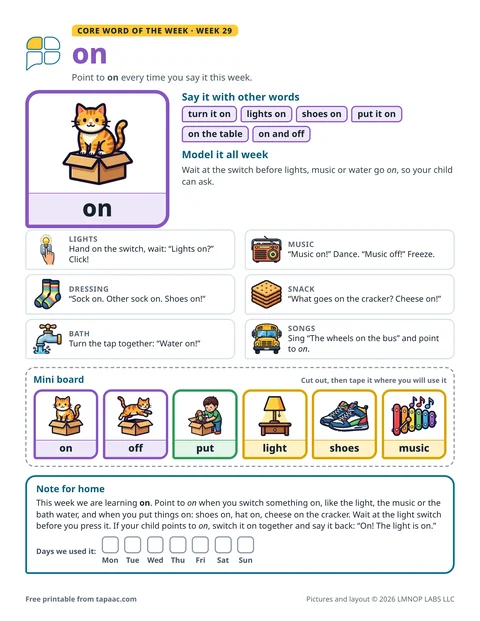
Week 29: on
Lights on, music on, shoes on: switch it on!
-
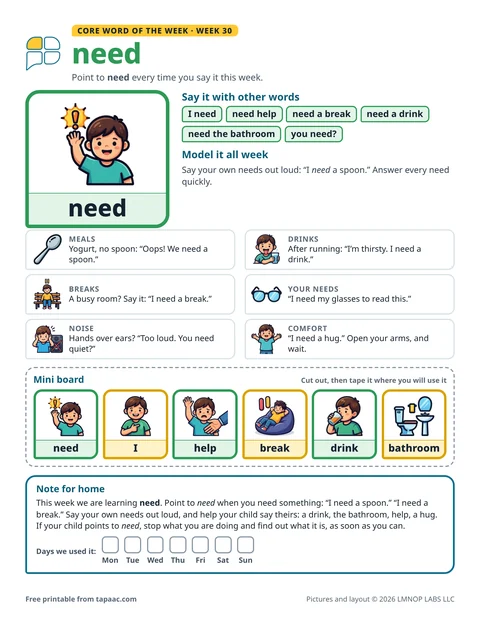
Week 30: need
Things that can’t wait: I need help, I need a break.
-
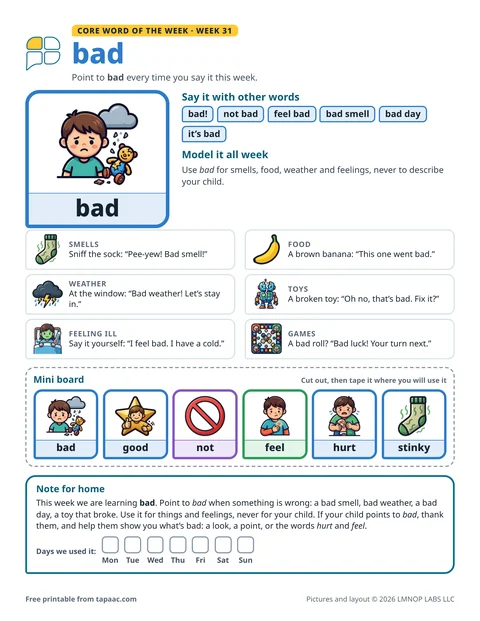
Week 31: bad
Say what’s wrong: bad smell, bad day, feel bad.
-
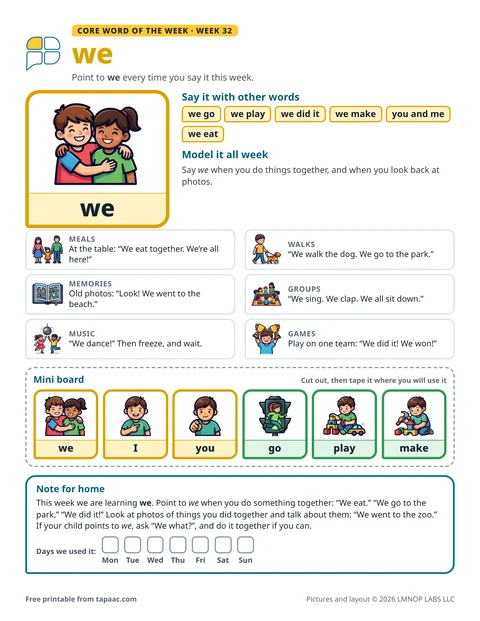
Week 32: we
Do it together: we go, we play, we did it!
How to run a core word of the week
- Print the week’s page. Put the big picture where everyone will see it: the fridge, the classroom door.
- Cut out the mini board. Tape it where the word will come up most: by the table, the bath or the toy shelf.
- Model the word in at least three routines a day. Each week’s page has ideas for meals, play, the bath, outings and school.
- Share the note for home with everyone who spends time with the person.
- Tick a box for each day you used the word. It is a reminder for you, not a score.
- Keep the word going. Next week’s word joins it; it doesn’t replace it.
Planning for a class or a caseload? The one-page core word of the week planner has a row for each week of a term: the word, where you will model it, phrases, a book or game, and what you noticed.
Why these 32, in this order
Weeks 1 to 8: first words
- more (week 1): a request that works with anything fun, with a quick result.
- go and stop (weeks 2 and 3): a pair that runs games and gives the person control.
- help (week 4): a way through a hard moment, anywhere.
- all done (week 5): a calm way to end things.
- want (week 6): the start of many requests, now that more, go and help are familiar.
- look (week 7): a word for sharing and commenting, not asking.
- not (week 8): a little word that changes others: not that, not now.
Weeks 9 to 16: opinions, people and questions
- like (week 9): an opinion, not a request, and not like is ready to use straight after week 8.
- open (week 10): a quick, concrete request again, which joins week 4’s help: help open.
- I (week 11): the start of two-word messages, I want, I like, I open, with words the person already knows.
- eat (week 12): an action for meals and snacks several times a day, and for pretend play.
- up (week 13): a little word for direction, with lifts, stairs and climbs, and it joins go.
- you (week 14): the partner of I, for turn-taking and talking to other people.
- again (week 15): the same thing once more, which is different from more, and later try again.
- what (week 16): a first question word, after fifteen weeks of words to answer with, because questions are easier once there are answers.
Weeks 17 to 24: places, play, making and feelings
- where (week 17): a second question word, straight after what, for things and people that are out of sight.
- play (week 18): an invitation with a big reward, someone to play with, and it joins want, you and again.
- in (week 19): a little word for places, and the answer to many where questions.
- put (week 20): an action that always comes with a place: put it in, put on.
- big (week 21): a first word for size, with lots of fun attached: big bubbles, big splashes.
- get (week 22): a busy action that joins earlier words: get up, get down, get in.
- make (week 23): for creating things and making things happen: make it go, make it big.
- good (week 24): how things are and how the person feels, and with not, a way to say that something is wrong.
Weeks 25 to 32: opposites, answers and doing things together
- down (week 25): the partner of up, for slides, stairs, sitting down and turning the music down.
- yes (week 26): a social word for agreeing and accepting, the other side of stop and not.
- give (week 27): an action between two people, which joins I, you and more: give me, give more.
- little (week 28): the partner of big, and a word for small amounts: a little more.
- on (week 29): a little word for switches and places: lights on, shoes on, put it on.
- need (week 30): for things that can’t wait, like help, a break or the bathroom; it comes well after want because it says that something matters.
- bad (week 31): the partner of good, one quick word for telling someone that something is wrong.
- we (week 32): I and you together, for doing things with other people and sharing memories.
Between them, the 32 words use all five word colors on the core word cards: people, social words, actions, describing words and little words. Four of the last eight are partners of earlier words, so pairs can be modeled side by side: up and down, big and little, good and bad, I, you and we. Change the order if a different word matters more to the person right now. If mealtimes are hard, start with all done or eat; if outings are hard, start with stop and go.
In a classroom
Post the word at the door and on the snack table. Ask every adult in the room to model it, and send the note home at the start of the week so families can use it too. A word wall with each week’s card, side by side, helps everyone remember the earlier words. To plan the whole term at once, use the planner.
After week 32
Keep going with the 52 core word cards. Good next words are off, out, that, wait, drink, hi and bye. Use the same plan: one word, many routines, a note for home. To print a board for any word, use the free AAC board maker.
More core word printables
-
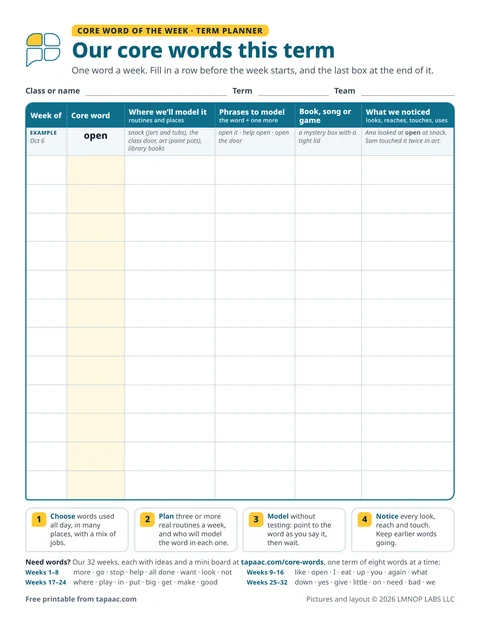 Core word of the week plannerPlan a term of core words on one page.
-
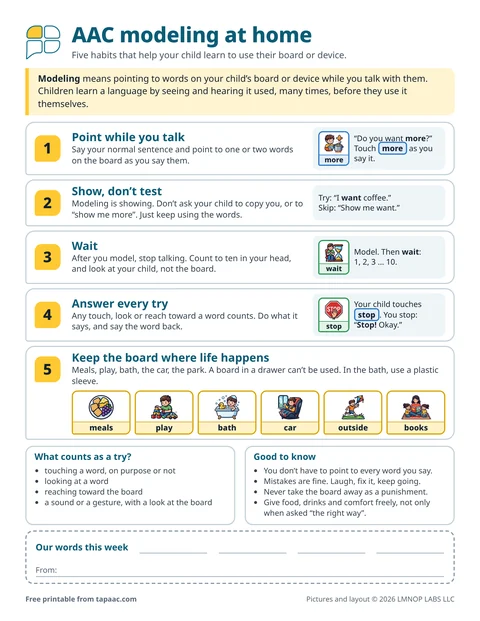 AAC modeling at homeFive habits on one page, to send home or stick on the fridge.
-
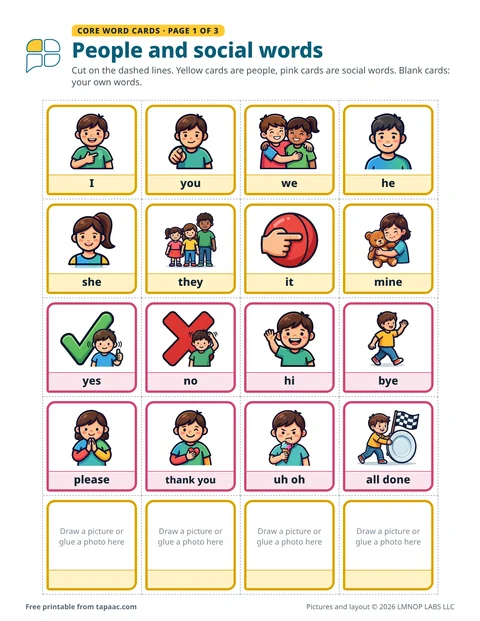 52 core word cardsWith pictures, in five colors, plus a one-page list for the fridge.
All core word printables and guides
Need a different board? Make your own with the free AAC board maker.
These cards, handouts and plans are general information, not therapy or medical advice, and they don’t replace a speech therapist. A speech therapist who knows the person can help choose the right words and the right way to practice. Everything here is free to print and share; please don’t sell it (terms of use). Questions? Email support@lmnoplabs.fun.