 Tap AAC
Core word “up”: more than “pick me up”
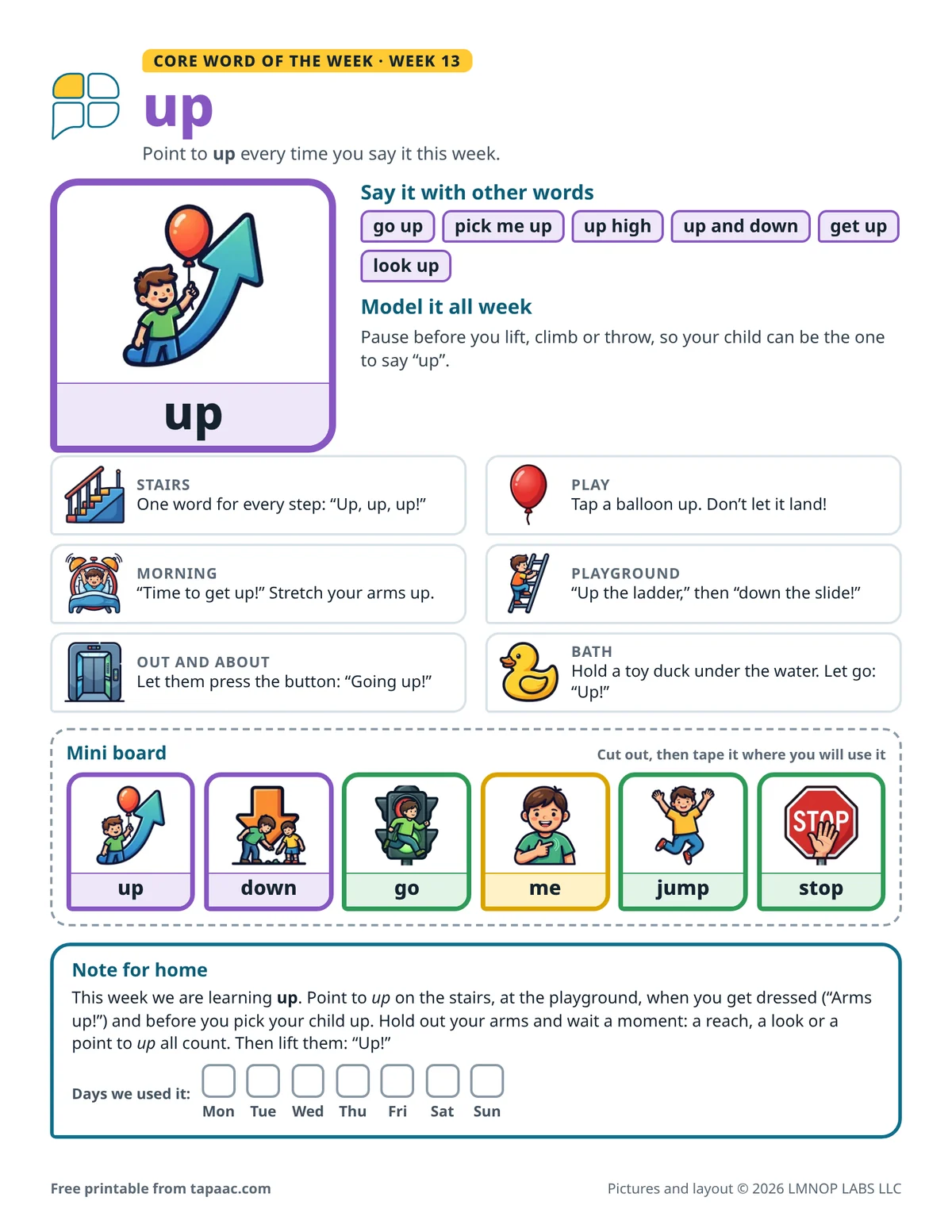
Up says which way: pick me up, up the stairs, arms up, get up. It is a little word with lots of uses, and many of them come with something fun, like a lift or a climb. This week, point to up whenever something goes up, and pause before you lift or climb so the person can say it first.
Download the free printable (PDF) US Letter, 1 page, 388 KB
Printing on A4 paper? Download the A4 PDF (1 page, 388 KB).
Have Tap AAC? Add to Tap AAC (.obz file, 194 KB) · How to add a board
- Week 13 of 32
- Free
- One page
Why up is easy to show
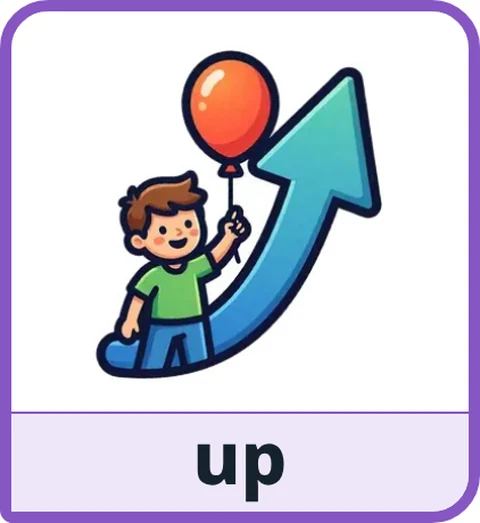
Up is short, easy to show and full of action: lifts, stairs, climbs, balloons, jumps. Most of those moments are fun, so the person has a good reason to say it.
It is also a little word that changes others: get up, stand up, wake up, go up, look up. It joins with week 2’s go, and down is its partner. Model both, but keep up as the focus this week.
Arms out, stairs, balloons and kites: up all day
At home
- Before you pick up a small child, hold out your arms and pause: “Up?” Wait for a reach, a look or a point, then lift.
- On the stairs, say one “up” for each step, and “down” on the way back.
- In the morning: “Time to get up!” Stretch your arms up together.
In play
- Tap a balloon up into the air and try to keep it from touching the floor: “Up! Up!”
- Lift a teddy high above your head, then bring it down for a hug: “Up... and down.”
- Jumping on a trampoline, off a low step or into a puddle: “Jump up!”
Getting dressed
- “Arms up!” as the shirt goes over the head, and “Pull up” for pants and socks.
Outside
- At the playground: “Up the ladder,” then “down the slide!”
- In an elevator, let the person press the button: “Going up!”
- Fly a kite, or watch one: “Up, up! It’s going up.”
In the bath and at school
- Hold a toy duck under the water and let go, so it pops up: “Up!”
- At circle time: “Stand up,” “Hands up,” and “Clean up” at the end of play.
At the playground, Zoe stands at the bottom of the climbing frame and looks at her dad. He points to up on the card clipped to his bag: “Up? Up the ladder?” Then he waits. Zoe looks at the ladder, then back at him. He touches up once more and holds out his hand. Zoe reaches for the card and taps it. “Up! Let’s go up.” He helps her climb, one rung at a time, “up, up”, and after she slides down she runs straight back to the card.
Pick me up, get up, look up
Once it joins other words, up means much more than being lifted.
- go up
- pick me up
- up high
- up and down
- get up
- look up
If up only means “pick me up”, or you can’t lift them every time
If up only ever means “pick me up”
That’s a great start. Keep using it for other things as well: stairs, balloons, getting up, arms up, so the word grows with the person.
If you can’t lift them every time they ask
Show you heard it: “You want up. My arms are full. Up when I put this down.” Then lift them as soon as you can, or offer another kind of up: up on the step, up on the couch next to you.
Note for home: hold out your arms and wait
This week we are learning up. Point to up on the stairs, at the playground, when you get dressed (“Arms up!”) and before you pick your child up. Hold out your arms and wait a moment: a reach, a look or a point to up all count. Then lift them: “Up!”
The same note is printed at the bottom of the week’s page, with a box to tick for each day. For families who are new to modeling, send the one-page AAC modeling at home handout with it, and keep using the word cards from earlier weeks.
More core word of the week plans
-
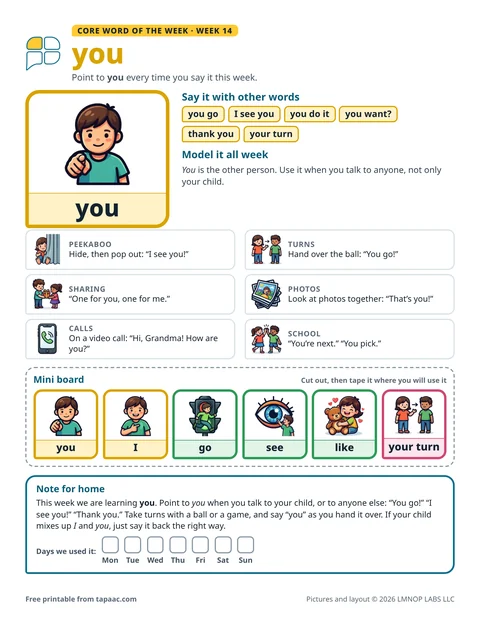 Week 14: youTurns, peekaboo and sharing: you go, I see you.
-
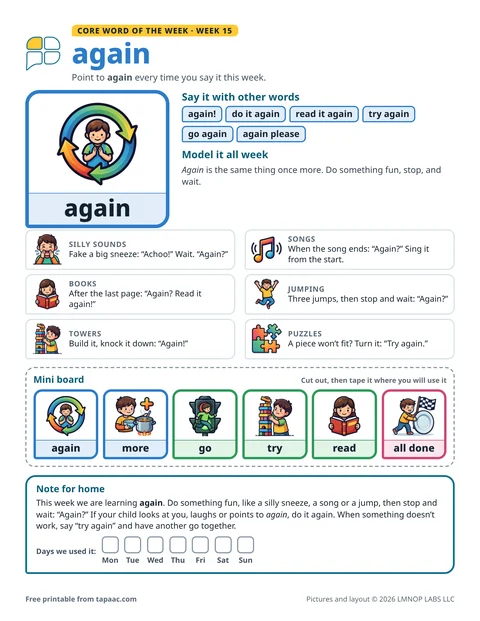 Week 15: againKeep the fun going: again! And try again.
-
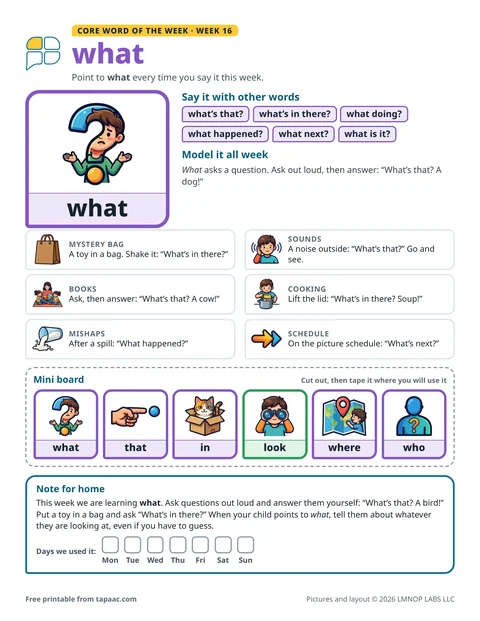 Week 16: whatAsk questions: what’s that? What’s in there?
-
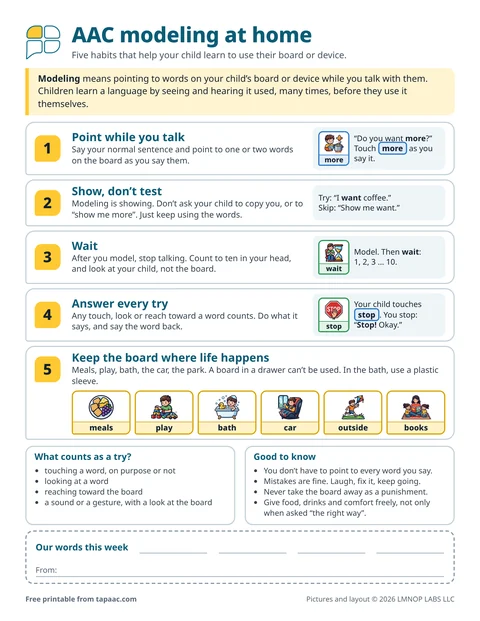 AAC modeling at homeFive habits on one page, to send home or stick on the fridge.
All core word printables and guides
Need a different board? Make your own with the free AAC board maker.
These cards, handouts and plans are general information, not therapy or medical advice, and they don’t replace a speech therapist. A speech therapist who knows the person can help choose the right words and the right way to practice. Everything here is free to print and share; please don’t sell it (terms of use). Questions? Email support@lmnoplabs.fun.