 Tap AAC
Core word “big”: a first describing word
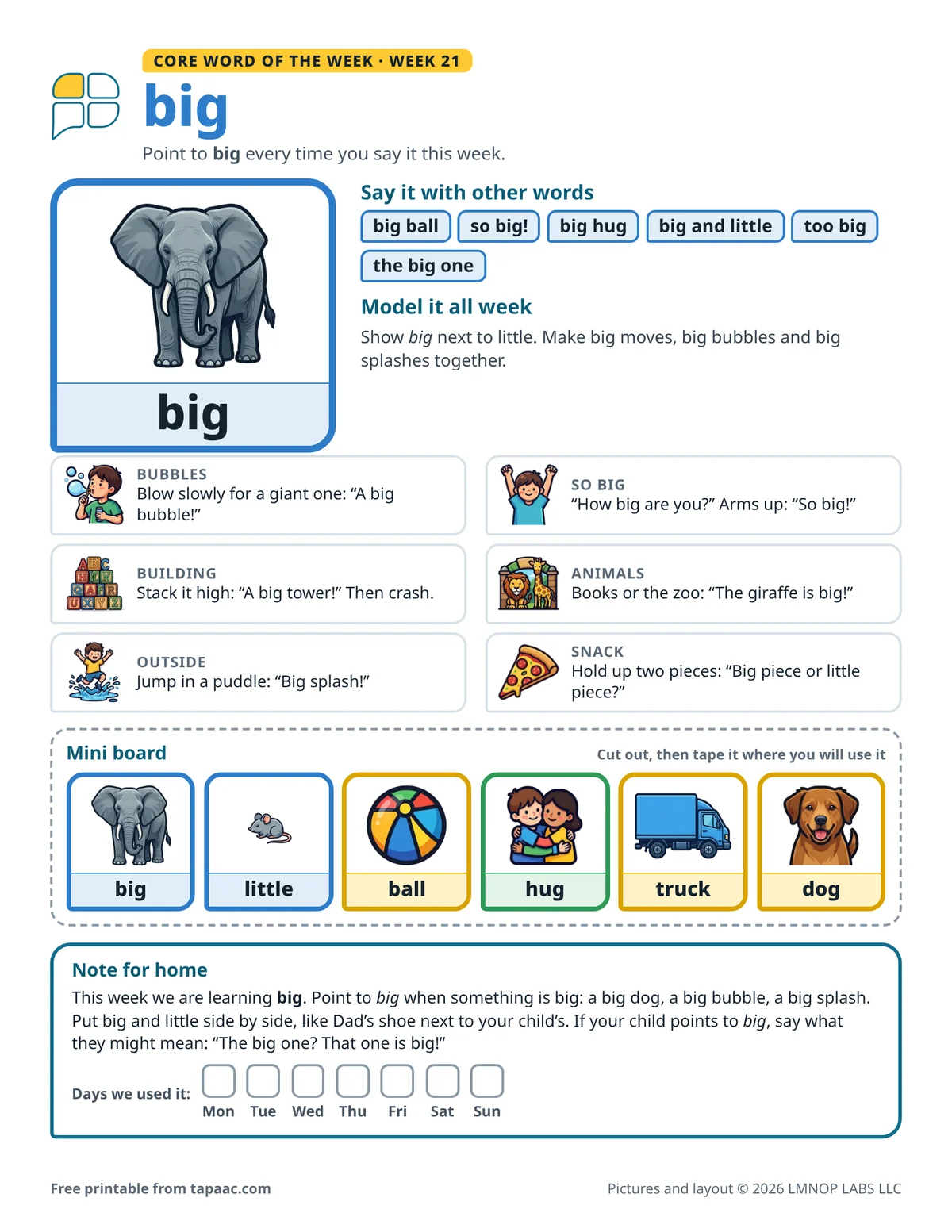
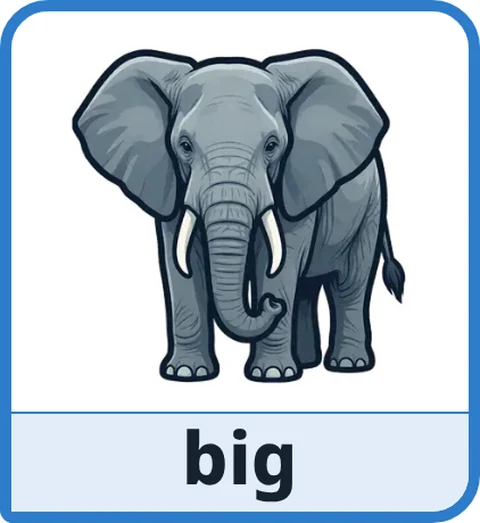
Big describes size: a big ball, a big dog, so big! It is often a person’s first describing word, because big things are easy to notice and fun to talk about. This week, point to big whenever something is big, and put big and little side by side so the difference is easy to see.
Download the free printable (PDF) US Letter, 1 page, 420 KB
Printing on A4 paper? Download the A4 PDF (1 page, 420 KB).
Have Tap AAC? Add to Tap AAC (.obz file, 188 KB) · How to add a board
- Week 21 of 32
- Free
- One page
Why big is a first step toward describing
Until now, most of the words have asked for things or done things. Big describes, which lets the person say more about what they mean: not just the ball, but the big ball. That is a first step toward choosing, comparing and commenting.
It comes with lots of movement and drama: big jumps, big splashes, big towers that topple. It joins with earlier words, big one, not big, look, big!, and little is its partner on the word cards. Week 23’s make will join it too: make it big.
Big bubbles, tall towers, Dad’s shoes and puddle splashes
In play
- Blow bubbles slowly for one giant bubble, then quickly for lots of tiny ones: “A big bubble!”
- Build a tower as high as it will go: “Big tower! So big!” Then knock it down together.
- Match your voice and body to the word: arms wide, slow and loud for “big”; tiny and quiet for “little”.
Getting dressed
- Try on a grown-up’s shoes or coat: “Too big! Dad’s shoes are big.”
- “How big are you?” Stretch your arms up high together: “So big!”
Meals and snack
- Offer two sizes: “Big piece or little piece?” Say which one you would choose, too.
- Pour water into a big cup and a little cup, side by side: “This one is big.”
Outside
- Jump into puddles together: “Big splash!”
- On a walk, point out big things as you pass them: a big truck, a big tree, a big dog.
Books and animals
- Animal books, the zoo or the farm: “The elephant is big. The mouse is little.”
At home and at school
- Big feelings and big moments: “A big hug!” “That was a big sneeze!”
- Sort toys or pictures into a big box and a little box: “The big ones go here.”
In the backyard, Marcus, who is 5, and his mom have a bubble wand and a tray of soapy water. She draws the wand through the air slowly, and a huge bubble wobbles out. She points to big on the card taped to the back door: “Big bubble!” Marcus chases it until it pops. Next she makes a quick stream of tiny bubbles, then holds the wand still and waits. Marcus looks at her, then at the card, and touches big. “Big one? Okay!” Slowly, slowly, and another giant bubble floats over the fence.
Big ball, so big!, too big
Put big in front of a thing to pick one out, or after too when something doesn’t fit.
- big ball
- so big!
- big hug
- big and little
- too big
- the big one
If everything they like is big, or big means something scary
If big means everything they like
That is a start: they have noticed the word gets a reaction. Keep showing big and little side by side, and say what you see: “That one is little. This one is big.”
If big is about something scary
A big dog or a big noise can be frightening. Take the message seriously: “Big dog. Scary. Let’s go this way.” The word worked, so answer it.
Note for home: put big things next to little ones
This week we are learning big. Point to big when something is big: a big dog, a big bubble, a big splash. Put big and little side by side, like Dad’s shoe next to your child’s. If your child points to big, say what they might mean: “The big one? That one is big!”
The same note is printed at the bottom of the week’s page, with a box to tick for each day. For families who are new to modeling, send the one-page AAC modeling at home handout with it, and keep using the word cards from earlier weeks.
More core word of the week plans
-
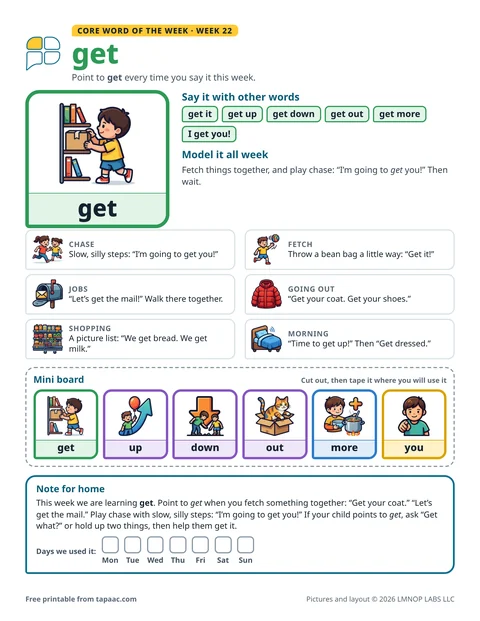 Week 22: getGet it, get up, get down, and I’m going to get you!
-
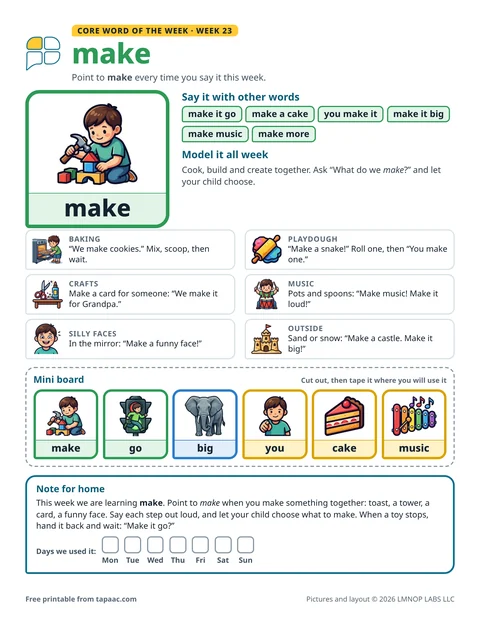 Week 23: makeCook, build and create: make it, make it go.
-
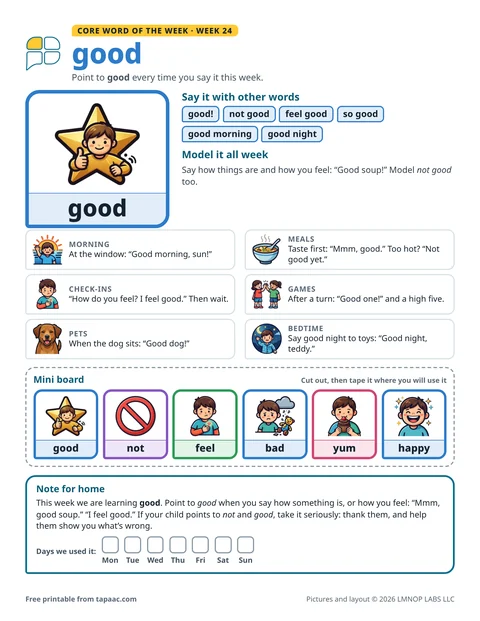 Week 24: goodHow things are, and how you feel: good, not good.
-
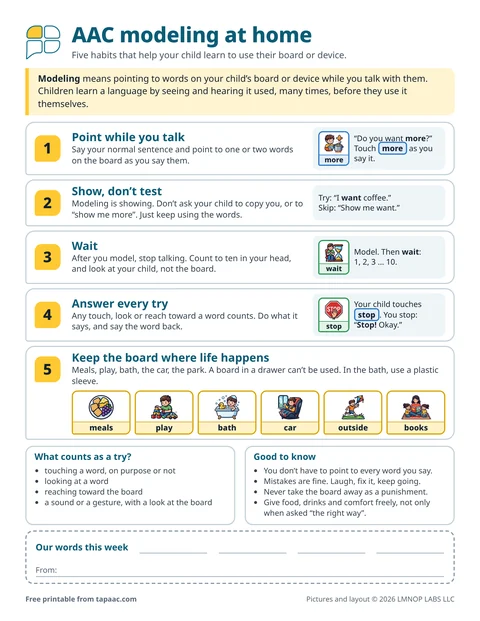 AAC modeling at homeFive habits on one page, to send home or stick on the fridge.
All core word printables and guides
Need a different board? Make your own with the free AAC board maker.
These cards, handouts and plans are general information, not therapy or medical advice, and they don’t replace a speech therapist. A speech therapist who knows the person can help choose the right words and the right way to practice. Everything here is free to print and share; please don’t sell it (terms of use). Questions? Email support@lmnoplabs.fun.