 Tap AAC
Core word of the week planner: a free one-page term plan
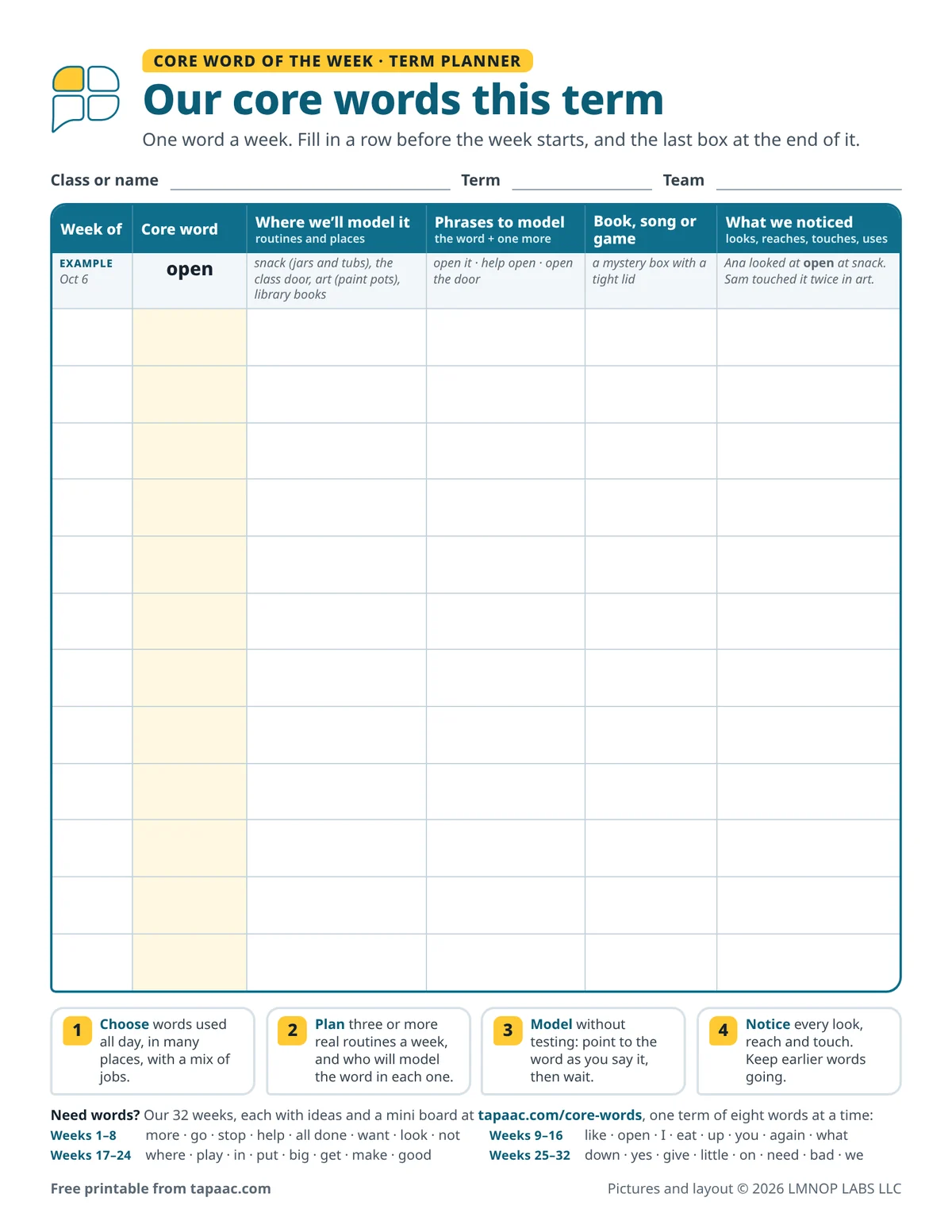
A core word of the week planner is a one-page grid for a whole term: one row per week, with the word, where you will model it, phrases to use, a book, song or game, and what you noticed. This free printable is made for speech therapists, teachers and classroom teams, and families can use it too. Print it, fill in the words before the term starts, and keep it where every adult can see it.
Download the free planner (PDF) US Letter, 1 page, 63 KB
Printing on A4 paper? Download the A4 PDF (1 page, 63 KB).
- Free
- One page
- 12 weeks a sheet
How to use the planner
- Write in the words before the term starts. One word per row, one row per week. The sheet has twelve rows, which covers most terms; print a second copy for a longer one.
- Plan where each word will happen. Write real routines and places, not general ones: “snack, the class door, art”, not “all day”. Three or more a week is plenty.
- Pick two or three phrases. The word plus one more: open it, help open. These are what the adults will say and point to.
- Add one book, song or game that uses the word many times, so there is at least one moment a day built around it.
- Share it. Post the planner by the door, give every adult in the room a copy, and send the week’s note for home on the first day.
- Fill in “What we noticed” at the end of the week. Write down looks, reaches, touches and any use of the word, by any learner. These notes help you plan the next term.
Choosing the words for a term
- Words that work all day. A word used at snack, in play and at home gets far more practice than a word that only fits one lesson.
- A mix of jobs. Over a term, include words for asking (more, want), for directing (go, stop, open), for sharing (look, like), for people (I, you), little words (not, up) and a question (what).
- Words that join earlier ones. Once want and like are familiar, I turns them into short sentences.
- Words on the learners’ own boards. Model on the board or device each learner uses, so the word they see is in the place they will find it.
- Words that fit the term. Plan around what is coming: open in a week of birthday presents, eat in a cooking week, up before a trip to the playground.
A row, filled in
The planner has one example row printed at the top, in gray, so new team members can see how to fill it in. Here is what it can look like in a class:
On Friday afternoon, the speech therapist and the class teacher fill in next week’s row. Week of: Oct 6. Core word: open. Where: snack (jars and tubs with lids), the classroom door, art (paint pots), library books. Phrases: open it, help open, open the door. Game: a mystery box with a tight lid at circle time. The teaching assistant takes snack and art; the teacher takes the door and circle. On the next Friday, the last box says: “Ana looked at open at snack. Sam touched it twice in art.”
Our 32 weeks, as a starting order
If you don’t have a word list yet, start with ours. Each week has its own page with ideas for every routine and a printable mini board. Weeks 1 to 8, 9 to 16, 17 to 24 and 25 to 32 make four terms of eight words, one sheet each, or change the order to suit your learners.
| Week and word | Good for |
|---|---|
| Week 1: more | asking for more of something fun |
| Week 2: go | starting things |
| Week 3: stop | stopping what isn’t wanted |
| Week 4: help | asking for help |
| Week 5: all done | ending things calmly |
| Week 6: want | asking and choosing |
| Week 7: look | sharing what you notice |
| Week 8: not | disagreeing and correcting |
| Week 9: like | giving an opinion |
| Week 10: open | asking for something to be opened |
| Week 11: I | talking about yourself |
| Week 12: eat | meals, snacks and pretend play |
| Week 13: up | saying which way |
| Week 14: you | talking to someone, taking turns |
| Week 15: again | repeating something, trying again |
| Week 16: what | asking a question |
| Week 17: where | asking where things and people are |
| Week 18: play | asking someone to play, joining in |
| Week 19: in | saying where something goes |
| Week 20: put | placing things: in, on, down |
| Week 21: big | describing size |
| Week 22: get | fetching things, getting up and out |
| Week 23: make | making things, and making things happen |
| Week 24: good | saying how things are and how you feel |
| Week 25: down | going down, sitting down, turning it down |
| Week 26: yes | agreeing and accepting |
| Week 27: give | handing things over, sharing |
| Week 28: little | small things and small amounts |
| Week 29: on | switching things on, and places |
| Week 30: need | saying what can’t wait |
| Week 31: bad | saying that something is wrong |
| Week 32: we | doing things together, sharing memories |
Planning as a team
The planner works best when every adult knows this week’s word. Give each adult two routines to cover, so the word turns up all day instead of only in therapy. A five-minute check on Friday is enough: what happened, and does the word need another week? At the end of the term, read down the last column together and choose which words to keep in focus next term. A focus word is a reminder for the adults, not a limit: keep modeling every word you say that is on the board.
For families
Families can use the same sheet: one row a week on the fridge, with home routines in the third column. Send it home with the one-page AAC modeling at home handout, and with each week’s page, which ends with a note for home.
Common questions
How long should one core word stay in focus?
A week is an easy rhythm to keep, but there is no rule. Some teams keep a word for two weeks, or bring it back later in the term. Either way, keep modeling the earlier words.
Should every learner in a class have the same word?
A shared class word is easier for the adults to remember and model. Learners can still have their own words on top, chosen with their speech therapist; write them in the notes column.
What if a learner already uses this week’s word?
Model it with a second word, like open it or help open, so the word grows into phrases. Their notes can track the new phrases instead of the single word.
More core word printables
-
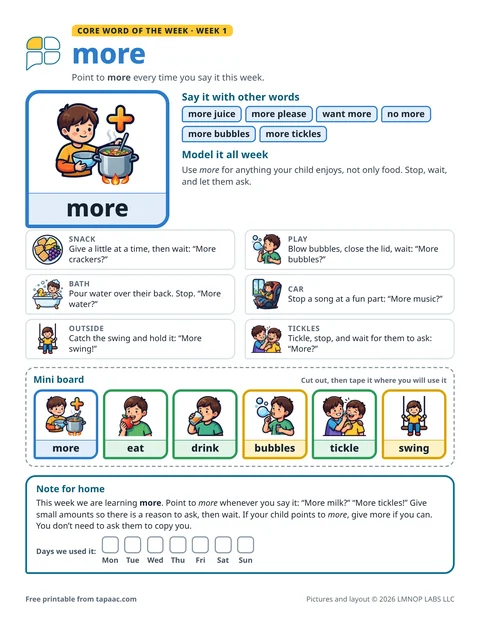 Core word of the week32 weeks of plans, from more to we.
-
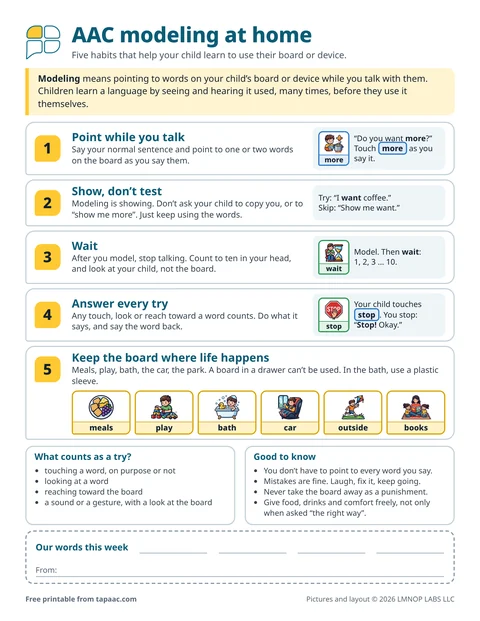 AAC modeling at homeFive habits on one page, to send home or stick on the fridge.
-
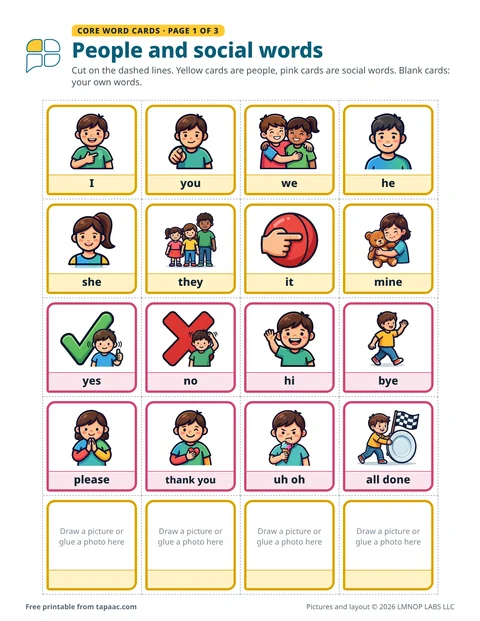 52 core word cardsWith pictures, in five colors, plus a one-page list for the fridge.
All core word printables and guides
Need a different board? Make your own with the free AAC board maker.
These cards, handouts and plans are general information, not therapy or medical advice, and they don’t replace a speech therapist. A speech therapist who knows the person can help choose the right words and the right way to practice. Everything here is free to print and share; please don’t sell it (terms of use). Questions? Email support@lmnoplabs.fun.