 Tap AAC
Core word “open”: getting to what’s shut away
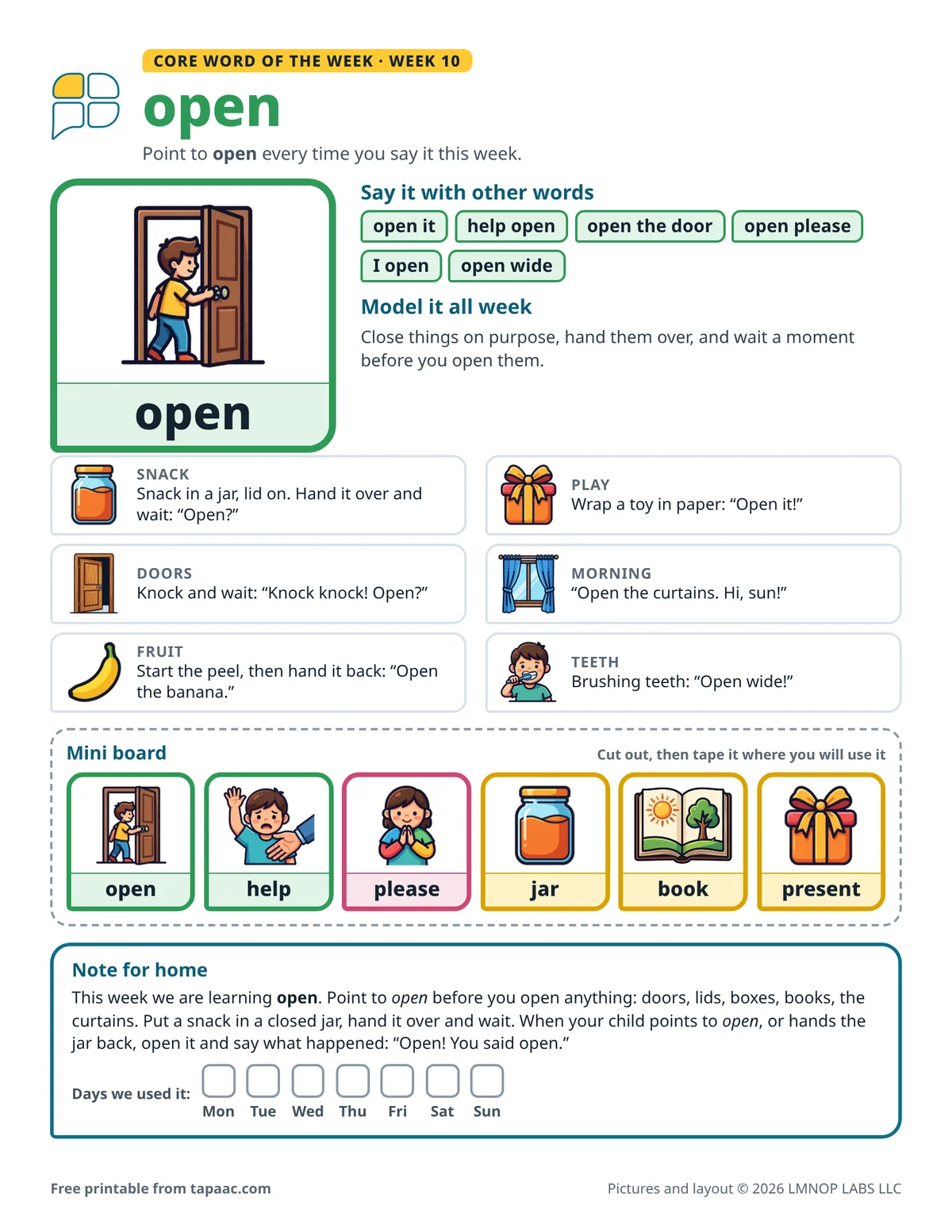
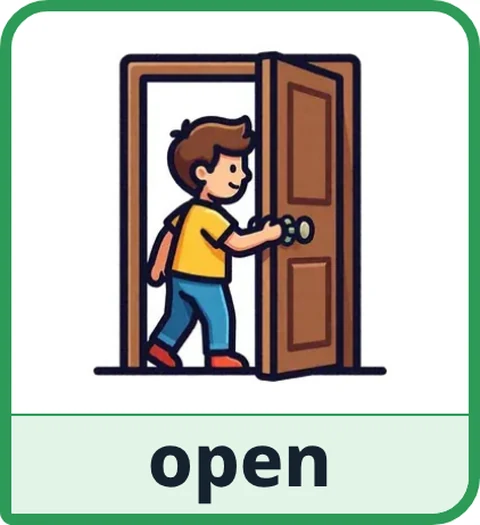
Open asks for something closed to be opened: a door, a jar, a present, a book. It comes up many times a day and gets a quick, clear result. This week, point to open every time you open something, and set up closed things the person wants to get into.
Download the free printable (PDF) US Letter, 1 page, 393 KB
Printing on A4 paper? Download the A4 PDF (1 page, 393 KB).
Have Tap AAC? Add to Tap AAC (.obz file, 199 KB) · How to add a board
- Week 10 of 32
- Free
- One page
Why open gets such a quick result
Open gives the person a way to get at what they want when it is shut away: a snack in a jar, a toy in a box, the garden behind a door. Something happens as soon as the word is understood, which makes it a satisfying word to use.
It joins with week 4’s help (help open) and with the names of things: open door, open box, open the book. Opening things is also a game in itself, with a small surprise every time something comes out.
Jars, gift bags, curtains and car doors to open
At snack and in the kitchen
- Put a snack in a clear jar, or a tub with a lid that is a little too tight. Hand it over and wait: “Open? Help open.”
- Bananas and oranges: start the peel, then hand it back. “Open the banana.”
- Let the person pull the fridge door: “Open! Cold!” Then name what you see inside.
In play
- Wrap a favorite toy in paper, or tuck it in a gift bag: “Open it!”
- Hide small toys in boxes, tubs and zip bags, each one closed a different way. Every time: “Open!”
- Paint pots, crayon boxes, the lid of the toy box: say “open” before you take anything out.
Doors, curtains and the car
- Knock on a closed door and wait: “Knock knock! Open?” Then open it slowly.
- In the morning: “Open the curtains. Hi, sun!”
- At the car: “Open the door.” Let the person pull the handle if they can.
Books and bedtime
- Hand over a closed book: “Open the book.” Let the person lift the cover.
- Brushing teeth: “Open wide!” Point to open, then show your own open mouth.
At school
- At lunch: “Open your lunch box.” Keep an open card on the table for packets, lids and cartons.
Snack time at the kitchen table. Dad puts Lily’s pretzels in a clear jar, screws on the lid and hands it to her. Lily turns the jar over and shakes it. Dad points to open on the mini board: “Open? You want it open.” Then he waits. Lily pushes the jar toward him and pats the board, near open, then right on it. “Open! Okay.” He loosens the lid and lets her twist it off. When the jar is empty, she carries it back to him and touches open again.
Open it, help open, open wide
Open joins week 4’s help well, and open wide fits right in at toothbrushing.
- open it
- help open
- open the door
- open please
- I open
- open wide
If they hand things over without asking, or open what should stay shut
If they hand things over without asking
Handing it over is a message too: it means “open” or “help”. Answer it, and give the word as you do: “Open? I’ll open it.” Point to open first, then open it.
If they want to open things that should stay shut
Show the word for those too: “Not open. That one is for grown-ups.” Keep a few boxes and jars that are fine to open, so there is always something you can say yes to.
Note for home: a snack in a closed jar, then wait
This week we are learning open. Point to open before you open anything: doors, lids, boxes, books, the curtains. Put a snack in a closed jar, hand it over and wait. When your child points to open, or hands the jar back, open it and say what happened: “Open! You said open.”
The same note is printed at the bottom of the week’s page, with a box to tick for each day. For families who are new to modeling, send the one-page AAC modeling at home handout with it, and keep using the word cards from earlier weeks.
More core word of the week plans
-
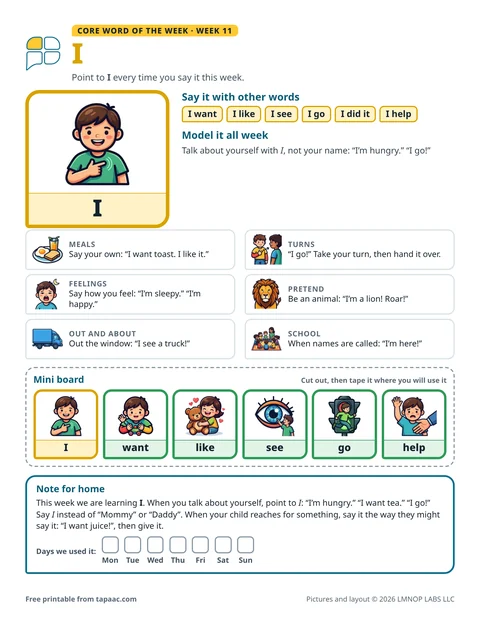 Week 11: ITalk about yourself: I want, I like, I see.
-
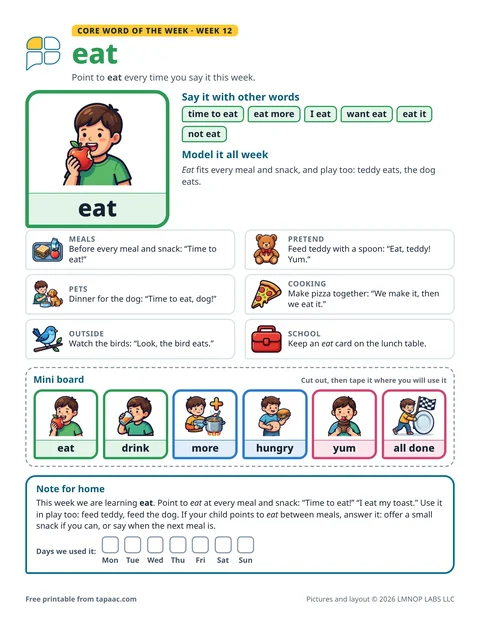 Week 12: eatMeals, snacks, pretend play and pets: time to eat.
-
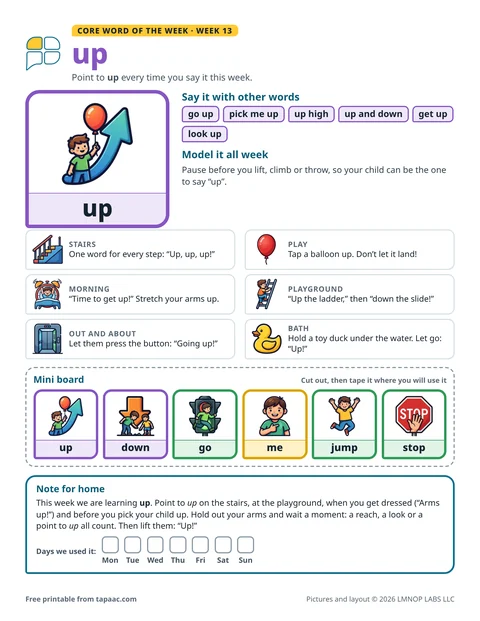 Week 13: upLifts, stairs, balloons and climbs: up, up, up!
-
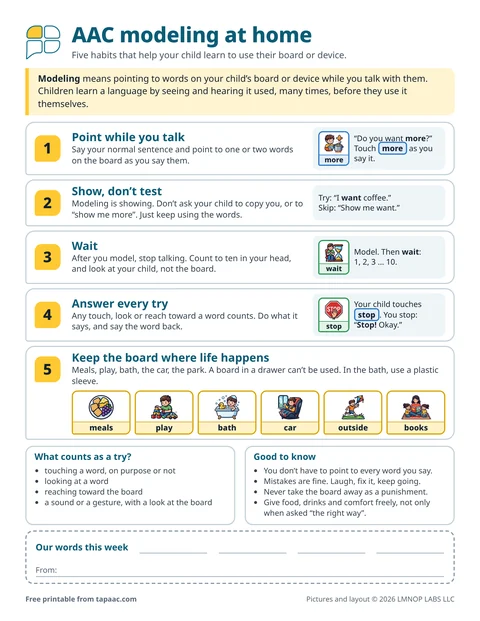 AAC modeling at homeFive habits on one page, to send home or stick on the fridge.
All core word printables and guides
Need a different board? Make your own with the free AAC board maker.
These cards, handouts and plans are general information, not therapy or medical advice, and they don’t replace a speech therapist. A speech therapist who knows the person can help choose the right words and the right way to practice. Everything here is free to print and share; please don’t sell it (terms of use). Questions? Email support@lmnoplabs.fun.