 Tap AAC
Core word “bad”: one tap for “something’s wrong”
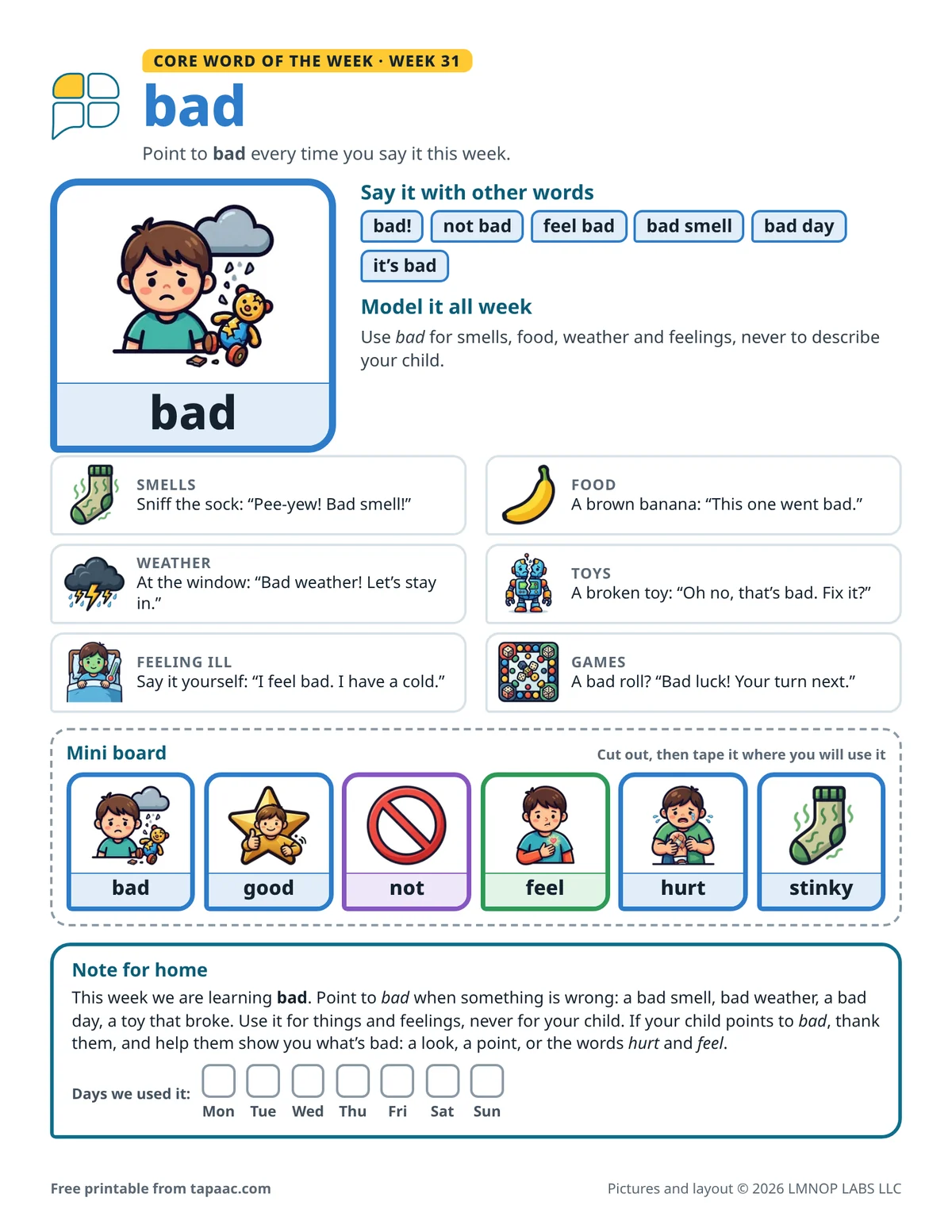
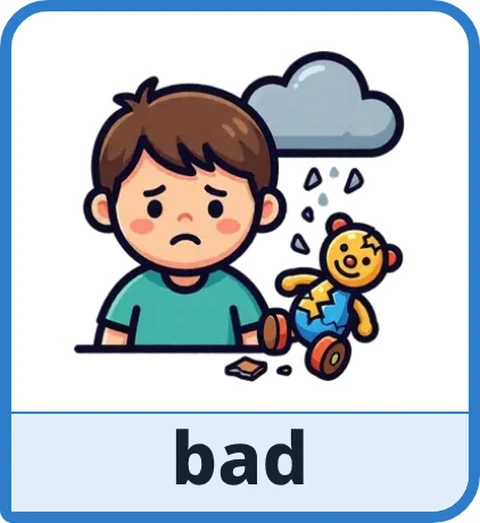
Bad says that something is wrong: a bad smell, bad weather, a bad day, I feel bad. It gives a person one quick word for trouble, so they can tell you instead of having to show you. This week, point to bad when something is wrong, and use it for things and feelings, never to describe the person.
Download the free printable (PDF) US Letter, 1 page, 408 KB
Printing on A4 paper? Download the A4 PDF (1 page, 408 KB).
Have Tap AAC? Add to Tap AAC (.obz file, 196 KB) · How to add a board
- Week 31 of 32
- Free
- One page
Why bad, when there’s already not good
Week 24’s good and week 8’s not already make not good. Bad is shorter and stronger, and it works on its own when things go wrong fast: one tap for “something’s wrong here”. Smells, food that has gone off and broken toys make easy, everyday practice.
How adults use it matters. “Bad smell” and “bad day” teach the word; “bad boy” teaches something else. Keep bad for things, places, weather and feelings, and the person learns it as a word for telling you, not a word about them.
Sour milk, storms and broken toys: what bad is for
Smells and food
- Sniff a sock, the trash can or a diaper and make a big face: “Pee-yew! Bad smell!”
- Find a brown banana or moldy bread: “This one went bad. In the trash!” Let the person drop it in.
- Taste something sour yourself and pull a face: “Ugh. Bad! Not for me.”
Weather
- At the window during a storm: “Bad weather! Lots of rain. Let’s stay in.”
Toys and games
- When a toy breaks: “Oh no, that’s bad. Can we fix it?” Then try together.
- A bad roll in a board game: “Bad luck! Never mind. Your turn next.” It shows that bad things can be small, and pass.
Getting dressed
- A scratchy sweater or a tight label: “Feels bad? Too itchy? Take it off.”
Feelings and health
- Say how you feel, honestly: “I feel bad. I have a cold.” “I had a bad day at work.”
- If the person seems unwell or upset, offer the words: “Feel bad? Where? Show me.”
Stories and shows
- When something goes wrong in a story: “Uh oh, the boat has a hole. That’s bad!” Talk about what happens, not who is bad.
At school or therapy
- A check-in at the start of the day with three choices: good, okay, bad. Give your own answer first, then wait.
- With teens and adults, real news: “Bad news: the pool is closed today.” “Was the bus bad?”
Grace, who is 11, is making cereal with her grandma. Grandma opens the milk, sniffs it and pulls a face. She points to bad on the kitchen board: “Ugh! Bad. The milk is bad.” She holds the carton out, and Grace sniffs, wrinkles her nose and taps bad herself. “Yes, bad! Down the sink.” Later that week, Grace comes in from the yard holding her arm and taps bad. Grandma doesn’t guess. She asks, “Bad? Show me,” and Grace points to a scrape on her elbow.
Bad smell, feel bad, not bad
Feel bad is the one to listen for: it can point to pain or sadness, not only a smell.
- bad!
- not bad
- feel bad
- bad smell
- bad day
- it’s bad
If bad comes up out of nowhere, or might mean pain
If bad comes up when nothing seems wrong
Check anyway, calmly: “Bad? Show me.” Look at their body, their food, the noise around them. If they were trying out the word, that’s fine too: they found out that adults listen.
If bad might mean pain or illness
Take it seriously and look for what’s wrong. Offer hurt and feel, or the where does it hurt board, to narrow it down. If you are worried, call a doctor or a nurse.
Note for home: bad is for things and feelings, never for your child
This week we are learning bad. Point to bad when something is wrong: a bad smell, bad weather, a bad day, a toy that broke. Use it for things and feelings, never for your child. If your child points to bad, thank them, and help them show you what’s bad: a look, a point, or the words hurt and feel.
The same note is printed at the bottom of the week’s page, with a box to tick for each day. For families who are new to modeling, send the one-page AAC modeling at home handout with it, and keep using the word cards from earlier weeks.
More core word of the week plans
-
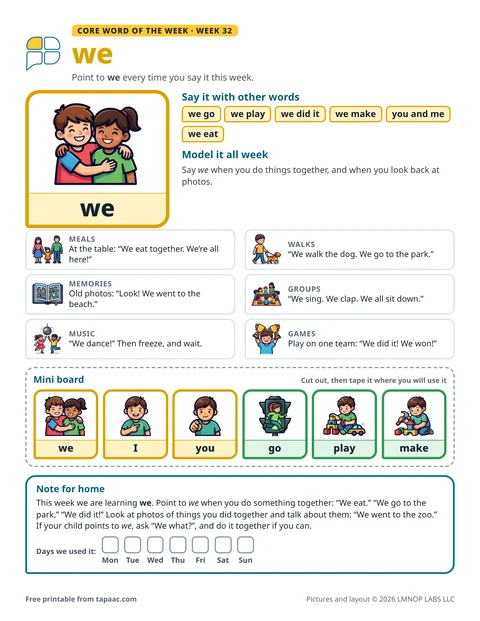 Week 32: weDo it together: we go, we play, we did it!
-
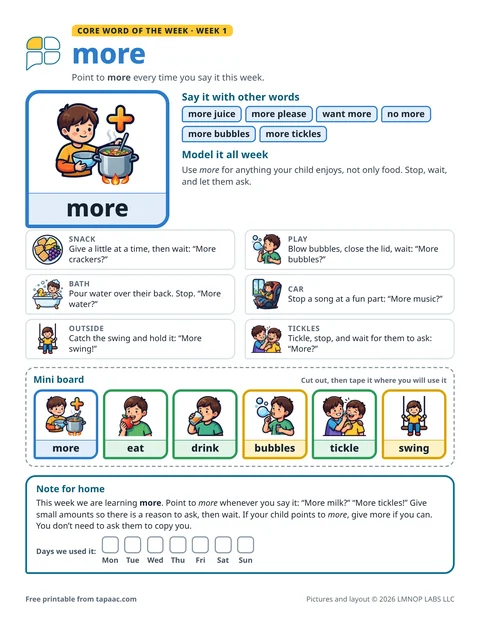 Week 1: moreAsk for more of anything fun: snacks, bubbles, tickles, songs.
-
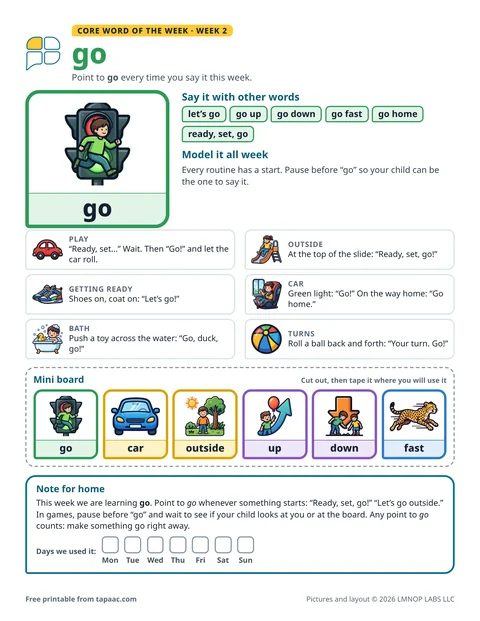 Week 2: goStart the fun: ready, set, go! Cars, slides and walks.
-
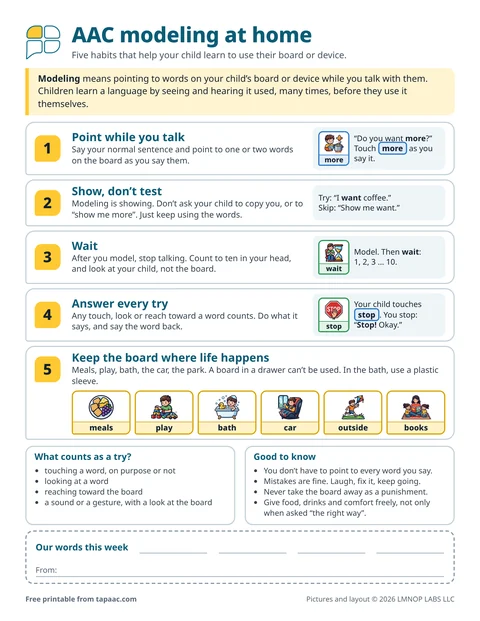 AAC modeling at homeFive habits on one page, to send home or stick on the fridge.
All core word printables and guides
Need a different board? Make your own with the free AAC board maker.
These cards, handouts and plans are general information, not therapy or medical advice, and they don’t replace a speech therapist. A speech therapist who knows the person can help choose the right words and the right way to practice. Everything here is free to print and share; please don’t sell it (terms of use). Questions? Email support@lmnoplabs.fun.