 Tap AAC
Core word “I”: putting the person in their own sentence
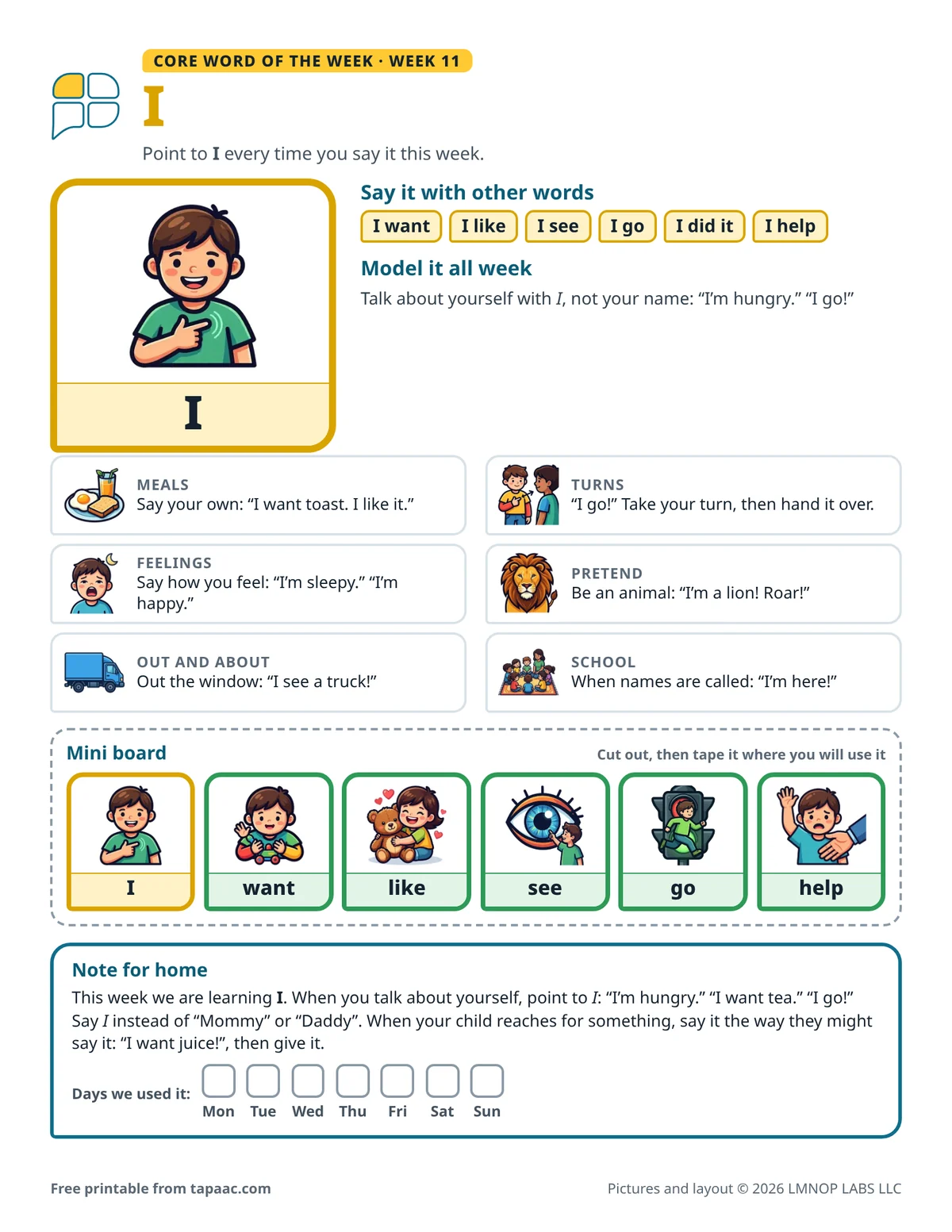
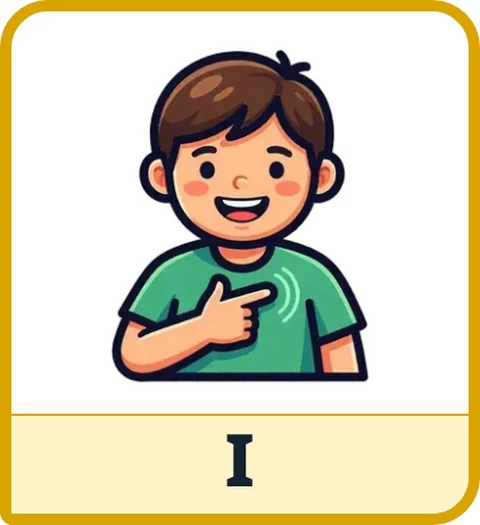
I lets a person talk about themselves: I want, I like, I see, I did it. It doesn’t name a thing you can point at, so it is learned by hearing other people use it. This week, point to I every time you talk about yourself, and say the person’s own messages back with I in them.
Download the free printable (PDF) US Letter, 1 page, 443 KB
Printing on A4 paper? Download the A4 PDF (1 page, 443 KB).
Have Tap AAC? Add to Tap AAC (.obz file, 228 KB) · How to add a board
- Week 11 of 32
- Free
- One page
Why I starts two-word messages
Many first messages are one word: more, go, help. I is how two-word messages start: I want, I like, I go. It puts the person into their own sentence.
Adults often talk to children about themselves by name: “Mommy is coming.” On the board, use I instead, so the person sees the word used the way they will use it. I follows like and open, so I like and I open are ready to go, and week 14’s you is its partner.
Talk about yourself with I: meals, turns and show and tell
Talk about yourself
- Say what you are doing, in short bits, as you do it, and touch I each time: “I wash. I dry.”
- Use I instead of your name: “I’m coming!” rather than “Mommy’s coming.”
- Say how you feel: “I’m hungry.” “I’m sleepy.” “I’m happy!”
At meals
- Say what you want and what you like at the table: “I want toast. I like toast.”
- When the person reaches for something, say it the way they might say it: “I want juice!” Then give it.
In play
- Taking turns: “I go!” Take your turn, then hand it over.
- Pretend to be an animal: “I’m a lion! Roar!” Then “I’m a cat. Meow.”
- When your part of a puzzle or a drawing is finished: “I did it!”
Out and about
- In the car or on a walk: “I see a truck!” Touch I, then see.
- At the store: “I need milk. I get it.”
At school or therapy
- At circle time, when names are called: “I’m here!” Model it for each person in turn.
- Show and tell with a photo from home: “I went to the park.”
Breakfast. Nora’s mom is making toast. Instead of “Mommy wants coffee,” she touches I and want on the board on the fridge: “I want coffee.” As she bites her toast, she touches I and like: “I like toast.” Nora watches. When the jam comes out, Nora reaches over, touches I and looks at the jar. “I... want jam? You want jam! Here you go.”
I want, I see, I did it
I on its own says little; it comes alive next to an action word from an earlier week.
- I want
- I like
- I see
- I go
- I did it
- I help
If I doesn’t mean anything yet, or they tap it and stop
If I doesn’t seem to mean anything yet
I has no picture you can hold up, so it is learned by hearing it, many times, in real sentences. Keep it short and always pair it with a second word: “I go.” “I like it.”
If they tap I and stop
Fill in the most likely end and check: “I... want? I... go?” Hold up two choices if you can. A sentence that has been started is worth answering.
Note for home: say I, not Mommy or Daddy
This week we are learning I. When you talk about yourself, point to I: “I’m hungry.” “I want tea.” “I go!” Say I instead of “Mommy” or “Daddy”. When your child reaches for something, say it the way they might say it: “I want juice!”, then give it.
The same note is printed at the bottom of the week’s page, with a box to tick for each day. For families who are new to modeling, send the one-page AAC modeling at home handout with it, and keep using the word cards from earlier weeks.
More core word of the week plans
-
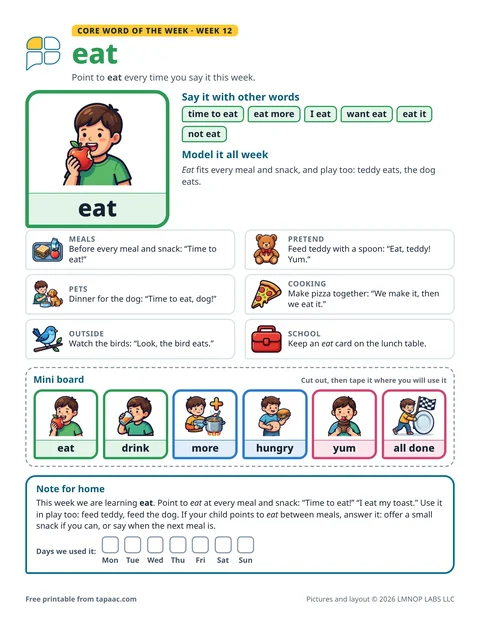 Week 12: eatMeals, snacks, pretend play and pets: time to eat.
-
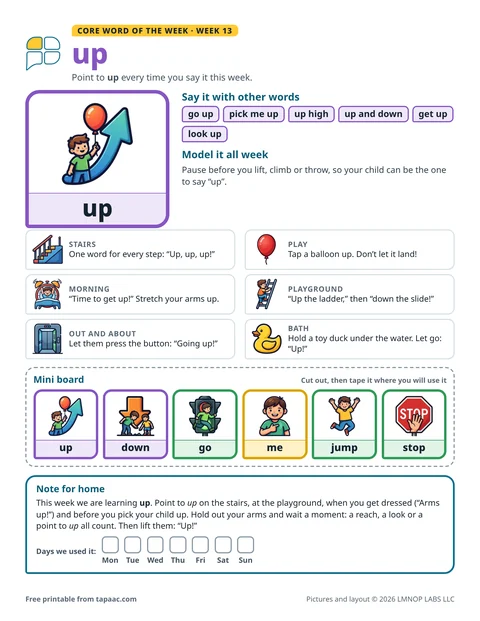 Week 13: upLifts, stairs, balloons and climbs: up, up, up!
-
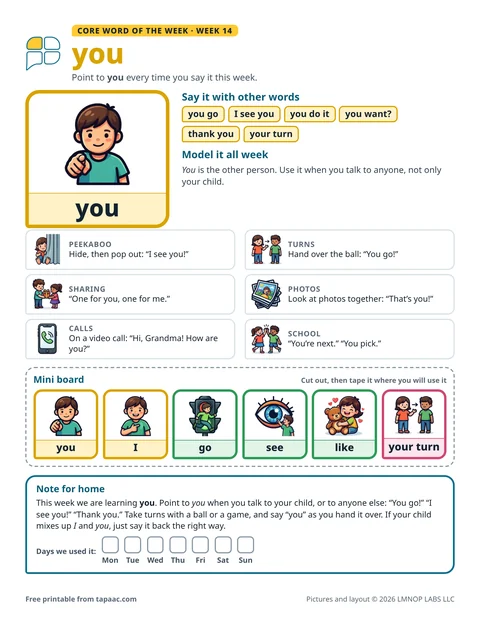 Week 14: youTurns, peekaboo and sharing: you go, I see you.
-
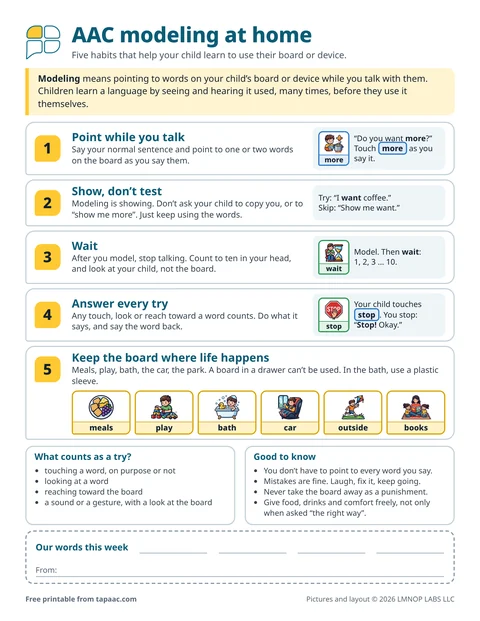 AAC modeling at homeFive habits on one page, to send home or stick on the fridge.
All core word printables and guides
Need a different board? Make your own with the free AAC board maker.
These cards, handouts and plans are general information, not therapy or medical advice, and they don’t replace a speech therapist. A speech therapist who knows the person can help choose the right words and the right way to practice. Everything here is free to print and share; please don’t sell it (terms of use). Questions? Email support@lmnoplabs.fun.