 Tap AAC
AAC modeling at home: a free one-page handout
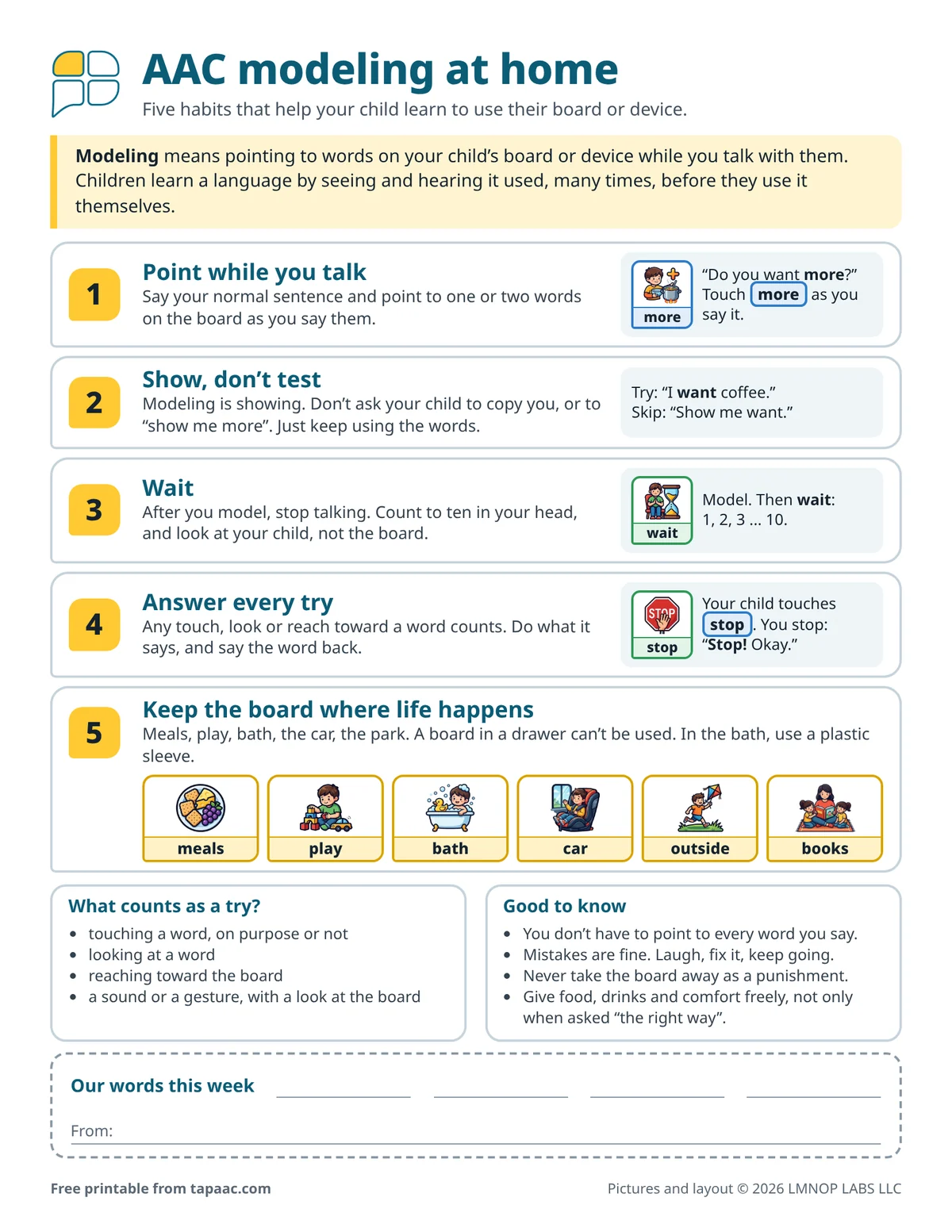
AAC modeling means pointing to words on a person’s board or device while you talk to them, so they see how it works. You don’t ask them to copy you; you just use their words yourself, in real moments. This free one-page handout explains five habits in plain words, for parents, grandparents and babysitters. Speech therapists and teachers are welcome to print it and send it home.
Download the free handout (PDF) US Letter, 1 page, 331 KB
Printing on A4 paper? Download the A4 PDF (1 page, 331 KB).
- Free
- One page
- Free to copy and share
The five habits, with examples
1. Point while you talk
Talk the way you normally do, and point to one or two of the most important words as you say them: “Let’s go to the car.” “That’s hot.” You don’t have to point to every word; the key words are enough. If the person uses a speech device, touch the buttons so it speaks, just as you would like them to.
2. Show, don’t test
Modeling is not quizzing. “Where’s more? Show me more” turns it into a test, and tests are no fun for anyone. Instead, say what you would say anyway, and use the board while you say it: “I want coffee.” “Uh oh, it fell.” Model for yourself, for other people and for the toy dinosaur, not only for the person.
3. Wait
After you model, stop talking for a while. Count to ten in your head. Look at the person, with a friendly, expectant face, not at the board. Many people need quiet time to plan a reach or a touch. If nothing happens, carry on with what you were doing; another chance will come along in a minute.
4. Answer every try
Treat every touch, look or reach toward a word as a message, even if it might be an accident. If the person touches stop, stop. If they touch eat in the middle of play, say “Eat? Are you hungry?” and offer a snack. That is how they learn that the words do something. Then add a word: “Stop. Stop the music.”
5. Keep the board where life happens
A board helps only if it is there when there is something to say. Keep one at the table, one in the car and one in a plastic sleeve by the bath. Take it on walks and to the store. If the person has a device, keep it charged and within their reach, not on a high shelf.
Bath time. The bath board hangs on the tiles in a plastic sleeve. Dad tests the water: “Not hot. Okay, in you go,” touching hot and in. A toy duck tips over: “Uh oh!” He points to uh oh and laughs. He doesn’t ask his daughter to point; he just keeps talking and pointing. When the water gets cool, he waits. She reaches over and touches all done. “All done. Out we get.”
When it feels hard
“I feel silly talking to a board.”
Most people do at first, and it gets easier with practice. Start with one routine, like snack, and two or three words.
“My child pushes the board away.”
Keep it nearby but out of their face, and model on it for yourself for a while. Pushing it away is a message too, so say it for them: “All done?” Try again later.
“They only press the same button.”
That is exploring. Answer it, then model a different word next to it.
“We don’t have time.”
Modeling doesn’t need extra time. It happens during things you already do: a few words at breakfast, a few in the bath, a few in the car. By bedtime, that adds up to a lot.
For speech therapists and teachers
You’re welcome to print the handout and send it home, give it out at a meeting or add it to a family folder. The box at the bottom has room for this week’s words and your name; circle the habit you would like the family to start with. The handout uses plain words with no jargon, so it works for grandparents and babysitters too. It is free to print, copy and share under the terms of use; please don’t sell it.
For the words themselves, pair it with the core word of the week pages, which each end with a note for home. To plan a whole term of words with your team, print the core word of the week planner. For families who worry that AAC will slow down talking, add the one-page AAC myths and facts handout; it prints well on the back of this one.
More core word printables
-
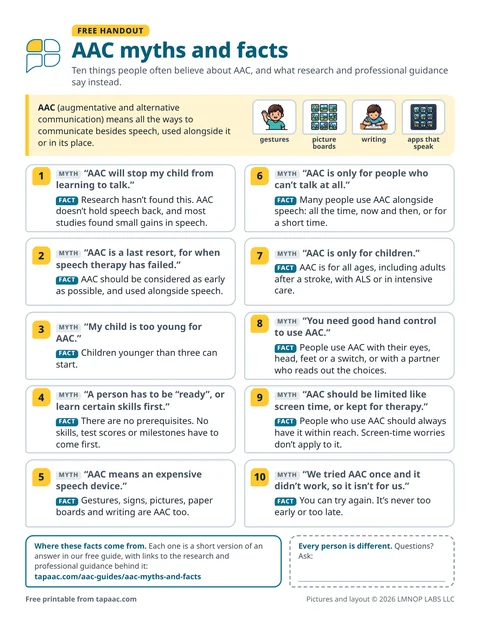 AAC myths and facts handoutTen common worries about AAC, answered on one page.
-
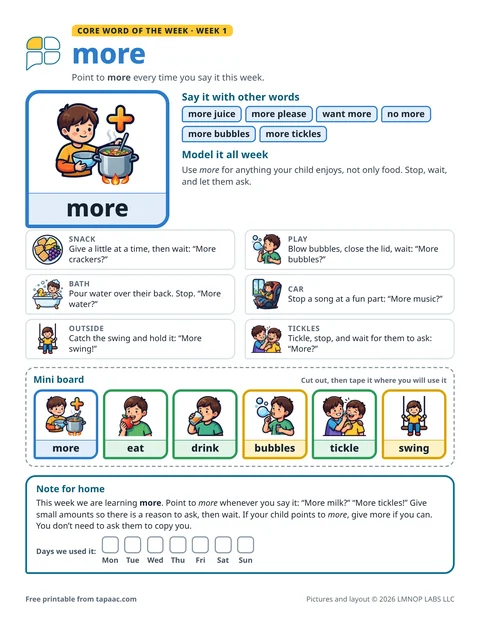 Core word of the week32 weeks of plans, from more to we.
-
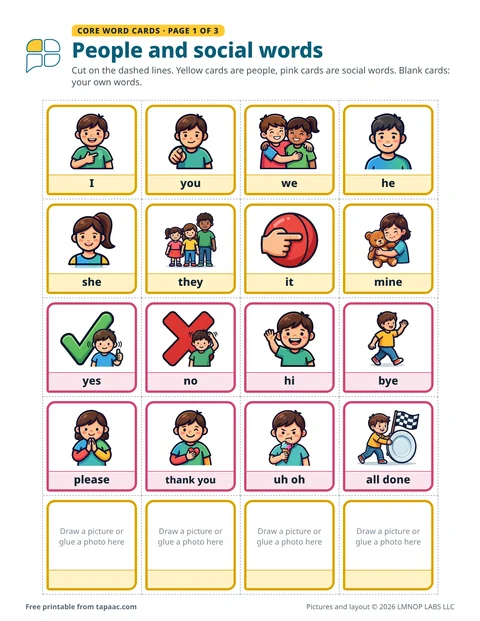 52 core word cardsWith pictures, in five colors, plus a one-page list for the fridge.
-
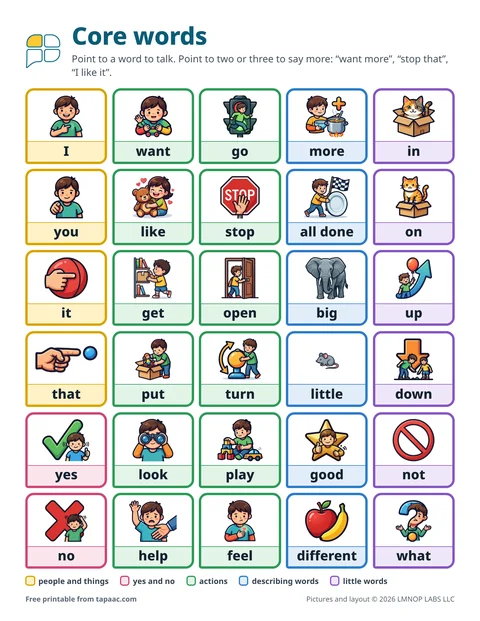 Core word board30 core words on one page, to point to all day.
All core word printables and guides
Need a different board? Make your own with the free AAC board maker.
These cards, handouts and plans are general information, not therapy or medical advice, and they don’t replace a speech therapist. A speech therapist who knows the person can help choose the right words and the right way to practice. Everything here is free to print and share; please don’t sell it (terms of use). Questions? Email support@lmnoplabs.fun.