 Tap AAC
Core word “look”: sharing what you notice
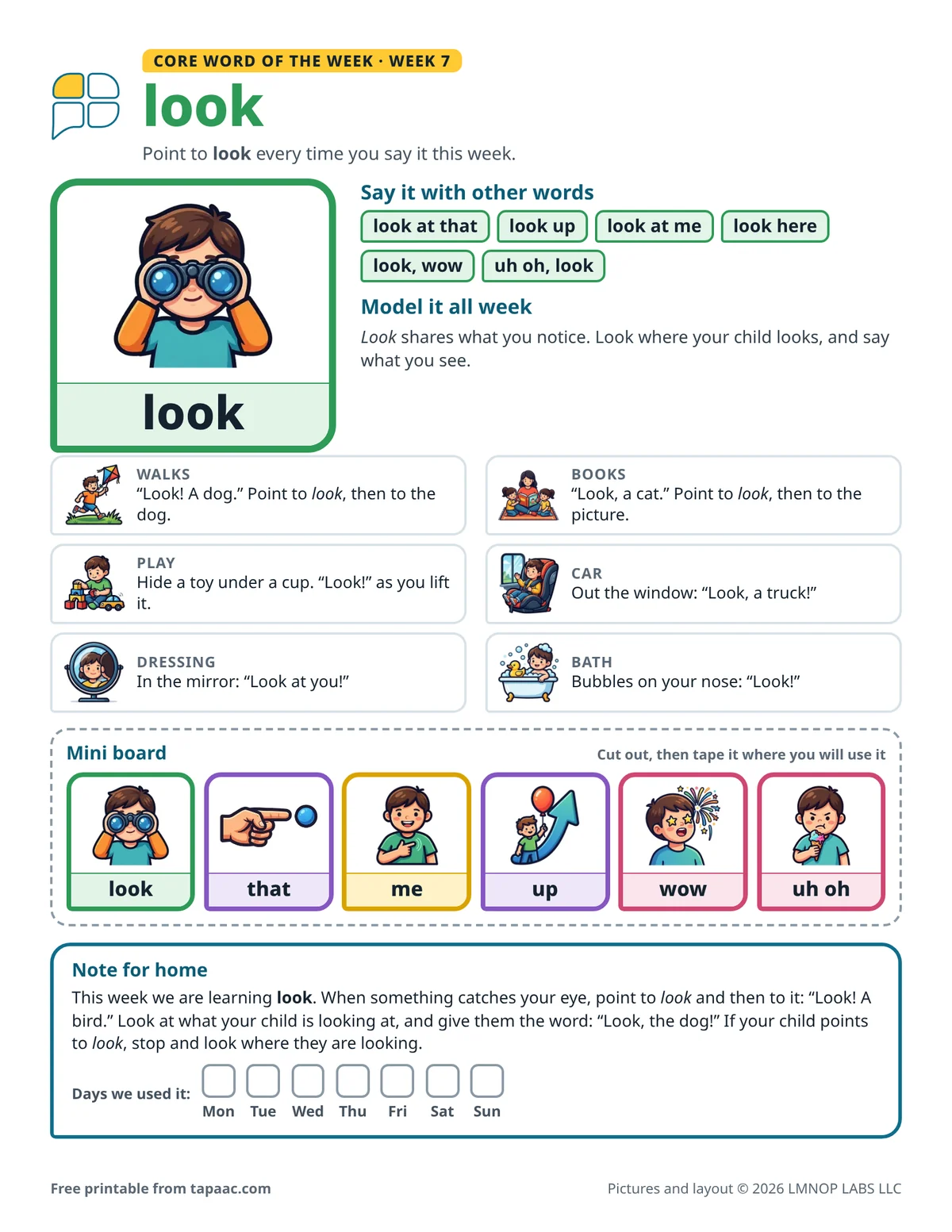
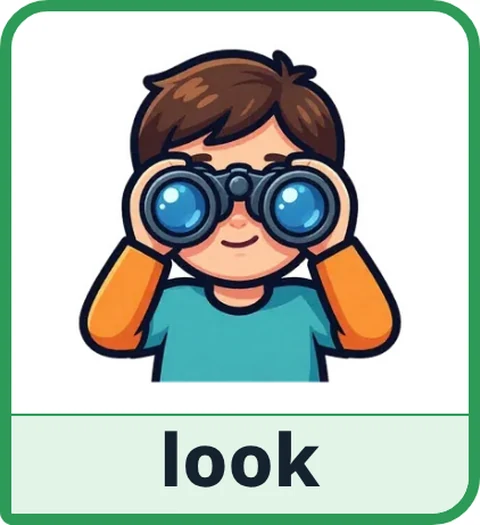
Look is for sharing what a person notices: look, a dog! Look at me! It doesn’t ask for anything. It starts a conversation and points out what’s interesting. This week, point to look whenever something catches your eye, and look where the person is looking.
Download the free printable (PDF) US Letter, 1 page, 428 KB
Printing on A4 paper? Download the A4 PDF (1 page, 428 KB).
Have Tap AAC? Add to Tap AAC (.obz file, 198 KB) · How to add a board
- Week 7 of 32
- Free
- One page
Why look is about sharing, not asking
Most first words ask for things. Look lets the person comment and share attention, which is a big part of how people talk to each other.
It works on walks, in books, at the window and in play, and joins with that, at me, up and here. When the person says look, they are inviting you in.
Look on walks, in books, in the mirror and from the car
Out and about
- On a walk: “Look! A dog.” Point to look, then to the dog.
- Planes, birds, cranes: “Look up!”
- At the store: “Look, bananas.”
With books
- Point to look, then to a picture in the book: “Look, a cat.”
- Lift-the-flap books: “Look! Uh oh, a bear!”
In play
- Hide a toy under a cup or a blanket, and say “Look!” as you lift it.
- Build something silly: “Look at my tower!”
In the bath and the car
- Bubbles on your nose: “Look!”
- Out of the car window: “Look, a truck.”
Getting dressed
- In the mirror: “Look at you! Look, a hat.”
At school and at home
- Show and tell: “Look at this.”
- When the person is already looking at something, give them the word: “Look, the fan!” You are saying what they might say.
On a walk to the park, a fire truck goes by with its lights flashing. Jake stops and stares. His dad points to look on the card clipped to the stroller: “Look! A fire truck!” Jake watches until it’s gone. On the way home they hear another siren. Jake grabs the card and taps look. His dad looks where Jake is looking: “Look! You saw it first.”
Look at that, look up, look at me
A second word sends the other person’s eyes somewhere: up at a plane, at that dog, or at me.
- look at that
- look up
- look at me
- look here
- look, wow
- uh oh, look
If they don’t follow your point, or it’s “look at me” all day
If the person doesn’t look where you point
Turn it around: point to look and name what they are already looking at, instead of moving their attention: “Look, the fan.”
If it becomes “look at me” all day
Wonderful. Look, and say what you see: “I see you jumping! So high!”
Note for home: look where your child is looking
This week we are learning look. When something catches your eye, point to look and then to it: “Look! A bird.” Look at what your child is looking at, and give them the word: “Look, the dog!” If your child points to look, stop and look where they are looking.
The same note is printed at the bottom of the week’s page, with a box to tick for each day. For families who are new to modeling, send the one-page AAC modeling at home handout with it, and keep using the word cards from earlier weeks.
More core word of the week plans
-
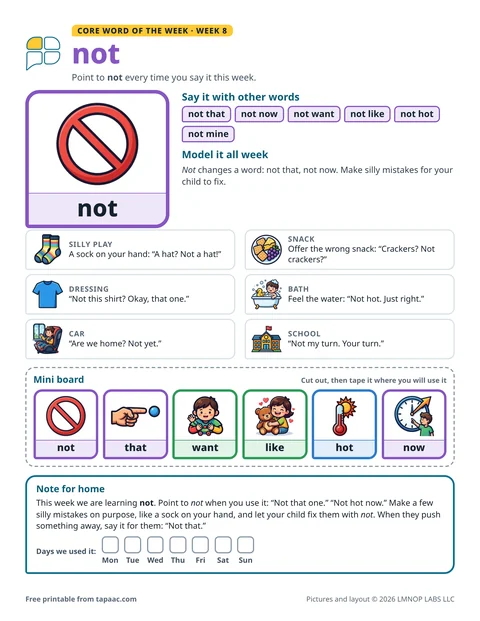 Week 8: notChange a word: not that, not now, not hot. And fix silly mistakes.
-
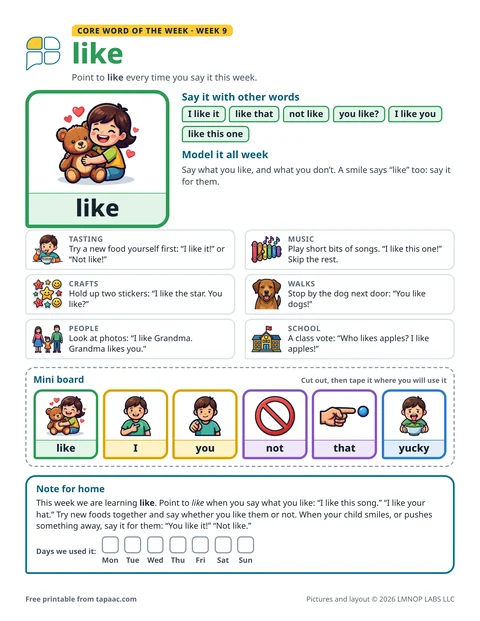 Week 9: likeShare opinions: I like it, not like, you like?
-
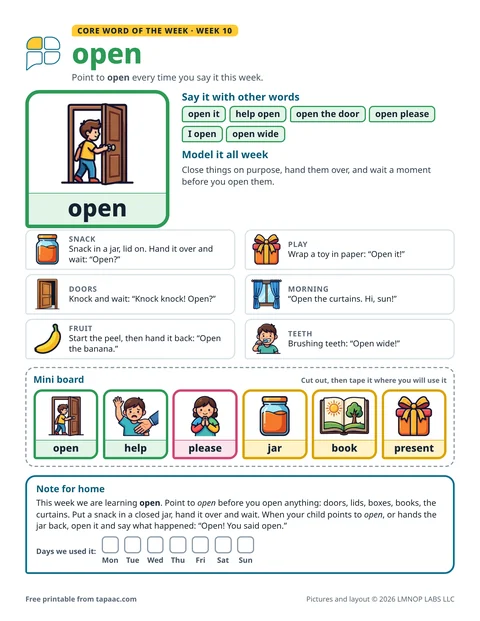 Week 10: openJars, presents, doors and books: open it!
-
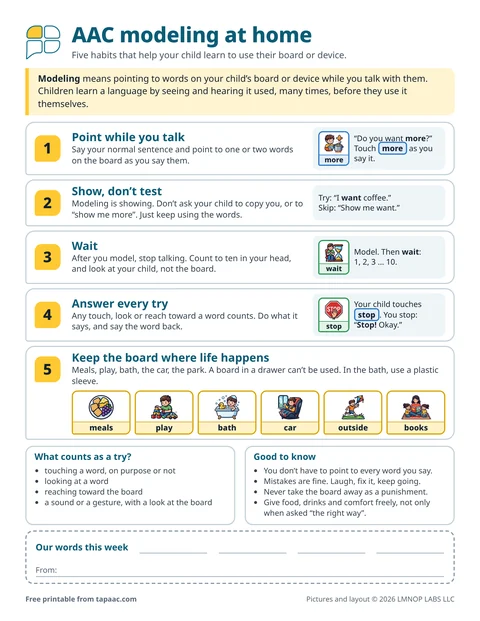 AAC modeling at homeFive habits on one page, to send home or stick on the fridge.
All core word printables and guides
Need a different board? Make your own with the free AAC board maker.
These cards, handouts and plans are general information, not therapy or medical advice, and they don’t replace a speech therapist. A speech therapist who knows the person can help choose the right words and the right way to practice. Everything here is free to print and share; please don’t sell it (terms of use). Questions? Email support@lmnoplabs.fun.