 Tap AAC
Core word “what”: now the person asks the questions
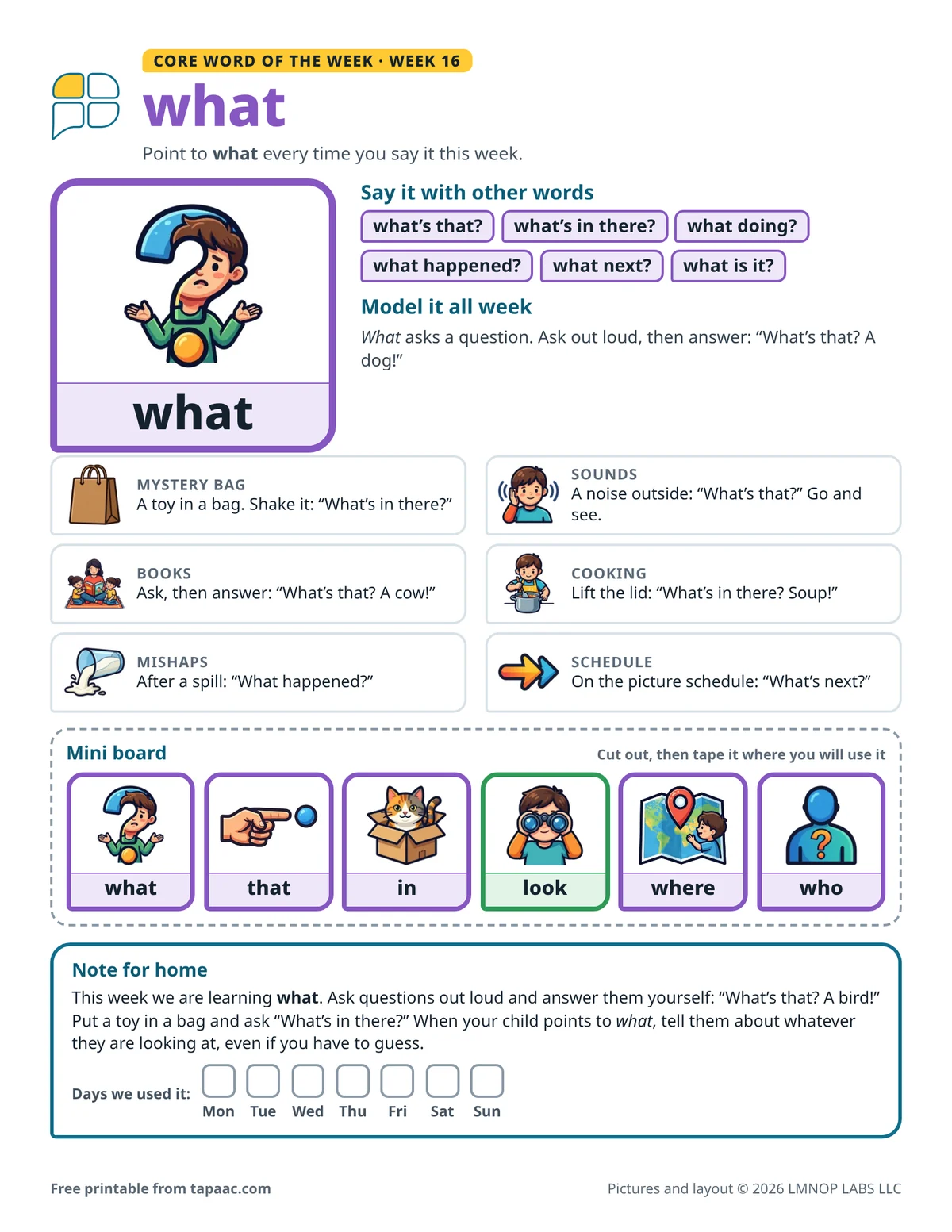
What asks a question: what’s that? what’s in there? what happened? With it, the person can ask about things, not only answer other people’s questions. This week, point to what when you ask a question, and answer your own questions out loud.
Download the free printable (PDF) US Letter, 1 page, 374 KB
Printing on A4 paper? Download the A4 PDF (1 page, 374 KB).
Have Tap AAC? Add to Tap AAC (.obz file, 186 KB) · How to add a board
- Week 16 of 32
- Free
- One page

Why what makes a good first question word
People who use AAC are often asked questions and expected to answer them. What turns that around: now the person can ask. It makes a good first question word, because what’s that? works anywhere.
It closes the first sixteen weeks because questions are easier once there are words to answer with. It joins with week 7’s look and with that: what’s that?, look, what’s that? Model it by asking out loud, then answering yourself.
Mystery bags, doorbells and pot lids: asking what
Mystery and surprise
- A mystery bag: put a toy in a cloth bag and shake it. “What’s in there?” Pull it out slowly.
- Wrap something in a towel and let the person feel it: “What is it?”
- A noise outside, the doorbell, the dog barking: “What’s that?” Go and see together.
With books
- Point to a picture, ask, then answer it yourself: “What’s that? A cow!”
- Before you turn the page: “What’s next?”
Meals and cooking
- Lift the lid of a pot: “What’s in there? Soup!”
- “What’s for lunch?” Then show the person what there is.
Every day
- After a spill or a crash: “What happened?” Then say it: “The cup fell.”
- On a picture schedule: “What’s next? Bath!”
- Guessing games: make an animal sound and ask “What am I?”
At school or therapy
- Show and tell: model the question for the class: “What did you bring?”
- When a classmate holds something up, give the person the words to ask: “What’s that?”
At circle time, Jonah’s teacher shakes a cloth bag. Something inside rattles. She points to what on the class board: “What’s in there?” She lets Jonah squeeze the bag, then waits. He looks at the board, then at her. She points to what again, and this time Jonah touches it. “What’s in there? Let’s see!” She pulls out a shaker and hands it to him. The next morning, Jonah touches what as soon as the bag comes out.
What’s that?, what happened?, what next?
Each question asks for a different kind of answer: a name, the story of what went wrong, or the plan.
- what’s that?
- what’s in there?
- what doing?
- what happened?
- what next?
- what is it?
If you can’t tell what they’re asking, or they press what over and over
If they press what and you aren’t sure what they mean
Follow their eyes and answer about what they are looking at: “What? That? That’s the fan.” If you guessed wrong, they can show you, and that is a conversation too.
If they press what over and over
Wonderful: they have learned that a question gets an answer. Answer each time, and add a word: “What’s that? A truck. A big truck.”
Note for home: ask out loud, then answer it yourself
This week we are learning what. Ask questions out loud and answer them yourself: “What’s that? A bird!” Put a toy in a bag and ask “What’s in there?” When your child points to what, tell them about whatever they are looking at, even if you have to guess.
The same note is printed at the bottom of the week’s page, with a box to tick for each day. For families who are new to modeling, send the one-page AAC modeling at home handout with it, and keep using the word cards from earlier weeks.
More core word of the week plans
-
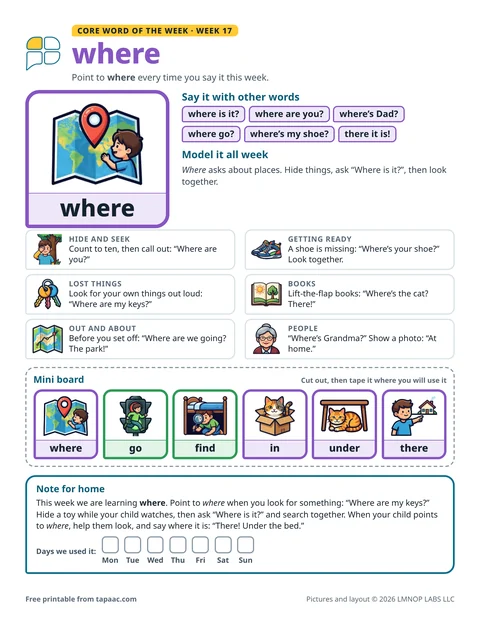 Week 17: whereHide and seek, lost shoes and outings: where is it?
-
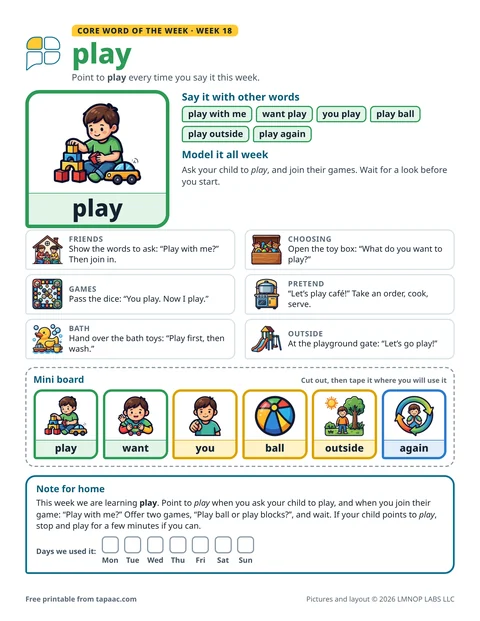 Week 18: playAsk someone to join in: play with me, play ball.
-
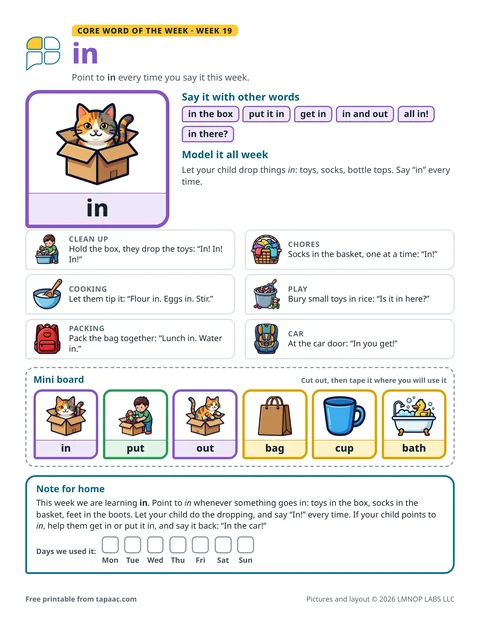 Week 19: inToys in the box, eggs in the bowl: in!
-
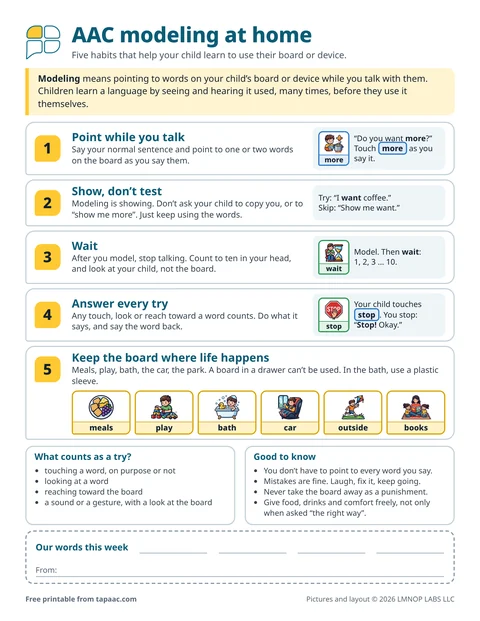 AAC modeling at homeFive habits on one page, to send home or stick on the fridge.
All core word printables and guides
Need a different board? Make your own with the free AAC board maker.
These cards, handouts and plans are general information, not therapy or medical advice, and they don’t replace a speech therapist. A speech therapist who knows the person can help choose the right words and the right way to practice. Everything here is free to print and share; please don’t sell it (terms of use). Questions? Email support@lmnoplabs.fun.