 Tap AAC
How to teach core words: a week-by-week plan
To teach core words, choose one everyday word at a time, like more, go or help, and use it yourself: point to it on the board while you say it, many times a day, in real moments, and answer whenever the person points to it. Core words are the small words that come up in every routine, so one word can do a lot of work. Below is the plan, week by week, with free cards, handouts and weekly plans.
Free printables
Print them free, as US Letter or A4 PDFs, with no sign-up.
-
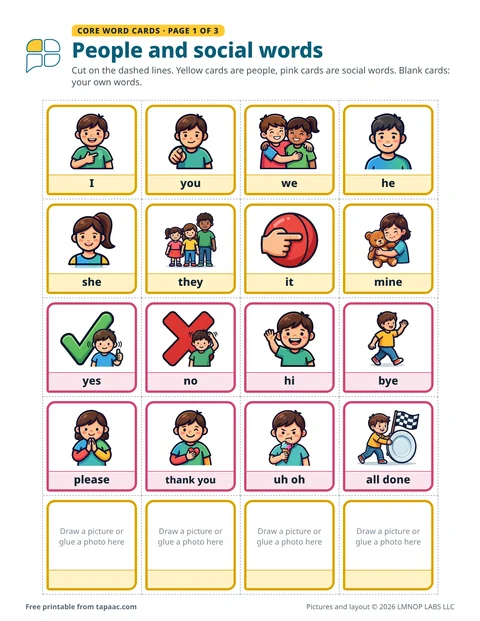
52 core word cards and a fridge list
Cut-out picture cards in five colors, and the same words on one page with examples.
-
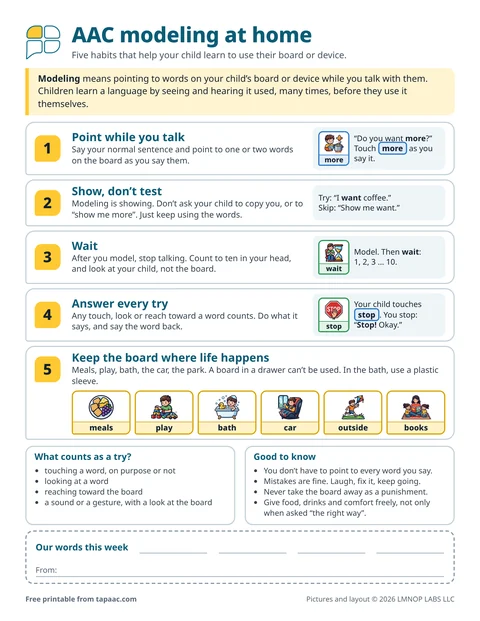
AAC modeling at home handout
Five habits on one page for parents, grandparents and babysitters.
-
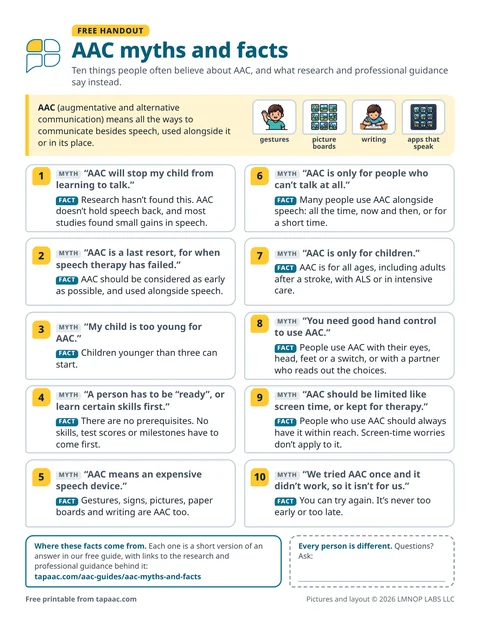
AAC myths and facts handout
Ten common myths, each with a one-line fact, to hand to families and school staff.
-
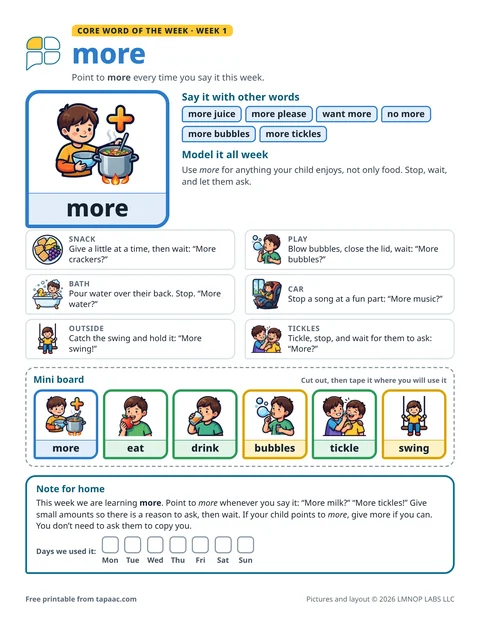
Core word of the week
32 weekly plans, from more, go and stop to yes, need and we.
-
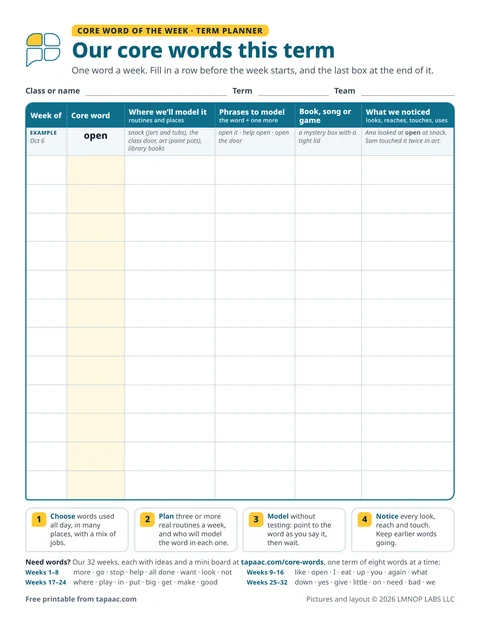
Core word of the week planner
A one-page grid to plan a term of core words, for speech therapists, teachers and families.
-
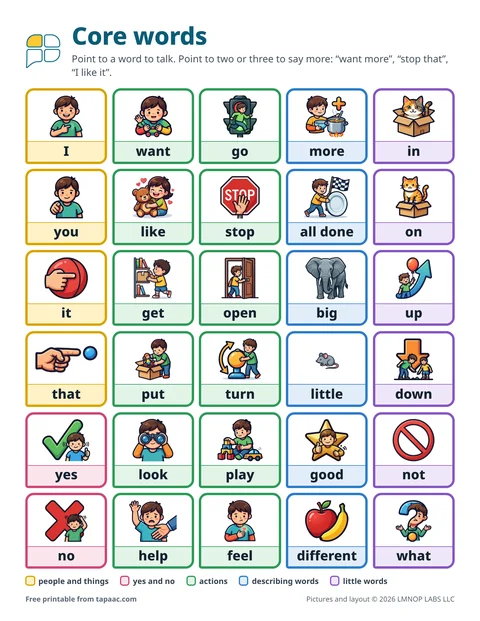
Core word board
30 core words on one page, to keep at the table, in the car and in the school bag.
Need a different board? Make your own with the free AAC board maker.
Six steps for each focus word
- Choose one focus word for the week. Pick one the person would want to say a lot, like more or go. The core word of the week plans cover 32 weeks, and a one-page planner helps you plan your own. Each week’s mini board is also a board file you can add to the Tap AAC app.
- Put the word everywhere. Print a few word cards: one on the fridge, one by the bath, one in the car. The person’s full board or device stays with them too.
- Use it in real routines, not drills. Model the word at meals, in play, in the bath and on outings. Short moments every day are the goal; there is no need for a sit-down lesson.
- Keep the other words going. A focus word is a reminder for you, not a limit for the person. Point to any word you say if it is on the board, especially the words from earlier weeks.
- Tell everyone. Give the note for home to grandparents, babysitters and school, so the person sees the word used by everyone around them.
- Watch, don’t test. Notice when the person looks at, reaches for or touches the word, and answer it. Those moments are the progress.
What modeling looks like
Modeling means pointing to words on the person’s board or device while you talk to them, without asking them to copy you. The one-page AAC modeling at home handout puts the five main habits on a sheet you can stick on the fridge.
For modeling with autistic children and in class, see AAC and autism and AAC in the classroom, or all our AAC guides. If someone in the family worries that a board will get in the way of talking, the one-page AAC myths and facts handout answers that worry and nine others.
At the bottom of the stairs, Grandpa says, “Up we go,” and touches up on the card taped to the banister. Every evening he does the same. One night he stops at the bottom step and waits. His grandson looks at the card, then pats it. “Up! Okay, up we go.”
Which words to start with
There is no single right list. Good first words are ones the person can use many times a day and that get a quick result: more, go, stop, help, all done. Then add words that do other jobs: look to share something, not to disagree, want with a choice, I and you to talk about people, what and where to ask.
Our 52 core word cards group the words we suggest by type, with a one-page list for the fridge. A speech therapist who knows the person can help choose.
Core words and the core word board
A core word like more works with snacks, songs and swings alike, which is why core words are worth teaching early, alongside the person’s favorite things. For what a core word board is, how core words differ from other words and why the words stay put, read what a core word board is. To print one, the free core word board has 30 core words on one page.
Core words for teens and adults
Core words aren’t only for young children. The same words work at any age; what changes is the examples. A teenager might use more for music, not tickles, and stop in a video game, not on the swing. Use topics and pictures that fit the person’s age, and talk to them the way you would talk to anyone their age.
Common questions
How many core words should we model at once?
Focus on one or two at a time so you remember to use them, but point to any word you say if it is on the board. The focus word is a reminder for you, not a limit for the person.
How long until they use a word?
There is no set time. Some people use a new word within days; for others it takes many weeks of seeing it used. Keep modeling, and count looks, reaches and touches along the way.
What if they press the same word over and over?
That is exploring, and it is a good sign. Answer it each time you can, then model a new word next to it: “More, more... more bubbles!”
Paper board or a speech app?
Both work, and many families use both. A paper board needs no charging and can go in the bath; a tablet says the word out loud. A speech therapist can help you decide what fits the person.
These cards, handouts and plans are general information, not therapy or medical advice, and they don’t replace a speech therapist. A speech therapist who knows the person can help choose the right words and the right way to practice. Everything here is free to print and share; please don’t sell it (terms of use). Questions? Email support@lmnoplabs.fun.