 Tap AAC
Core word “little”: small things and small amounts
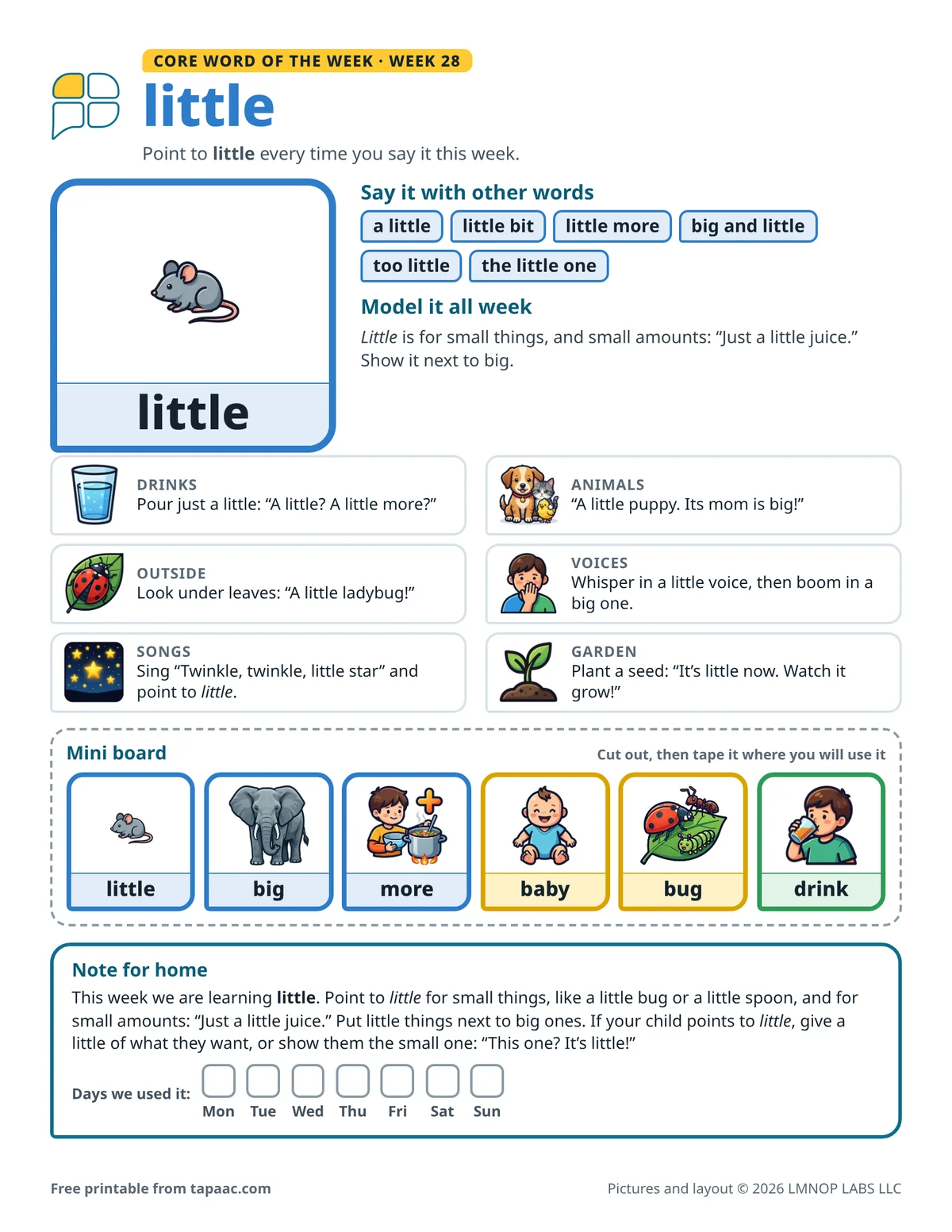
Little describes small things, like a little bug or a little car, and small amounts: a little juice, a little bit, a little more. That second job makes it useful at every meal. This week, point to little whenever something is small or you only want a bit, and put little things next to big ones.
Download the free printable (PDF) US Letter, 1 page, 401 KB
Printing on A4 paper? Download the A4 PDF (1 page, 401 KB).
Have Tap AAC? Add to Tap AAC (.obz file, 193 KB) · How to add a board
- Week 28 of 32
- Free
- One page
Why big needs little
Week 21’s big needs a partner to mean much: a dog is only big next to a little one. Little completes the pair, so the person can choose a size (“the little one”) and notice when things are different.
Its second job is amount. “A little” lets a person ask for some, not all: a little juice, a little more (week 1), a little help (week 4). It works for sound, too: a little voice, a little quieter.
Little sips, ladybugs, seeds, whispers and stars
Meals and drinks
- Pour just a little into the cup, stop, and wait: “A little? A little more?”
- Serve yourself out loud: “Just a little for me. I’m not very hungry.”
Play
- Line up toys from big to small, like nesting cups or teddies: “Big bear... middle bear... little bear.”
- In a dollhouse or a toy farm, talk about the small ones: “The little pig wants to go in.”
- Tickles in two sizes: “A little tickle, or a big tickle?” Start little.
Outside
- Hunt for bugs under leaves and stones: “Look, a little ladybug! So little.”
- Plant a bean in a cup on the windowsill: “It’s little now. Let’s watch it grow.”
Animals and books
- Baby animals, in books, at the farm or at a friend’s house: “A little puppy. Its mom is big.”
Voices and songs
- Talk in a little voice, almost a whisper, then a big one. Let the person choose which voice comes next.
- Sing “Twinkle, twinkle, little star,” pointing to little each time it comes round.
Helping
- Share out the jobs by size: “You carry the little bag. I carry the big one.”
At school or therapy
- Art time: “Just a little glue. A little more paint?” Squeeze slowly and wait for the person to say when.
Breakfast. Isla, who is 3, watches her mom tip the milk jug over her cereal. A tiny splash comes out, and Mom stops. She points to little on the mini board taped to the table: “A little milk.” Isla looks at her bowl, still almost dry. Mom points to more and waits. Isla touches it. “More? A little more.” Another small splash. By the end of the week, Isla taps little before the jug even moves, and then more until the bowl is just right.
A little, little more, the little one
A little and little more are about amounts, which makes them useful at every meal.
- a little
- little bit
- little more
- big and little
- too little
- the little one
If little and big get mixed up, or little means less
If little and big get mixed up
That’s part of learning a pair. Don’t correct with “No, that’s big”; just say what you see, side by side: “This one is little. That one is big.” Silly sizes help, like a doll’s hat on Dad’s head.
If little means they want less
Treat it as a real request: “A little? Okay, just a little.” Being able to ask for a small amount can make a new food or a busy place feel less like a big deal.
Note for home: give a little, and put little next to big
This week we are learning little. Point to little for small things, like a little bug or a little spoon, and for small amounts: “Just a little juice.” Put little things next to big ones. If your child points to little, give a little of what they want, or show them the small one: “This one? It’s little!”
The same note is printed at the bottom of the week’s page, with a box to tick for each day. For families who are new to modeling, send the one-page AAC modeling at home handout with it, and keep using the word cards from earlier weeks.
More core word of the week plans
-
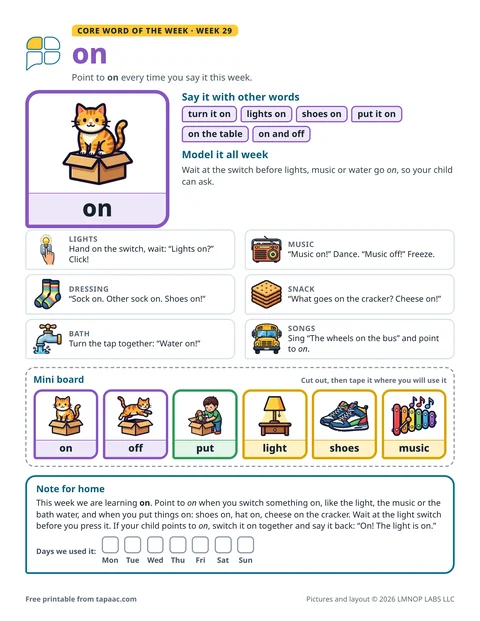 Week 29: onLights on, music on, shoes on: switch it on!
-
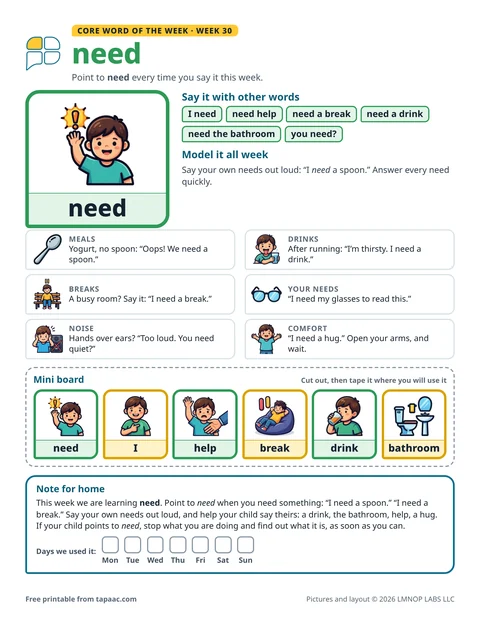 Week 30: needThings that can’t wait: I need help, I need a break.
-
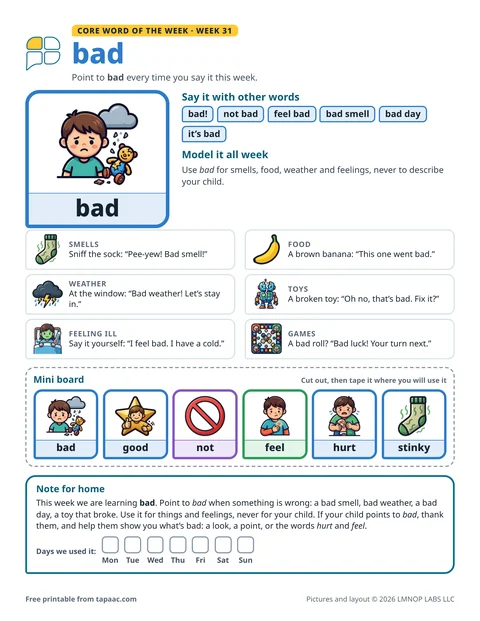 Week 31: badSay what’s wrong: bad smell, bad day, feel bad.
-
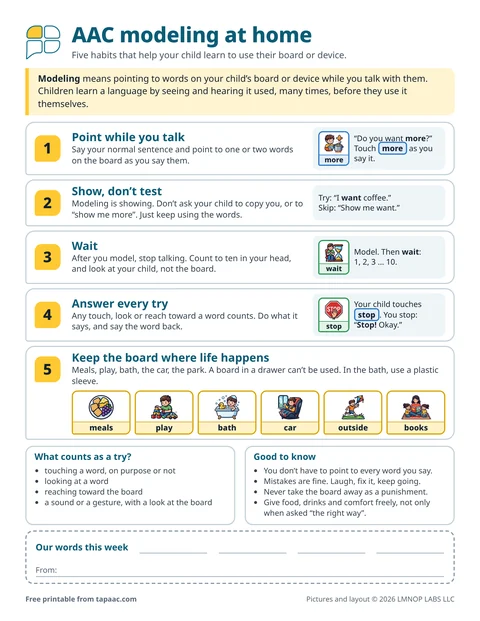 AAC modeling at homeFive habits on one page, to send home or stick on the fridge.
All core word printables and guides
Need a different board? Make your own with the free AAC board maker.
These cards, handouts and plans are general information, not therapy or medical advice, and they don’t replace a speech therapist. A speech therapist who knows the person can help choose the right words and the right way to practice. Everything here is free to print and share; please don’t sell it (terms of use). Questions? Email support@lmnoplabs.fun.