 Tap AAC
Core word “want”: this one or that one?
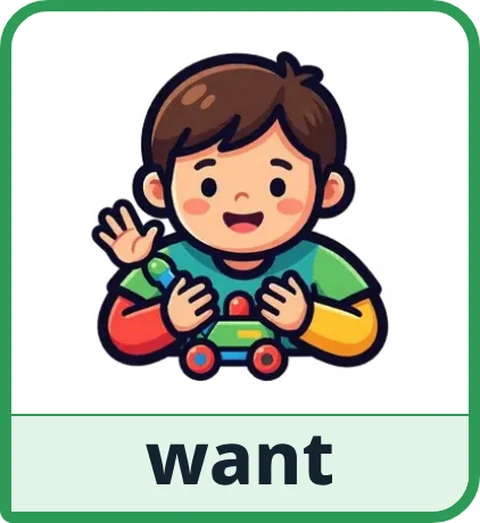
Want tells people what a person would like: want that, want juice, I want to go. It turns reaching and pointing at things into a clear message, and it works with almost every other word on the board. This week, point to want whenever you offer a choice, and whenever you say what you want yourself.
Download the free printable (PDF) US Letter, 1 page, 413 KB
Printing on A4 paper? Download the A4 PDF (1 page, 412 KB).
Have Tap AAC? Add to Tap AAC (.obz file, 190 KB) · How to add a board
- Week 6 of 32
- Free
- One page
Why want opens up so many requests
Want is the start of many requests. With want and one more word, like want more, want that or want help, the person can ask for almost anything they can see or name.
It comes after more, go and help in this plan because it joins with them. Hearing adults say what they want, “I want a coffee”, also shows that wanting things is fine to say out loud.
Want this or that? Choices from snacks and shirts to people
At snack
- Hold up two choices: “Want this or that?” Point to want, then hold up each one.
- Say your own: “I want an apple.”
In play
- Keep a few favorite toys in sight but out of reach, in a clear box or on a high shelf: “Want the ball?”
- Stop a game partway: “Want more? Want go?”
- Let the person choose for you: “What do I want?”
Getting dressed
- Hold up two shirts: “Want this one? Want the blue one?”
In the bath
- “Want bubbles? Want the duck?”
In the car
- Before you set off: “Want music?” Say your own too: “I want quiet now.”
Books and screens
- “Want this book or that book?”
- Choosing a show: “Want that one?”
With people
- “Want Mom? Want Grandpa?” Show photos of the people next to the board.
- When the person pushes something away, say it for them: “Not want. You don’t want that.”
Getting ready for the bath. Grandpa holds up two toys, a duck and a boat. “Want duck? Or want boat?” He points to want on the bath board, then holds up each toy in turn. Rosa reaches for the boat, then taps the board. “Want boat! Here’s the boat.” Then Grandpa picks up the duck: “I want the duck,” pointing to want again, and they race them across the water.
I want, want that, want help
Start with I want for your own wishes, then add the thing you are offering.
- I want
- want that
- want more
- want help
- want go
- you want?
If they want something they can’t have, or point without want
If they say want and point at something you can’t give
Say back what they asked for, so they know the word worked: “You want cookies. Cookies after dinner.” Being understood matters, even when the answer is no.
If they point at things without using want
That’s fine: pointing is communication. Keep modeling want with the thing: “Want cup. Here’s the cup.”
Note for home: favorite things in sight, out of reach
This week we are learning want. Point to want when you offer a choice, “Want juice or milk?”, and when you say what you want: “I want coffee.” Keep a few favorite things in sight but out of reach. If your child points to want, say back what you think they want, and check.
The same note is printed at the bottom of the week’s page, with a box to tick for each day. For families who are new to modeling, send the one-page AAC modeling at home handout with it, and keep using the word cards from earlier weeks.
More core word of the week plans
-
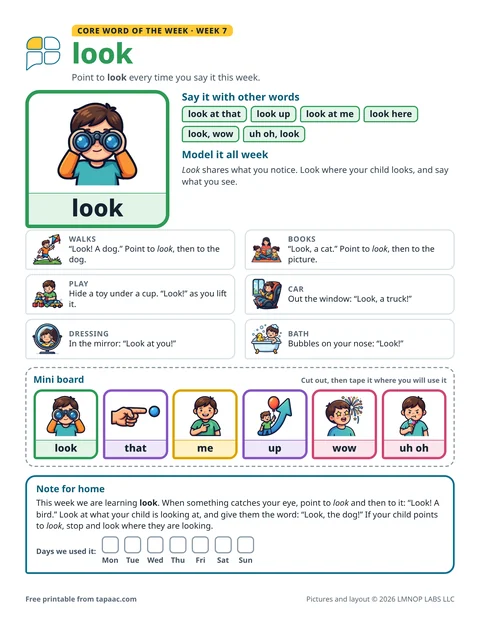 Week 7: lookShare what you notice: look, a dog! Look at me!
-
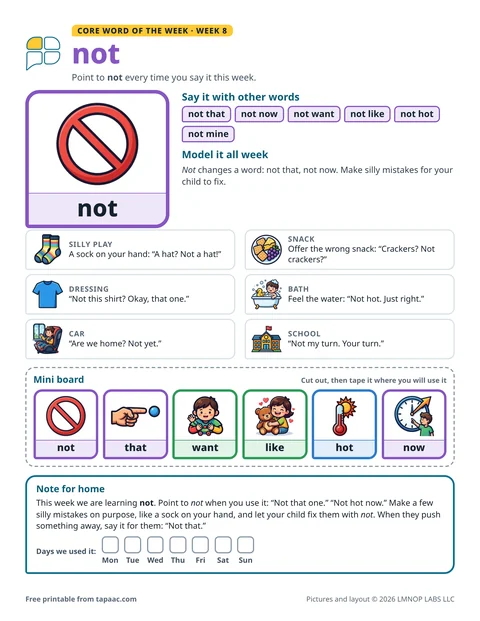 Week 8: notChange a word: not that, not now, not hot. And fix silly mistakes.
-
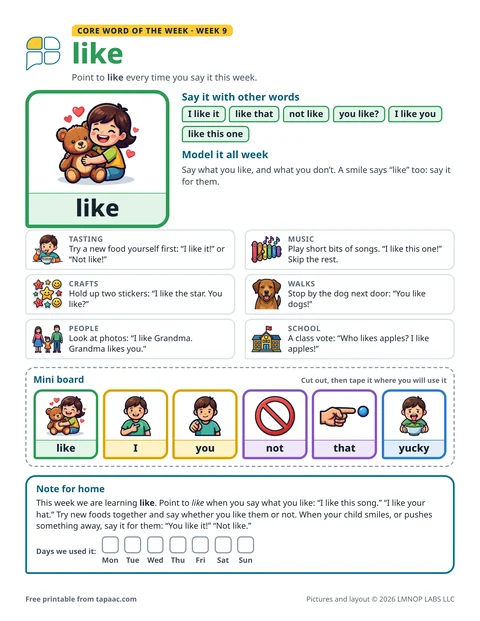 Week 9: likeShare opinions: I like it, not like, you like?
-
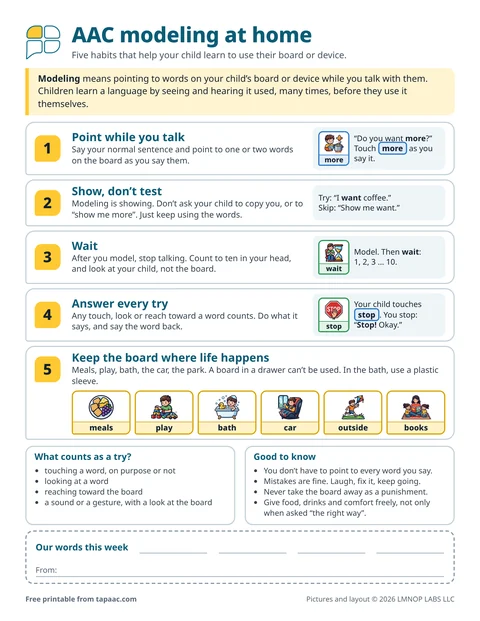 AAC modeling at homeFive habits on one page, to send home or stick on the fridge.
All core word printables and guides
Need a different board? Make your own with the free AAC board maker.
These cards, handouts and plans are general information, not therapy or medical advice, and they don’t replace a speech therapist. A speech therapist who knows the person can help choose the right words and the right way to practice. Everything here is free to print and share; please don’t sell it (terms of use). Questions? Email support@lmnoplabs.fun.