 Tap AAC
Core word “yes”: a clear way to accept and agree
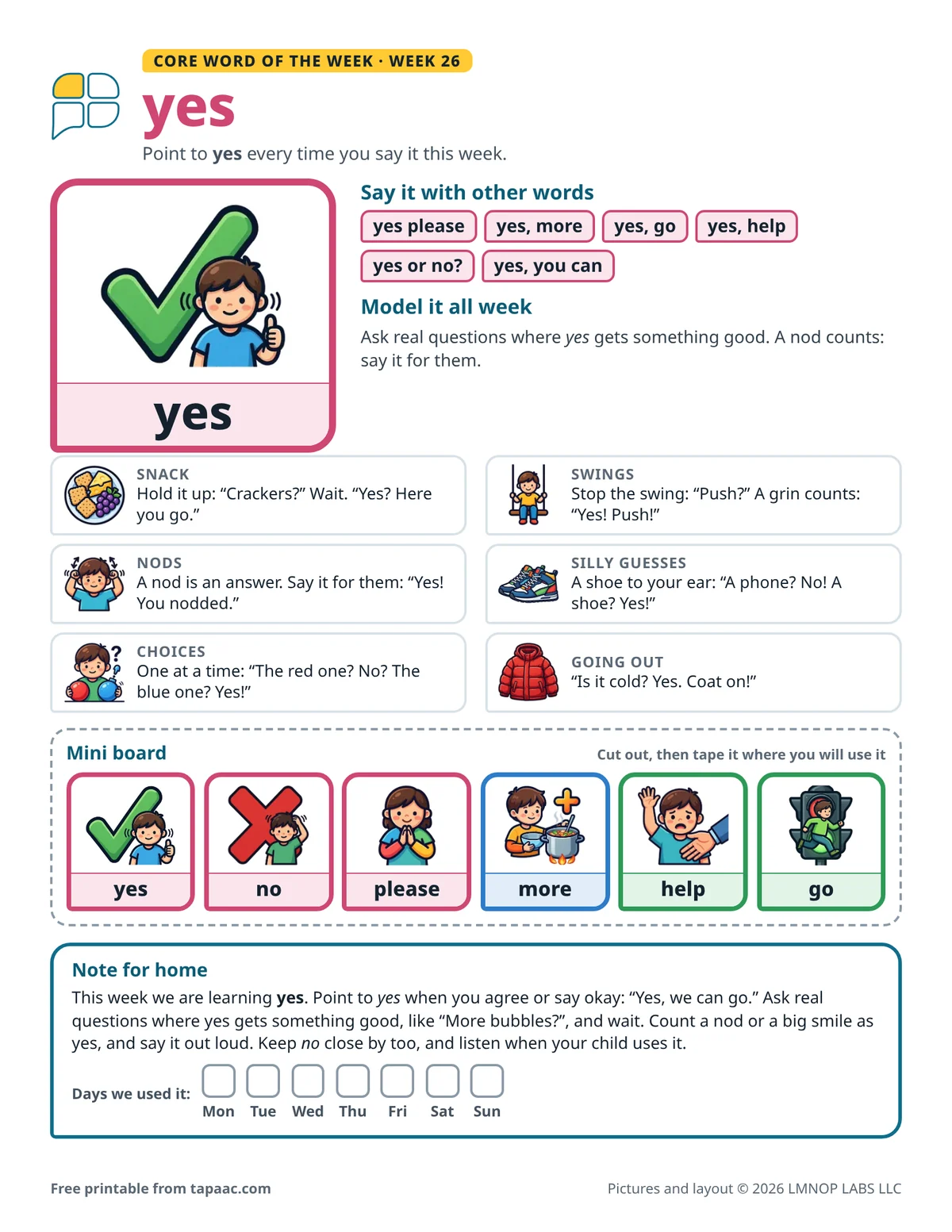
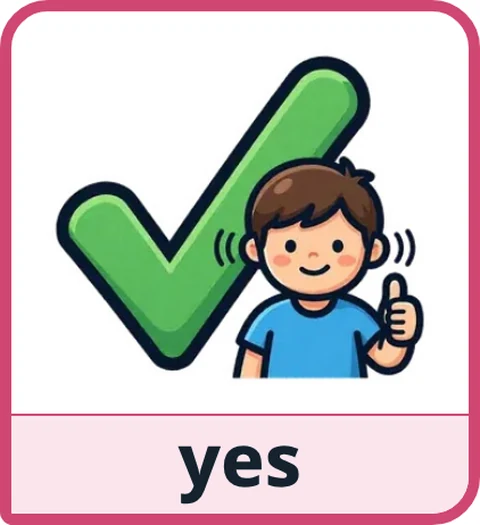
Yes agrees, accepts and answers: yes please, yes more, yes, let’s go. Adults ask questions all day, and yes is one of the quickest ways to answer them. This week, point to yes whenever you agree or say okay, and ask questions where yes gets the person something they want.
Download the free printable (PDF) US Letter, 1 page, 427 KB
Printing on A4 paper? Download the A4 PDF (1 page, 427 KB).
Have Tap AAC? Add to Tap AAC (.obz file, 209 KB) · How to add a board
- Week 26 of 32
- Free
- One page
Why yes belongs next to stop and not
By now the person has stop (week 3) and not (week 8) for turning things down. Yes is the other side: a fast, clear way to accept an offer or agree with a plan, so the adults don’t have to guess from a smile or a reach.
It works on its own, which makes it quick, and it joins earlier words when there is more to say: yes please, yes more, yes help. Model no beside it, and listen to both. A yes means more when a no is taken seriously too.
Swing pushes, silly guesses and nods: room for a yes
Snack and meals
- Hold up something the person loves and ask: “Crackers?” Point to yes as you ask, wait, and hand it over the moment they answer.
- Model your own answers, touching yes as you say them: “Coffee? Yes please!” “More soup? Yes.”
Play
- Stop the swing and ask: “Push?” If the answer is a grin or a kick of the legs, say it for them: “Yes! Push!”
- Silly guesses: hold a shoe to your ear like a phone. “Is it a phone? No! Is it a shoe? Yes!”
Choices
- Offer one thing at a time and ask about each: “The red cup?” Wait for a head shake. “The blue cup?” “Yes!” Point to no or yes with each answer.
Getting ready and going out
- Check the plan together out loud: “Is it cold? Yes. Coat on.” “Are we going to the park? Yes!”
Nods and smiles
- When the person nods, smiles or reaches, put it into words and point to yes: “Yes. You nodded yes.”
- A mirror game: nod together and say “Yes, yes, yes,” then shake your heads and say “No, no, no.”
Books and songs
- Ask the story’s questions out loud and answer them yourself: “Is the bear asleep? Yes! Shh.”
- Make up a song about the day: “Did we go on the bus? Yes, yes, yes!”
At school or therapy
- Take a class vote: “Sing the bus song? Hands up for yes!” Point to yes as you count the hands.
- Ask before you step in: “Help? Yes?” Wait for the answer instead of helping straight away.
After school, Amara, who is 8, sits at the kitchen table with her babysitter. He holds up a plate of apple slices and points to yes and no on her board: “Apple? Yes? No?” Amara looks at the plate and doesn’t move. He waits. Then she gives a tiny nod. “Yes! You nodded yes,” he says, touching yes, and slides the plate over. When he holds up the popcorn next, Amara reaches over and taps yes before he can finish asking. “Yes? Popcorn it is.”
Yes please, yes, more, yes or no?
Keep no close by on the board, so that yes is a real choice and not the only answer.
- yes please
- yes, more
- yes, go
- yes, help
- yes or no?
- yes, you can
If every answer is yes, or you can’t give what they said yes to
If they say yes to everything
Mix in a silly offer now and then, like “Sock for lunch?”, and laugh together if a yes comes out. If yes seems to mean “I heard you”, keep modeling no beside it, honestly, in your own answers.
If you can’t give them what they said yes to
Thank them for the answer, then say when: “Yes, the park! After lunch.” Show the park on a picture schedule, so the yes isn’t lost.
Note for home: count a nod or a big smile as yes
This week we are learning yes. Point to yes when you agree or say okay: “Yes, we can go.” Ask real questions where yes gets something good, like “More bubbles?”, and wait. Count a nod or a big smile as yes, and say it out loud. Keep no close by too, and listen when your child uses it.
The same note is printed at the bottom of the week’s page, with a box to tick for each day. For families who are new to modeling, send the one-page AAC modeling at home handout with it, and keep using the word cards from earlier weeks.
More core word of the week plans
-
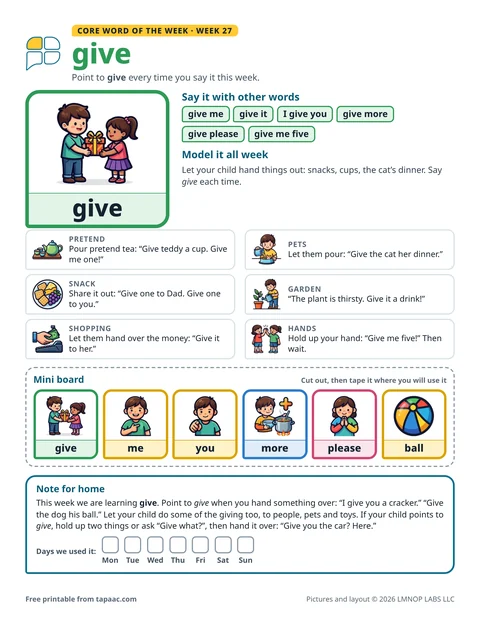 Week 27: givePass it on: give me, give you, give me five!
-
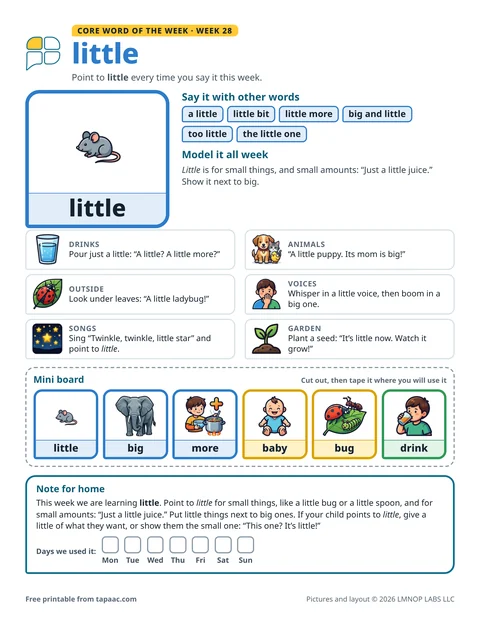 Week 28: littleSmall things and small amounts: a little bit more.
-
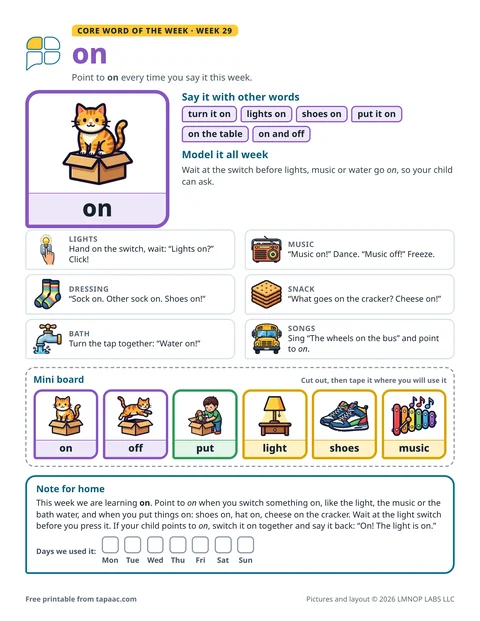 Week 29: onLights on, music on, shoes on: switch it on!
-
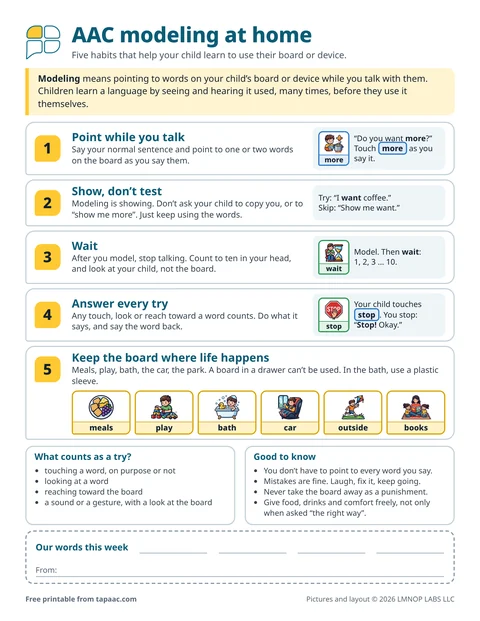 AAC modeling at homeFive habits on one page, to send home or stick on the fridge.
All core word printables and guides
Need a different board? Make your own with the free AAC board maker.
These cards, handouts and plans are general information, not therapy or medical advice, and they don’t replace a speech therapist. A speech therapist who knows the person can help choose the right words and the right way to practice. Everything here is free to print and share; please don’t sell it (terms of use). Questions? Email support@lmnoplabs.fun.