 Tap AAC
Core word “where”: asking about things out of sight
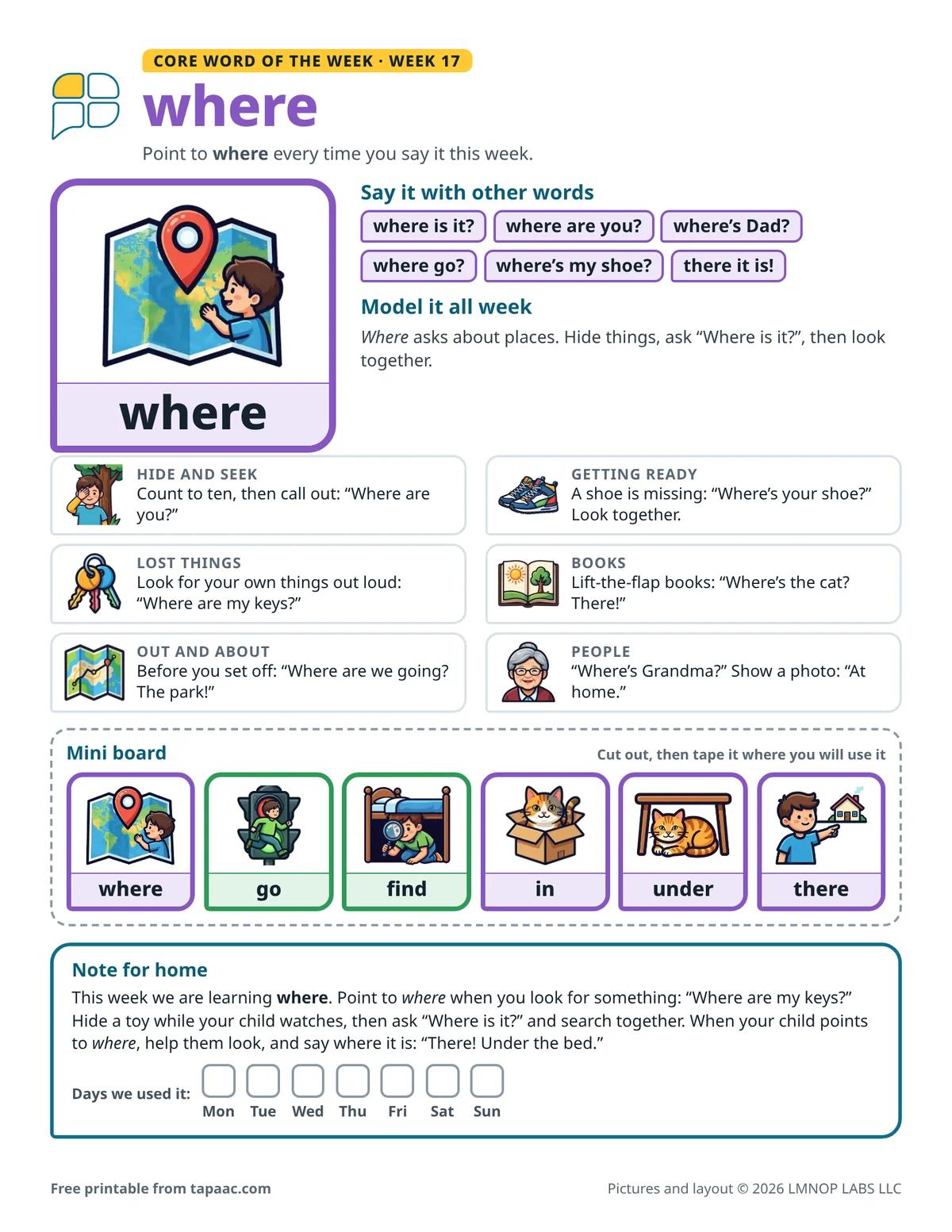
Where asks about places: where is it? where are we going? where’s Dad? With it, a person can ask about something or someone they can’t see, which pointing can’t do. This week, point to where whenever you look for something or wonder about a place, and say the answer out loud when you find it.
Download the free printable (PDF) US Letter, 1 page, 424 KB
Printing on A4 paper? Download the A4 PDF (1 page, 423 KB).
Have Tap AAC? Add to Tap AAC (.obz file, 210 KB) · How to add a board
- Week 17 of 32
- Free
- One page
From what to where: asking about places
Last week’s what asks about a thing. Where asks about a place, or about something that isn’t there: the missing shoe, the cat that ran off, Grandpa who has gone to work. Asking about things that are out of sight is one of the big jobs words can do, and a board makes it possible.
It is also the word of every hiding game, so practice can be fun. It joins with week 2’s go: where go? And its answers are often little words, like in, under and there. In is week 19.
Hiding games, missing keys and trips out: where is it?
Hide and seek
- Hide a favorite toy while the person watches, then ask “Where’s teddy?” and search together, lifting cushions and opening drawers.
- Take turns hiding behind a door or a curtain. The seeker calls “Where are you?” and the hider answers “Here!”
- Hide something that makes a sound, like a phone playing a song: “Listen! Where is it?”
Getting ready
- When a shoe or a coat goes missing, look for it out loud: “Where’s your shoe? Not here... where is it?”
- Look for your own things too, and let the person help: “Where are my keys? Oh, in my bag!”
Out and about
- Before you leave the house: “Where are we going? To the park!” Show a photo of the place if you have one.
- When the car stops: “Where are we? At the store.”
Books and photos
- Lift-the-flap and search-and-find books: “Where’s the cat? Under the bed!”
- Family photos: “Where is Grandma in this one? At the beach.”
Tidying up
- Hold up a toy at clean-up time and ask “Where does it go?” Then show the box or the shelf.
At school or therapy
- When a classmate is away: “Where’s Sam? Sam is at home today.”
- Hide picture cards around the room for a treasure hunt, and model the question at each new spot: “Where is it?”
In the living room, Kai, who is 4, watches his mom tuck his toy dog under a cushion. She sits back and points to where on the mini board: “Where’s doggy? Where is it?” She looks around, puzzled, and waits. Kai giggles and pulls the cushion away. “There! Under the cushion!” Next time she hides it behind the curtain and says nothing at all. Kai looks at the board and pats where. “Where? Let’s look!” They search together until his hand finds a furry tail.
Where is it?, where’s Dad?, there it is!
Every where question needs an answer you can point to, so model there and in straight after it.
- where is it?
- where are you?
- where’s Dad?
- where go?
- where’s my shoe?
- there it is!
If you don’t know what they’re looking for, or they can’t go there
If they press where and you don’t know what they are looking for
Look around with them and guess out loud: “Where... is Dad? Where... is your cup?” Watch where their eyes go, and hold up two photos or objects if you can.
If the answer is somewhere they can’t go
Answer anyway, so the question was worth asking: “Where’s Dad? At work. He comes home after dinner.” A photo of the place makes the answer easier to follow.
Note for home: hide it while they watch, then search together
This week we are learning where. Point to where when you look for something: “Where are my keys?” Hide a toy while your child watches, then ask “Where is it?” and search together. When your child points to where, help them look, and say where it is: “There! Under the bed.”
The same note is printed at the bottom of the week’s page, with a box to tick for each day. For families who are new to modeling, send the one-page AAC modeling at home handout with it, and keep using the word cards from earlier weeks.
More core word of the week plans
-
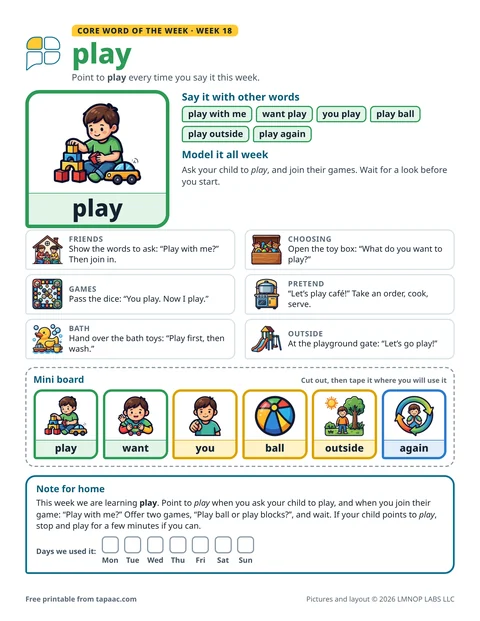 Week 18: playAsk someone to join in: play with me, play ball.
-
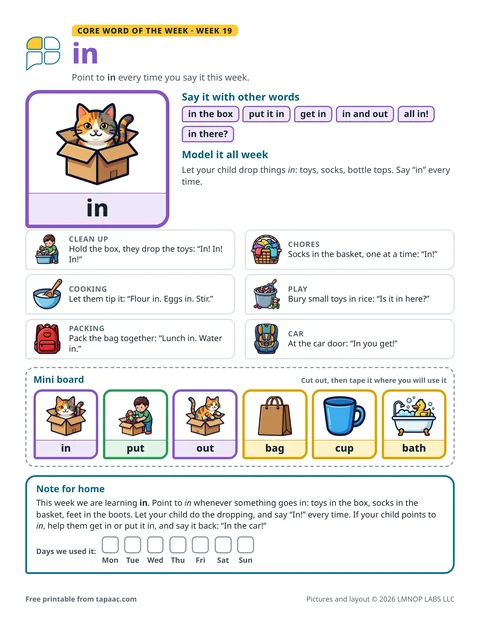 Week 19: inToys in the box, eggs in the bowl: in!
-
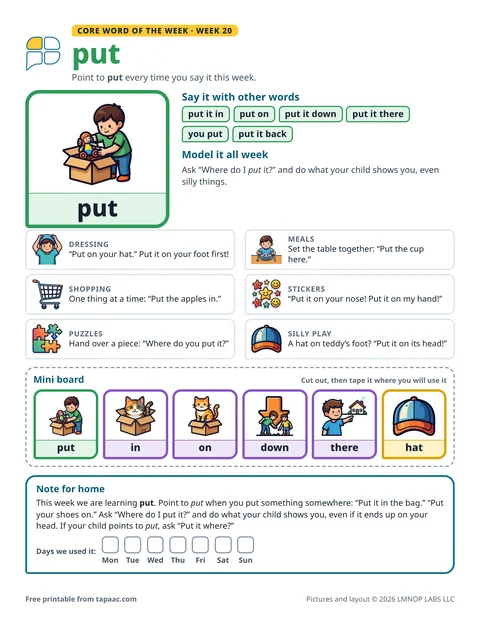 Week 20: putPut it on, put it in, put it down. You’re the boss!
-
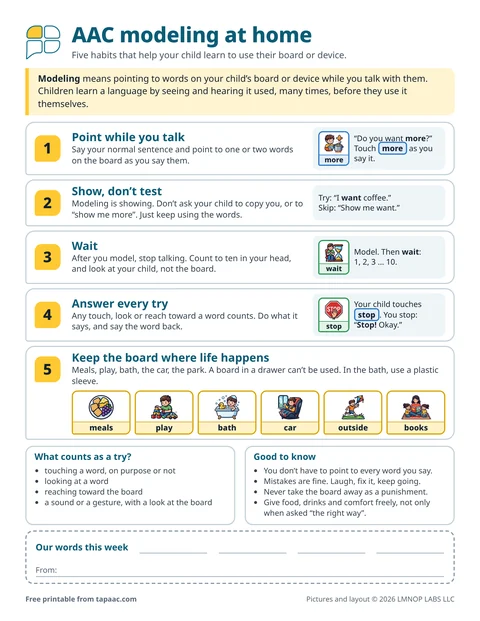 AAC modeling at homeFive habits on one page, to send home or stick on the fridge.
All core word printables and guides
Need a different board? Make your own with the free AAC board maker.
These cards, handouts and plans are general information, not therapy or medical advice, and they don’t replace a speech therapist. A speech therapist who knows the person can help choose the right words and the right way to practice. Everything here is free to print and share; please don’t sell it (terms of use). Questions? Email support@lmnoplabs.fun.