 Tap AAC
Core word “help”: getting through lids, shoes and hard work
Help is how a person asks someone to do something with them: open a lid, find a toy, fix a shoe. It turns “I’m stuck” into a clear message, at home, at school and anywhere else. This week, point to help whenever someone helps, and set up small moments where help is needed.
Download the free printable (PDF) US Letter, 1 page, 433 KB
Printing on A4 paper? Download the A4 PDF (1 page, 433 KB).
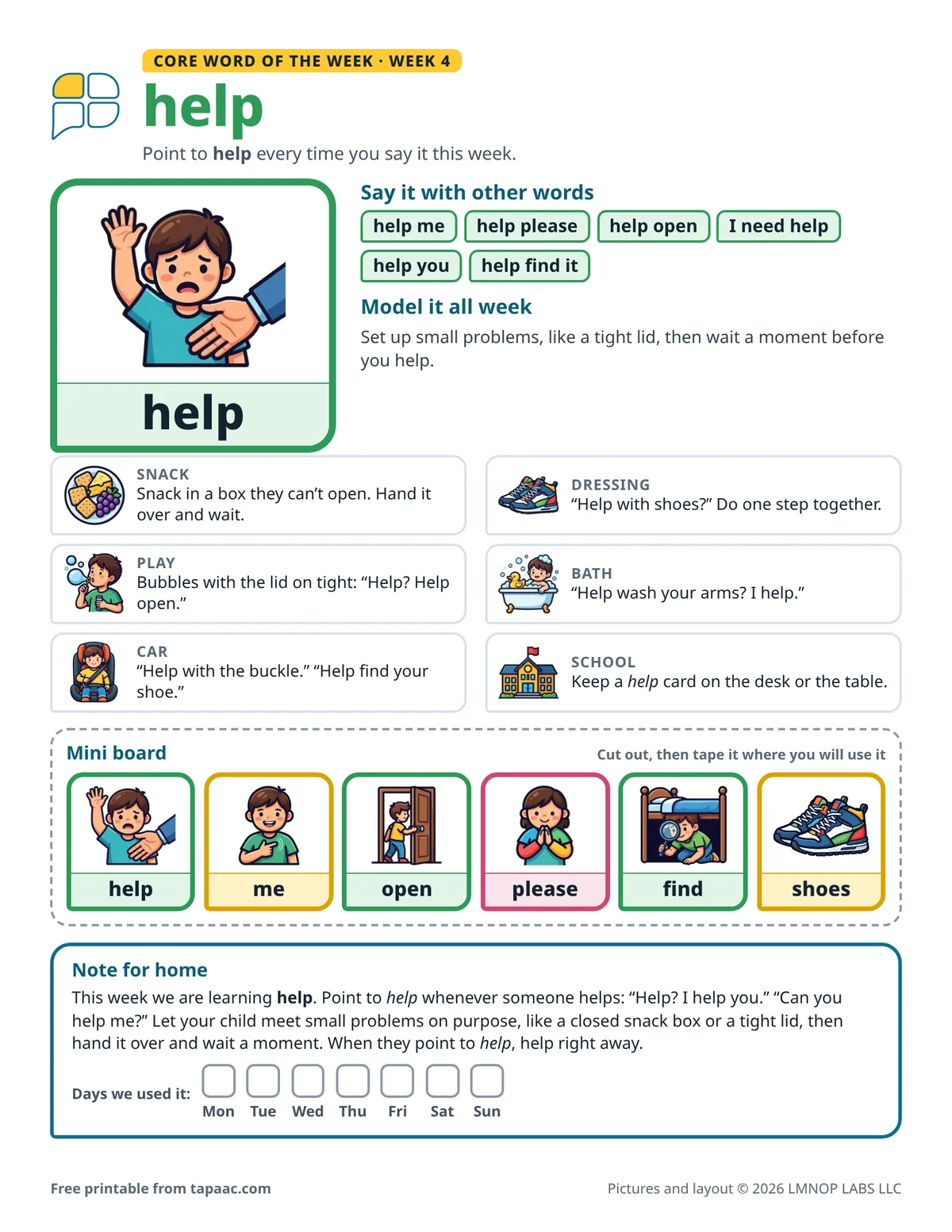
Have Tap AAC? Add to Tap AAC (.obz file, 206 KB) · How to add a board
- Week 4 of 32
- Free
- One page
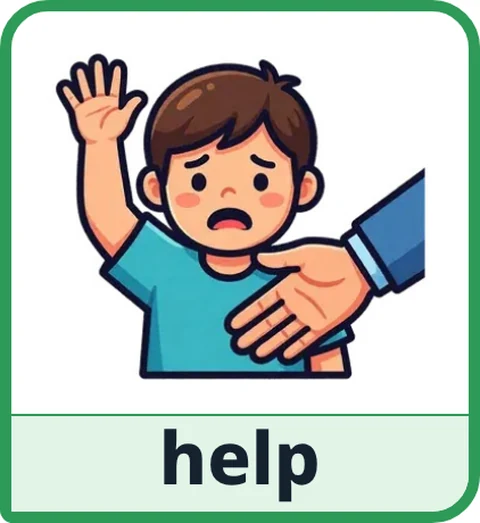
Why help is worth teaching early
Help works in every place and with every person. Used early, it gives the person a way through a hard moment before it turns into a bad one.
Modeling help also shows that asking is normal: adults ask for help too. Later the word grows into help me, help please, I need help and help you.
Small problems on purpose, so there’s a reason for help
At snack
- Put a favorite snack in a box the person can’t open. Hand it over and wait: “Help? Help open.”
- Ask for help yourself when you carry the plates: “Can you help me?”
Getting dressed
- Socks, shoes, zippers: “Help with shoes?” Do one step together, and let them do the rest.
- Get stuck on purpose: “Help! My sleeve is stuck.”
In play
- A wind-up toy that has stopped: hand it back and wait. “Help? Help make it go.”
- Bubbles with the lid on tight, or a puzzle piece that won’t fit: “Help?”
- A toy you “can’t find”: “Help me find it.”
In the bath and the car
- “Help wash your arms? I help.”
- Buckling up: “Help with the buckle.”
At home and at school
- Chores together: “You help me,” putting the shopping away or feeding a pet.
- Keep a help card on the desk at school, and model it when work gets hard: “You can ask for help.”
- Reading together: “Help me turn the page.”
After school, Dad gives Mia her yogurt with the lid still sealed. She pulls at it, then pushes it at him with a frown. He points to help on the card stuck to the table: “Help? You need help.” He waits a moment. Mia looks at the card and touches it. “Help! Okay, I’ll help you open it.” He peels the lid halfway and lets her pull off the rest.
Help me, help open, I need help
Adding who, or what to do, makes a request for help clearer to everyone around.
- help me
- help please
- help open
- I need help
- help you
- help find it
If they ask for help with everything, or get upset before asking
If the person asks for help with everything
Answer it every time: asking is better than giving up. Help a little, not all the way: “I help, you do the last bit.”
If they get upset before they ask
Point to help right away, before you help, so the word becomes the way through: “Help. Let’s fix it.”
Note for home: set up a small problem, then hand it over
This week we are learning help. Point to help whenever someone helps: “Help? I help you.” “Can you help me?” Let your child meet small problems on purpose, like a closed snack box or a tight lid, then hand it over and wait a moment. When they point to help, help right away.
The same note is printed at the bottom of the week’s page, with a box to tick for each day. For families who are new to modeling, send the one-page AAC modeling at home handout with it, and keep using the word cards from earlier weeks.
More core word of the week plans
-
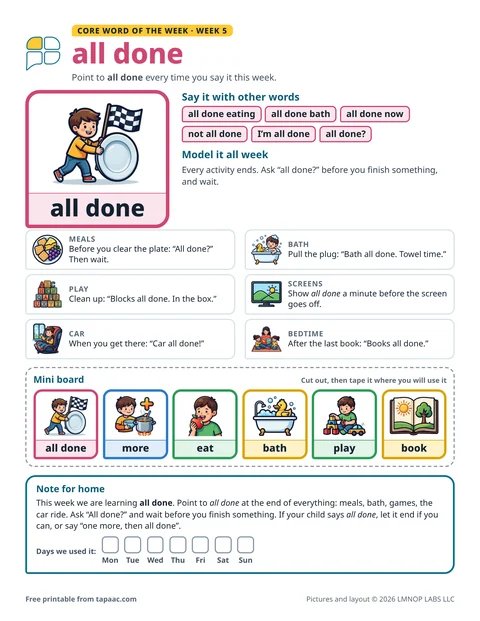 Week 5: all doneA calm way to end meals, baths, games and screen time.
-
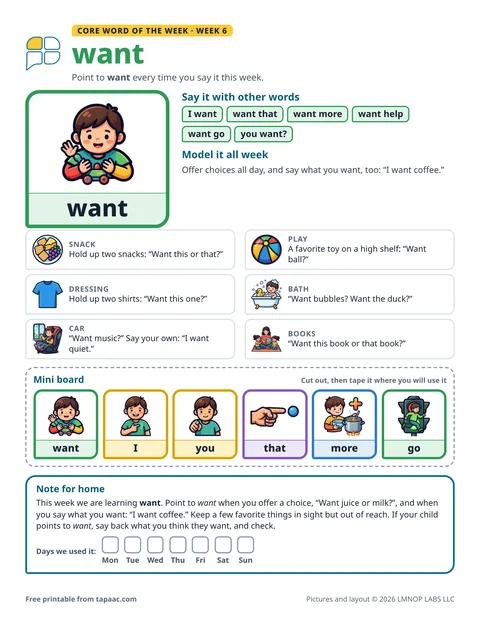 Week 6: wantChoices all day: want this or that? I want...
-
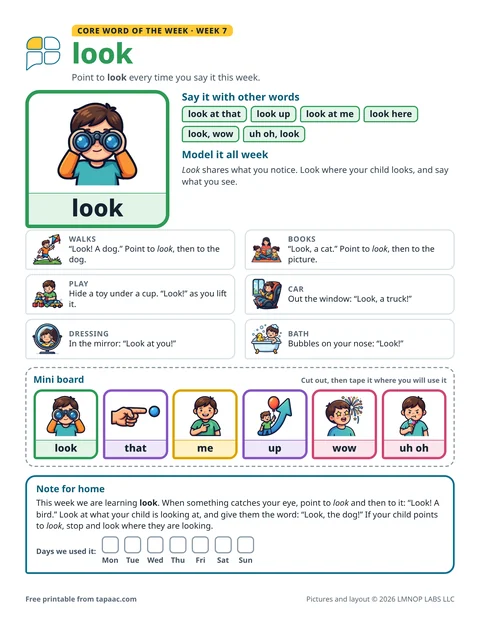 Week 7: lookShare what you notice: look, a dog! Look at me!
-
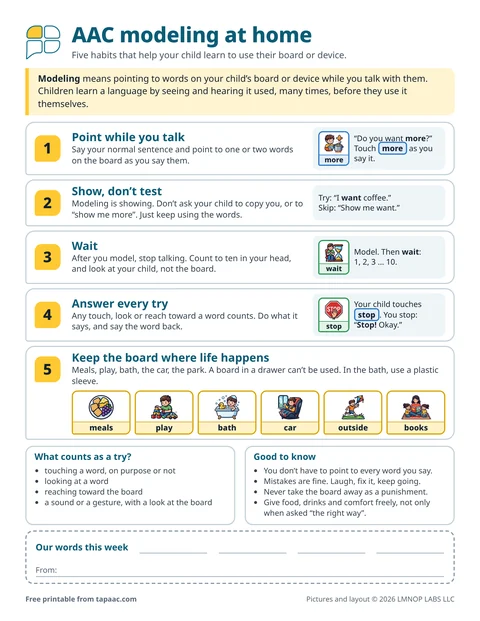 AAC modeling at homeFive habits on one page, to send home or stick on the fridge.
All core word printables and guides
Need a different board? Make your own with the free AAC board maker.
These cards, handouts and plans are general information, not therapy or medical advice, and they don’t replace a speech therapist. A speech therapist who knows the person can help choose the right words and the right way to practice. Everything here is free to print and share; please don’t sell it (terms of use). Questions? Email support@lmnoplabs.fun.