 Tap AAC
Core word “you”: who does what in a turn-taking game
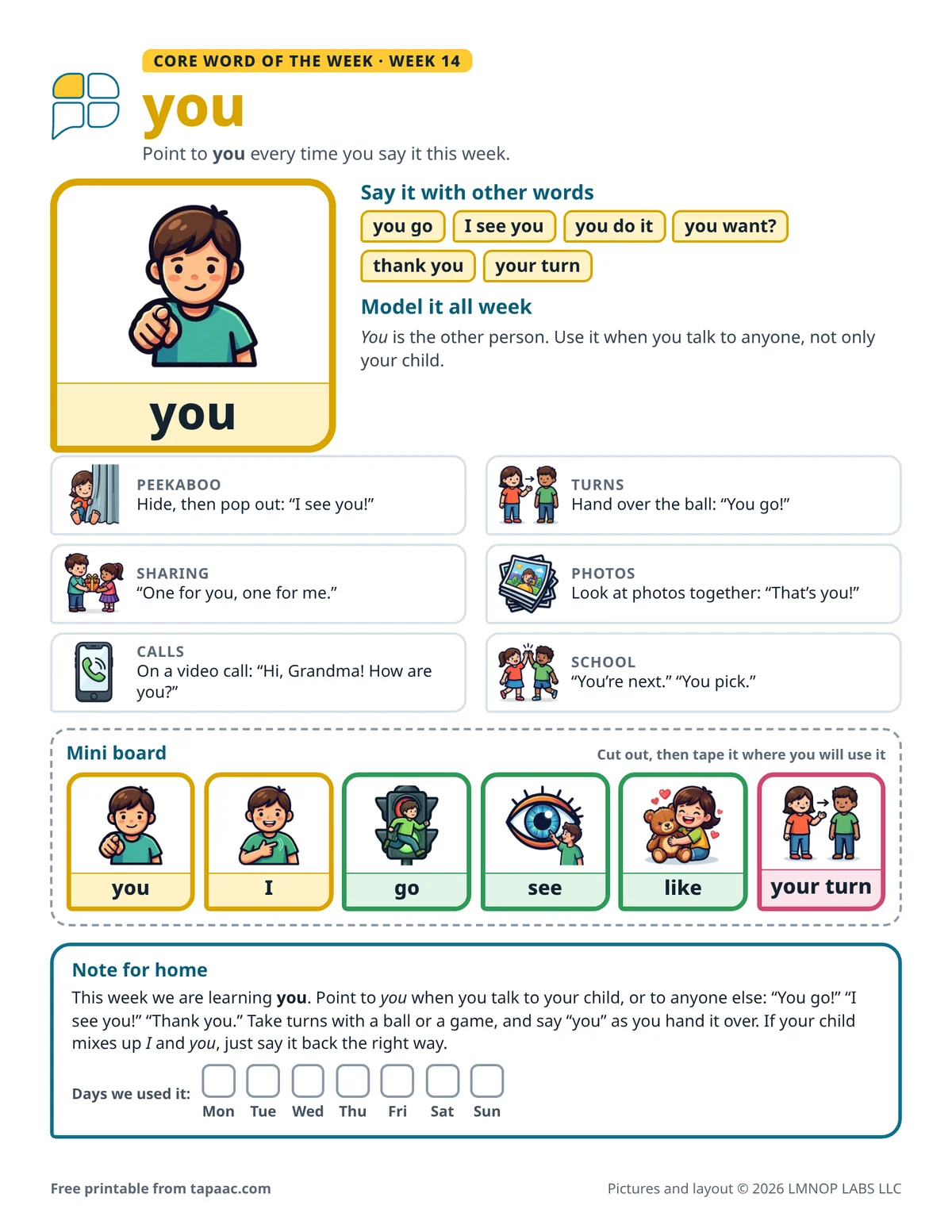
You is the word for the other person: you go, I see you, you do it. It points a message at someone, which turns talking into a back-and-forth. This week, point to you whenever you talk to someone, and use it in turn-taking games.
Download the free printable (PDF) US Letter, 1 page, 441 KB
Printing on A4 paper? Download the A4 PDF (1 page, 441 KB).
Have Tap AAC? Add to Tap AAC (.obz file, 219 KB) · How to add a board
- Week 14 of 32
- Free
- One page

Why you is the partner of I
You is how a message reaches someone else: you go, you help, I see you. With week 11’s I and now you, the person can say who does what, which is the heart of every turn-taking game.
It is a tricky word, because it changes with who is talking: when you say you you mean them, and when they say it they mean you. That is why it helps to see many people use it, with each other as well as with the person.
“I see you”: peekaboo, ball rolls, photos and video calls
Games
- Peekaboo: hide behind a blanket or your hands, then pop out: “I see you!”
- Roll a ball or a car back and forth: “You go!” as you send it, and “I go” when it comes back.
- Hide and seek: “Where are you?” Then, when you find them: “Found you!”
- Chase games: “I’m coming to get you!”, with lots of slow, silly steps.
At meals
- Sharing: “One for you, one for me.”
- Ask before you serve: “You want more?” Point to you, then hold up the bowl.
People and photos
- Look at photos of the person: “That’s you! You at the beach.”
- On a video call, model it for the person on the screen: “Hi, Grandma! How are you?”
Every day
- Say what you see them doing: “You’re jumping! You’re so fast.”
- When they finish something hard: “You did it!”
At school or therapy
- Taking turns at the table: “You’re next.” “You pick.”
- Sing a hello song and point to you for each person in the group.
Rolling a ball in the living room. Theo’s mom holds the ball and points to I: “I go.” She rolls it to him. When it reaches him, she points to you: “You go!” Theo pushes it back, a bit crooked. A few turns later, she keeps hold of the ball and waits, looking at him. Theo reaches over and touches you. She laughs: “Me? You want me to go? Okay!” She rolls it, and he claps.
You go, I see you, your turn
With I from week 11, you lets a game pass back and forth: I go, you go.
- you go
- I see you
- you do it
- you want?
- thank you
- your turn
If you and I get swapped, or you goes unnoticed
If they say you when they mean I
Mixing up I and you happens a lot, because the word changes with who is talking. Don’t correct it. Say it back the right way: “You want it? You want the ball. Here.”
If they don’t notice when you say you
Add their name or a light touch on the arm as you point to you: “Theo! You go.” Handing them something at the same time makes it even clearer.
Note for home: say you as you hand it over
This week we are learning you. Point to you when you talk to your child, or to anyone else: “You go!” “I see you!” “Thank you.” Take turns with a ball or a game, and say “you” as you hand it over. If your child mixes up I and you, just say it back the right way.
The same note is printed at the bottom of the week’s page, with a box to tick for each day. For families who are new to modeling, send the one-page AAC modeling at home handout with it, and keep using the word cards from earlier weeks.
More core word of the week plans
-
 Week 15: againKeep the fun going: again! And try again.
-
 Week 16: whatAsk questions: what’s that? What’s in there?
-
 Week 17: whereHide and seek, lost shoes and outings: where is it?
-
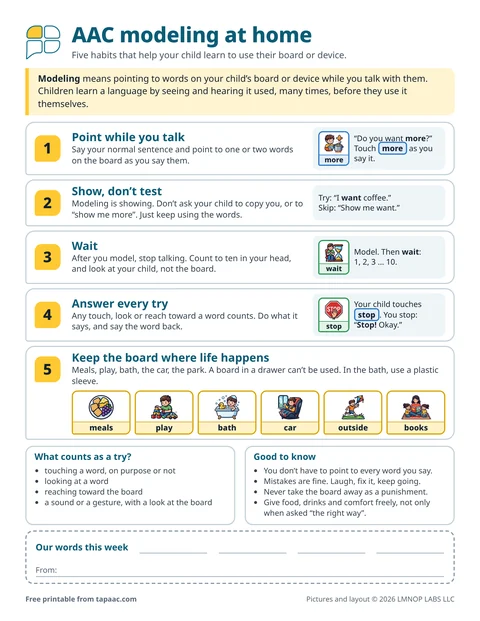 AAC modeling at homeFive habits on one page, to send home or stick on the fridge.
All core word printables and guides
Need a different board? Make your own with the free AAC board maker.
These cards, handouts and plans are general information, not therapy or medical advice, and they don’t replace a speech therapist. A speech therapist who knows the person can help choose the right words and the right way to practice. Everything here is free to print and share; please don’t sell it (terms of use). Questions? Email support@lmnoplabs.fun.