 Tap AAC
Core word “make”: creating things and making things happen
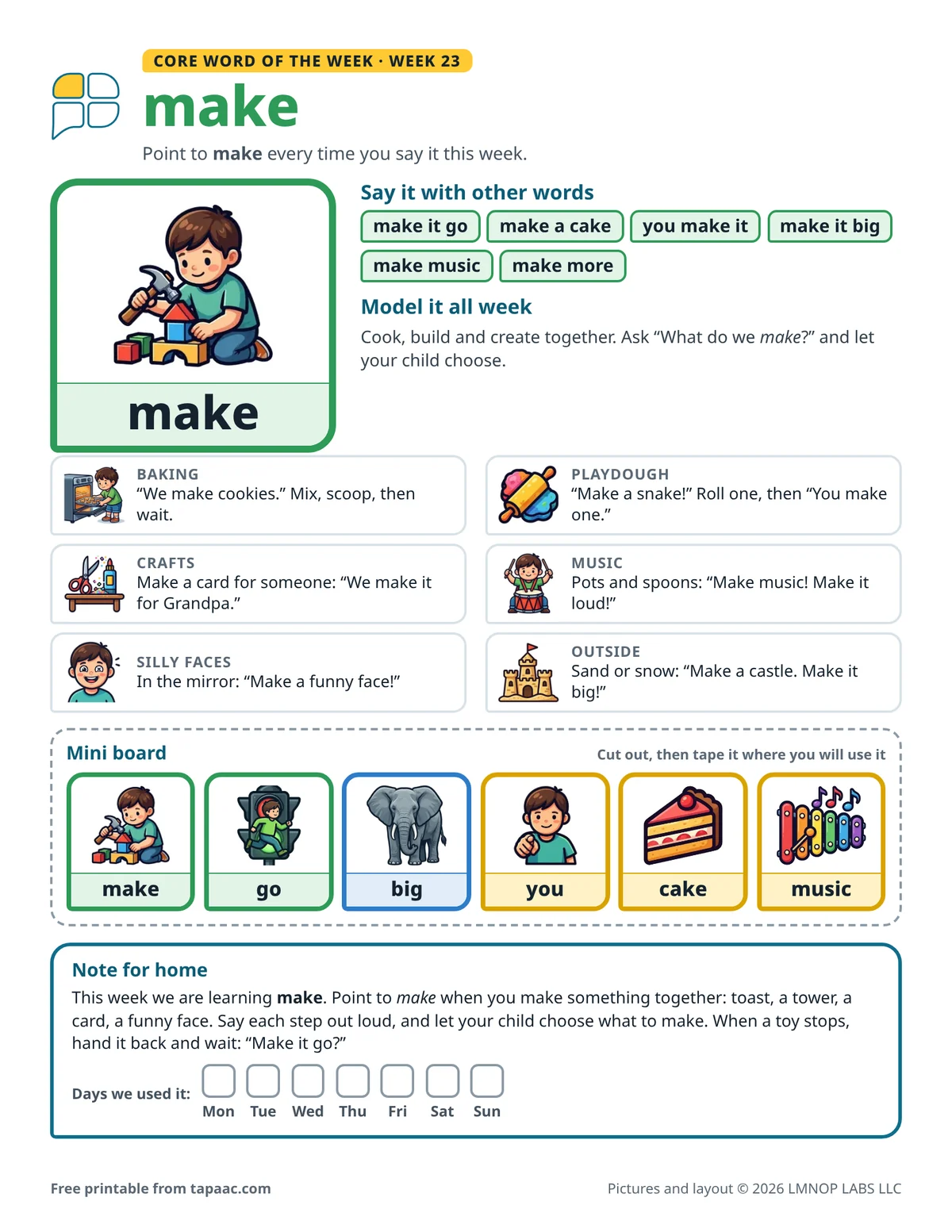
Make is the word for creating, and for causing things: make a cake, make a tower, make it go, make a funny face. It gives a person a way to start a project and to steer it. This week, point to make whenever you make something together, and let the person decide what happens next.
Download the free printable (PDF) US Letter, 1 page, 424 KB
Printing on A4 paper? Download the A4 PDF (1 page, 424 KB).
Have Tap AAC? Add to Tap AAC (.obz file, 207 KB) · How to add a board
- Week 23 of 32
- Free
- One page
Two jobs for make
Make has two big jobs. It names creating something, like a picture, a sandwich or a sandcastle, and it asks for something to happen: make it go, make it stop. People of every age want to say both.
It joins with earlier words to build longer messages: make it go (week 2), make it big (week 21), make more, you make. And because projects take several steps, there is a lot to talk about along the way.
Pancakes, playdough and pot drums: things to make together
Cooking
- Make something simple together, like toast, a smoothie or pancakes, and name each step: “We make pancakes. Mix, pour, flip!”
- Let the person choose: “Make a sandwich, or make toast?”
Crafts and playdough
- Playdough: “Make a snake!” Roll a long one, then hand over the dough: “You make one.”
- Make a card for someone the person knows: “We make it for Grandpa.” Let them choose the stickers.
- Paint or draw together, and ask what to add next: “Make a sun? Make a dog?”
Toys and building
- When a wind-up toy or a spinning top stops, hand it back and wait: “Make it go?”
- Blocks, bricks or sofa cushions: “Let’s make a house!”
Music and noise
- Pots and wooden spoons: “Make music! Make it loud!” Then whisper: “Make it quiet.”
Silly moments
- In the mirror: “Make a funny face!” Make one yourself first, the sillier the better.
At home
- Chores with a game in them: “Make the bed!” Pull the covers up together in one big swoosh.
Outside and at school
- Sand, snow or mud: “Make a castle!” “Make a snowman!”
- Mix two colors of paint and ask first: “What will it make?” Then see together.
Diego, who is 16, is in a cooking class at school with his teaching assistant. Today it’s pancakes. She points to make on the kitchen board: “We make pancakes. What do we need?” They gather flour, eggs and milk, and Diego works the whisk. When the first pancake lands on the plate, she asks, “Make more?” and waits. Diego looks at the bowl, then taps make and more. “Make more! You’re the chef.” He pours the next one himself.
Make it go, make a cake, make it big
Make it go brings back week 2, and make it big week 21: old words, new messages.
- make it go
- make a cake
- you make it
- make it big
- make music
- make more
If you don’t know what to make, or the result isn’t much to look at
If they say make but you don’t know what to make
Offer two choices with pictures or real things: “Make a tower, or make a card?” Or start something simple and let them change it.
If the result doesn’t look like much
It doesn’t need to. The making is the talking: every step, every color and every “oops” is a chance to model make and the words around it.
Note for home: say each step, and let them choose what to make
This week we are learning make. Point to make when you make something together: toast, a tower, a card, a funny face. Say each step out loud, and let your child choose what to make. When a toy stops, hand it back and wait: “Make it go?”
The same note is printed at the bottom of the week’s page, with a box to tick for each day. For families who are new to modeling, send the one-page AAC modeling at home handout with it, and keep using the word cards from earlier weeks.
More core word of the week plans
-
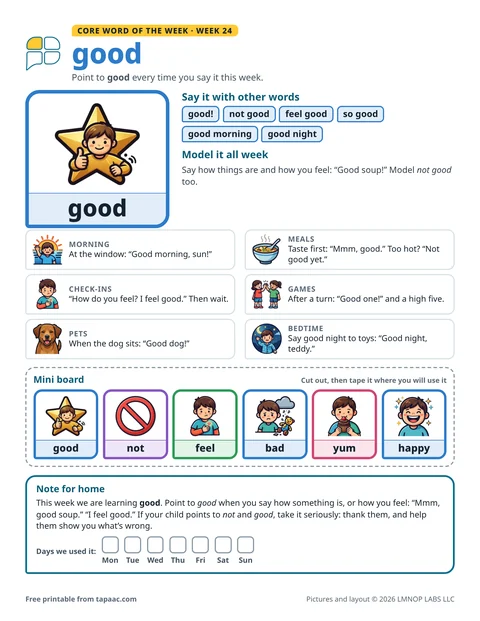 Week 24: goodHow things are, and how you feel: good, not good.
-
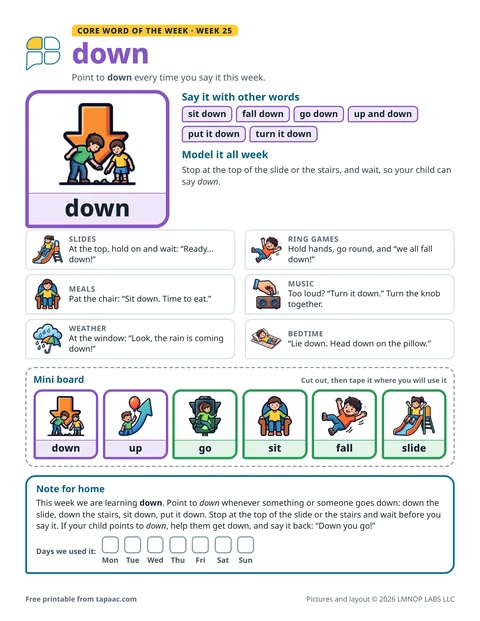 Week 25: downSlides, stairs and “we all fall down”: the partner of up.
-
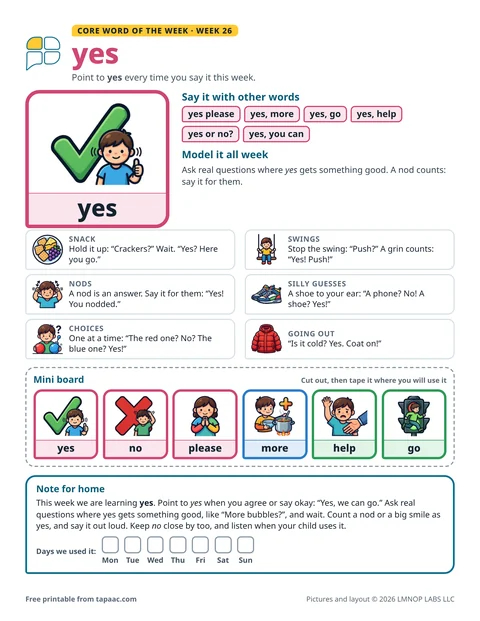 Week 26: yesAgree, accept and answer: yes please, yes more.
-
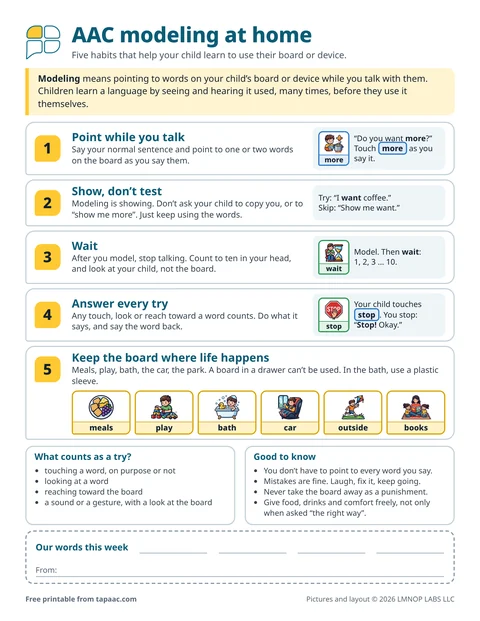 AAC modeling at homeFive habits on one page, to send home or stick on the fridge.
All core word printables and guides
Need a different board? Make your own with the free AAC board maker.
These cards, handouts and plans are general information, not therapy or medical advice, and they don’t replace a speech therapist. A speech therapist who knows the person can help choose the right words and the right way to practice. Everything here is free to print and share; please don’t sell it (terms of use). Questions? Email support@lmnoplabs.fun.