 Tap AAC
Core word “in”: a little word that’s easy to show
In says where something is, or where it goes: in the box, in the bag, get in. It is a little word that comes up all day, in tidying, cooking, dressing and getting about. This week, point to in whenever something goes in, and let the person do the dropping.
Download the free printable (PDF) US Letter, 1 page, 391 KB
Printing on A4 paper? Download the A4 PDF (1 page, 391 KB).
Have Tap AAC? Add to Tap AAC (.obz file, 179 KB) · How to add a board
- Week 19 of 32
- Free
- One page
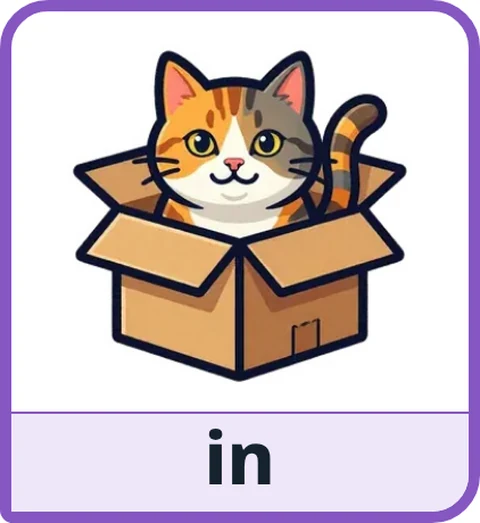
Why in is hard to draw but easy to show
Little words like in are hard to draw but easy to show: drop a block in a tin, and the word means something at once. Every drop is a chance to say it, and a clink or a splash makes it fun to hear again.
In answers week 17’s question: where’s the ball? In the box. It also joins words the person already knows: go in, look in, not in. Next week’s put is its partner: put it in.
Clean-up, posting tins and mixing bowls: everything goes in
Tidying and chores
- At clean-up time, hold the box and let the person drop each toy in: “In! In! In the box.”
- Laundry: socks in the basket, clothes in the machine. Say “in” for every one.
- Unpacking the shopping: “Milk in the fridge. Apples in the bowl.”
Play
- A posting game: cut a slot in the lid of a box or a tin, and post cards, coins or bottle tops through it: “In!”
- Bury small toys in a tub of rice or dried beans, then dig for them: “Is it in here?”
- Make a laundry basket the goal for a soft ball: “In! It went in!”
Cooking
- Let the person tip each thing into the bowl: “Flour in. Eggs in. Now stir.”
Getting ready
- Pack a bag together: “Lunch in. Water in. Zip it up.”
- Arms in the sleeves, feet in the boots: “Arm in! Foot in!”
The bath and the car
- Drop bath toys into the water one by one: “In! Splash!”
- At the car door: “In you get!” Then “In your seat.”
At school or therapy
- Sorting games: “Red ones in here, blue ones in there.”
Grandpa sits on the floor with Eli, who is 3, and an old coffee tin with a slot cut in the lid. He holds up a bottle top, points to in on the card taped to the tin and pushes it through: “In!” Clink. He does it twice more, then hands Eli a bottle top. Eli pushes it in. “In! You did it.” After a few turns, Grandpa holds the next bottle top just out of reach and waits. Eli looks at the card and touches in. “In? Here you go.” Clink.
Put it in, get in, in and out
In pairs with action words, and with its opposite, out, on the mini board.
- in the box
- put it in
- get in
- in and out
- all in!
- in there?
If they only tip things out, or you can’t tell what in means
If they only want to tip things out
Take turns: you say “in” as things go in, and they tip them out. Tipping out is half the game, and out is a good word to model too.
If they point to in and you aren’t sure what they mean
Look at where you are. By the car door it may mean “get in”; by the toy box, “put it in”. Say your best guess and check: “In? You want to get in the car?”
Note for home: let your child do the dropping
This week we are learning in. Point to in whenever something goes in: toys in the box, socks in the basket, feet in the boots. Let your child do the dropping, and say “In!” every time. If your child points to in, help them get in or put it in, and say it back: “In the car!”
The same note is printed at the bottom of the week’s page, with a box to tick for each day. For families who are new to modeling, send the one-page AAC modeling at home handout with it, and keep using the word cards from earlier weeks.
More core word of the week plans
-
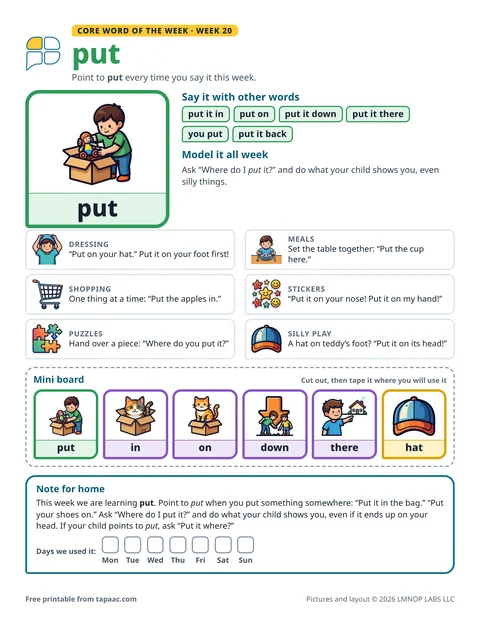 Week 20: putPut it on, put it in, put it down. You’re the boss!
-
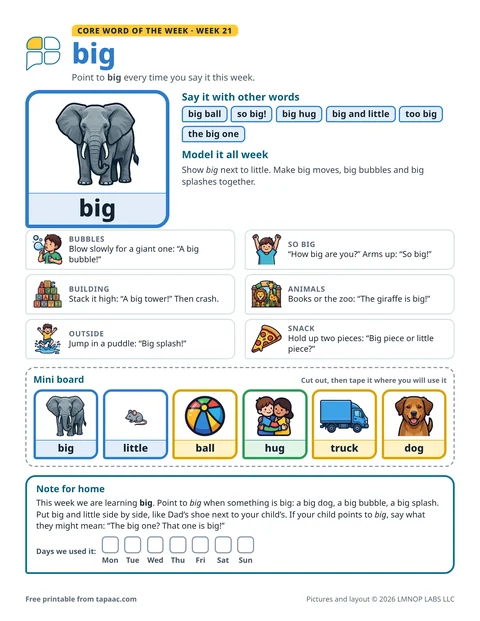 Week 21: bigBig bubbles, big towers, big hugs: so big!
-
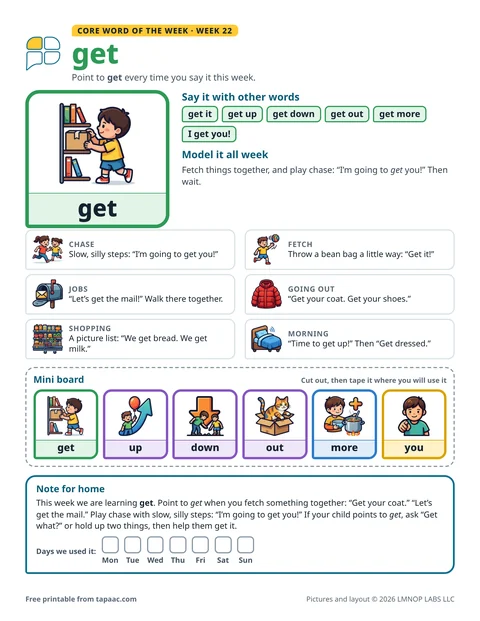 Week 22: getGet it, get up, get down, and I’m going to get you!
-
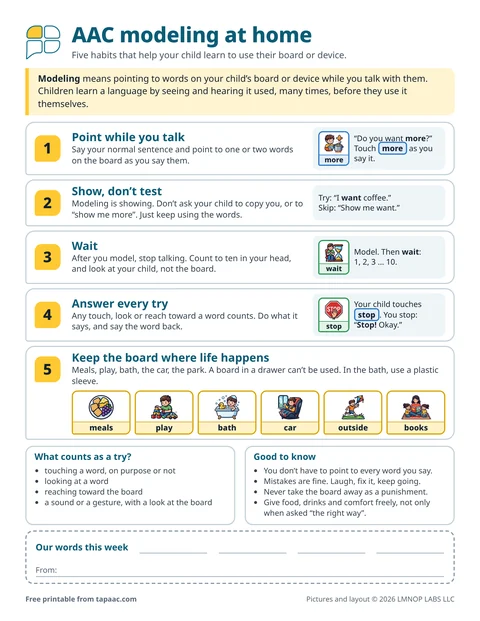 AAC modeling at homeFive habits on one page, to send home or stick on the fridge.
All core word printables and guides
Need a different board? Make your own with the free AAC board maker.
These cards, handouts and plans are general information, not therapy or medical advice, and they don’t replace a speech therapist. A speech therapist who knows the person can help choose the right words and the right way to practice. Everything here is free to print and share; please don’t sell it (terms of use). Questions? Email support@lmnoplabs.fun.