 Tap AAC
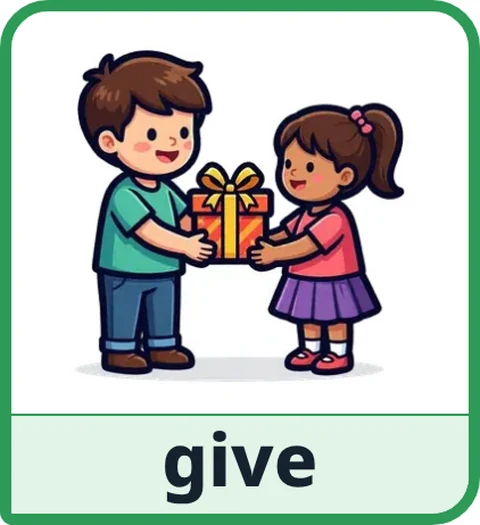
Core word “give”: two people, one word
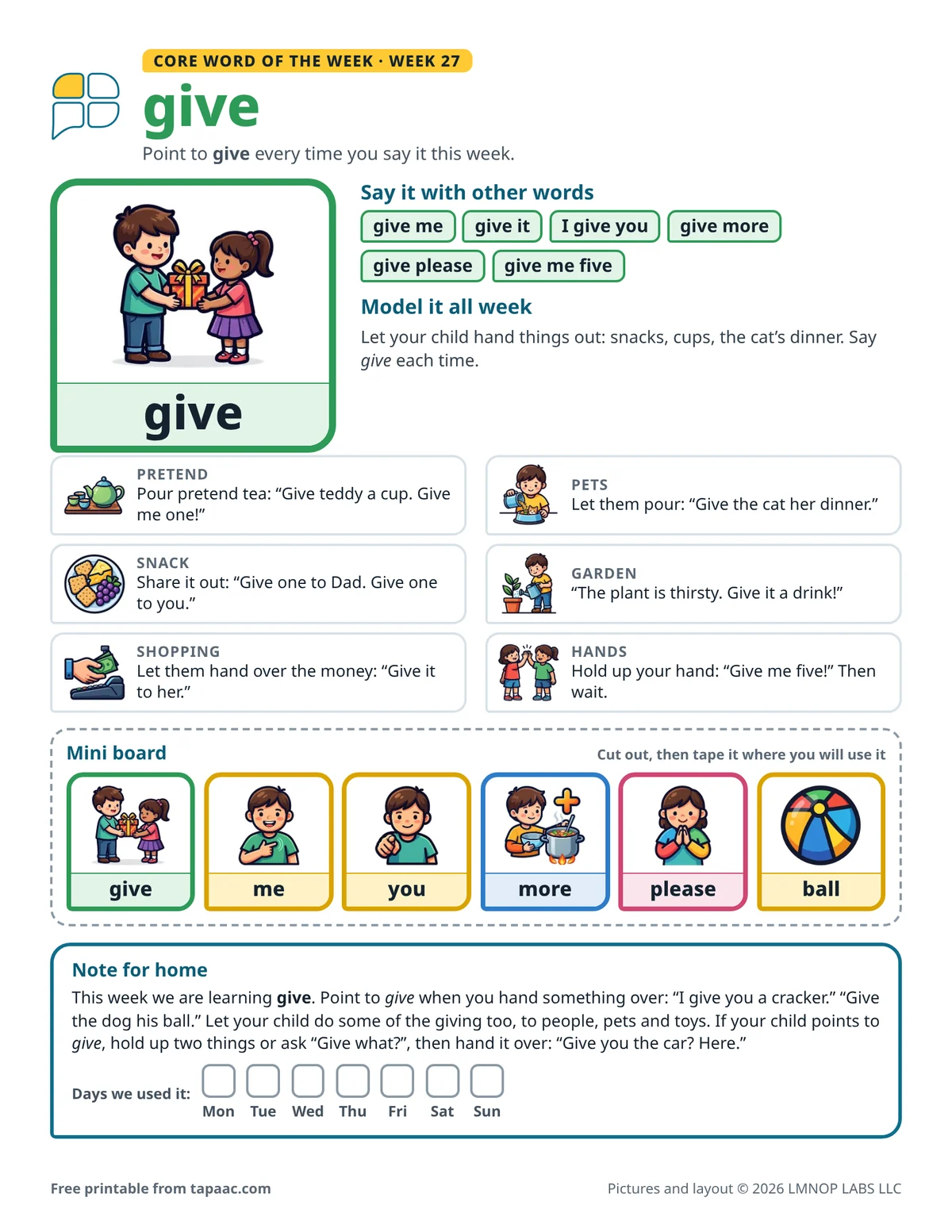
Give is for passing something from one person to another: give me, give you, give it to Dad. It turns a reach or a grab into a clear request, and it lets the person be the one who hands things out. This week, point to give every time something changes hands, and let the person do some of the giving.
Download the free printable (PDF) US Letter, 1 page, 427 KB
Printing on A4 paper? Download the A4 PDF (1 page, 426 KB).
Have Tap AAC? Add to Tap AAC (.obz file, 211 KB) · How to add a board
- Week 27 of 32
- Free
- One page
Why give follows I and you
Give always takes two people, so it fits well after the people words of weeks 11 and 14: give me, I give you. A person who can say give me doesn’t have to grab, and a person who can say give you gets to share.
It is also a word for taking part. Handing out snacks, paying at the store and feeding the cat are real jobs, and every one is practice. With week 1’s more and last week’s yes it makes quick back-and-forth talk: “Give more?” “Yes!”
Snack helpers, tea parties and presents: things to give
Snack and meals
- Let the person share out a snack: “Give one to Dad. Give one to Grandma. Give one to you!”
- Hold the cup just out of reach and wait. If they reach, say it for them: “Give me? Here you go.”
Play
- A pretend tea party: “Give teddy a cup. Give me one too!” Then slurp it, loudly.
- Pass a ball or a beanbag back and forth: “I give it to you. You give it to me.”
- Swapping games: a few toys in a basket, and take turns trading: “Give me the car? I give you the duck.”
Pets and plants
- Feed the pet together, and let the person pour: “Give the cat her dinner.”
- Water the plants: “The plant is thirsty. Give it a drink!”
Out and about
- At the store or the café, let the person hand over the money or the card: “Give it to the lady. Thank you!”
Birthdays and visits
- Wrap a present together and practice handing it over: “We give it to Sam. Happy birthday!”
- Gifts don’t have to be bought: a drawing, a flower, a cookie. “Let’s give Grandpa your picture.”
Greetings
- Hold up your hand: “Give me five!” Wait for the slap, then: “Up high! Down low!”
At school or therapy
- Make the person the class helper who gives out the cups or the crayons: “Give one to Lee. Give one to Rosa.”
Felix, who is 6, is the snack helper in his class today. His teacher puts the basket of apple slices in front of him and points to give on the class board: “Give one to Lee.” She helps his hand to Lee’s plate. “You give! Thank you.” At the next plate she points to give and waits, and Felix drops a slice in front of Rosa by himself. When every plate is full, the teacher holds the basket out to him and waits. Felix taps give and me. “Give me? Of course. Here’s yours.”
Give me, I give you, give me five
Who gives to whom changes the message, so model both give me and I give you.
- give me
- give it
- I give you
- give more
- give please
- give me five
If give turns into grabbing, or they don’t want to give
If give turns into grabbing
Hold on gently for a second, point to give, and say it for them: “Give me?” Then let go straight away. The word gets the thing faster than pulling does.
If they don’t want to give something away
That’s fair: some things are theirs. Say it for them, “Not give. That’s yours,” and use things that come back, like a ball, or that there are plenty of, like crackers, for giving games.
Note for home: let your child do some of the giving
This week we are learning give. Point to give when you hand something over: “I give you a cracker.” “Give the dog his ball.” Let your child do some of the giving too, to people, pets and toys. If your child points to give, hold up two things or ask “Give what?”, then hand it over: “Give you the car? Here.”
The same note is printed at the bottom of the week’s page, with a box to tick for each day. For families who are new to modeling, send the one-page AAC modeling at home handout with it, and keep using the word cards from earlier weeks.
More core word of the week plans
-
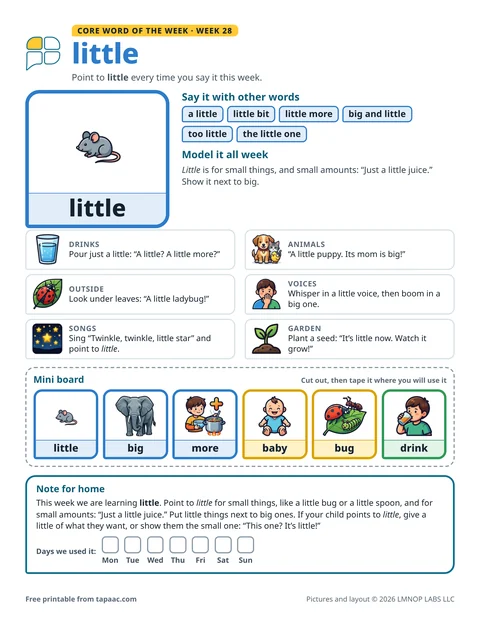 Week 28: littleSmall things and small amounts: a little bit more.
-
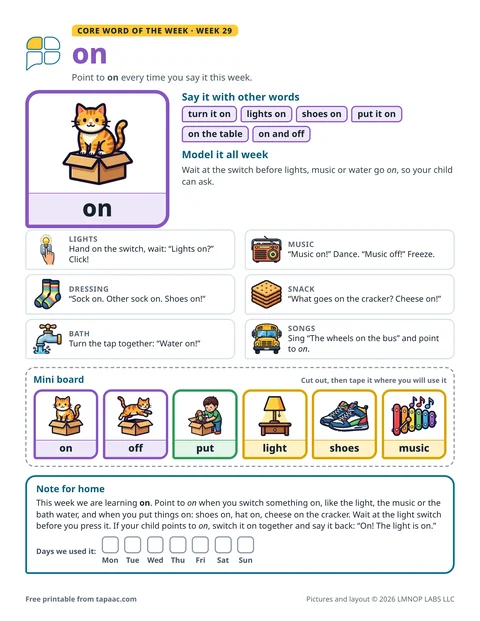 Week 29: onLights on, music on, shoes on: switch it on!
-
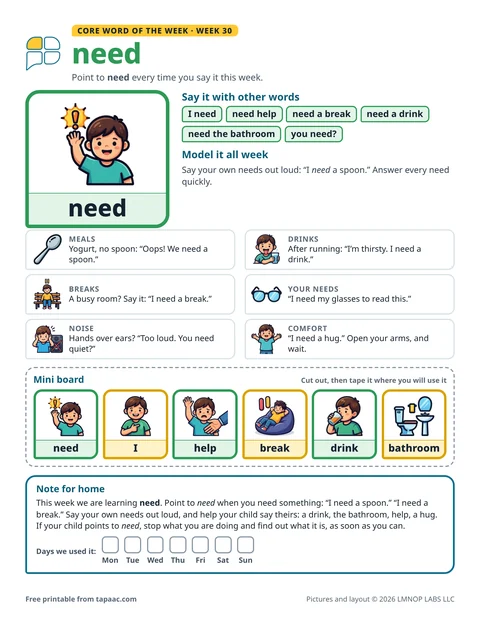 Week 30: needThings that can’t wait: I need help, I need a break.
-
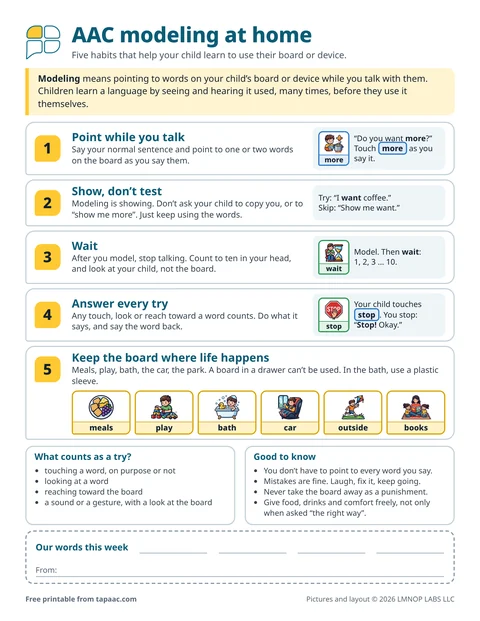 AAC modeling at homeFive habits on one page, to send home or stick on the fridge.
All core word printables and guides
Need a different board? Make your own with the free AAC board maker.
These cards, handouts and plans are general information, not therapy or medical advice, and they don’t replace a speech therapist. A speech therapist who knows the person can help choose the right words and the right way to practice. Everything here is free to print and share; please don’t sell it (terms of use). Questions? Email support@lmnoplabs.fun.