 Tap AAC
Core word “we”: from “you play” to “we play”
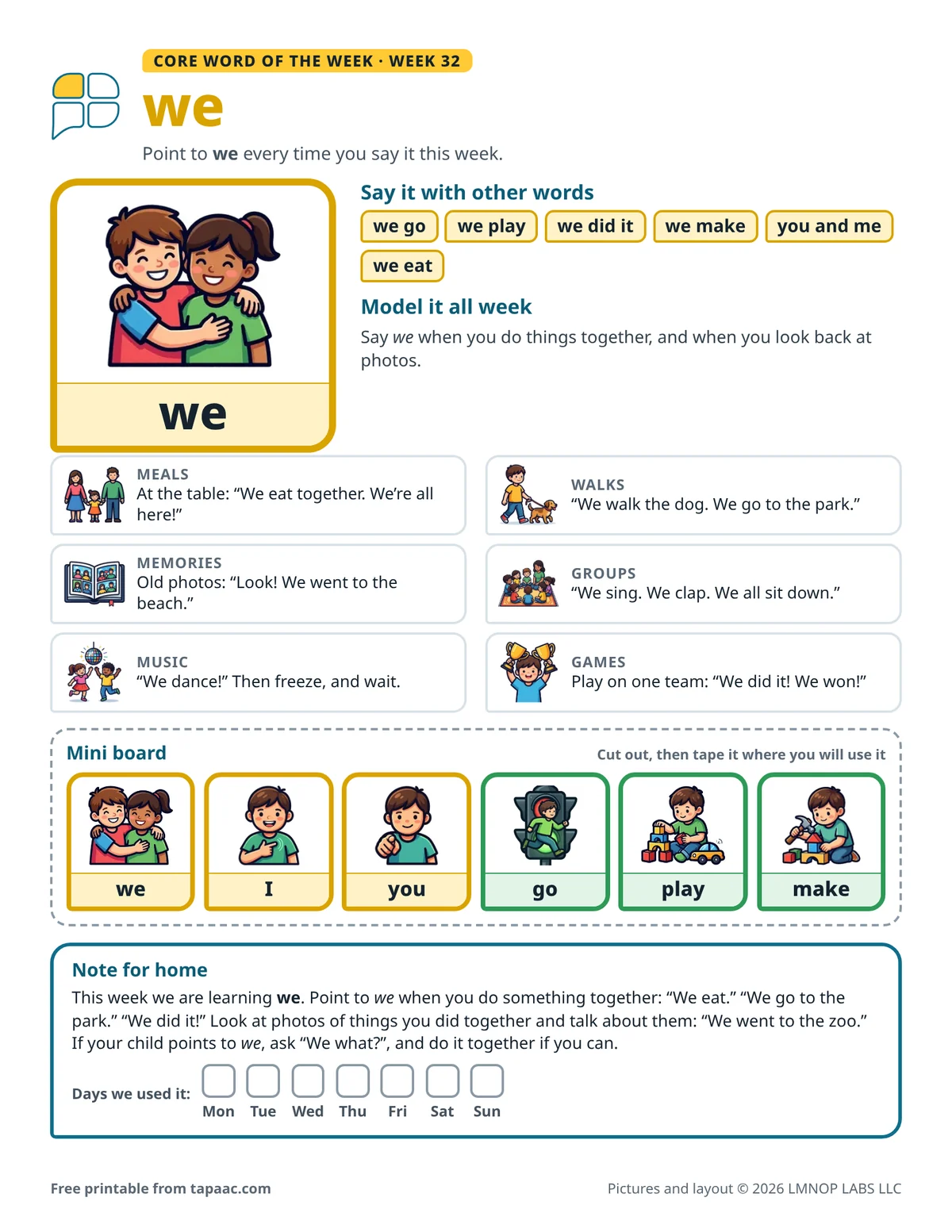
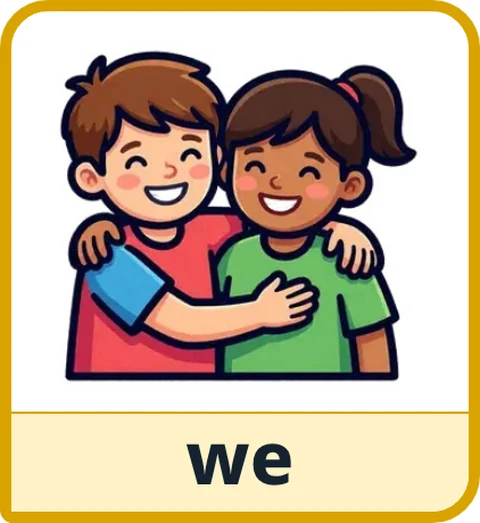
We means me and someone else, together: we go, we play, we did it. It lets a person talk about doing things with other people, and about things that happened to all of you. This week, point to we whenever you do something together, and look back at shared moments in photos.
Download the free printable (PDF) US Letter, 1 page, 432 KB
Printing on A4 paper? Download the A4 PDF (1 page, 431 KB).
Have Tap AAC? Add to Tap AAC (.obz file, 209 KB) · How to add a board
- Week 32 of 32
- Free
- One page
Why we turns an order into an invitation
I (week 11) and you (week 14) are one person each. We puts them together, and it turns an order into an invitation: not “you play” but “we play”. It joins the action words of earlier weeks: we go, we make, we eat.
It also opens up the past. “We went to the beach,” “we saw a dog”: with a photo to point at, a person can share a memory, one of the best things there is to talk about. It closes these 32 weeks because it is a word for doing things together, and so is modeling.
We at family meals, on trips, in photos and in team games
Meals
- Gather everyone at the table and say it as you sit: “We eat. We’re all here.”
- Plan dinner out loud: “What do we want tonight? We make pasta!”
Out and about
- Before you leave, point to we, then to the person and to yourself: “We go to the park. We walk the dog.”
- In the car or on the bus: “We’re going to Grandma’s house.”
Photos and memories
- Look through photos on a phone or in an album: “Look! We went to the beach. We had ice cream.”
- At bedtime, look back over the day: “Today we went to the store, and we made cookies.”
Games and music
- Play on the same team, against a grown-up or a timer: “We did it! We won!”
- Dance together, then freeze: “We dance... we stop!” Wait for the person to start the music again.
Chores
- Carry a heavy basket between you: “We lift. We carry. We did it!”
With brothers, sisters and friends
- Talk to the whole group: “We share the blocks. We take turns.” Point to we and then to each child.
At school or therapy
- At circle time: “We sing. We clap. We all sit down.”
- At the end of a session, sum it up together: “We played, we read a book, and we laughed.”
After a family trip to the lake, Luca, who is 15, sits on the couch with his older sister and her phone full of photos. She swipes to a picture of the two of them in a canoe and points to we on his board: “We went in the canoe! We got so wet.” Luca grins. She swipes again and waits. Luca taps we and go, and points at the lake in the picture. “We go again? Yes! Next summer.” At dinner, he finds the canoe photo for Dad and taps we.
We go, we did it, you and me
We did it! is worth saying after every shared win, big or small.
- we go
- we play
- we did it
- we make
- you and me
- we eat
If adults say we but mean you, or they want to do it alone
When adults say we but mean you
“We put our shoes on now” often means “you do it”. Try to keep we for things you really do together, and point to each person as you say it. Then the word means what the picture shows.
If they want to do it on their own
Respect that, and switch words: “Okay, you do it. I watch.” Doing it alone is a fine message too, and I and you are right there on the mini board.
Note for home: look at photos together and talk about what we did
This week we are learning we. Point to we when you do something together: “We eat.” “We go to the park.” “We did it!” Look at photos of things you did together and talk about them: “We went to the zoo.” If your child points to we, ask “We what?”, and do it together if you can.
The same note is printed at the bottom of the week’s page, with a box to tick for each day. For families who are new to modeling, send the one-page AAC modeling at home handout with it, and keep using the word cards from earlier weeks.
More core word of the week plans
-
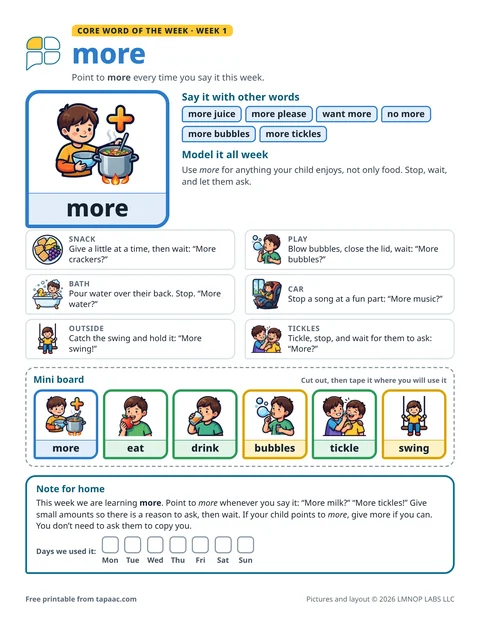 Week 1: moreAsk for more of anything fun: snacks, bubbles, tickles, songs.
-
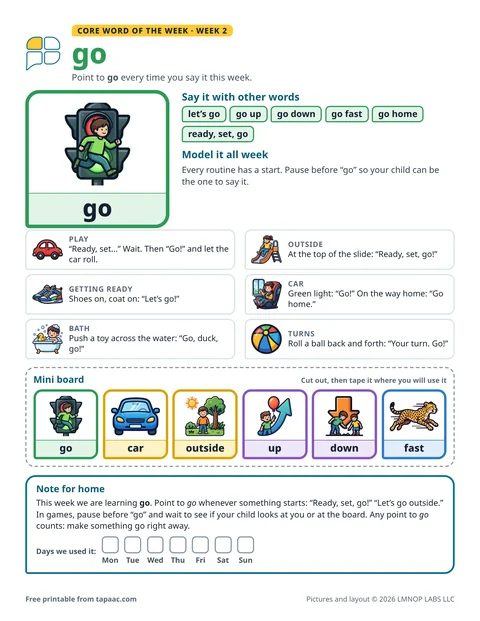 Week 2: goStart the fun: ready, set, go! Cars, slides and walks.
-
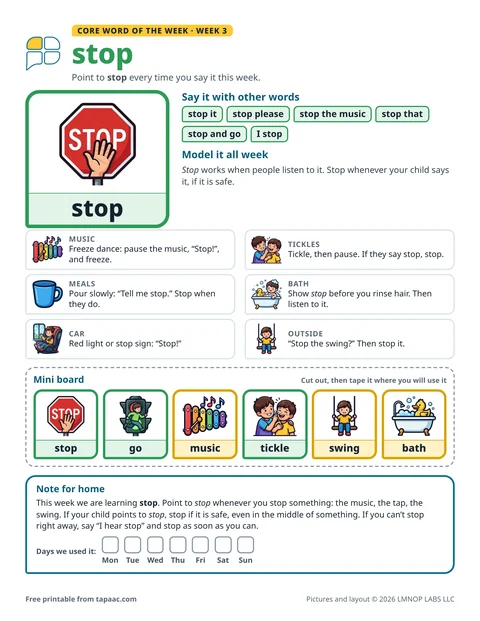 Week 3: stopEnd what isn’t wanted, or freeze a game, and be listened to.
-
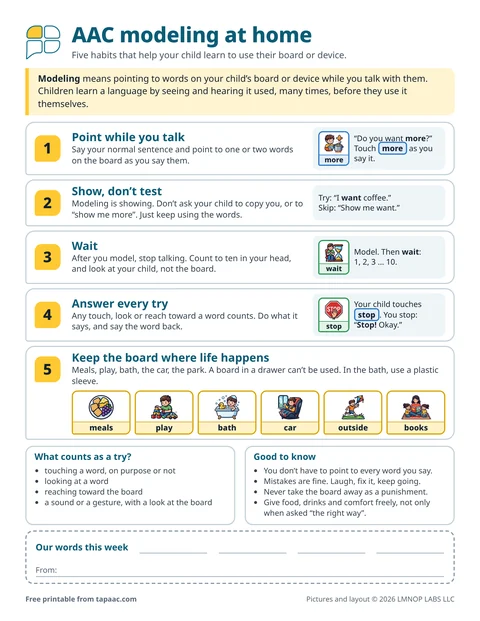 AAC modeling at homeFive habits on one page, to send home or stick on the fridge.
All core word printables and guides
Need a different board? Make your own with the free AAC board maker.
These cards, handouts and plans are general information, not therapy or medical advice, and they don’t replace a speech therapist. A speech therapist who knows the person can help choose the right words and the right way to practice. Everything here is free to print and share; please don’t sell it (terms of use). Questions? Email support@lmnoplabs.fun.