 Tap AAC
Core word “go”: ready, set, go, and out of the door
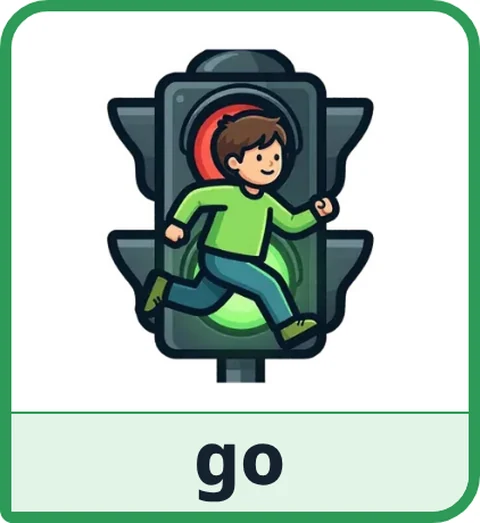
Go starts things: go outside, go down the slide, ready, set, go! It lets the person make something happen, and later say where they want to be. This week, point to go whenever something starts moving, and give the person the chance to be the one who says it.
Download the free printable (PDF) US Letter, 1 page, 421 KB
Printing on A4 paper? Download the A4 PDF (1 page, 421 KB).
Have Tap AAC? Add to Tap AAC (.obz file, 206 KB) · How to add a board
- Week 2 of 32
- Free
- One page
Why go hands the start of the fun to the person
Every routine has a start, so go fits all day: cars, slides, bath toys, walks, getting out of the door. In a game, waiting for “go” puts the person in charge of when the fun starts.
Go joins easily with other words: let’s go, go up, go fast, go home. Next week’s word, stop, is its partner.
Ramps, slides, races and the front door: moments for go
In play
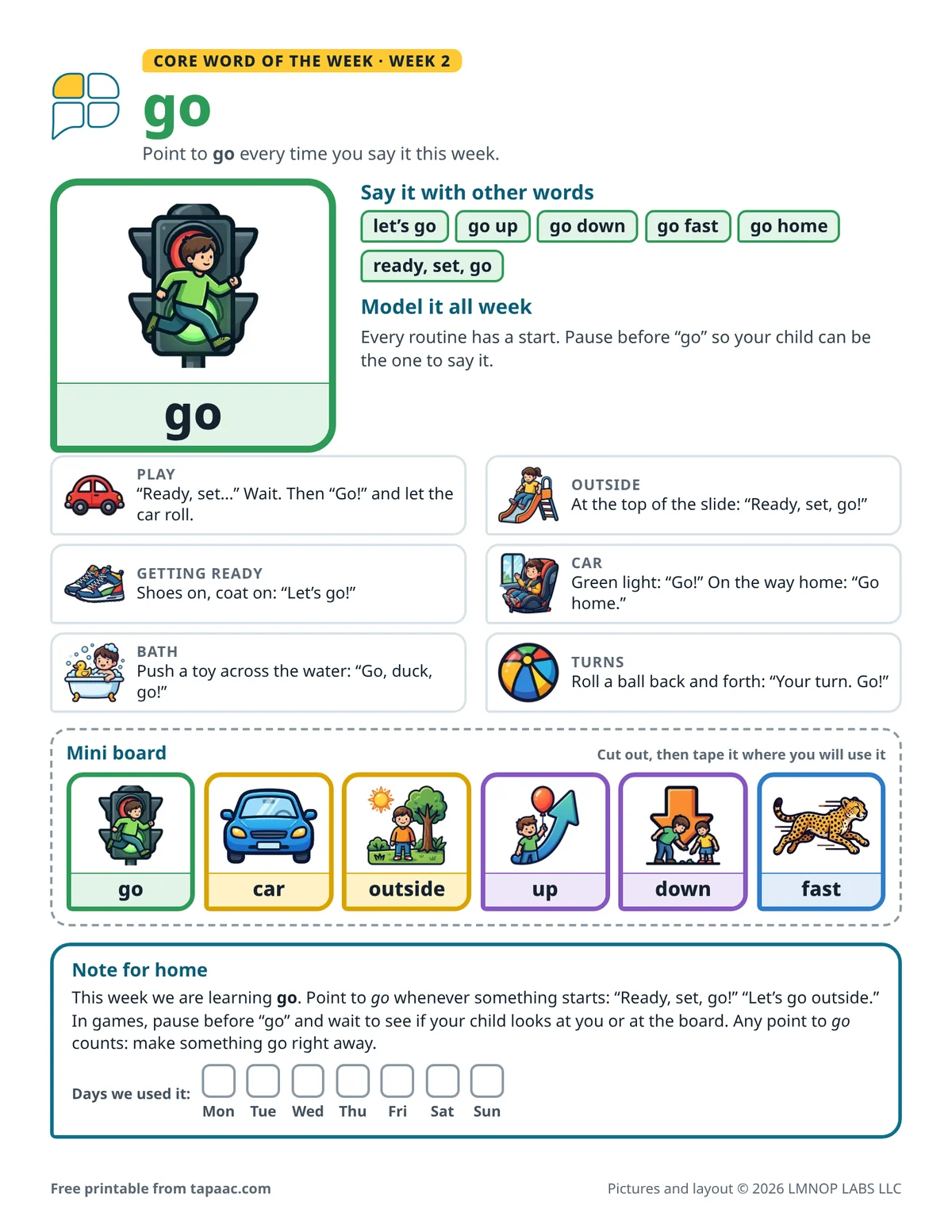
- Line up toy cars at the top of a ramp or a couch cushion. “Ready, set...” Pause, then point to go: “Go!” Let the car roll.
- Wind-up toys and spinning tops: “Ready, set, go!” each time you let one go.
- Roll a ball back and forth, and say “go” as it leaves your hands.
Outside
- At the top of the slide: “Ready, set, go!” Next time, wait after “set”.
- On a walk, where the path splits: “Go this way? Go that way?”
- Races: “On your marks, get set, go!”
Getting out of the door
- Shoes on, coat on: “Let’s go!”
- Say where you’re going: “Go to the store.” “Go to Grandma’s.”
In the bath
- Push a toy boat or a duck across the water: “Go, duck, go!”
- When you pull the plug: “Bye, water. Go down!”
At school or therapy
- Turn-taking games: “Your turn. Go!”
- Moving to the next activity: “Time to go outside.”
In the living room, Dad sets a toy car at the top of a cushion ramp. “Ready... set...” He stops and points to go on the mini board. Ava watches the car. “Go!” He lets it roll, and she laughs. The second time, he waits longer after “set”. Ava slaps the board, near go. “Go! You said go!” The car zooms down, and she pushes it back to him for another turn.
Let’s go, go fast, go home
Pair go with a direction, a speed or a place, and the same game gets a new twist.
- let’s go
- go up
- go down
- go fast
- go home
- ready, set, go
If go can’t happen yet, or it’s the only word in the game
If the person says go and you can’t go yet
Show you heard it: “You want to go. We go after lunch.” A first-then board can show what has to happen first.
If go is the only word in the game
Keep the game and add a word: “Go fast!” “Go up!” Point to both words as you say them.
Note for home: pause before “go” and wait
This week we are learning go. Point to go whenever something starts: “Ready, set, go!” “Let’s go outside.” In games, pause before “go” and wait to see if your child looks at you or at the board. Any point to go counts: make something go right away.
The same note is printed at the bottom of the week’s page, with a box to tick for each day. For families who are new to modeling, send the one-page AAC modeling at home handout with it, and keep using the word cards from earlier weeks.
More core word of the week plans
-
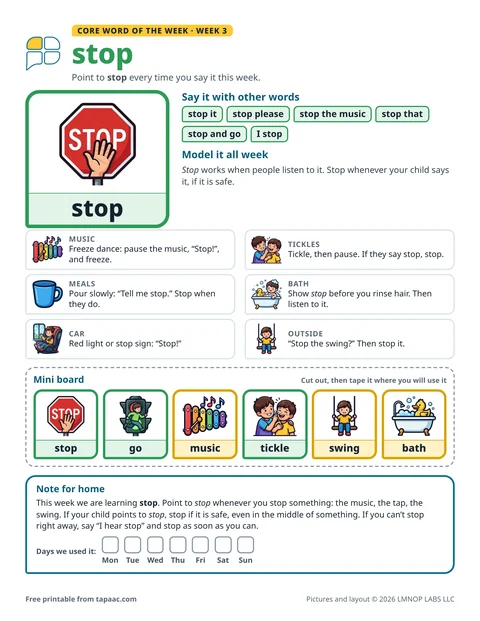 Week 3: stopEnd what isn’t wanted, or freeze a game, and be listened to.
-
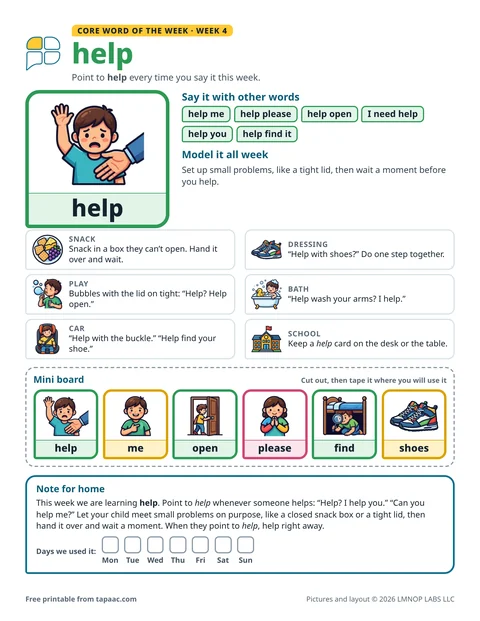 Week 4: helpAsk for help with lids, shoes, toys and hard work.
-
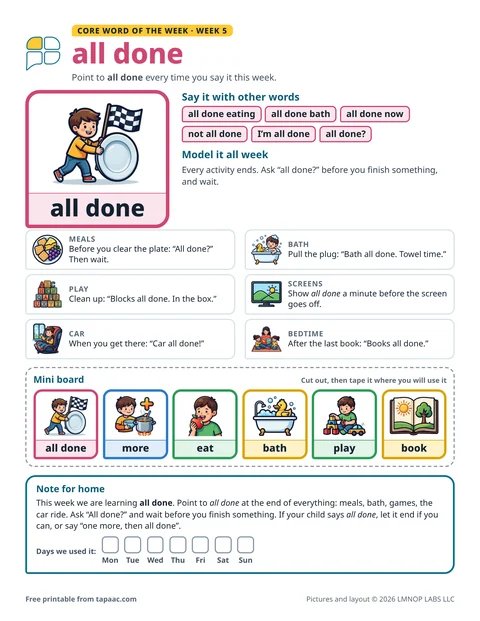 Week 5: all doneA calm way to end meals, baths, games and screen time.
-
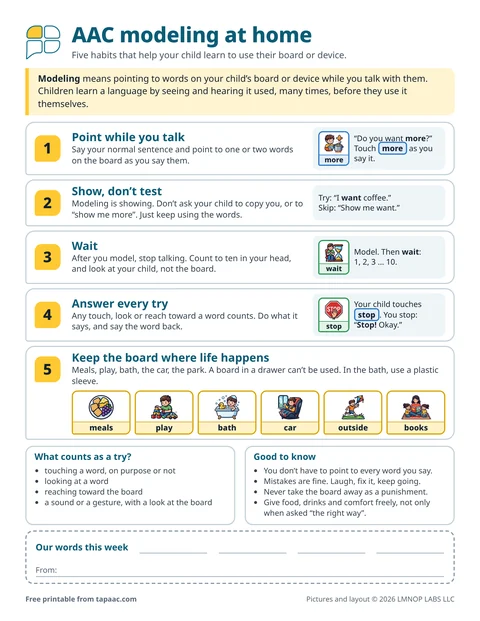 AAC modeling at homeFive habits on one page, to send home or stick on the fridge.
All core word printables and guides
Need a different board? Make your own with the free AAC board maker.
These cards, handouts and plans are general information, not therapy or medical advice, and they don’t replace a speech therapist. A speech therapist who knows the person can help choose the right words and the right way to practice. Everything here is free to print and share; please don’t sell it (terms of use). Questions? Email support@lmnoplabs.fun.