 Tap AAC
What the letters mean
Augmentative means adding to speech. Alternative means instead of speech.1 So AAC can help someone whose speech is hard to understand, someone who says a few words, and someone who doesn’t speak at all.
For example, a child might say “juice” clearly but point to pictures for everything else. A man who has had a stroke might write the first letter of a name to help his wife guess it. A teenager might type on a tablet that says the words out loud. All of these are AAC.
The kinds of AAC
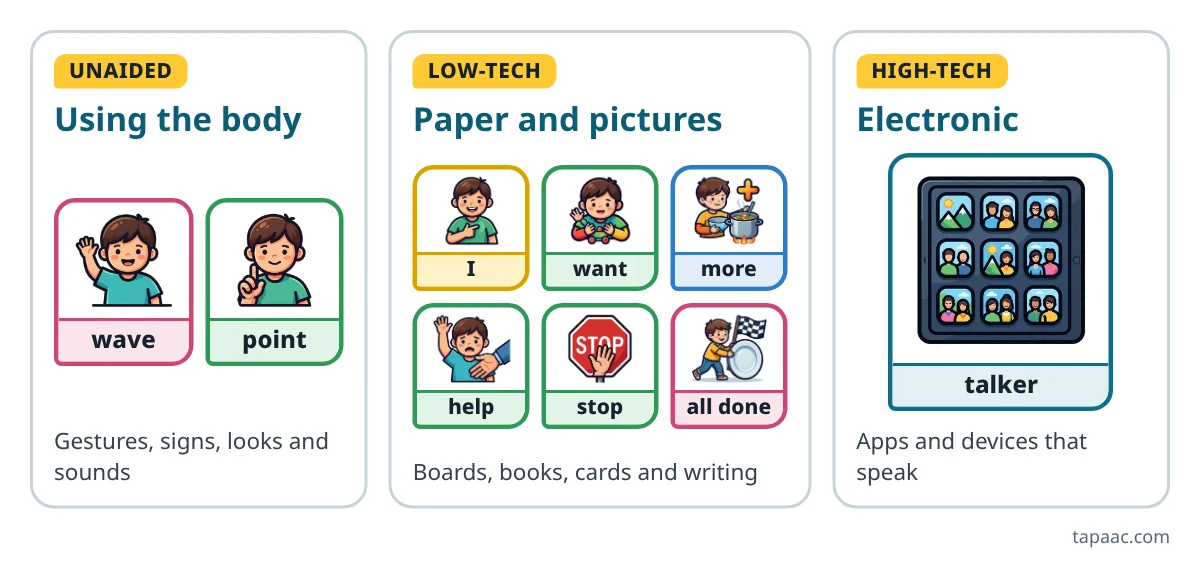
Speech-language pathologists usually sort AAC into two groups: unaided AAC, which uses only the body, and aided AAC, which uses a tool. Tools without electronics are called low-tech or light-tech; electronic ones are called high-tech.2
| Kind | What it is | Examples |
|---|---|---|
| Unaided | The body, with no tool | Gestures, facial expressions, body language, signs, finger spelling, sounds and words |
| Low-tech (aided) | A tool with no electronics | Picture boards, communication books, photos, objects, visual schedules, writing |
| High-tech (aided) | An electronic tool | Speech apps on a tablet or phone, text-to-speech, texting, devices that speak (speech-generating devices) |
You may also hear “no-tech”. People use it for body-based AAC and for simple tools like pointing to pictures, drawing or writing,1 so ask what someone means if it matters.
Most people mix them. One person might sign “more” at dinner, point to a paper board in the bath and use a tablet at school. The professional guidance says a person may use one form of AAC or a combination.2
Who uses AAC
AAC is for people of all ages. Some use it all the time because they don’t speak. Some use it now and then, to help people understand their speech. Some need it only for a short time, for example after surgery.1 People who may benefit include:2
- Children and adults with disabilities from birth or early childhood, such as cerebral palsy, developmental apraxia of speech, genetic disorders, developmental disability or intellectual disability. See our guides to AAC and cerebral palsy, AAC and childhood apraxia of speech and AAC and Down syndrome.
- Autistic children and adults. Our guide to AAC and autism answers the questions parents ask most.
- Adults after a stroke or a brain injury, for example people with aphasia, a language disorder. See how to talk with someone who has aphasia.
- People with conditions that change over time, such as ALS or primary progressive aphasia. See AAC for adults, and for memory books and picture cards, communication aids for dementia.
- Patients who can’t speak for a while, such as people with a breathing tube in intensive care, or after surgery on the mouth or throat. See the bedside steps on our hospital communication board.
Does someone have to be “ready” for AAC?
No. The professional guidance for speech-language pathologists says there are no prerequisites for AAC, and that it should be considered as early as possible.2 The public information page from the same association adds that children younger than three can start, and that no thinking skills, test scores or other milestones are needed first.1 Our guide to AAC for toddlers covers starting early.
People who have trouble moving their hands can use AAC too, with their arms, feet, head or eyes. A speech-language pathologist can work with occupational and physical therapists to find the best way.1
Will AAC stop someone from learning to talk?
This is one of the most common worries, and research hasn’t found it to be true. A 2006 review looked at studies of AAC and speech in children and adults with developmental disabilities. In the 27 cases from the best-designed studies, nobody talked less after AAC was introduced. Most talked a little more, and the rest stayed the same.3
The professional guidance says AAC may help improve natural speech when it is used alongside other ways of communicating.2 Our guide to AAC and autism looks at the research for autistic children, and AAC myths and facts answers nine more common worries.
Who can help
A speech-language pathologist (SLP; in the UK, a speech and language therapist) can assess what the person needs, recommend AAC that fits their body and their life, teach them and the people around them to use it, and work with teachers and other therapists so it works everywhere.1
Some AAC tools are covered by insurance and some are not; an SLP can help you work out the options.1 In the US, how to get an AAC device goes through Medicaid, Medicare, insurance and the school. For a child in a US public school, the IEP team must consider whether the child needs assistive technology. See AAC at school.
Six first steps
- Notice how the person communicates now. Looks, sounds, reaching, pulling you by the hand, pushing things away: all of these say something. A good AAC system builds on the person’s speech, sounds and gestures; it doesn’t replace them.2
- Ask for an AAC assessment. Ask your doctor, your child’s school or a local clinic how to see a speech-language pathologist who knows AAC. Assessment can carry on alongside therapy, and trying devices is often part of the process.2 See what happens in an AAC evaluation.
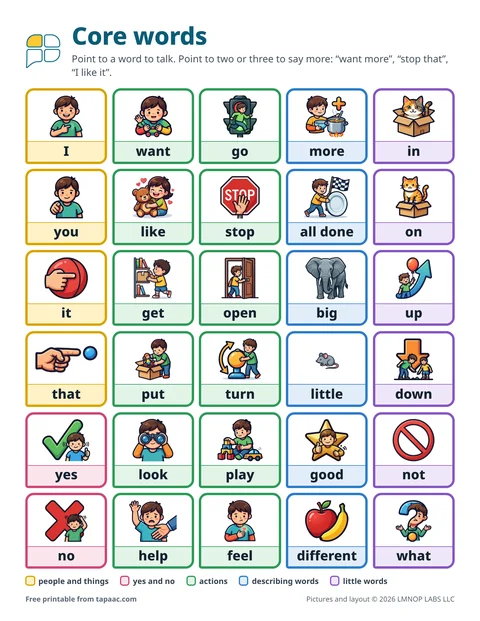
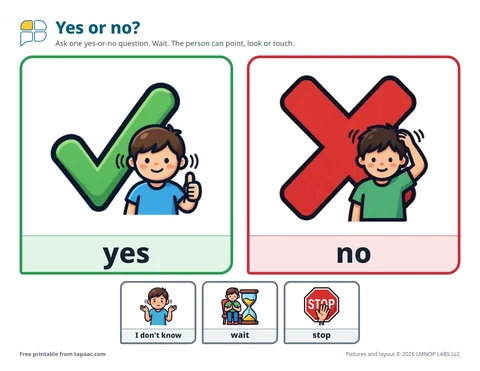
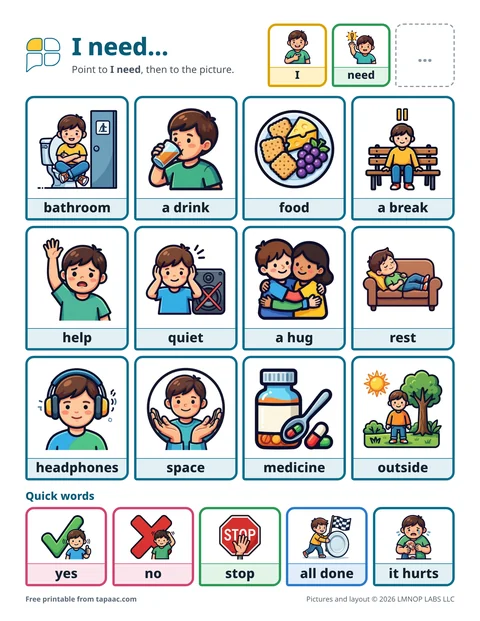
- Start with paper today. You don’t have to wait for an assessment to point to pictures while you talk. Print a core word board or a yes and no board, or read how to get started with low-tech AAC and how to make a communication board.
- Show, don’t test. Point to words on the board as you talk, without asking the person to copy you. This is called modeling, and the AAC modeling at home handout explains it on one page.
- Keep it within reach, all day. People who use AAC should always have access to their communication tools.2 A board in a drawer can’t be used.
- Try before you decide on high-tech. Our guide on how to choose an AAC app lists the questions to ask.
Words you may hear
- Speech-language pathologist (SLP)
- A professional who assesses and treats speech, language and communication. Also called a speech therapist.
- Speech-generating device (SGD)
- An electronic AAC device that speaks out loud. A speech app on a tablet does the same job. See dedicated devices and tablets compared.
- Core words
- Small words used all day, in any situation: more, stop, go, help, not, what. See core words, explained.
- Fringe words
- Words for particular things, people and places, mostly nouns: pizza, Grandma, the pool.2
- Modeling
- Pointing to words on the person’s AAC while you talk to them. Also called augmented input, aided language stimulation or aided language modeling.2
- Communication partner
- Anyone talking with a person who uses AAC: family, friends, teachers, nurses.
- Partner-assisted scanning
- The partner points to or reads out choices one at a time, and the person makes an agreed signal, such as a nod or a blink, when the right one comes up.2
- Visual scene
- A photo of a real place or moment, with spots you can tap to say something.2
Try this today
- Write down three ways the person already tells you things: a look, a sound, a reach.
- Print the yes and no board or the core word board and put it where you eat.
- Each time you offer more food or more play, point to more as you say it.
- Write down your questions for a speech-language pathologist.
More AAC guides
- AAC myths and facts: 10 common myths, and what the research saysTen things people believe about AAC, and what research and professional guidance say instead.
- Low-tech AAC: choosing and using boards, books and cardsBoards, books and cards with no batteries: which to choose, and how to use them every day.
- AAC for toddlers: when to start, and how to begin at homeStarting before your child talks: one routine, a few words, modeling and early intervention.
- AAC and autism: answers to common parent questionsWill AAC stop my child from talking? Is my child ready? How do I start?
- AAC for adults: after a stroke, with ALS or MND, and in the hospitalAfter a stroke, with ALS or MND, and in the hospital: what helps, and when to plan.
Sources
We read each of these on October 12, 2026. Numbers in the text point to them.
- Communication Health Support Association, powered by the American Speech-Language-Hearing Association. Augmentative and Alternative Communication (AAC). Information for the public. Accessed October 12, 2026.
- American Speech-Language-Hearing Association. Augmentative and Alternative Communication (Practice Portal). Professional guidance for speech-language pathologists. Accessed October 12, 2026.
- Millar DC, Light JC, Schlosser RW (2006). The impact of augmentative and alternative communication intervention on the speech production of individuals with developmental disabilities: a research review. Journal of Speech, Language, and Hearing Research, 49(2), 248–264. Abstract on PubMed.
 Core word board
 Yes and no board
 Choice boards
 Needs board