 Tap AAC
Who does it
Speech-language pathologists (SLPs) play a central role in assessing people who may need AAC. The professional guidance calls for an assessment that is comprehensive, involves several professions, and fits the person’s culture and languages.1 Depending on the person, the SLP may bring in others, such as an occupational or physical therapist, a vision specialist, a special educator, an assistive technology professional or a rehabilitation engineer.1 An SLP without enough AAC experience should refer the person to, or at least consult, one who has it.1
The person and the family are part of the team. Family members can describe the person’s usual ways of communicating beyond what an SLP sees in a session, and a lack of family involvement is named as a significant factor when people stop using a device they still need.1
How to ask for one
- A child at a US public school: ask the IEP team, in writing, for an assistive technology evaluation. IDEA lists it among assistive technology services, as a functional evaluation in the child’s customary environment,2 and the school needs your consent before it starts.3 More in AAC and the IEP.
- A child under 3: ask the early intervention service coordinator. A functional assistive technology evaluation is one of the examples the US Department of Education gives for infants and toddlers.3
- An adult, or a child outside school: ask the person’s doctor for a referral to an SLP who works with AAC, or search the American Speech-Language-Hearing Association’s ProFind directory.4
- If you hope Medicare or insurance will pay: say so at the start, because the written report will have to meet the payer’s rules (see the report below).
What the evaluation looks at
Many parts may already be in medical or school records, so bring them; the SLP completes the rest. The professional guidance lists these typical parts:1
| Area | What the SLP wants to know |
|---|---|
| History | Health, school or work, the languages used, any AAC tried before, and how a condition is expected to change |
| Communication now | How the person communicates today, how well it works, and what they need to say in each place and with each person |
| The person’s own view | What works, what is hard, which situations matter most, and the person’s own goals and preferences |
| Seeing, hearing and moving | Whether they can see the symbols and text, their hearing, and how they could reach a system: sitting position, hands, head or eyes |
| Speech and language | How they show what they mean, the words they understand and use, putting words together, following instructions, answering yes and no, and pointing to a picture or object someone names |
| Reading and writing | Literacy skills, now or before an illness or injury |
| Symbols | Which kinds work (objects, photos, pictures, letters or printed words), how big, how many on a page, and how they are arranged |
| Thinking skills in use | Memory, attention and problem solving while using AAC |
| What helps and what gets in the way | Motivation, family support and comfort with technology; and barriers such as low confidence, vision or movement difficulties, or seating |
Glasses and hearing aids should be worn, and hearing aids checked first. The assessment should be done in the language or languages the person needs, with an interpreter if necessary.1
Tests, trials and everyday life
Many standard tests ask a person to name pictures out loud or to point. When a task has to be changed for someone who can’t, its standard scores can no longer be used, so the evaluation also relies on informal and dynamic assessment, such as watching the person communicate in everyday situations.1 For school evaluations, IDEA requires tests to be given in the child’s own mode of communication, and the results must reflect what the child can do, not their impaired speaking skills, unless speaking is what the test measures.5
The SLP then matches the person’s skills and needs to the features a system would need. This is called feature matching, and the features include:1
- written messages, and the range of things the person will need to say
- use in different places and with different people
- the type and number of symbols, and the display (color or black and white, fixed or changing pages)
- how the person selects: touching directly, or indirectly, for example with a switch
- the voice and other output
- positioning, and accessories such as mounts and switches
- portability, and room to change as the person’s abilities and needs change
- the person’s own preference, and whether it motivates them to use it
- cost and upkeep
Then the person tries the likely options. Trials of specific devices are often part of AAC treatment, and whether one device will work may not be clear at the first assessment, so assessment can carry on alongside therapy.1 Your state’s assistive technology program may be able to lend a device for a short trial.6
There is no test to pass
AAC has no prerequisites. Anyone whose communication abilities don’t meet their communication needs is a candidate, and the time and effort AAC takes is not a reason to leave someone out.1 An evaluation is about finding what fits, not deciding whether someone is “ready”.
It helps to start before the evaluation. The professional guidance says introducing symbols and AAC before the assessment, for example with core and fringe word boards at home and at school, may make the results more accurate.1 A printed core word board, used in a few routines with the core words plans, is an easy way to begin.
How to prepare
- Write down how the person communicates now: sounds, words, gestures, signs, looks, pointing, behavior, any AAC. Note what each one usually means.
- Take two or three short videos of everyday communication, such as a meal or a game, if the person is happy for you to.
- List the places, people and activities in a typical week, and what the person wants to say in each but can’t yet.
- List favorite things and topics, so the words are about the person’s own life.
- Gather records: recent hearing and vision results (the SLP will want them, or may refer for them),1 and school, medical and therapy reports.
- Bring what the person uses now: boards, a device, glasses, hearing aids, a switch.
- Choose a good time of day, and bring snacks and something calming for breaks.
- Write your goals and questions, and help the person add their own.
Questions to ask
- What did you see that tells you what will work?
- Which features does the person need most, and which options did you compare?
- Can we try it at home and at school or work before deciding, and for how long?
- Who will set up the words, and who will train us and the other people the person talks with?
- What is the plan for a paper backup when the device is charging or being repaired?
- How will we know it is working, and when will we review it?
- Do you have any financial relationship with a device maker? An SLP writing a funding request must disclose one.1
The report
Ask for a copy of the written report. In US schools, the school gives parents a copy of the evaluation report at no cost.7 If you disagree with a school evaluation, you can ask for an independent educational evaluation at public expense, and a private evaluation you share with the school must be considered, if it meets the school’s criteria.8
For Medicare, the SLP’s written evaluation must cover at least: the communication impairment, its severity and expected course; whether natural ways of communicating could meet daily needs; the goals and treatment options; why a specific device and accessories were chosen; a training plan; and whether the person can use the device. A copy goes to the treating practitioner before the device is ordered.9 Other payers set their own rules, which is why it helps to tell the SLP early. See how to get an AAC device.
After the evaluation
An AAC system isn’t chosen once and then left alone. Assessment is ongoing, and decisions keep being made after a system is chosen.1 People stop using a device they still need in about a third of cases, even when the system is well designed.1 The guidance says barriers to using AAC are lower when the person values the system and feels it is theirs, when it matches their abilities well, and when the person and the family get thorough training once it arrives.1
Teaching starts at home on day one: see how to teach a child to use AAC and the AAC modeling at home handout.
Try this today
- Write down three ways the person communicates now, and what each one means.
- Find the latest hearing and vision results.
- Point to three words on a printed core word board during one routine.
- Write your top three questions for the speech-language pathologist.
More AAC guides
- How to get an AAC device: Medicaid, Medicare, insurance and schoolThe evaluation first, then Medicaid, Medicare, insurance, the school or a state loan program (US).
- What is a speech-generating device? Dedicated devices and tablets comparedRecorded and computer voices, dedicated devices versus apps on a tablet, and what Medicare covers.
- How to choose an AAC app: questions to ask before you buyStart with the person, try before you buy, and the questions to ask about any app.
- AAC and the IEP: what parents can ask forWhat IDEA says about assistive technology, and what to ask about evaluations, goals, home use and training.
- How to teach a child to use AAC: model, wait and respondModeling, waiting and responding in depth, with examples, and what to do when it isn’t working.
Sources
We read each of these on October 13, 2026. Numbers in the text point to them.
- American Speech-Language-Hearing Association. Augmentative and Alternative Communication (Practice Portal). Professional guidance for speech-language pathologists. Accessed October 12, 2026.
- U.S. Department of Education, IDEA regulations. 34 CFR §300.6: Assistive technology service. Accessed October 12, 2026.
- U.S. Department of Education. Myths and Facts Surrounding Assistive Technology Devices and Services (PDF). January 2024.
- Communication Health Support Association, powered by the American Speech-Language-Hearing Association. Augmentative and Alternative Communication (AAC). Information for the public. Accessed October 12, 2026.
- U.S. Department of Education, IDEA regulations. 34 CFR §300.304: Evaluation procedures. Accessed October 13, 2026.
- National Assistive Technology Act Technical Assistance and Training (AT3) Center. AT Act Programs (directory of state and territory programs). Accessed October 12, 2026.
- U.S. Department of Education, IDEA regulations. 34 CFR §300.306: Determination of eligibility. Accessed October 13, 2026.
- U.S. Department of Education, IDEA regulations. 34 CFR §300.502: Independent educational evaluation. Accessed October 13, 2026.
- Centers for Medicare & Medicaid Services (CMS), Medicare Coverage Database. Local Coverage Determination: Speech Generating Devices (SGD) (L33739). The rules used by Medicare’s equipment contractors; revision effective October 1, 2024.
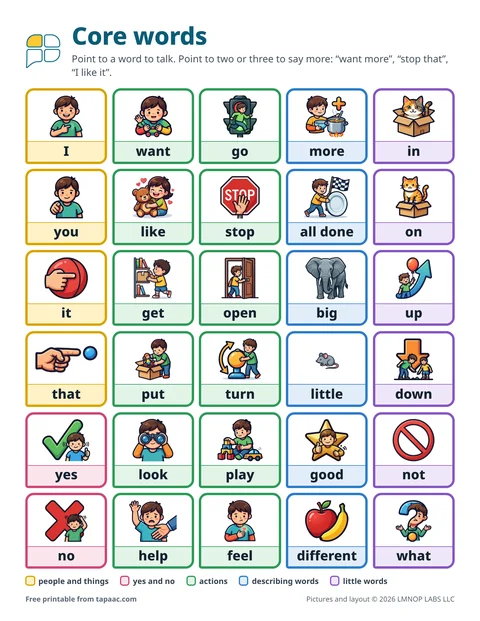 Core word board
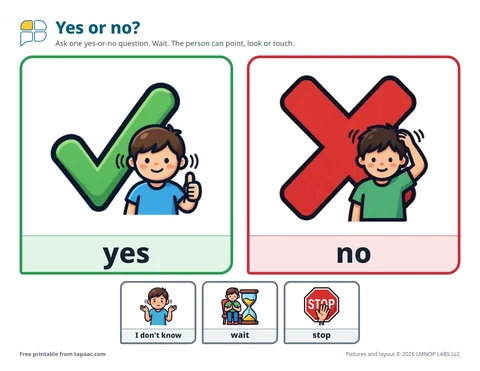 Yes and no board
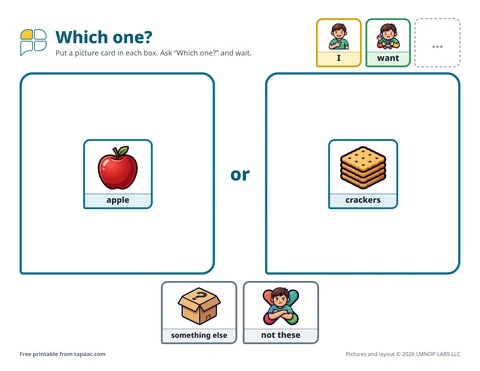 Choice boards
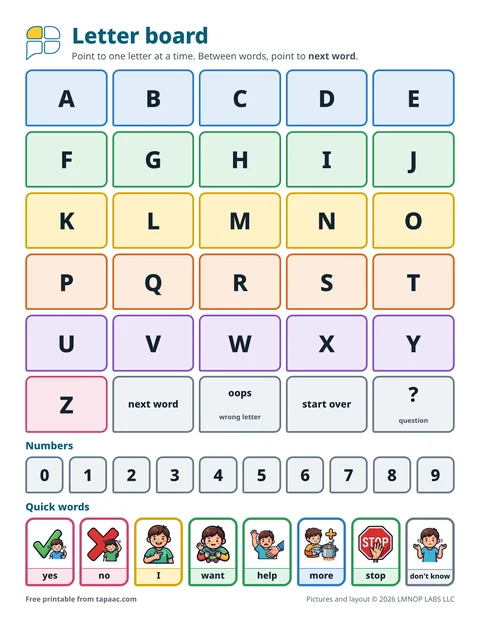 Alphabet board