 Tap AAC
Sudden trouble speaking or finding words can be a sign of a stroke, especially with a drooping face, a weak arm or blurred vision. Call emergency services straight away.1
What aphasia is
Aphasia is a language disorder. It happens when the parts of the brain that handle language are damaged, usually by a stroke or a head injury, and it can affect speaking, understanding, reading and writing.2 Stroke is the most common cause; others include a brain tumor, bleeding or infection in the brain, and conditions such as dementia.1
It’s different for everyone. Some people speak in short phrases with great effort and leave out small words like “is” and “the”. Others speak easily in long sentences, but the words come out mixed up, and understanding others is harder for them.2 A person’s aphasia may not fit neatly into one type, and it can change as they recover.3
Language and thinking are separate, though overlapping, skills. Having aphasia doesn’t, by itself, mean that a person’s thinking is affected.3 A stroke or injury can cause other problems too, so ask the care team what applies to the person you’re supporting. Aphasia can also come with other speech problems, such as dysarthria (weak speech muscles) or apraxia of speech (trouble planning speech movements).2
12 tips for talking together
Most of these tips are from the advice for families of the US National Institute on Deafness and Other Communication Disorders.2 Not every tip suits every person; the person’s speech-language pathologist can tell you which matter most for them.
Before you start
- Find a quiet spot. Turn off the TV or the radio, and keep side conversations down.2
- Get their attention first. Sit where they can see your face, say their name, and check that their glasses and hearing aids are in.
When you talk
- Use short, simple sentences. One idea at a time: “Lunch is ready.” Then: “Do you want soup?”2
- Talk to them as the adult they are. Keep a natural, adult way of talking, and adult topics.2 Never talk down.
- Write down key words as you say them. A name, a place, a time: “Doctor, Tuesday, 2 pm.”2 Keep a pad and pen where you usually talk.
- Show as well as tell. Point, gesture, draw a quick sketch, or show a photo or a calendar. Drawing and gesturing are among the strategies speech-language pathologists coach both partners to use.3
- Ask questions that are easy to answer. Yes-or-no questions and written choices are easier than open questions. There’s more on this below.
When they talk
- Give them time. Allow plenty of time to talk,2 and don’t jump in at the first pause. Ask before you finish a sentence for them: some people welcome it, others don’t.
- Accept any way of saying it. Encourage any kind of communication: speech, gesture, pointing or drawing.2 Writing and pictures count too.
- Don’t correct their speech.2 If you understood the meaning, answer the meaning. Leave practice to therapy, unless the person asks you to help them practice.
- Check you’ve understood. Say back what you think they mean: “You want to call Maria tonight?” If you didn’t understand, say so kindly and try another way. Don’t pretend.
Keep them in it
- Include them, and ask their opinion. Include the person in conversations, and ask for and value their opinion, especially on family matters.2 Talk to them, not about them, even in a group or at the doctor’s.
Questions that are easier to answer
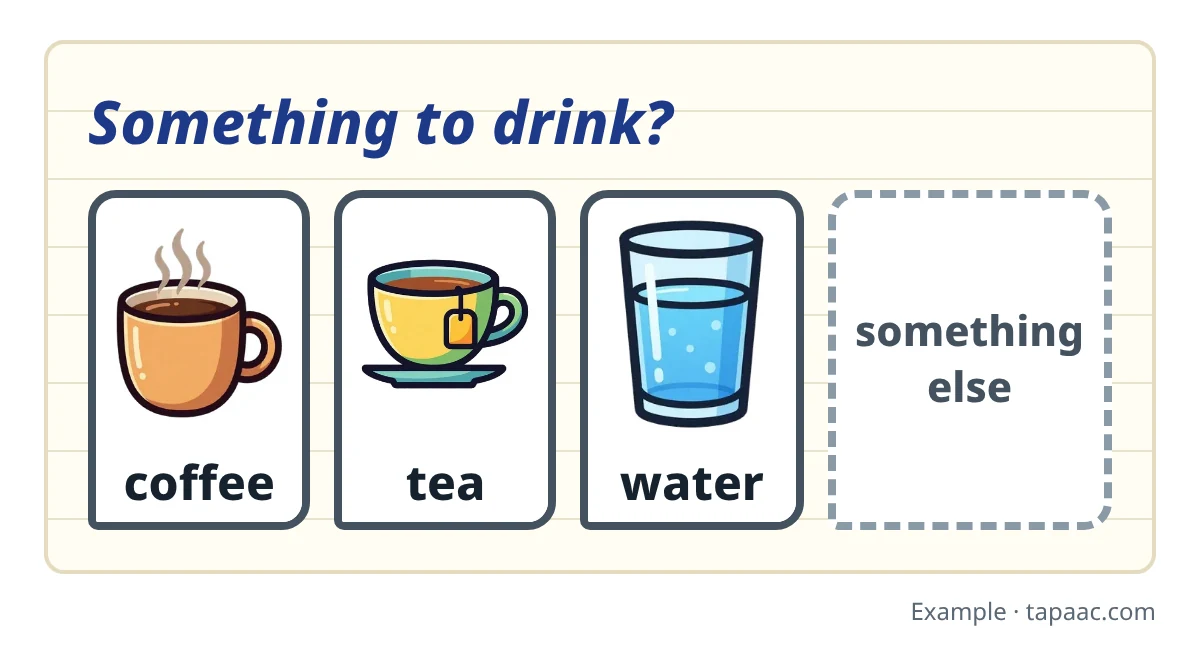
An open question (“What do you want to do today?”) asks the person to find all the words themselves. Choices and yes-or-no questions ask much less. Offering written or visual choices helps people with aphasia show what they want, think and feel.3
| Instead of | Try |
|---|---|
| “What do you want for lunch?” | “Soup or a sandwich?” Write both words and hold the paper where they can point. |
| “How was therapy?” | Write good, OK and hard, and let them point. |
| “Who called?” | “Was it Sam?” Or write the names of three people who might have called. |
| “Where did you put your glasses?” | “Bedroom?” (point that way) “Kitchen?” |
| “Why are you upset?” | “Is it pain?” “Is it about home?” “Something I said?” Then narrow it down. |
When you don’t understand
Everyone gets stuck sometimes. It’s nobody’s fault. These steps can help:
- Say what you’ve got so far. “It’s about the car. And tomorrow.”
- Narrow it down with yes or no. Topic first (“Is it about the family?”), then who, then when.
- Ask them to show you. Point, gesture, draw, or write the first letter, if they can.
- Use what’s around you. Photos, a calendar, a map, the newspaper, their phone.
- Take a break if you both need one. “Let’s come back to this after lunch.” Write a note so the topic isn’t lost, and do come back to it.
What it can look like
Dad: “The... the... no. The thing!” (He points out of the window.)
You: “Something outside. Is it the car?” (He shakes his head.) “The garden?” (He nods.)
You: “The garden.” (Write garden, and draw a flower and a spade.) “Something to do in the garden?” (He taps the flower and mimes digging.)
You: “Planting? You want to plant something?” Dad: “Yes! Yes.”
Tools that can help
- A notebook and a pen, kept wherever you talk, for key words, choices and quick drawings.
- Photos, a calendar and a map, for talking about people, plans and places.
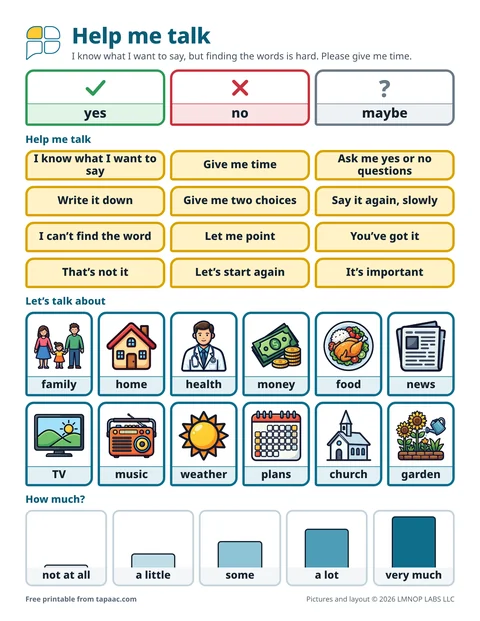
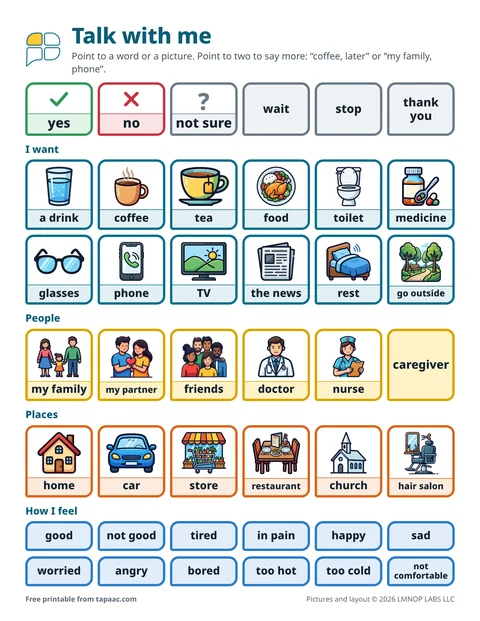
- A communication board or book with the person’s own words: family names, places, daily needs, and the things they like to talk about. Our free aphasia communication board is a place to start.
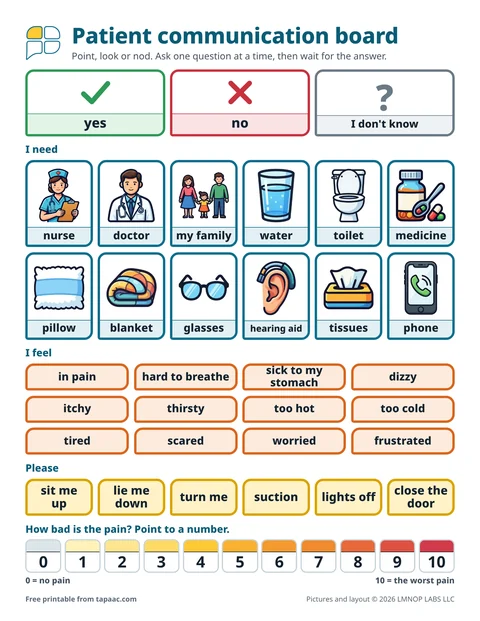
- Yes and no, and a pain scale, especially in the hospital: see our hospital communication board and how to use it. Nurses can find more in communicating with nonverbal patients.
- An alphabet board, for people who can still spell some words. Aphasia can affect reading and writing too,1 so don’t count on spelling working; try it and see. Print our alphabet board.
- A speech app on a tablet or phone. Speech-generating apps can give people with aphasia another way to communicate.2 A speech-language pathologist can help choose one and set it up; read how to choose an AAC app.
Learning other ways to communicate, such as gestures, pictures, notebooks and electronic devices, is one of the aims of aphasia therapy.2 For apraxia of speech, the hospital and ALS, see AAC for adults.
Ask to learn how to help
Family members are encouraged to take part in therapy sessions, and a strong therapy program includes training for communication partners.2 The research behind this is encouraging:
- A 2016 review of 25 studies found that all of them reported positive changes from communication partner training, and recommended the training to improve partners’ skill in helping people with long-term aphasia communicate.4
- In a 2001 controlled study, volunteers trained in Supported Conversation for Adults with Aphasia got better at helping people with aphasia show what they knew. The people with aphasia also communicated better with them, even though only the volunteers were trained.5
So ask the speech-language pathologist: “Can I come to a session and learn how to help?”
Recovery and support
When aphasia is caused by a stroke, a head injury or a brain tumor, most people improve with treatment, especially in the first few months, and people can still improve months or years later. When it’s caused by a condition that gets worse over time, such as dementia, treatment may focus on learning and practicing other ways of communicating.1 For dementia, see communication aids for dementia.
Stroke clubs and aphasia groups can help both the person and the family.2 Looking after yourself matters too: these conversations take patience on both sides.
Try this today
- Turn off the TV before your next conversation.
- Keep a pad and pen where you usually talk, and write key words as you go.
- Turn one open question into a written choice of two.
- Ask the speech-language pathologist if you can join a therapy session.
More AAC guides
- AAC for adults: after a stroke, with ALS or MND, and in the hospitalAfter a stroke, with ALS or MND, and in the hospital: what helps, and when to plan.
- Communication aids for dementia: picture cards, boards, memory books and tipsPicture cards, memory books, labels and calendars, and tips for talking together.
- What is AAC? A plain-language guide for familiesWhat the letters mean, the kinds of AAC, who uses it, and six first steps.
- Low-tech AAC: choosing and using boards, books and cardsBoards, books and cards with no batteries: which to choose, and how to use them every day.
- Using a communication board in the hospitalOn the hospital board’s page: yes and no, asking about pain, and spelling with a patient who can’t speak.
Sources
We read each of these on October 12, 2026. Numbers in the text point to them.
- NHS (UK). Aphasia. Page last reviewed April 1, 2025.
- National Institute on Deafness and Other Communication Disorders (NIH). Aphasia. Last updated April 16, 2025.
- American Speech-Language-Hearing Association. Aphasia (Practice Portal). Professional guidance for speech-language pathologists. Accessed October 12, 2026.
- Simmons-Mackie N, Raymer A, Cherney LR (2016). Communication Partner Training in Aphasia: An Updated Systematic Review. Archives of Physical Medicine and Rehabilitation, 97(12), 2202–2221. Abstract on PubMed.
- Kagan A, Black SE, Duchan FJ, Simmons-Mackie N, Square P (2001). Training volunteers as conversation partners using “Supported Conversation for Adults with Aphasia” (SCA): a controlled trial. Journal of Speech, Language, and Hearing Research, 44(3), 624–638. Abstract on PubMed.
 Aphasia communication board
 Communication board for adults
 Hospital communication board
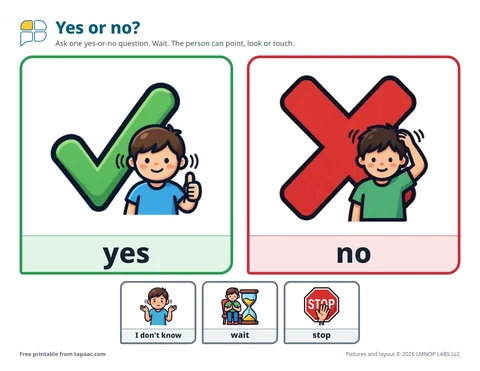 Yes and no board