 Tap AAC
These myths come up again and again, from families, teachers and sometimes professionals. Each answer links to where it comes from. For decisions about one person, talk to a speech-language pathologist who knows them.
| Myth | Fact |
|---|---|
| AAC stops people learning to talk | Research hasn’t found this; most studies found small gains in speech |
| AAC is a last resort | It should be considered as early as possible, alongside speech |
| A child can be too young | Children under three can start |
| You have to be “ready” | There are no prerequisites |
| AAC means an expensive device | Gestures, signs and paper boards are AAC too |
| AAC is only for people who can’t talk at all | Many people use it alongside speech |
| AAC is only for children | Adults use it too, for a short time or for life |
| You need good hands | People use AAC with their eyes, head, feet or a switch |
| Limit it like screen time | It should be within reach all day |
| We tried it once, so it’s not for us | It’s never too late to try again |
Free one-page handout of the ten myths
To share these with family or school staff, print the one-page AAC myths and facts handout. It has a short box on what AAC is, the ten myths in the order above, each with a one-line fact, and a line to write in who to ask. The link at the bottom of the sheet opens this guide, so anyone can check where each fact comes from.
Download the free handout (PDF) US Letter, 1 page, 172 KB
Printing on A4 paper? Download the A4 PDF (1 page, 172 KB).
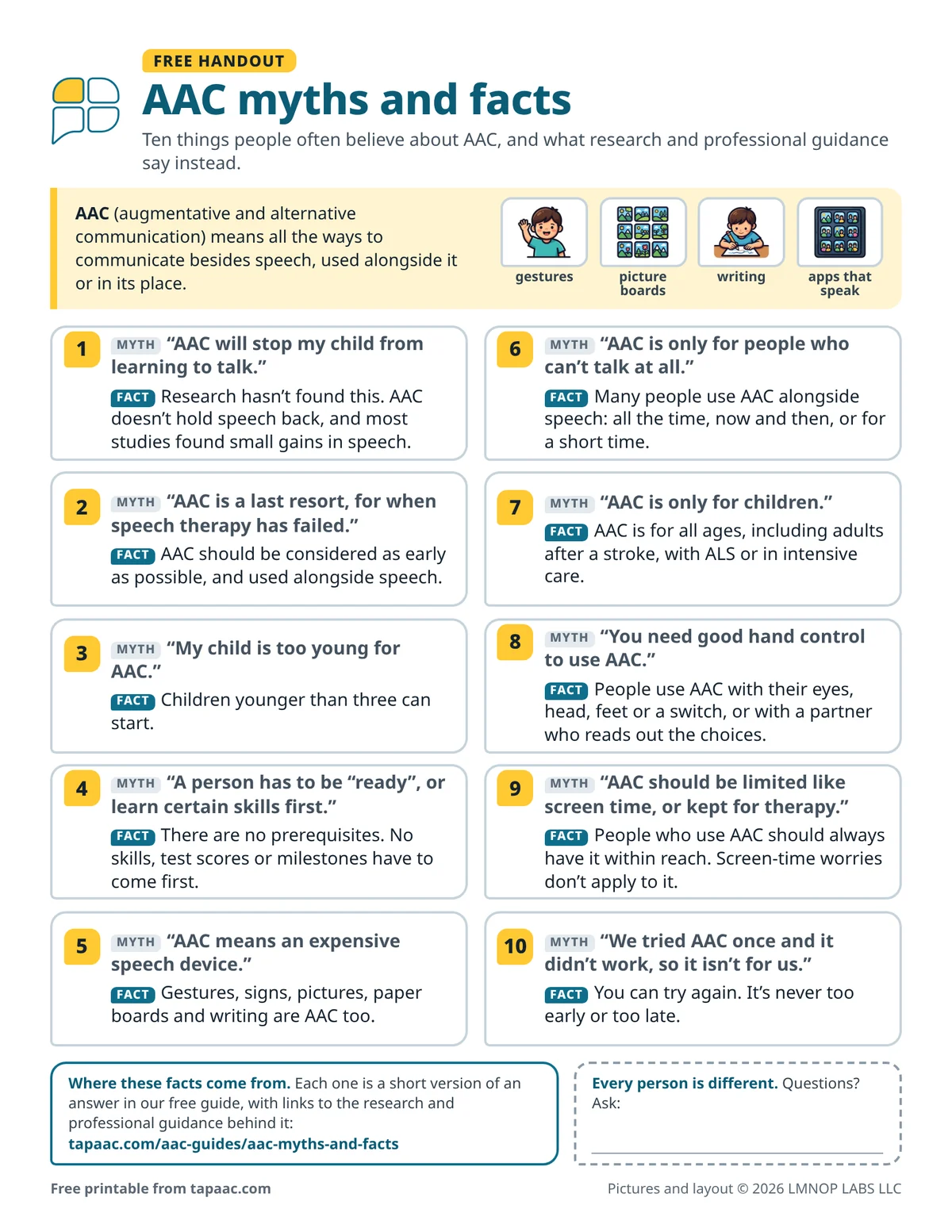
Hand it out at a first AAC appointment, before a team meeting or at a staff training, or give it to grandparents and babysitters who worry that a board will get in the way of talking. Point to the one myth the person is worried about rather than all ten, and talk it through. The handout is free to print, copy and share; please don’t sell it.
Myth 1: AAC will stop my child from learning to talk
Fact: research hasn’t found this. A 2006 review looked at studies of AAC and speech in children and adults with developmental disabilities. In the 27 cases from the best-designed studies, none showed less speech after AAC was introduced, 89% showed gains, and 11% stayed the same. Most of the gains were modest.1
A 2010 trial with 68 toddlers who said fewer than 10 words found that children in the two groups taught with augmented communication used both augmented and spoken words, and ended with larger vocabularies than children in the spoken-only group. The authors concluded that augmented communication does not hinder, and actually aids, speech in young children with developmental delays.2 For autistic children, our guide to AAC and autism sums up three reviews.
The honest summary: AAC doesn’t hold speech back and may help a little, but it isn’t a promise that someone will talk. Its first job is to let the person communicate now.
Myth 2: AAC is a last resort, for when speech therapy has failed
Fact: AAC should be considered as early as possible, whatever the cause of the communication difficulty, and preferred practice combines it with the person’s speech, gestures and other ways of communicating.3 “Augmentative” means adding to speech; people who use AAC can use both speech and AAC to talk to others.4
For example, the professional guidance for childhood apraxia of speech lists AAC as part of treatment, used to support speech while it is still developing.5 See AAC and childhood apraxia of speech.
Myth 3: My child is too young for AAC
Fact: children younger than three can start.4 Some families and professionals think young children aren’t ready until school age, but the professional guidance says early AAC use can help develop speech and language, and can increase vocabulary for children with developmental delays aged three and younger.3
The US Department of Education lists the idea that infants and toddlers don’t benefit from assistive technology as a myth, and gives AAC, such as pictures of activities or objects or a handheld tablet, as an example of what can help.6 See AAC for toddlers.
Myth 4: A person has to be “ready”, or learn certain skills first
Fact: there are no prerequisites for AAC. The professional guidance says this directly, and supports a zero-exclusion policy: everyone whose communication doesn’t meet their needs is a candidate, and the time and effort AAC takes is not a reason to leave anyone out.3
It also answers a specific version of this myth: the idea that skills such as understanding cause and effect, or showing an intention to communicate, have to come first. Impaired cognition does not rule out communication.3 No thinking skills, test scores or other milestones are needed before AAC can help.4
Myth 5: AAC means an expensive speech device
Fact: AAC includes no-tech and low-tech tools. Gestures, signs, facial expressions, communication boards and books, pictures, photos and writing are all AAC, as well as apps and devices that speak.3 The US Department of Education makes the same point about assistive technology in general: it isn’t always electronic or high-tech, and many tools cost little or nothing.6
You can start today with paper. Read how to get started with low-tech AAC, print a core word board, or start with one core word a week.
Myth 6: AAC is only for people who can’t talk at all
Fact: many people use AAC alongside speech. Some people use AAC all the time; others use it now and then, to help people understand their speech; others need it only for a short time, for example after surgery.4 AAC is called augmentative when it adds to existing speech, and alternative when it is used in place of speech.3
A child who talks at home but can’t be understood at school, or an adult whose speech gets harder when tired, may both benefit.
Myth 7: AAC is only for children
Fact: AAC is for people of all ages. Adults may need it after a stroke or a brain injury, with progressive conditions such as ALS, after surgery such as removal of the voice box, or for a short time in intensive care.3 See AAC for adults and how to talk with someone who has aphasia.
Myth 8: You need good hand control to use AAC
Fact: people use AAC with their arms, feet, head or eyes.4 A board doesn’t have to be touched: choices can be made with eye gaze, a head pointer or scanning with a switch, or with a partner who reads out the choices while the person signals yes.3 See AAC and cerebral palsy for the ways to choose.
Myth 9: AAC should be limited, like screen time, or kept for therapy
Fact: people who use AAC should always have access to it. Concerns about screen time for young children don’t apply to screens used as part of an AAC system.3 The US Department of Education adds that a child who needs a communication device will need it with them at all times of the day, not only in class.6
A device used only at home, and not at school or work, may not work as well as it could.3 Keep it within reach at meals, in the car, in the bath (a paper copy) and at bedtime. AAC at home has ideas for every room.
Myth 10: We tried AAC once and it didn’t work, so it isn’t for us
Fact: you can try again. A public information page powered by the American Speech-Language-Hearing Association puts it plainly: even if you tried once before, you can try again, and it’s never too early or too late.4
Success with a particular system often can’t be judged at the first assessment, and trying devices is a normal part of AAC therapy.3 Before you give up, look at the known reasons AAC gets dropped: words that don’t matter to the person, too little training for the people around them, a setup that doesn’t match how they move or see, and too little family involvement in choosing it.3 Each of these can be changed.
Try this today
- Pick the myth you hear most often, and share the fact with one person in the AAC user’s life.
- Print one board today; you don’t need to wait for a device.
- Keep the person’s AAC within reach at every meal this week.
- Write down your own questions about AAC for the speech-language pathologist.
More AAC guides
- What is AAC? A plain-language guide for familiesWhat the letters mean, the kinds of AAC, who uses it, and six first steps.
- AAC and autism: answers to common parent questionsWill AAC stop my child from talking? Is my child ready? How do I start?
- AAC for toddlers: when to start, and how to begin at homeStarting before your child talks: one routine, a few words, modeling and early intervention.
- Low-tech AAC: choosing and using boards, books and cardsBoards, books and cards with no batteries: which to choose, and how to use them every day.
Sources
We read each of these on October 12, 2026. Numbers in the text point to them.
- Millar DC, Light JC, Schlosser RW (2006). The impact of augmentative and alternative communication intervention on the speech production of individuals with developmental disabilities: a research review. Journal of Speech, Language, and Hearing Research, 49(2), 248–264. Abstract on PubMed.
- Romski M, Sevcik RA, Adamson LB, Cheslock M, Smith A, Barker RM, Bakeman R (2010). Randomized comparison of augmented and nonaugmented language interventions for toddlers with developmental delays and their parents. Journal of Speech, Language, and Hearing Research, 53(2), 350–364. Abstract on PubMed.
- American Speech-Language-Hearing Association. Augmentative and Alternative Communication (Practice Portal). Professional guidance for speech-language pathologists. Accessed October 12, 2026.
- Communication Health Support Association, powered by the American Speech-Language-Hearing Association. Augmentative and Alternative Communication (AAC). Information for the public. Accessed October 12, 2026.
- American Speech-Language-Hearing Association. Childhood Apraxia of Speech (Practice Portal). Professional guidance for speech-language pathologists. Accessed October 12, 2026.
- U.S. Department of Education. Myths and Facts Surrounding Assistive Technology Devices and Services (PDF). January 2024.
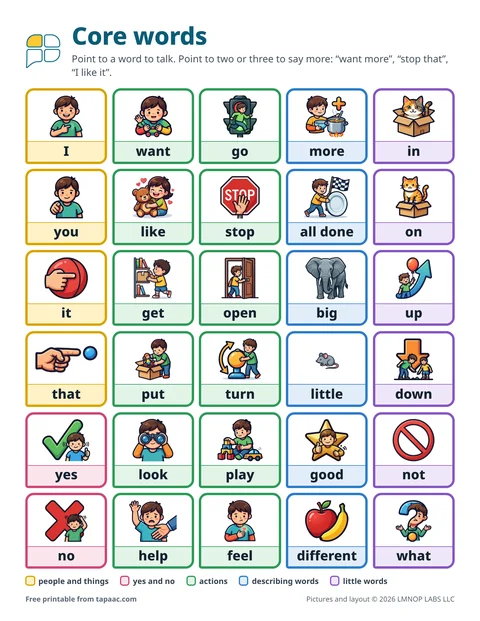 Core word board
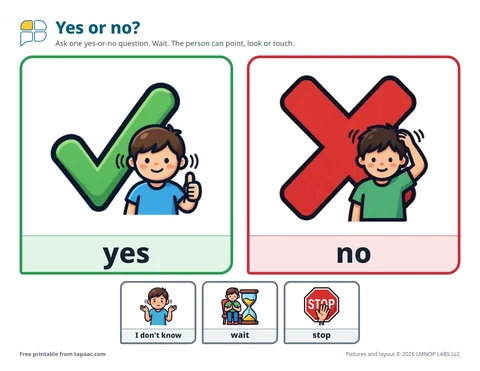 Yes and no board
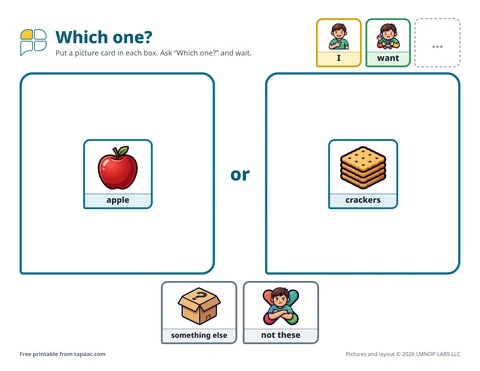 Choice boards
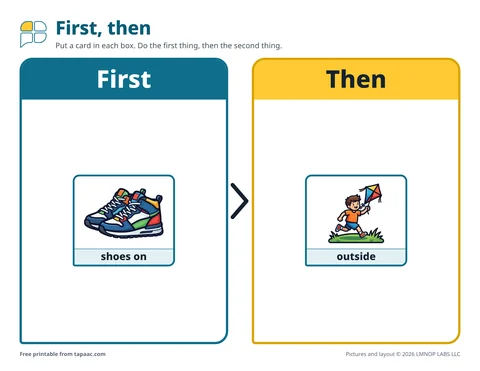 First-then board