 Tap AAC
What it is
Speech-generating devices translate words or pictures into speech. Some use a vocabulary of prerecorded words; others have an unlimited vocabulary and make speech as words are typed in; and software can turn a personal computer into a speaking device.1 They belong to high-tech AAC, along with communication apps, text-to-speech, and single-message and recordable devices. A person may use one form of AAC or combine paper, signs and a device.2 For the bigger picture, start with what is AAC.
Recorded voices and computer voices
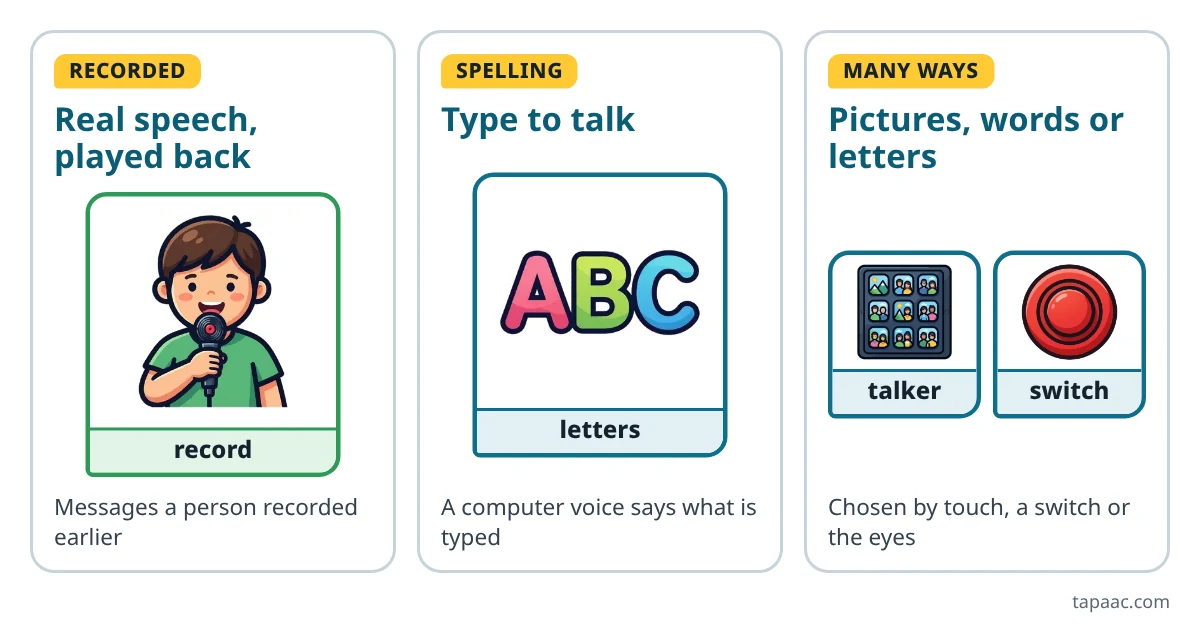
Devices use digitized speech, synthesized speech, or both. The professional guidance compares them:2
| Recorded (digitized) | Computer voice (synthesized) | |
|---|---|---|
| What it is | Real speech, recorded and played back | Speech the device makes from letters, words or symbols |
| How natural | More natural | Less natural |
| New messages | Only what was recorded | Can say new messages |
| Languages | Can be the person’s own voice, languages and dialect | Can speak in several languages |
| Storage | Needs more memory | Needs less |
With voice banking and message banking, a person who is losing their speech can keep their own voice in their AAC. See AAC for adults.
How Medicare defines one
For Medicare, a speech-generating device is durable medical equipment that lets a person with a severe speech impairment meet their functional speaking needs, used only by that person. There are four kinds: prerecorded messages; a computer voice where messages are spelled and the device is touched directly; a computer voice with several ways to make messages and several ways to reach the device; and software that lets a computer or other electronic device speak. Sending email, text or phone messages counts as a covered feature.3
The supplier rules spell out the most flexible kind: “several ways to make messages” means two or more of letters, words, pictures or symbols, and “several ways to reach it” means two or more ways of access, such as touching a keyboard or touch screen, or an access device like a joystick, a head mouse, a switch or a scanning device.4 Eye tracking accessories are covered when a person has a demonstrated medical need for them.5
Dedicated devices and tablets
A dedicated device is built for communication. Medicare’s rules say a device made from tablet, smartphone or computer hardware must be designed by its manufacturer to work only as a speech-generating device when it is first issued, and that ordinary desktops, laptops, tablets and smartphones aren’t durable medical equipment, even though they may serve a medical purpose.4 A device doesn’t have to be limited to speaking out loud, as long as it is limited to the person and used mainly to produce speech.3
A non-dedicated system is an ordinary tablet, phone or computer running an AAC app. The professional guidance treats tablets, apps and computers as non-durable, non-dedicated devices, and payers’ coverage of them varies.2
Two reviews of tablets used as speech devices looked at autistic people. A 2015 systematic review found that participants who used tablets or portable media players as speech-generating devices learned new communication quickly; in studies that compared them with exchanging picture cards or with manual signs, learning was often quicker on the tablet, and most participants preferred it.6 A 2024 meta-analysis of 31 single-case studies, with 84 autistic participants, found large to very large improvements in requests and in responses to what others said, and moderate improvements in naming things and in vocalizing.7 Neither review compared tablets with dedicated devices.
Questions to weigh
| Question | Dedicated device | AAC app on a tablet |
|---|---|---|
| Who might pay? | Medicare, Medicaid or insurance can treat it as medical equipment, after an evaluation2 | Coverage of tablets and apps varies; Medicare may pay for the speech software but not the tablet4 |
| What else does it do? | Made for communication; Medicare doesn’t pay for extras such as games, documents or video calls3 | Everything a tablet does, which is handy and can distract; Android can pin one app to the screen8 |
| Ways to reach it | Ask which ways of choosing it supports: touch, switches, scanning, eye gaze, and which accessories are needed | |
| Repairs | Ask about the warranty, how long repairs take, who pays, and whether there is a loaner | |
| Upgrades | Medicare doesn’t pay for upgrades within the device’s 5-year useful lifetime4 | Depends on the app maker and the tablet |
| Trying it first | State assistive technology programs lend devices for a short time9; ask whether an app has a free trial | |
The hardware is only part of it
An AAC system is a group of parts that work together: the form of AAC, the symbols, how the person selects, and strategies. A well-designed system is flexible, and its vocabulary and way of access can change as the person’s language and physical needs change.2 Whichever box you choose:
- Choose features from the person’s needs, through an AAC evaluation, not from the device.
- Check the words: does it have the small core words used all day, as well as names of things?
- Plan who will set it up, add words and teach the people around the person.
- Keep a paper copy of the main page for when the device is charging or away: see low-tech AAC.
Where Tap AAC fits
Tap AAC is an AAC app for Android tablets and phones, so it is a non-dedicated option: it shares the tablet with everything else, which is why it can keep itself on screen with screen pinning and protect editing with a PIN. It isn’t a medical device, and we don’t bill Medicare, Medicaid or insurance. If the person needs a funded device, read how to get an AAC device; to compare apps, read how to choose an AAC app.
Try this today
- List what the person needs a device to do: talk face to face, send texts, work with a switch, be loud enough.
- Ask your state assistive technology program which devices it lends.
- Print a backup board for the times a device is charging.
- Ask the speech-language pathologist which features matter most for this person.
More AAC guides
- What is an AAC evaluation? What to expect, and how to prepareWho does it, what they look at, trying devices, how to prepare and what to ask.
- How to get an AAC device: Medicaid, Medicare, insurance and schoolThe evaluation first, then Medicaid, Medicare, insurance, the school or a state loan program (US).
- How to choose an AAC app: questions to ask before you buyStart with the person, try before you buy, and the questions to ask about any app.
- AAC and cerebral palsy: touch, switches, eye gaze and partner-assisted scanningWays to choose when pointing is hard: touch, switches, eye gaze and partner-assisted scanning.
- AAC for adults: after a stroke, with ALS or MND, and in the hospitalAfter a stroke, with ALS or MND, and in the hospital: what helps, and when to plan.
Sources
We read each of these on October 13, 2026. Numbers in the text point to them.
- National Institute on Deafness and Other Communication Disorders (NIH). Assistive Devices for People with Hearing, Voice, Speech, or Language Disorders. Last updated November 12, 2019.
- American Speech-Language-Hearing Association. Augmentative and Alternative Communication (Practice Portal). Professional guidance for speech-language pathologists. Accessed October 12, 2026.
- Centers for Medicare & Medicaid Services (CMS). National Coverage Determination: Speech Generating Devices (50.1). Accessed October 12, 2026.
- Centers for Medicare & Medicaid Services (CMS), Medicare Coverage Database. Speech Generating Devices (SGD) - Policy Article (A52469). Revision effective October 1, 2024.
- Centers for Medicare & Medicaid Services (CMS), Medicare Coverage Database. Local Coverage Determination: Speech Generating Devices (SGD) (L33739). The rules used by Medicare’s equipment contractors; revision effective October 1, 2024.
- Lorah ER, Parnell A, Whitby PS, Hantula D (2015). A Systematic Review of Tablet Computers and Portable Media Players as Speech Generating Devices for Individuals with Autism Spectrum Disorder. Journal of Autism and Developmental Disorders, 45(12), 3792–3804. Abstract on PubMed.
- Muharib R, Walker V, Dunn W (2024). Effects of Interventions Involving Tablet-Based Speech-Generating Devices for Individuals with ASD: A Meta-analysis. Journal of Autism and Developmental Disorders, 54(12), 4496–4514. Abstract on PubMed.
- Android Help (Google). Pin & unpin screens. Accessed October 13, 2026.
- National Assistive Technology Act Technical Assistance and Training (AT3) Center. AT Act Programs (directory of state and territory programs). Accessed October 12, 2026.
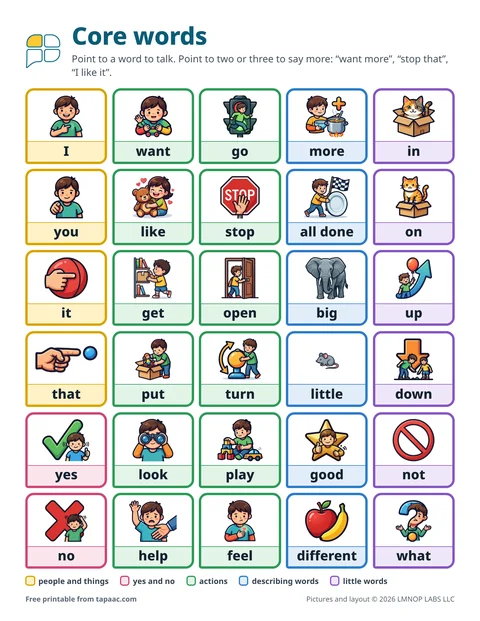 Core word board
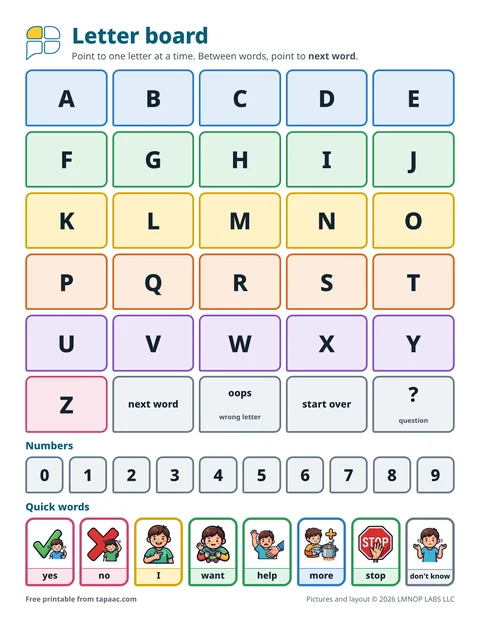 Alphabet board
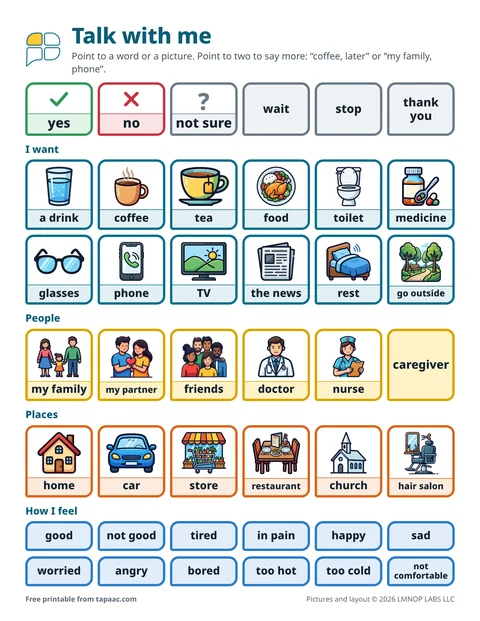 Communication board for adults
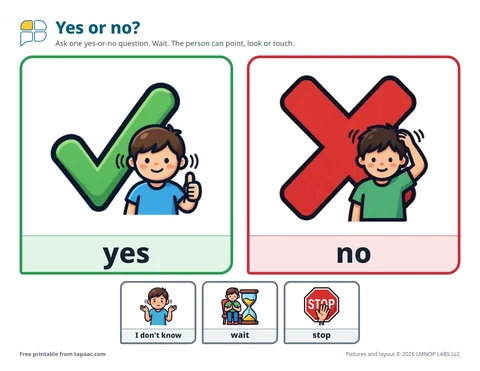 Yes and no board