 Tap AAC
What is covered depends on the plan, the state and the person’s needs, and the rules change. Use this guide to know what to ask, then check with the plan, the state Medicaid agency or the school team. Outside the US, ask your speech and language therapy service how devices are provided where you live.
The main routes at a glance
| Route | What it can pay for | First step |
|---|---|---|
| Medicaid | Medical equipment that is medically necessary; for under-21s, any medically necessary service federal Medicaid law allows1 | An evaluation, and a request through the state’s process |
| Medicare Part B | Speech-generating devices as durable medical equipment, for a severe speech impairment2 | A formal evaluation by a speech-language pathologist |
| Private insurance | Varies a great deal from plan to plan3 | Ask the plan what it covers and what it needs |
| The school (IEP) | Assistive technology a child needs for school, at no cost to the family4 | Ask the IEP team to consider it |
| Early intervention | Assistive technology for children under 3, written into the family’s plan4 | Ask the service coordinator |
| State AT program | Short loans, demonstrations, reused devices and financial loans5 | Find your state’s program |
Step 1: an evaluation by a speech-language pathologist
For health coverage, the speech-language pathologist (SLP) has to show that the device is medically necessary, and checks what the person’s own plan covers. Some payers want the evaluation to compare several devices that aren’t all from the same maker or product line.3 Device companies may help with funding questions and paperwork, but that doesn’t replace a full AAC evaluation, and an SLP writing a funding request must disclose any financial relationship with a device maker.3
Our guide to what happens in an AAC evaluation explains what it covers and how to prepare. To find an SLP, ask the person’s doctor or school, or search the American Speech-Language-Hearing Association’s ProFind directory.6
Medicaid
Children and young people under 21
Medicaid’s Early and Periodic Screening, Diagnostic and Treatment benefit (EPSDT) is for children under 21 who are enrolled in Medicaid. States must provide the services federal Medicaid law allows them to cover when they are medically necessary to treat, correct or reduce a health condition, whether or not the service is in the state’s own Medicaid plan. Each state decides medical necessity case by case.1
Adults, and how equipment is covered
Home health services are a mandatory Medicaid benefit,7 and under the federal rule they include medical supplies, equipment and appliances. That rule also says:8
- state coverage of equipment isn’t limited to what Medicare covers as durable medical equipment
- a state may keep a list of pre-approved equipment, but it can’t have absolute exclusions: it must have a way to ask for items that aren’t on the list, judged by reasonable and specific criteria
- if the state turns down a request, it must tell you about your right to a fair hearing
- a doctor or other licensed practitioner reviews the need for the equipment every year
Each state runs its own program, and the professional guidance sends speech-language pathologists to their own state’s Medicaid guidelines,3 so ask the state agency or the person’s Medicaid plan what it needs before the paperwork starts.
Medicare
Medicare covers speech-generating devices as durable medical equipment for people with a severe speech impairment and a medical condition that warrants one.2 Under Part B, after the Part B deductible you pay 20% of the Medicare-approved amount if the supplier accepts assignment, and Medicare only pays for equipment from suppliers enrolled in Medicare.9
The rules Medicare’s equipment contractors use list what must happen first. Among them:10
- a formal, written evaluation by a speech-language pathologist before the device is delivered
- the medical condition causes a severe expressive speech impairment, and natural ways of communicating can’t meet the person’s speaking needs
- other forms of treatment have been considered and ruled out
- a copy of the evaluation goes to the person’s treating practitioner before the device is ordered
- the SLP who does the evaluation can’t be employed by the supplier or have a financial relationship with it
Three more things to know:
- Tablets. Computers and tablets generally aren’t durable medical equipment, because they are useful to people who aren’t ill or injured.2 Medicare can pay for speech software installed on a general tablet or computer, but not for the tablet or computer itself.11
- Extra features. Features the person doesn’t need for speaking, such as games, documents or video calls, aren’t covered, and their cost is the person’s own.2
- Upgrades and settings. Upgrades within the device’s 5-year useful lifetime aren’t covered,11 and Medicare may not cover AAC devices in every setting, such as a skilled nursing facility or hospice.3
If Medicare says no, you can appeal. There are generally five levels, and each decision letter explains how to go to the next. Your State Health Insurance Assistance Program (SHIP) gives free counseling to people with Medicare.12
Private health insurance
Plans and companies differ a great deal on AAC devices, so the professional guidance tells SLPs to check with the insurer before starting. The Affordable Care Act prohibits disability-based discrimination in insurance policies for essential health benefits, which often include speech-generating devices. Tablets, apps and computers count as non-durable, non-dedicated devices, and payers vary on whether they cover them.3
Questions to ask the plan:
- Are speech-generating devices covered, and under which benefit, such as durable medical equipment?
- Is prior authorization needed, and what paperwork: the evaluation, a prescription, a price quote?
- Which equipment suppliers are in network?
- What will we pay: the deductible, coinsurance, any yearly limit on equipment?
- Are accessories covered? The SLP documents why each is needed, and they can include a case, keyguard, stylus, amplification, a joystick, or a mount or stand.3
- Who pays for repairs, and is there a loaner while the device is away?
If the insurer refuses to pay, you have the right to an internal appeal, a full and fair review by the insurer. You also have the right to an external review by an independent third party, which means the insurer no longer has the final say.13
Through the school
If a child’s IEP team decides the child needs assistive technology to receive a free appropriate public education, the school must provide and fully fund it.4 The school may bill Medicaid or your private insurance for services in the IEP, but only on your terms. Under the federal rule, the school:14
- can’t require you to sign up for Medicaid or another public benefit for your child to get a free appropriate public education
- can’t make you pay a deductible or co-pay for it
- can’t use your child’s Medicaid if that would reduce lifetime coverage, raise premiums, risk a home and community-based waiver, or leave you paying for services your child needs outside school time
- needs your written consent before billing Medicaid for the first time, and your consent each time it wants to use your private insurance
- must still provide the services at no cost to you if you say no
Ask what happens to a school-bought device at weekends, over the summer, at a change of school and after graduation. The school must let it go home case by case, when the IEP team decides the child needs it there,15 and the professional guidance lists device ownership after school as something to plan for.3 AAC and the IEP covers evaluations, home use and the meeting itself.
Children under 3: early intervention
Under Part C of IDEA, assistive technology devices and services are early intervention services. When the family’s IFSP team decides a device is needed, it must be provided at no cost, unless the state has an approved system of payments, such as family fees or the use of insurance.4 See AAC for toddlers.
Try before you buy: state assistive technology programs
Every state and territory has an assistive technology program funded under the federal Assistive Technology Act.3 Through it, families and school teams can talk to a specialist about devices, see one demonstrated, borrow one for a short time, and learn about buying through the school or about financing and loan options.4 The national directory lists each program with its device loan, demonstration, reuse and financial loan contacts.5
Borrowing helps because whether a particular device will work may not be clear at the first assessment;3 a short loan lets the person try it at home, at school or at work.
While you wait
Funding can take time, and communication can’t wait for it. Paper boards are usually made by the SLP and don’t usually need funding of their own.3 Start now with the free printable boards, the core word board and the core words plans, or make your own in the free board maker. Later, keep one as a backup for when the device is away. More in low-tech AAC.
Where an app like Tap AAC fits
Tap AAC is an app for Android tablets and phones that a family pays for itself through Google Play: free for 30 days, then $29.99 once. It isn’t a medical device, and we don’t bill Medicare, Medicaid or insurance. It can be a first step while you wait, a second system at home, or a backup. It doesn’t replace an evaluation, and a funded device chosen with an SLP may suit the person better. For the difference between the two, read what is a speech-generating device.
Try this today
- Find the health plan documents and look for “durable medical equipment” or “speech-generating device”.
- Ask the doctor or the school for an AAC evaluation by a speech-language pathologist.
- Look up your state’s assistive technology program and ask about borrowing a device.
- Print a free board to use while you wait.
More AAC guides
- What is an AAC evaluation? What to expect, and how to prepareWho does it, what they look at, trying devices, how to prepare and what to ask.
- What is a speech-generating device? Dedicated devices and tablets comparedRecorded and computer voices, dedicated devices versus apps on a tablet, and what Medicare covers.
- AAC and the IEP: what parents can ask forWhat IDEA says about assistive technology, and what to ask about evaluations, goals, home use and training.
- How to choose an AAC app: questions to ask before you buyStart with the person, try before you buy, and the questions to ask about any app.
- AAC for adults: after a stroke, with ALS or MND, and in the hospitalAfter a stroke, with ALS or MND, and in the hospital: what helps, and when to plan.
Sources
We read each of these on October 13, 2026. Numbers in the text point to them.
- Medicaid.gov (Centers for Medicare & Medicaid Services). Early and Periodic Screening, Diagnostic, and Treatment. Accessed October 13, 2026.
- Centers for Medicare & Medicaid Services (CMS). National Coverage Determination: Speech Generating Devices (50.1). Accessed October 12, 2026.
- American Speech-Language-Hearing Association. Augmentative and Alternative Communication (Practice Portal). Professional guidance for speech-language pathologists. Accessed October 12, 2026.
- U.S. Department of Education. Myths and Facts Surrounding Assistive Technology Devices and Services (PDF). January 2024.
- National Assistive Technology Act Technical Assistance and Training (AT3) Center. AT Act Programs (directory of state and territory programs). Accessed October 12, 2026.
- Communication Health Support Association, powered by the American Speech-Language-Hearing Association. Augmentative and Alternative Communication (AAC). Information for the public. Accessed October 12, 2026.
- Medicaid.gov (Centers for Medicare & Medicaid Services). Mandatory & Optional Medicaid Benefits. Accessed October 13, 2026.
- Electronic Code of Federal Regulations (eCFR). 42 CFR §440.70: Home health services. The federal Medicaid rule that covers medical equipment. Accessed October 13, 2026.
- Medicare.gov. Durable medical equipment (DME) coverage. Accessed October 13, 2026.
- Centers for Medicare & Medicaid Services (CMS), Medicare Coverage Database. Local Coverage Determination: Speech Generating Devices (SGD) (L33739). The rules used by Medicare’s equipment contractors; revision effective October 1, 2024.
- Centers for Medicare & Medicaid Services (CMS), Medicare Coverage Database. Speech Generating Devices (SGD) - Policy Article (A52469). Revision effective October 1, 2024.
- Medicare.gov. Filing an appeal. Accessed October 13, 2026.
- HealthCare.gov. How to appeal an insurance company decision. Accessed October 13, 2026.
- U.S. Department of Education, IDEA regulations. 34 CFR §300.154: Methods of ensuring services. Accessed October 13, 2026.
- U.S. Department of Education, IDEA regulations. 34 CFR §300.105: Assistive technology. Accessed October 12, 2026.
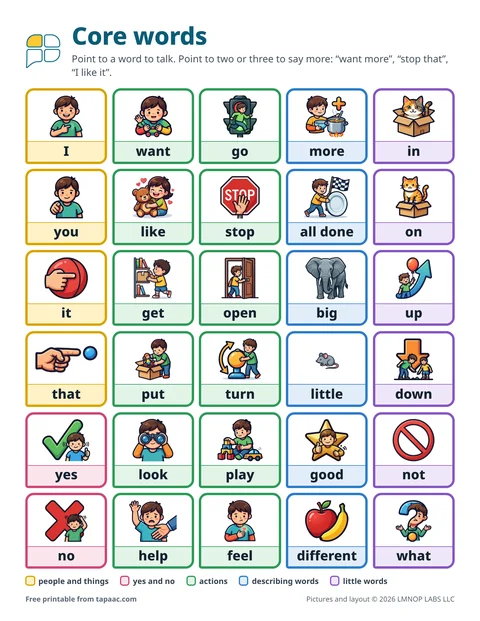 Core word board
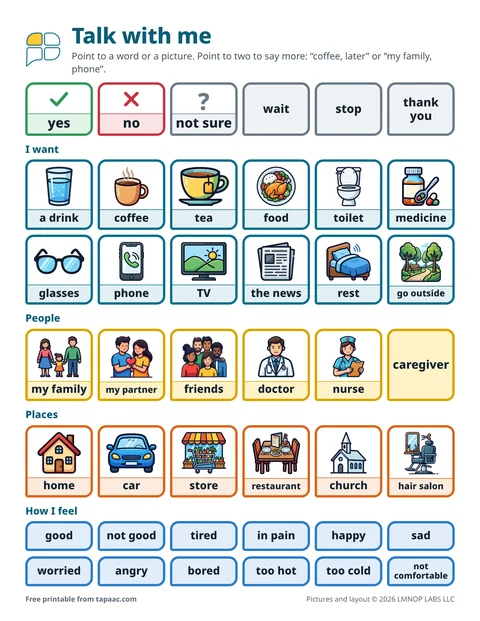 Communication board for adults
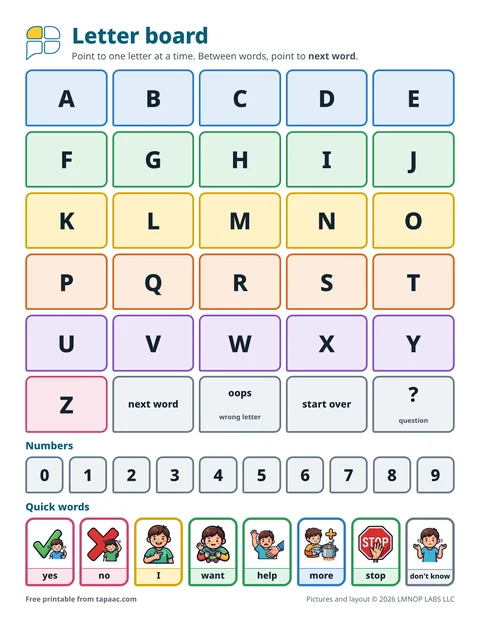 Alphabet board
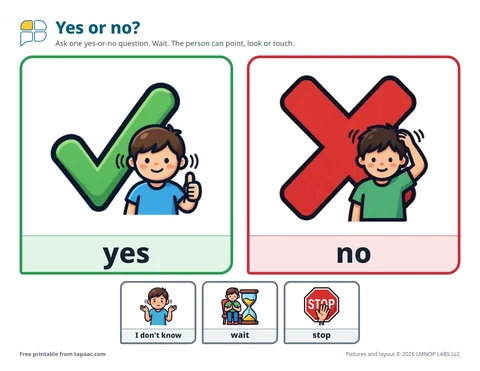 Yes and no board