 Tap AAC
Core word board: free printable PDF
A core word board is one page of small words that work almost anywhere: I, want, more, stop, go, help. This free board has 30 of them, each with a picture. Point to the words while you talk, and the person can point to them too, to say what they mean.
Download the free PDF US Letter, 1 page, 1,058 KB
Portrait (tall page, 1 page): US Letter PDF (1,058 KB) · A4 PDF (1,058 KB)
Landscape (wide page, 1 page): US Letter PDF (1,058 KB) · A4 PDF (1,058 KB)
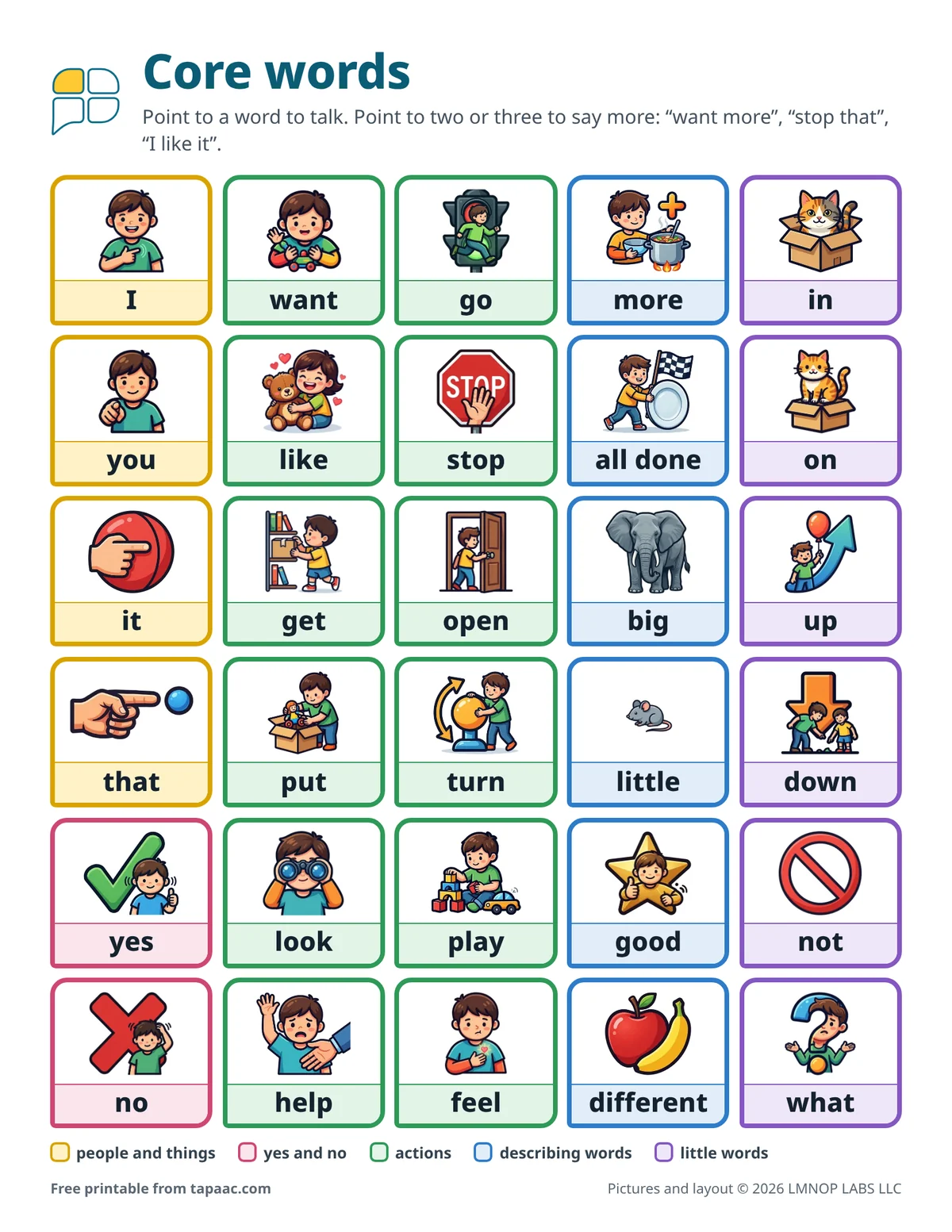
Edit this board in the free board maker: change the words and pictures, then print.
Have Tap AAC? Add to Tap AAC (.obz file, 991 KB) · How to add a board
- Free
- No sign-up
- Print as many as you need
Who it’s for
Anyone starting to communicate with pictures: young children who are just beginning with AAC, older children and adults who don’t speak or don’t speak much, and the parents, teachers and speech therapists who talk with them. It’s also a backup for someone who already uses a talker or a tablet. Paper works in the bath, at the pool and when the battery is flat, and the words are the same ones the person uses all day.
Why core words
A board of things, like apple, ball and car, only helps where those things are. Core words like more, stop, help, go and not work at breakfast, in the bath, on the playground and in the classroom, and they combine: want more, go up, not that. That’s why this board has no food or toys on it. Pair it with a topic board for the things, like the mealtime communication board. New to the idea? Read what a core word board is.
The same words, all day
- Snack time: more, all done, open, help, different.
- Play: go, stop, turn, up, down, look.
- Art time: more, different, big, little, put, on. The art communication board adds the paint, the glue and the scissors.
- Story time: look, what, turn the page, more, all done. On a trip to the library, the library communication board adds books and quiet words.
- Getting dressed: put, on, in, help, not that one.
How to use it
- Pick a few words to start. Choose two or three that fit your day, like more, stop and go. You don’t have to use all 30.
- Point while you talk. Say “Want more?” and point to want and more. This is called modeling. You don’t need to point to every word you say, and you don’t need to ask the person to copy you.
- Use it all day. The same words work at snack, at play, in the bath and in the car. That is what makes them core words.
- Wait, then answer. Give extra time. If the person points to stop, stop, even if you aren’t sure it was meant. That’s how a word gets its power.
- Put two words together. When one word comes easily, show two: “want more”, “go up”, “stop that”, “I like it”.
Children and adults
Core words aren’t baby words: adults say I, want, not and different as often as children do. A teenager or an adult can use the same board to talk about grown-up things: “I like that song”, “not now”, “look, it’s good”. An adult who can spell can keep the alphabet board next to it, for the words that aren’t here. For an adult who prefers grown-up pictures and topics, try the communication board for adults.
Ella is three and has just started with the board. At snack time her dad points as he talks: “Want more?”, touching want and more. He waits. Ella reaches for the crackers, so he points to more again and hands her one. After a week of snacks, Ella slaps more before he asks. That evening the bubbles in the bath run out, and she taps more again: the same word, in a new place.
What’s on the PDF
One page with 30 words in five columns of six, read from top to bottom, and a color key along the bottom. Each kind of word has its own color, so the eye finds it faster. The colors print best on a color printer.
- Yellow: people and things. I, you, it, that
- Pink: yes and no. yes, no
- Green: actions. want, like, get, put, look, help, go, stop, open, turn, play, feel
- Blue: describing words. more, all done, big, little, good, different
- Purple: little words. in, on, up, down, not, what
Printing tips
- Print on card stock if you have it. Laminate the page, or slide it into a sheet protector, so it can be wiped clean.
- Print several copies: one for the kitchen, one for the car, one for the school bag.
- Keep every copy the same. When a word is always in the same place, the hand learns where it is.
- Teaching one word at a time? Try the core word of the week plans, or print 52 core word cards with pictures and a list for the fridge.
More free boards
-
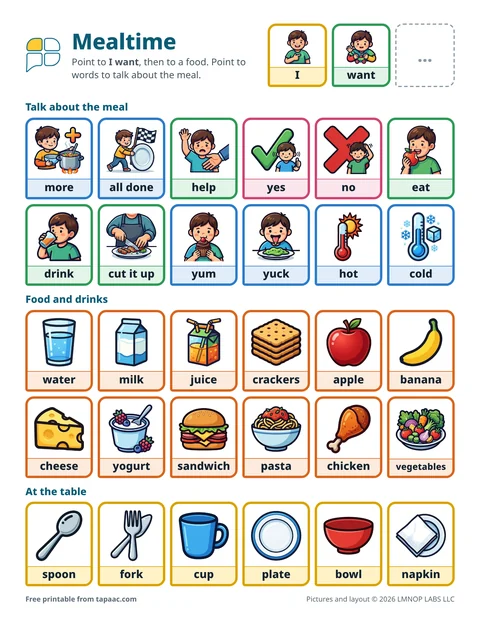 Mealtime communication boardMore, all done, yum, yuck, 12 foods and drinks, and the things on the table.
-
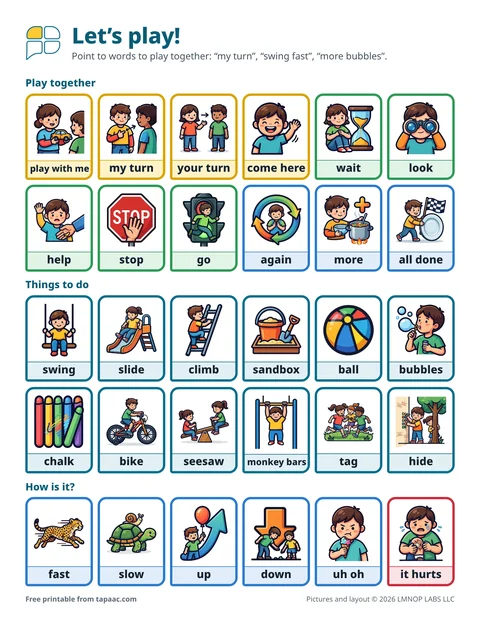 Playground communication boardMy turn, your turn, swing, slide, fast, again and more, for playing together.
-
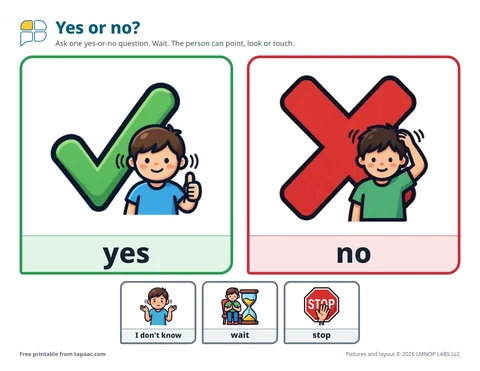 Yes and no boardA big yes and no to point to or look at, plus 20 cards to cut out.
-
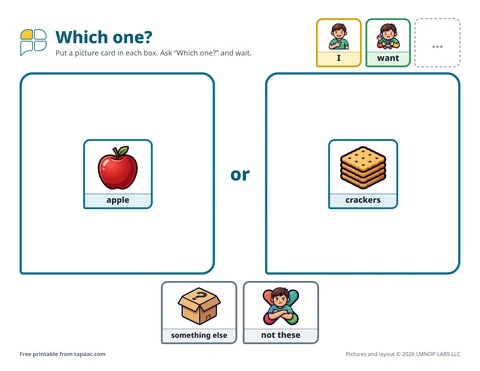 Choice boardsTwo-choice and four-choice boards, with 18 snack, drink and toy cards to cut out.
Need a different board? Make your own with the free AAC board maker.
These boards and guides are general information, not therapy or medical advice, and they don’t replace a speech therapist. A speech therapist who knows the person can help choose the right words, pictures and layout. The boards are free to print and share; please don’t sell them (terms of use). Questions about the boards? Email support@lmnoplabs.fun.