 Tap AAC
Needs board: free printable PDF
A needs board gives a quick way to ask for the basics: the bathroom, a drink, food, a break, help. This free board has 12 needs that finish the sentence “I need…”, plus quick words along the bottom: yes, no, stop, all done and it hurts.
Download the free PDF US Letter, 1 page, 745 KB
Portrait (tall page, 1 page): US Letter PDF (745 KB) · A4 PDF (746 KB)
Landscape (wide page, 1 page): US Letter PDF (745 KB) · A4 PDF (745 KB)
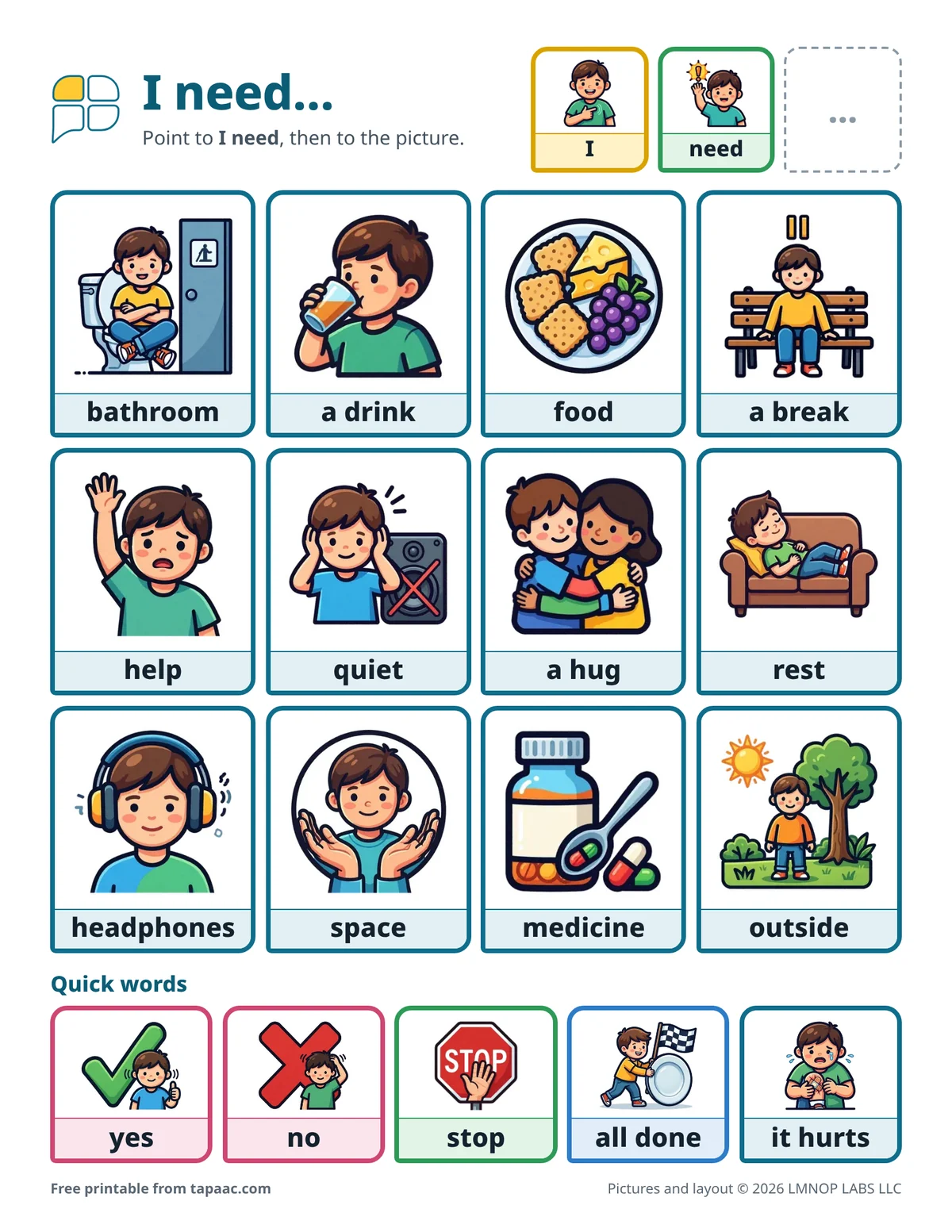
Edit this board in the free board maker: change the words and pictures, then print.
Have Tap AAC? Add to Tap AAC (.obz file, 691 KB) · How to add a board
- Free
- No sign-up
- Print as many as you need
Who it’s for
Anyone who can’t easily ask for the basics out loud: children and adults who don’t speak or don’t speak much, people whose speech is hard for others to understand, and people who lose their words when they’re tired, upset or in pain. It suits a person who can point to a picture, look at it, or say yes when a partner points to it. Parents, teachers, aides and care staff can all use the same board, so a need is understood the same way everywhere.
When a needs board helps
- Before outings: a look at bathroom, a drink and food before the car, the bus or the store can head off a hard moment later.
- At school or work: a break, quiet, headphones and space let a person say the room is too much before it becomes too much.
- At bedtime and on sick days: rest, medicine and a hug are within reach when talking is hardest.
- With new people: a babysitter, a substitute teacher or a new caregiver can read the board on day one.
How to use it
- Keep it where needs come up. At the table, in the classroom, in the car, by the bed. A board in a drawer can’t be used.
- Show how it works. Point to the words when you name your own needs: “I need a drink,” pointing to I, need and a drink. This is called modeling.
- Offer it at the right moment. Before you leave the house, ask “Bathroom?” and point to bathroom.
- Answer fast. When the person points to a need, meet it if you can, right away. That shows the board works.
- If you can’t, say why and when. “Food after reading.” A first-then board can show it, and a wait card helps with “not yet”.
- Use yes and no to check. Ask “Do you need a break?” and hold the board so yes and no are easy to reach.
The quick words
The row along the bottom is for moments when there’s no time to look for a picture. Answer stop and it hurts quickly, every time, even if you aren’t sure it was meant: a person who finds that stop works has a way to say it without pushing away. All done ends an activity without a fuss. If someone points to it hurts, the where does it hurt board can help find out where and how much.
Children and adults
The pictures are plain, so the board works for an adult as well as a child. With a child, expect to do most of the pointing at first, showing the words through the day. With an adult who used to talk, after a stroke for example, treat the board as a shortcut, not a lesson: hold it up, ask, and let them choose. In the hospital, the hospital communication board adds the nurse, water and a pain scale; at home, the communication board for adults has grown-up pictures and topics.
Kai is nine and doesn’t use much speech. In the noisy lunchroom he used to cover his ears and slide under the table. Now his aide keeps the needs board on his tray. Today he taps I, need, then headphones. She hands them over: “Headphones. Thanks for telling me.” Ten minutes later he points to all done and outside, and they walk out to the playground together.
What’s on the PDF
One page, headed I need…, with the words I and need to point to first. The 12 needs are teal. The quick words use the colors of the core word board: pink for yes and no, green for stop and blue for all done.
I need
- bathroom
- a drink
- food
- a break
- help
- quiet
- a hug
- rest
- headphones
- space
- medicine
- outside
Quick words
- yes
- no
- stop
- all done
- it hurts
Printing tips
- Laminate it, or slide it into a sheet protector, so it can be wiped clean.
- Swap a picture for something personal: glue a photo of their own cup, or of the bathroom door at school, over the picture.
- Print copies for school, the car and the grandparents’ house, and show each person how it’s used. Keep every copy the same, so the hand learns where each need is.
- Need words that aren’t here? Change them in the board maker with the edit link at the top of this page, or read how to make a communication board.
More free boards
-
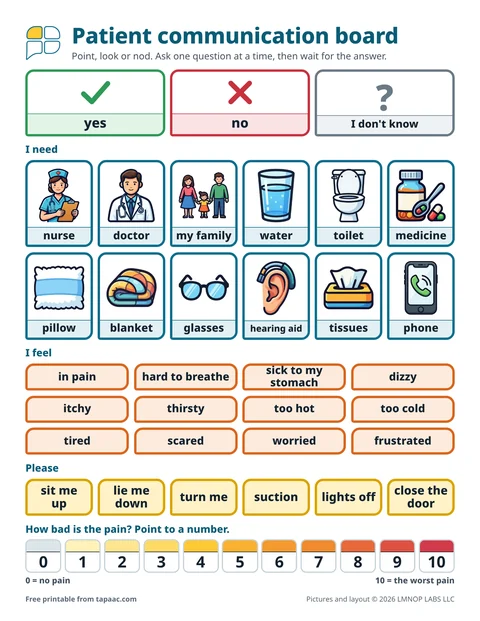 Hospital communication boardFor adult patients: needs, feelings, a 0 to 10 pain scale, letters and questions.
-
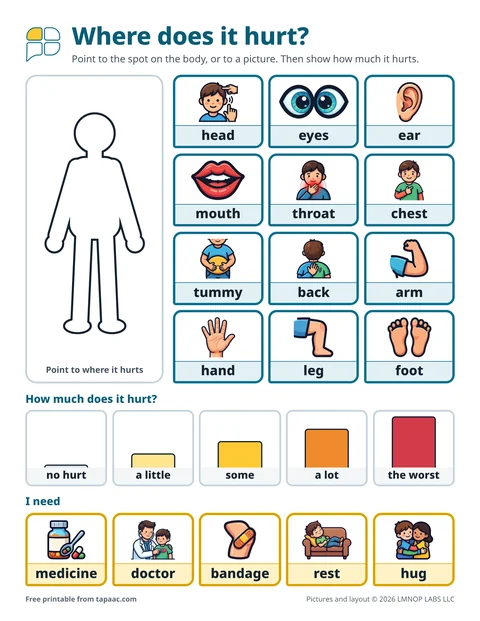 Where does it hurt boardA body outline, 12 body parts and a simple scale for how much it hurts.
-
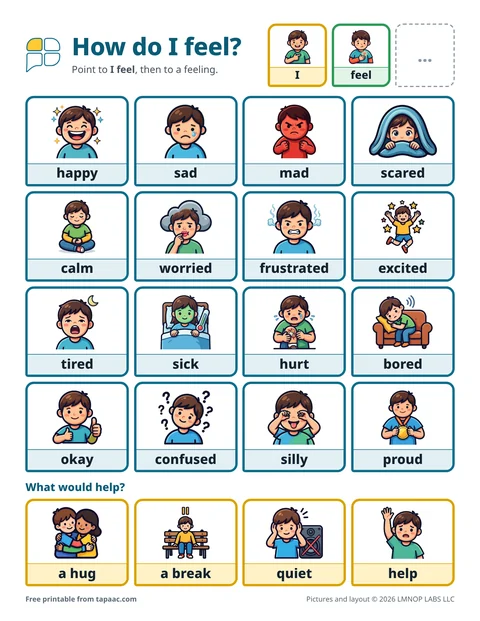 Feelings board16 feelings, from happy and calm to mad and worried, plus what would help.
-
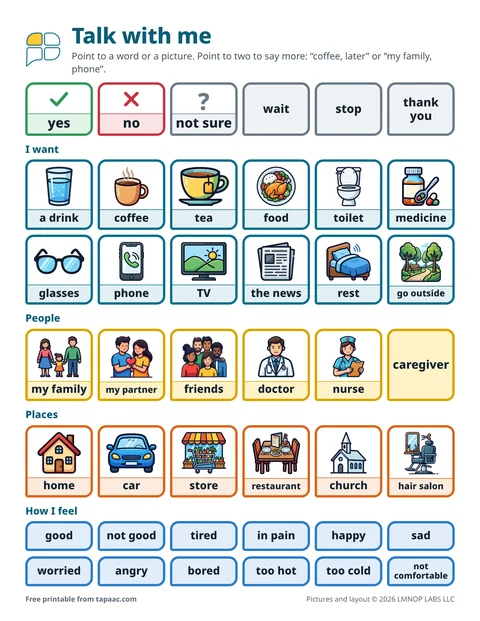 Communication board for adultsGrown-up pictures and plain words: wants, people, places, feelings, and a keyboard page for spelling.
Need a different board? Make your own with the free AAC board maker.
These boards and guides are general information, not therapy or medical advice, and they don’t replace a speech therapist. A speech therapist who knows the person can help choose the right words, pictures and layout. The boards are free to print and share; please don’t sell them (terms of use). Questions about the boards? Email support@lmnoplabs.fun.