 Tap AAC
These are the questions parents ask most often. For decisions about your own child, talk to a speech-language pathologist (SLP) who knows them.
Will AAC stop my child from talking?
The research so far says no. Three reviews have looked at this question:
- A 2006 review of AAC and speech in children and adults with developmental disabilities, most of them with intellectual disability or autism, found that none of the 27 cases in the strongest studies talked less after AAC. Most (89%) talked more, and the rest stayed the same. Most of the gains were modest.1
- A 2008 review of studies with autistic children concluded that AAC does not get in the way of speech. Most studies reported an increase in speech, but the gains were rather modest.2
- A 2021 review that updated it, with studies up to 2020, found that AAC overall led to improved speech in autistic children, but the speech gains did not overtake their use of AAC.3
So the honest summary is: AAC doesn’t hold speech back, and it may help a little, but it isn’t a promise that a child will talk. Its first job is to give your child a way to communicate today, whatever happens with speech.
The professional guidance for speech-language pathologists says the same: some families believe AAC reduces the motivation to speak, but AAC may help improve natural speech when it’s used alongside other ways of communicating.4
My child talks a bit. Do they still need AAC?
They might. “Augmentative” means adding to speech, not replacing it. AAC can help when speech is hard to understand, and people who use AAC can use both speech and AAC to talk to others.5
For example, a child might say “juice” and “out” clearly but have no way to say “I don’t like that” or “my tummy hurts”. Or a child might talk at home but find words much harder when they’re upset or somewhere new. AAC gives them a way through those moments. An SLP can look at what your child can and can’t say yet, and suggest what would help. The same is true for many autistic adults: see AAC for autistic adults.
Is my child too young, or not ready yet?
There’s no “ready”. Some parents and professionals think young children aren’t ready for AAC until school age, but the professional guidance says there are no prerequisites for AAC, that it should be considered as early as possible, and that early AAC use can help develop speech and language.4 Children younger than three can start, and no thinking skills, test scores or milestones are needed first.5 See AAC for toddlers for how to begin.
Which kind of AAC is best for an autistic child?
There isn’t one best kind. AAC is customized for each person,5 and the right choice depends on how your child moves, sees, hears and learns, what they love, and where they need to communicate. An SLP matches the features of a system to the child, and trying a device for a while is often part of deciding.4
Many families use a mix: a paper board in the bath and at the park, a speech app at home and at school, and the child’s own gestures and signs. Read how to get started with low-tech AAC and how to choose an AAC app. Schedules, first-then boards and timers help with understanding the day: see visual supports for autism at home.
How do I teach my child to use it?
By using it yourself. Point to words on your child’s board or app while you talk to them, in real moments, without asking them to copy you. This is called modeling (also augmented input or aided language stimulation).4 A 2018 review of 48 studies found that interventions with this kind of modeling were generally effective at improving the expressive communication of children and young people with complex communication needs.6
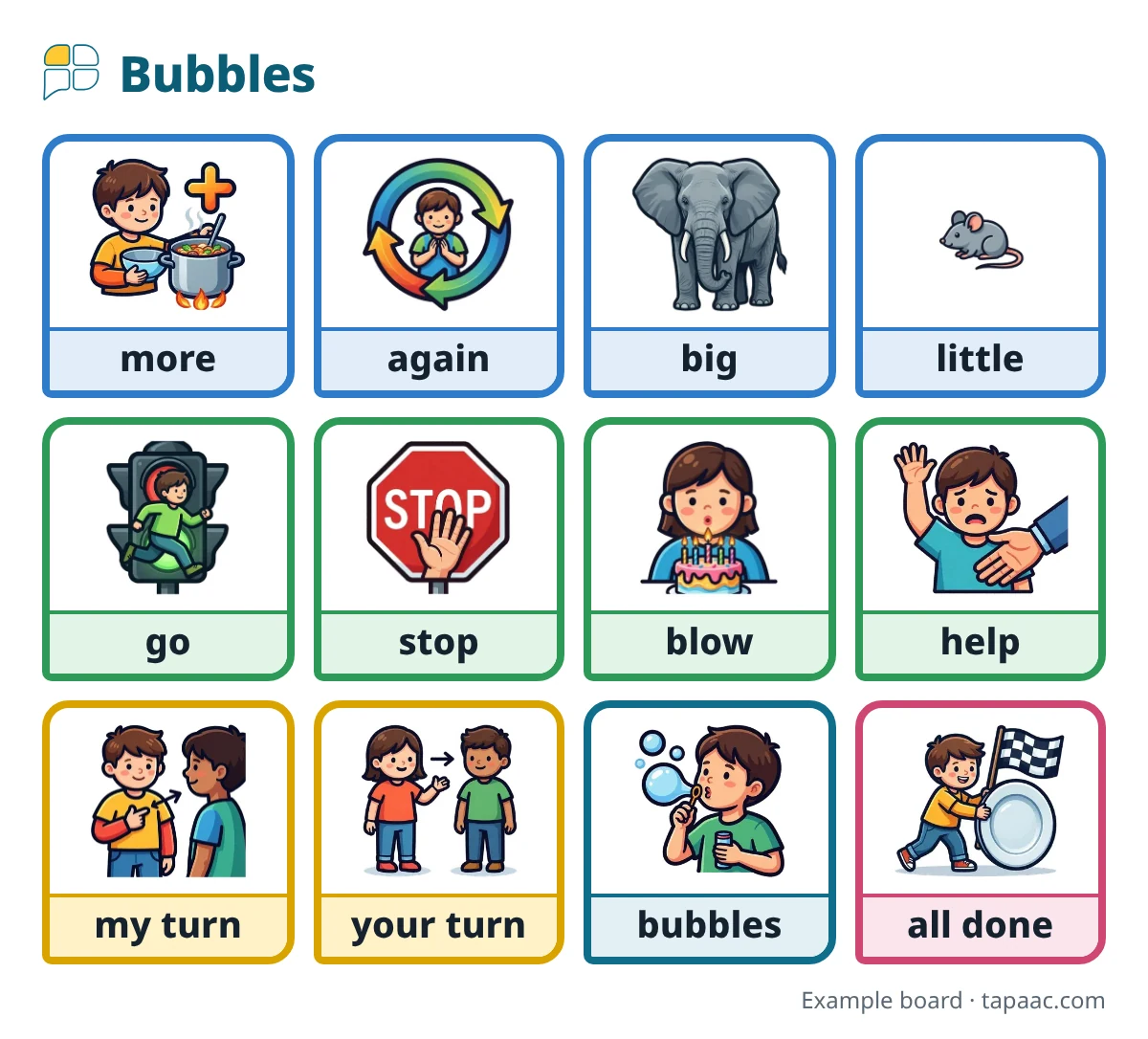
What it can look like with bubbles
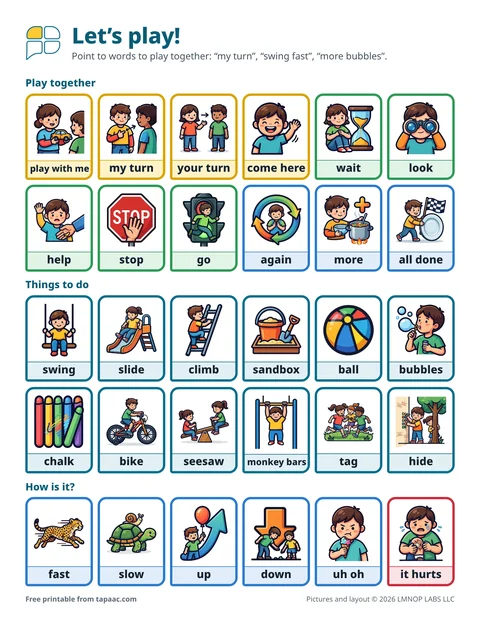
You blow bubbles. “Bubbles! More bubbles.” (Point to more, then blow again.)
(Stop, and hold the wand near your mouth. Look at your child. Wait.)
(Your child looks at the wand, then at you.) You: “More? More bubbles!” (Point to more, then blow.)
Later: “Uh oh, all gone. All done.” (Point to all done.)
- Follow their interests. Model words for the things your child already loves: trains, songs, spinning, water.
- Model, don’t test. Skip “Show me more.” Just use more yourself, again and again.
- Pause. Stop at a fun moment and wait. Give your child time to look, reach or touch.
- Answer every try as if it was meant. A touch on more gets more, straight away.
- Little and often. A few moments in each routine work better than one long lesson.
Our AAC modeling at home handout puts these habits on one page, the core word of the week plans give you one word to focus on at a time, and how to teach a child to use AAC covers modeling, waiting and responding in depth.
Should we save it for therapy, or limit it like screen time?
Neither. People who use AAC should always have access to their communication tools, and concerns about too much screen time don’t apply to screens used as part of an AAC system.4 Your child can only use AAC if it’s there when they have something to say: at meals, in the car, at bedtime and at the park.
For the same reason, don’t take it away as a consequence for behavior. It’s how your child talks. If the same tablet is also used for games and videos, ask your SLP about keeping the speech app on its own tablet, or locking the tablet to the app.
My child presses the same button over and over. Is that a problem?
Usually not. Pressing a button to hear what it says is one way children find out what the buttons do. Answer it sometimes as if it was meant (“Stop? OK, I’ll stop!”), and model another word next to it. If the sound becomes a problem in class, ask the SLP about volume settings rather than taking the device away.
What if my child doesn’t use it?
Give it time, and look at the setup with your SLP:
- Is it there? Within reach, charged, in every room, every day.
- Are the words worth saying? Add favorite things, people and activities. Personal, meaningful words make it more likely that a person keeps using AAC.4
- Can your child reach and see it? Button size, how many buttons there are, and seating all matter. Occupational and physical therapists can help with positioning.4
- Is everyone modeling? When families aren’t involved, AAC is more likely to be dropped, and too little training for the people around the child is a known barrier to using it.4
Try this today
- Pick one thing your child loves and choose three words for it, like more, go and stop.
- Model those words five times during that activity, without asking your child to copy you.
- Pause at the best moment, and wait ten seconds.
- Write down your questions for your child’s speech-language pathologist.
More AAC guides
- AAC myths and facts: 10 common myths, and what the research saysTen things people believe about AAC, and what research and professional guidance say instead.
- AAC for toddlers: when to start, and how to begin at homeStarting before your child talks: one routine, a few words, modeling and early intervention.
- Visual supports for autism at home: schedules, choices and timersSchedules, first-then boards, choice boards, timers and labels, and how to start at home.
- How to teach a child to use AAC: model, wait and respondModeling, waiting and responding in depth, with examples, and what to do when it isn’t working.
- Low-tech AAC: choosing and using boards, books and cardsBoards, books and cards with no batteries: which to choose, and how to use them every day.
- AAC at school: how teachers can support a student who uses AACModeling in lessons, wait time, better questions, classmates, and the IEP.
Sources
We read each of these on October 12, 2026. Numbers in the text point to them.
- Millar DC, Light JC, Schlosser RW (2006). The impact of augmentative and alternative communication intervention on the speech production of individuals with developmental disabilities: a research review. Journal of Speech, Language, and Hearing Research, 49(2), 248–264. Abstract on PubMed.
- Schlosser RW, Wendt O (2008). Effects of augmentative and alternative communication intervention on speech production in children with autism: a systematic review. American Journal of Speech-Language Pathology, 17(3), 212–230. Abstract on PubMed.
- White EN, Ayres KM, Snyder SK, Cagliani RR, Ledford JR (2021). Augmentative and Alternative Communication and Speech Production for Individuals with ASD: A Systematic Review. Journal of Autism and Developmental Disorders, 51(11), 4199–4212. Abstract on PubMed.
- American Speech-Language-Hearing Association. Augmentative and Alternative Communication (Practice Portal). Professional guidance for speech-language pathologists. Accessed October 12, 2026.
- Communication Health Support Association, powered by the American Speech-Language-Hearing Association. Augmentative and Alternative Communication (AAC). Information for the public. Accessed October 12, 2026.
- Biggs EE, Carter EW, Gilson CB (2018). Systematic Review of Interventions Involving Aided AAC Modeling for Children With Complex Communication Needs. American Journal on Intellectual and Developmental Disabilities, 123(5), 443–473. Abstract on PubMed.
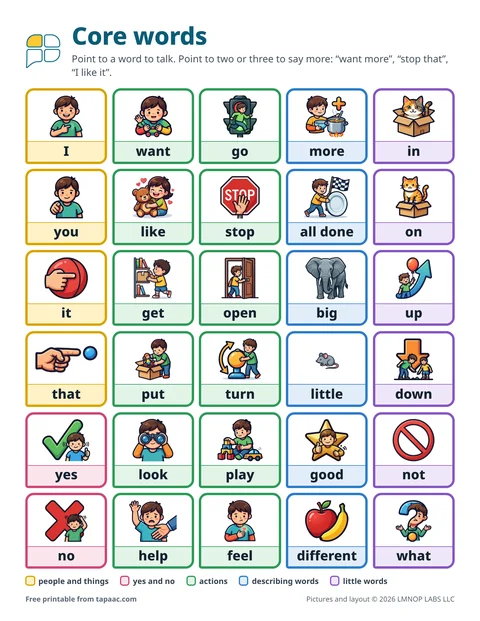 Core word board
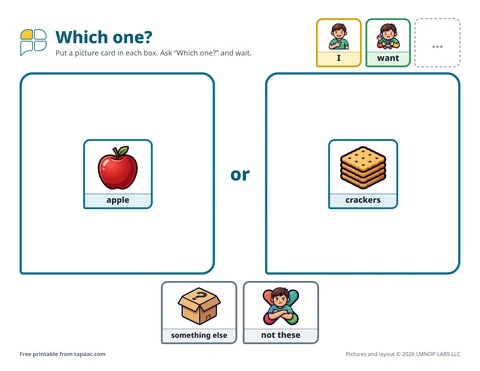 Choice boards
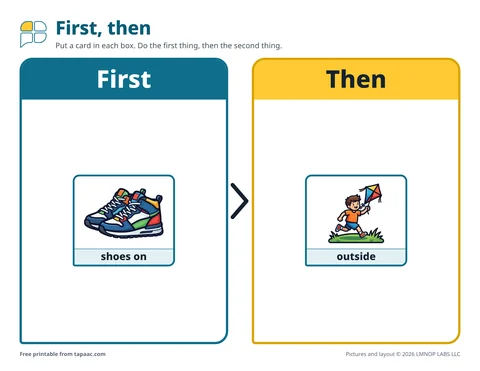 First-then board
 Playground communication board