 Tap AAC
What childhood apraxia of speech is
CAS is a neurological speech sound disorder in children. Reflexes are intact and muscle tone is typical, but planning and programming the timing, direction, force and order of speech movements is hard.1 The brain knows what it wants to say but can’t properly plan and sequence the movements. CAS isn’t caused by weak speech muscles; that is a different disorder, called dysarthria.2
Features that researchers broadly agree on include inconsistent errors when the same word or syllable is said again, choppy moves from one sound or syllable to the next, and stress and rhythm that sound unusual.1 A child may seem to grope for the right sound, and long words are usually harder than short ones. Children with CAS generally understand language much better than they can use it.2
There’s no single sign or test that diagnoses CAS,2 so diagnosis takes a speech-language pathologist, and often time. In children under three, a clinician may write that CAS is “suspected” or “can’t be ruled out” and treat it as if it is there. Children don’t grow out of CAS, but they can improve with speech and language services.1
Speech therapy comes first
Improving speech takes a lot of practice. Frequent, intensive, one-on-one therapy is needed, and children with severe CAS may need it for years; support from family and extra practice at home are important too.2 Early treatment is also recommended for children who are only suspected of having CAS.1
AAC doesn’t replace any of this. It answers a different question: how does your child get their message across today, while speech is still hard?
Where AAC fits
The professional guidance names two ways that treatment for CAS improves communication: working on speech itself, and, when it’s needed, AAC such as gestures, manual signs, voice output devices and communication boards for particular activities.1 When a child with CAS can’t communicate well enough by speech alone, AAC can give them a way to communicate that supports and enhances their speech at the same time, and it may help them develop language skills they can’t yet practice out loud.1
For children and adults with severe apraxia, the US National Institute on Deafness and Other Communication Disorders gives examples: sign language, a notebook of pictures or written words to point to, or a phone, tablet or laptop that writes or speaks. It adds that these methods can also help children with apraxia learn to read and better understand spoken language.2
Research on AAC for CAS in particular is still small. A 2026 scoping review found 11 studies from twenty years. All of them suggested that starting AAC early may give children with CAS better communication outcomes, and the therapy studies showed AAC playing a complementary role alongside speech treatment.3
Will AAC make my child stop trying to talk?
Many parents worry about this. Research on CAS alone is limited, but research across children and adults with developmental disabilities hasn’t found that AAC reduces speech. A 2006 review found that none of the people in the best-designed studies spoke less after AAC was introduced, and most spoke a little more.4
Speech and AAC can be used side by side: your child tries a word, and if you don’t get it, shows you. Ask your child’s speech-language pathologist how they’d like the two to work together at home, for example when to encourage another try at a word and when to go straight to the board.
Which kind of AAC?
- Gestures and signs need no equipment and are always there. But some children with CAS also have apraxia in their hands and arms, which can make signing hard,1 so watch whether your child’s signs are easy for others to read.
- Picture boards for one activity are quick to make and fit in a pocket. Start with a few core words and the things that matter in that activity.
- A speech app or device says the word the same way every time, strangers can understand it, and it holds many more words than a board.
- Letters, once your child is learning to spell: an alphabet board, or the keyboard in a speech app.
Many children use a mix, and it can change as speech improves. A speech-language pathologist matches the AAC to the child, and trying a system for a while is often part of deciding.5
When your child isn’t understood
Every family of a child with CAS knows this moment. These steps keep it short and kind:
- Say what you did understand. “Something about Grandma. And the park?”
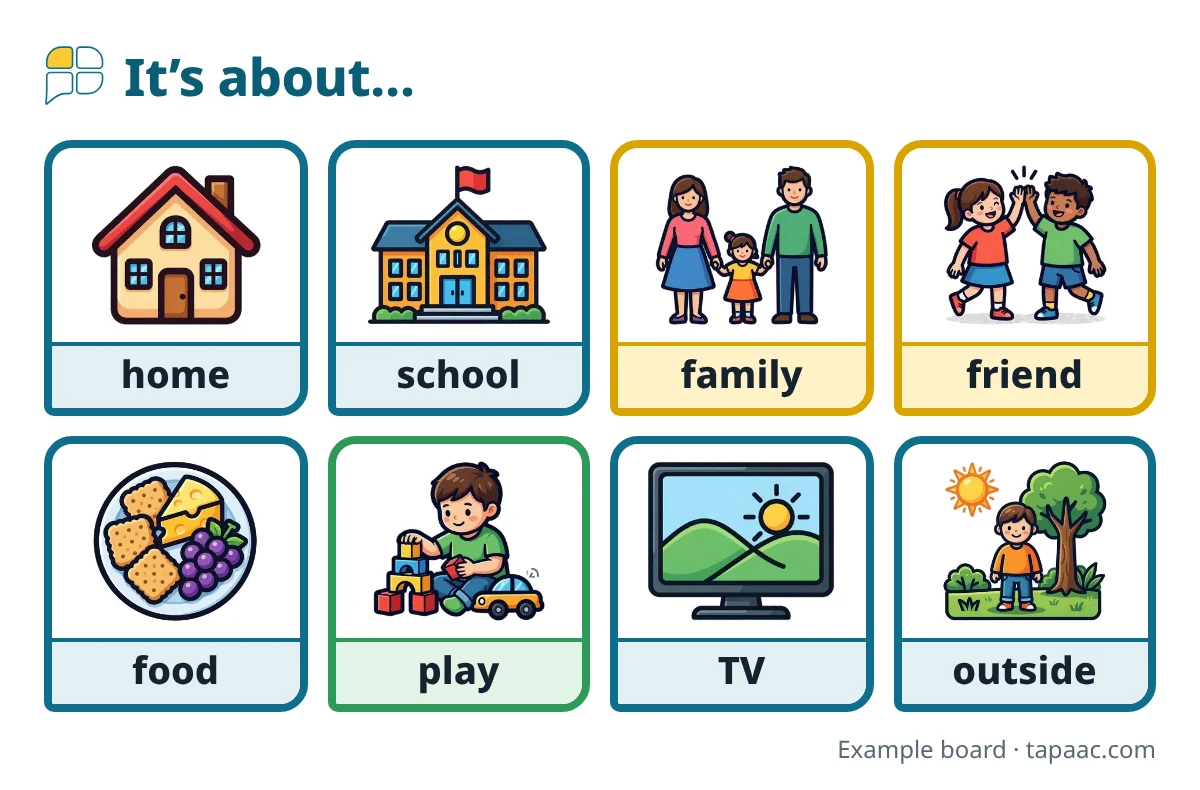
- Ask for the topic first. A topic board (“It’s about…”) gives you a head start before the details.
- Ask your child to show you: point, act it out, or find it on the board or app.
- Narrow it down with yes or no. “Is it about school?” “Did it happen today?”
- Be honest if you’re still lost. Say so kindly, and try another way, or come back to it later.
- Answer the message. When your child is telling you something, what they mean matters more than how it sounded. Leave sound practice for practice time.
At school, and with reading
Children with CAS often have other language and literacy needs too: delayed language, trouble with word order and grammar, and difficulty learning to read, spell and write are commonly present.1 In a US public school, ask the IEP team how your child will answer questions and take part in class when speech isn’t understood. Our guide to AAC in the classroom has ideas for teachers.
Questions to ask the speech-language pathologist
- What should we practice at home, and how often?
- Which kind of AAC should we try, and in which situations?
- What should we do when our child can’t say a word clearly?
- Which words and phrases should go on a board first?
- How will we know AAC is helping?
Try this today
- Write down the ten things your child most often tries to tell you.
- Make a small “It’s about…” topic board and keep it where you talk most.
- Next time you don’t understand, ask for the topic first, then narrow it down with yes or no.
- Ask your child’s speech-language pathologist what to practice at home this week.
More AAC guides
- AAC myths and facts: 10 common myths, and what the research saysTen things people believe about AAC, and what research and professional guidance say instead.
- AAC for toddlers: when to start, and how to begin at homeStarting before your child talks: one routine, a few words, modeling and early intervention.
- AAC and Down syndrome: signs, pictures and speech appsUnderstanding more than they can say: signs, pictures and speech apps, and how to start.
- AAC at school: how teachers can support a student who uses AACModeling in lessons, wait time, better questions, classmates, and the IEP.
Sources
We read each of these on October 12, 2026. Numbers in the text point to them.
- American Speech-Language-Hearing Association. Childhood Apraxia of Speech (Practice Portal). Professional guidance for speech-language pathologists. Accessed October 12, 2026.
- National Institute on Deafness and Other Communication Disorders (NIH). Apraxia of Speech. Last updated October 31, 2017.
- Adams S, Zakrzewski K, King T, Vecchio S, Lim J, Conlon C (2026). A scoping review of augmentative and alternative communication use in children with childhood apraxia of speech. Augmentative and Alternative Communication, published online February 6, 2026. Abstract on PubMed.
- Millar DC, Light JC, Schlosser RW (2006). The impact of augmentative and alternative communication intervention on the speech production of individuals with developmental disabilities: a research review. Journal of Speech, Language, and Hearing Research, 49(2), 248–264. Abstract on PubMed.
- American Speech-Language-Hearing Association. Augmentative and Alternative Communication (Practice Portal). Professional guidance for speech-language pathologists. Accessed October 12, 2026.
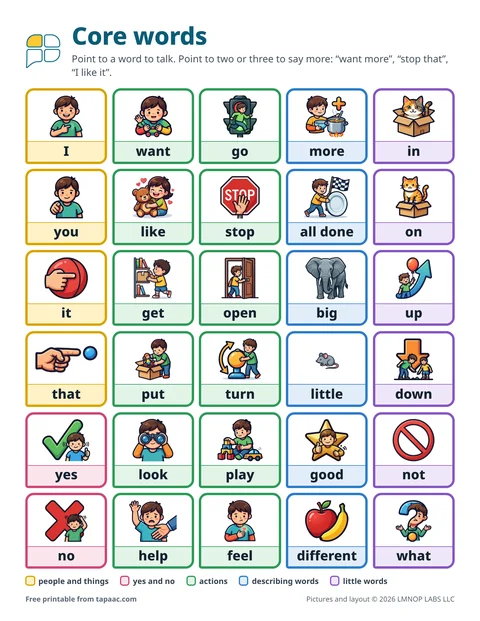 Core word board
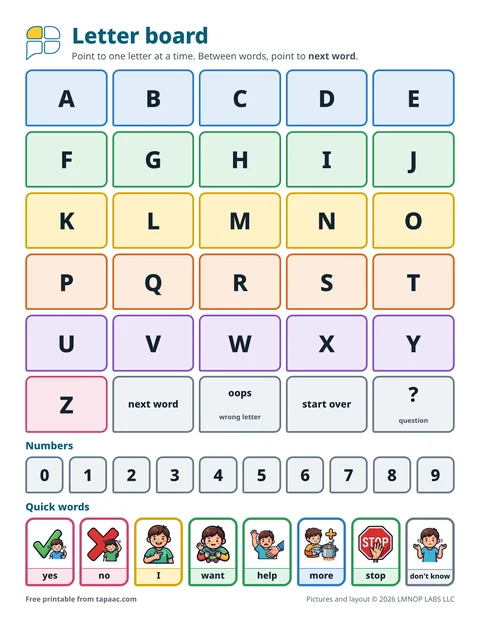 Alphabet board
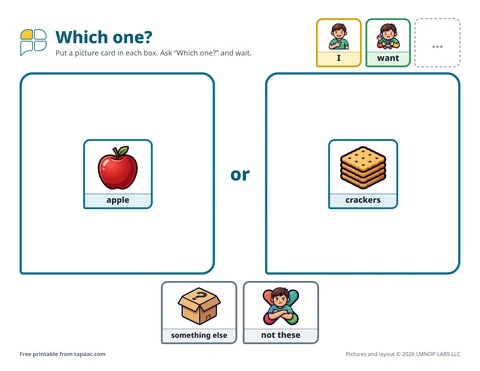 Choice boards
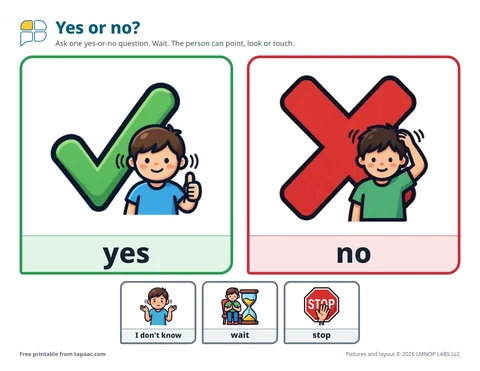 Yes and no board