 Tap AAC
What counts as low-tech AAC
Low-tech (or “light-tech”) AAC is any AAC tool without electronics. Examples are communication boards and books, objects, pictures, photographs, visual schedules and writing.1 The simplest is one page of pictures: a person might touch a picture of a glass to ask for a drink.2
| Tool | Good for | Free to print |
|---|---|---|
| Core word board | Short sentences from everyday words, anywhere | Core word board |
| Topic board | The words for one activity, like a meal or a game | Mealtime, playground |
| Choice board | Picking one thing from two or more | Choice board |
| Yes and no board | Answering questions quickly | Yes and no board |
| Visual schedule | Seeing what happens now and next | First-then, morning routine |
| Alphabet board | Spelling words that aren’t on a board | Alphabet board |
| Communication book | Many pages of words, with tabs | Make your own (see below) |
Why start with paper
- It’s ready today. Print it, and you can start at the next meal.
- It goes anywhere. The bath, the beach, a walk, a power cut.
- Anyone can read it. A picture shown with its written word helps people who don’t know the person’s pictures, especially when there’s no voice output.1
- It’s a backup. People who use AAC should always have access to a way to communicate.1 A paper copy covers the times a tablet is charging, broken or left at home.
Paper has limits too. The listener has to be looking. Only so many words fit on a page. And the person can’t call you from across the room. That’s why many people use paper alongside a device that speaks, not instead of it.
Three boards to start with
1. A core word board
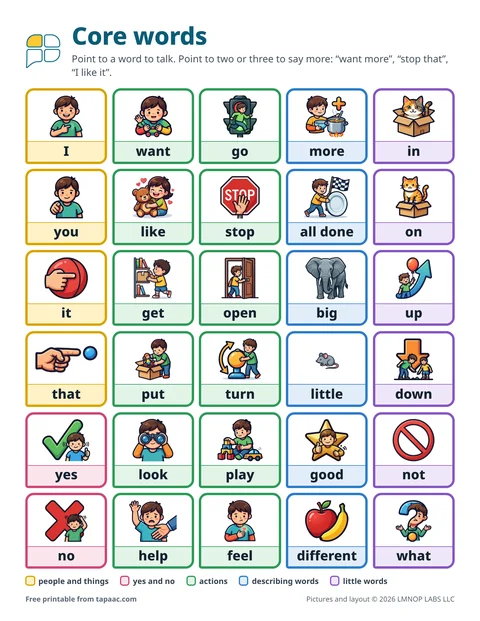
Core words are small words that work almost anywhere: more, stop, go, help, not. One page of core words lets a person say many different things. Read what a core word board is, or print our core word board.
2. A topic board for one routine
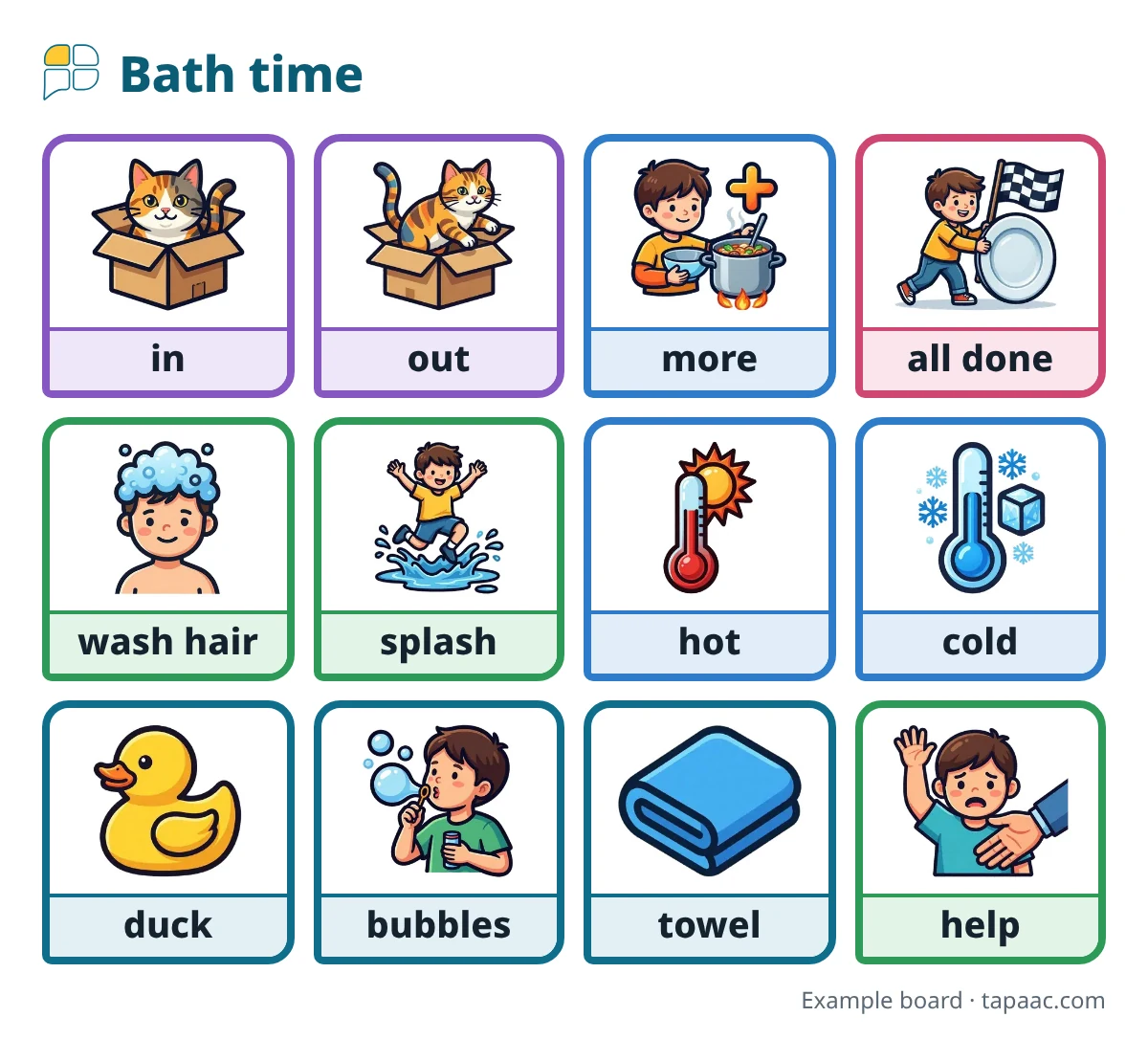
A topic board holds the words for one activity: a bath, a snack, a game. It mixes a few core words with the things in that activity, so it is a good first board for someone who wants to talk about one thing they love. Choosing those words is step 2 of how to make a communication board.
3. Quick-answer boards
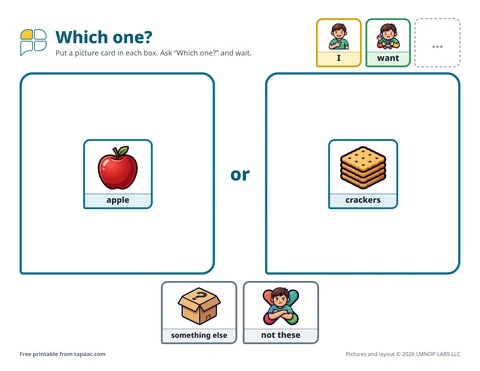
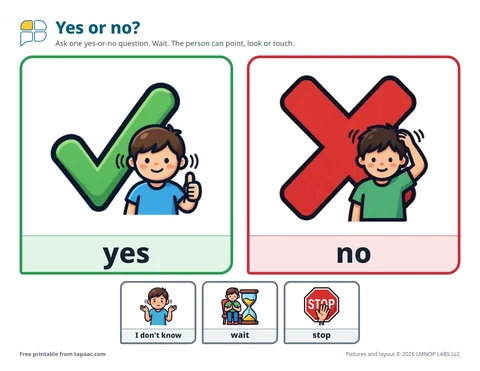
Some moments only need a fast answer. A yes and no board and a choice board with two to four pictures make those moments easier, and they fit in a pocket.
Visual schedules and first-then boards are low-tech AAC too. Picture supports like these can help a person understand, expect and talk about daily routines.1 See how to make a visual schedule.
Making your own
A printed board can be ready today. Start from one of the free printable boards, change its words and pictures in the free AAC board maker, or draw one on card. Our step-by-step guide, how to make a communication board, covers choosing the words, the number of boxes, the layout and the pictures, then printing and laminating it so it lasts.
How to use a board: model, wait, answer
Show the board working before you expect the person to use it. Point to words on the board while you talk, without asking them to copy you. Speech-language pathologists call this modeling, augmented input or aided language stimulation.1 A 2018 review of 48 studies found that interventions with this kind of modeling were generally effective at improving how children and young people with complex communication needs expressed themselves.3
What it can look like at bath time
You: “Duck goes in.” (Point to in, then drop the duck in.)
You: “Uh oh. Duck is out!” (Lift it out and point to out.)
(Hold the duck up. Look at the child. Wait.)
The child touches in. You: “In! Duck goes in.” (Splash it in.)
- Point to one or two key words in each sentence. You don’t have to point to every word.
- Wait. After you model, pause and count to ten in your head. Longer wait time is one of the skills speech-language pathologists teach communication partners.1
- Answer every try. A point, a look or a touch counts. Do what it says, then show another word if you think they meant something else.
- Don’t quiz. “Show me duck” tests. “Duck goes in!” teaches.
The one-page AAC modeling at home handout has these habits on a sheet for the fridge, and how to teach a child to use AAC goes through them in depth.
If the person can’t point
Partner-assisted scanning lets someone choose without pointing. You point to or read out the choices one at a time, and the person makes an agreed signal, such as a nod, a blink or a sound, when you reach the one they want. It can also be used when the person’s usual AAC isn’t available or isn’t working.1
- Agree on one clear yes signal, and practice it with easy questions first.
- Go in the same order every time, for example row by row, top to bottom.
- Say each choice as you point, at an even pace, and wait at each one.
- Read back what they chose, and check it with yes or no.
The spelling steps on our hospital communication board show how to spell with an alphabet board this way. For people who choose with their eyes, the eye gaze board page goes step by step.
When one page isn’t enough: communication books
As the person learns more words, one board gets crowded. A communication book holds several pages: a page of core words at the front, then pages for topics such as food, people, places, feelings and school. A few tips:
- Keep the core word page the same, and put it first.
- Add tabs, or color the page edges, so pages are quick to find.
- Put “another page” and “it’s not here” on every page, so the person can ask you to turn the page or tell you the word they need is missing.
- Use real photos for the people and places that matter: family, school, the park.
Paper and high-tech together
Low-tech and high-tech AAC aren’t rivals. A person may use one form of AAC or combine unaided, low-tech and high-tech AAC.1 If the person has a speech app, make the paper boards match it where you can: the same pictures and words, in the same places. Then a word learned on paper is easy to find on the tablet, and the other way round. Every free board on this site also comes as a board file for the Tap AAC app; see how to add a free board to Tap AAC.
Try this today
- Pick one routine and print or make one board for it.
- Point to a word on it at least three times during that routine.
- After each model, count to ten in your head before you say more.
- Put a second copy where the person spends the most time.
More AAC guides
- What is AAC? A plain-language guide for familiesWhat the letters mean, the kinds of AAC, who uses it, and six first steps.
- How to make a communication board: a step-by-step guideChoosing the words, the layout and the pictures, then printing, laminating and using it.
- AAC for toddlers: when to start, and how to begin at homeStarting before your child talks: one routine, a few words, modeling and early intervention.
- How to choose an AAC app: questions to ask before you buyStart with the person, try before you buy, and the questions to ask about any app.
- AAC at school: how teachers can support a student who uses AACModeling in lessons, wait time, better questions, classmates, and the IEP.
- How to add a free board to Tap AAC (and other apps that open .obz files)Download the board file on the tablet, import it from the Page library, and find the new page.
Sources
We read each of these on October 12, 2026. Numbers in the text point to them.
- American Speech-Language-Hearing Association. Augmentative and Alternative Communication (Practice Portal). Professional guidance for speech-language pathologists. Accessed October 12, 2026.
- National Institute on Deafness and Other Communication Disorders (NIH). Assistive Devices for People with Hearing, Voice, Speech, or Language Disorders. Last updated November 12, 2019.
- Biggs EE, Carter EW, Gilson CB (2018). Systematic Review of Interventions Involving Aided AAC Modeling for Children With Complex Communication Needs. American Journal on Intellectual and Developmental Disabilities, 123(5), 443–473. Abstract on PubMed.
 Core word board
 Choice boards
 Yes and no board
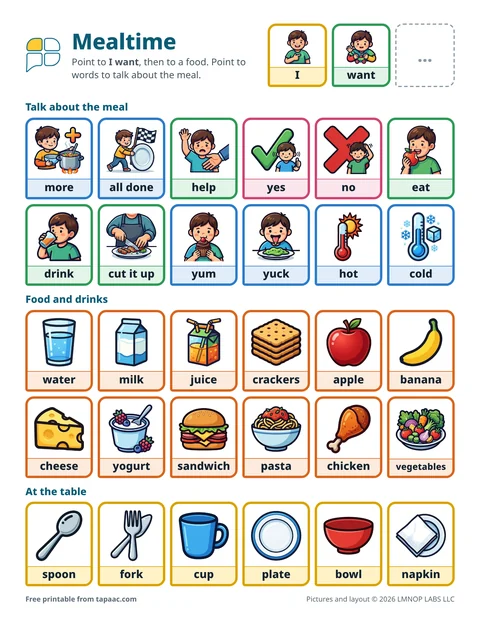 Mealtime communication board