 Tap AAC
Sudden confusion is not the same as the slow changes of dementia. It has many possible causes, including infections (urinary tract infections are a common cause in older people and people with dementia), and it can sometimes be life threatening. Get medical help immediately.1
How dementia changes communication
Dementia is a progressive illness that, over time, affects a person’s ability to remember and understand everyday facts such as names, dates and places, and it gradually changes the way they communicate.2 People with Alzheimer’s disease may struggle to find the right word, understand what words mean, pay attention in long conversations, keep their train of thought, or block out background noise.3
Not everyone has every difficulty; it depends on the cause, the stage and the person. Some people ask the same question again and again, lose track of the topic, or find reading and writing harder, and people who speak more than one language may use only the one they learned first.4 Some people with frontotemporal dementia develop primary progressive aphasia: a gradual loss of language, while memory is relatively well kept.4
Communication aids that can help
Speech-language pathologists call these external aids. They help people with memory problems in daily life: they can make up for memory loss, support independence, improve conversation, reduce anxiety and cut down repeated questions.4 A 2019 review of 39 studies of AAC in dementia found that most of the research so far has been with people with Alzheimer’s-type dementia, using memory and communication aids made of paper rather than electronics.5
Written and picture choices
An open question asks a lot. A choice of two, said and shown, asks much less. The US National Institute on Aging suggests questions with a yes or no answer, and gives the example of asking “Do you want fish or chicken for dinner?” instead of “What do you want for dinner?”3 The NHS also advises simple choices rather than complicated ones.2 Write the two words in large print, or hold up the two things, and let the person point.
Cards or a board for everyday needs
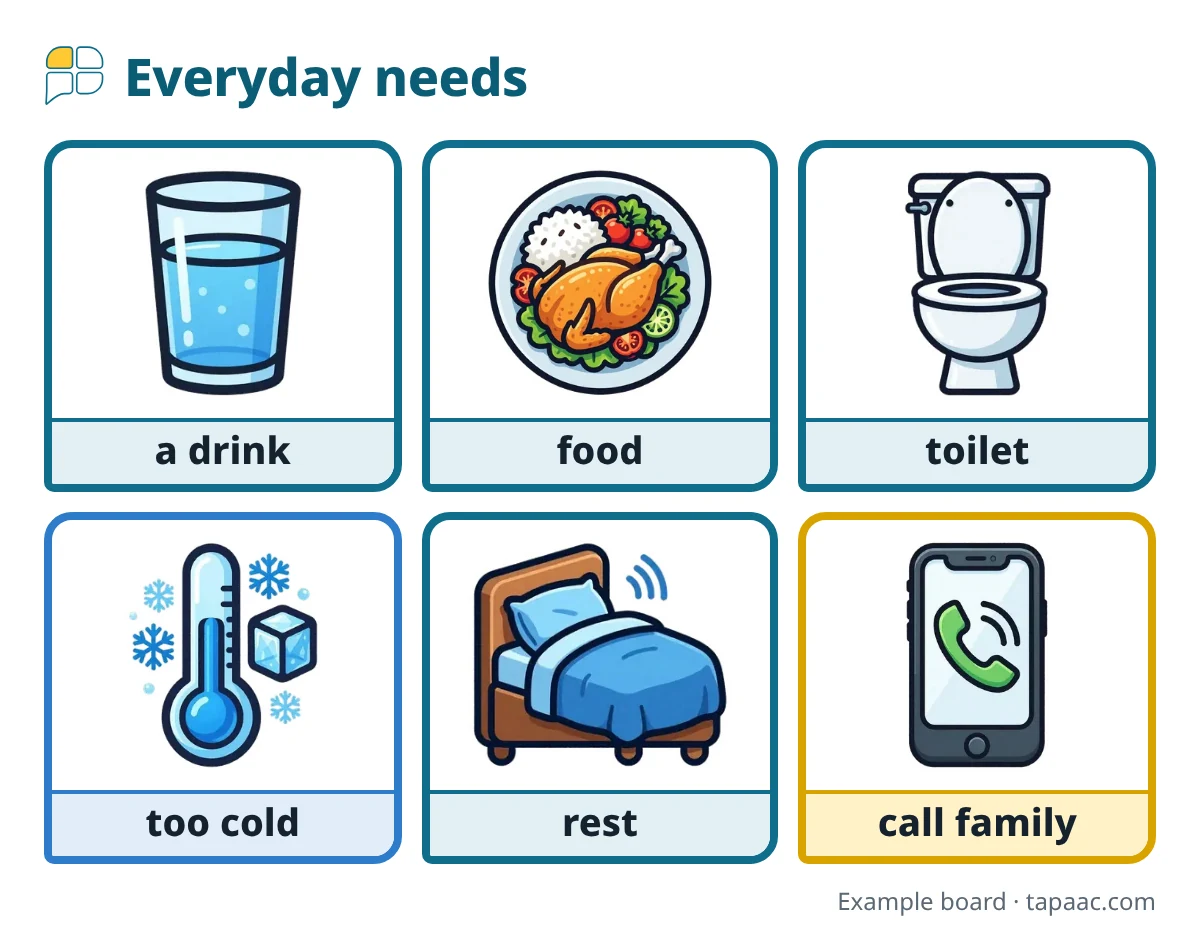
A few big picture cards, each with its word, for what the person needs most often: a drink, food, the toilet, being too cold, rest, family. Communication cards are among the external aids the professional guidance lists.4 Our care home communication board has needs, comfort, personal care, feelings and things to enjoy, with an About me page; the communication board for adults and the yes and no board are other places to start.
A memory book or a memory wallet
A small book or wallet of photos, each with a short sentence: “My wife is Ruth. We married in 1968.” “I drove a bus for 30 years.” “My grandson Leo plays soccer.” Memory books and memory wallets can help a person recall their own information, to start conversations and keep them going.4
The research is small but encouraging. In a 1992 study, nine people with dementia used memory wallets with 30 pictures and sentences about people, places and events they had trouble remembering. All nine made more accurate factual statements in conversations with familiar partners, and for three of them the effect was still there up to 30 months later.6 A 2010 systematic review of 13 studies found one approach that looked potentially effective for conversation in Alzheimer’s disease: memory aids combined with training for caregivers, although the studies had limitations.7
- One photo and one short sentence per page, in large print.
- Write it the way the person would say it: “I”, “my”.
- Choose people, places and events the person enjoys talking about, and ones they find hard to remember.
- Make it personal, and show the person how to use it: aids are more effective when they are taught, and personalized aids are more likely to be used every day.4
- Start early, while the person can help choose. The professional guidance says to design aids and start using them as early as possible.4
The free AAC board maker can lay out a page of photos with words, and your photos stay on your device.
Labels, signs and a plan for the day
Labels and signs on cupboards and doors, such as a toilet sign on the bathroom door, can help someone find their way around. Signs should be clear, with words and a picture that contrast with the background, and placed a little lower than usual, because older people tend to look down. Photos on cupboards can show what’s inside, and a noticeboard or whiteboard can list the day’s tasks.8
An up-to-date calendar, a clock that shows the time of day clearly, and photos of family and care partners around the person can help with knowing the date, the time and the people.4 Clocks with large displays of the day, date and time are made for this.8
Tablets and speech apps
Some people use a tablet or a speech app, especially early on. Which device suits depends on the stage of dementia, since people in the early stages can usually use a wider range of devices, and on the person and their care partner, the cost, and how familiar they are with the technology.4 Paper aids need no charging and no learning to switch on, so keep a paper copy of the most important words either way.
Tips for talking together
These come from the US National Institute on Aging and the NHS. Use them alongside the aids.
- Start the conversation. As dementia progresses, you may need to start conversations, because the person starts fewer of them.2
- Get attention kindly. Make eye contact and use the person’s name.3 If they are sitting, being at the same level or lower can help.2
- Cut background noise. Turn down a TV or radio that’s too loud, after checking that it’s OK with the person.2
- Short and clear. Speak clearly and slowly, in short sentences.2
- Give time. Allow more time for an answer, and try not to interrupt.3
- Rephrase, don’t just repeat. If the person doesn’t understand the first time, say it again with different words.3
- Acknowledge what they say, even if it doesn’t answer your question or seems out of context.2
- Respect. Don’t use baby talk, and don’t talk about the person as if they aren’t there.3 Let them speak for themselves about their health and welfare.2
- Touch and body language. Holding the person’s hand while you talk can reassure them, if they are comfortable with it, and their face and body may say what words can’t.2
For language problems after a stroke, see how to talk with someone who has aphasia; for other adult conditions, AAC for adults.
Check eyesight and hearing
Problems with sight and hearing together can make the symptoms of dementia worse, so regular eye tests and hearing checks matter, even for someone who already has hearing aids.8 Put glasses and hearing aids in before you talk.
Getting help
Ask the doctor about seeing a speech-language pathologist (in the UK, a speech and language therapist). They work with people with dementia and their families. Training families and care partners in communication strategies may help them understand and repair breakdowns, have more successful conversations, and improve quality of life for the person with dementia.4
Look after yourself too. Caring for someone with Alzheimer’s can be demanding and stressful, and the changes in communication can be especially hard; the National Institute on Aging encourages caregivers to ask for help and take time for themselves.3
Try this today
- Turn one open question into a choice of two, said and shown.
- Make three big picture cards for the person’s most common needs.
- Start a memory book with one photo and one short sentence.
- Put a picture label on the bathroom door.
More AAC guides
- How to talk with someone who has aphasia: 12 tips for family and friendsTwelve tips for family and friends, easier questions, and what to do when you’re stuck.
- AAC for adults: after a stroke, with ALS or MND, and in the hospitalAfter a stroke, with ALS or MND, and in the hospital: what helps, and when to plan.
- Using a communication board in the hospitalOn the hospital board’s page: yes and no, asking about pain, and spelling with a patient who can’t speak.
- Low-tech AAC: choosing and using boards, books and cardsBoards, books and cards with no batteries: which to choose, and how to use them every day.
Sources
We read each of these on October 13, 2026. Numbers in the text point to them.
- NHS (UK). Sudden confusion (delirium). Page last reviewed May 28, 2024.
- NHS (UK). Communicating with someone with dementia. Page last reviewed February 13, 2023.
- National Institute on Aging (NIH). Communicating With Someone Who Has Alzheimer’s Disease. Content reviewed July 11, 2024.
- American Speech-Language-Hearing Association. Dementia (Practice Portal). Professional guidance for speech-language pathologists. Accessed October 13, 2026.
- May AA, Dada S, Murray J (2019). Review of AAC interventions in persons with dementia. International Journal of Language & Communication Disorders, 54(6), 857–874. Abstract on PubMed.
- Bourgeois MS (1992). Evaluating memory wallets in conversations with persons with dementia. Journal of Speech and Hearing Research, 35(6), 1344–1357. Abstract on PubMed.
- Egan M, Bérubé D, Racine G, Leonard C, Rochon E (2010). Methods to Enhance Verbal Communication between Individuals with Alzheimer’s Disease and Their Formal and Informal Caregivers: A Systematic Review. International Journal of Alzheimer’s Disease, 2010, 906818. Abstract on PubMed.
- NHS (UK). How to make your home dementia friendly. Page last reviewed January 23, 2025.
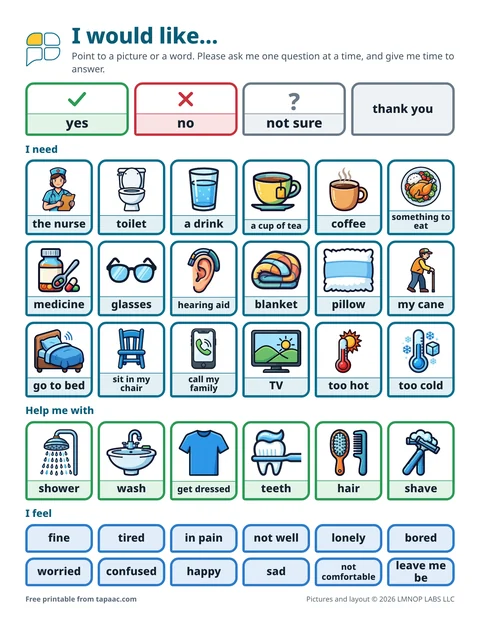 Care home communication board
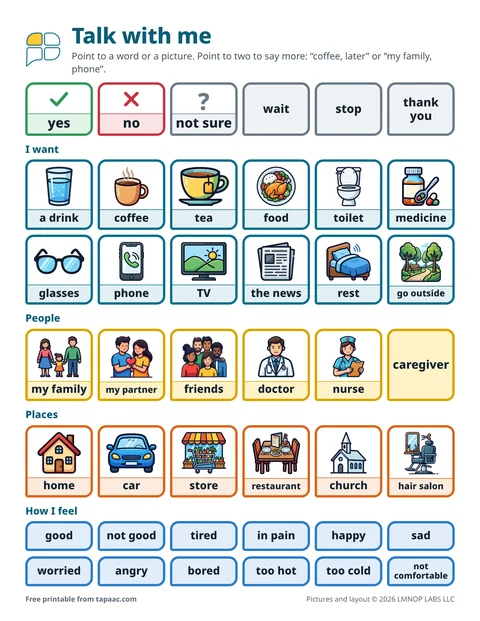 Communication board for adults
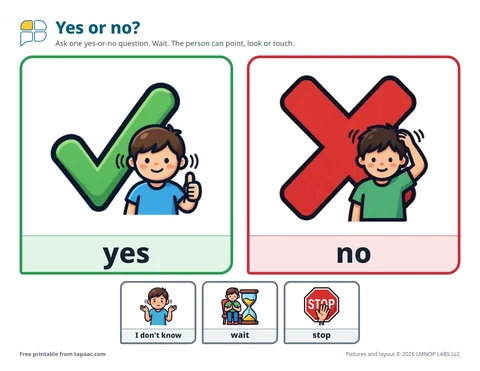 Yes and no board
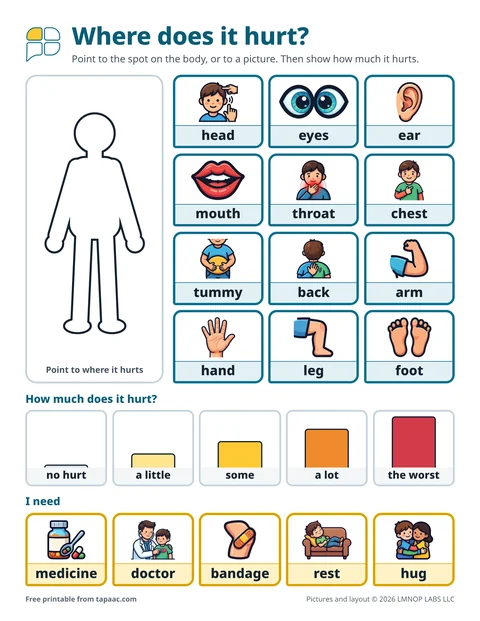 Where does it hurt board