 Tap AAC
Hospital communication board for patients: free printable
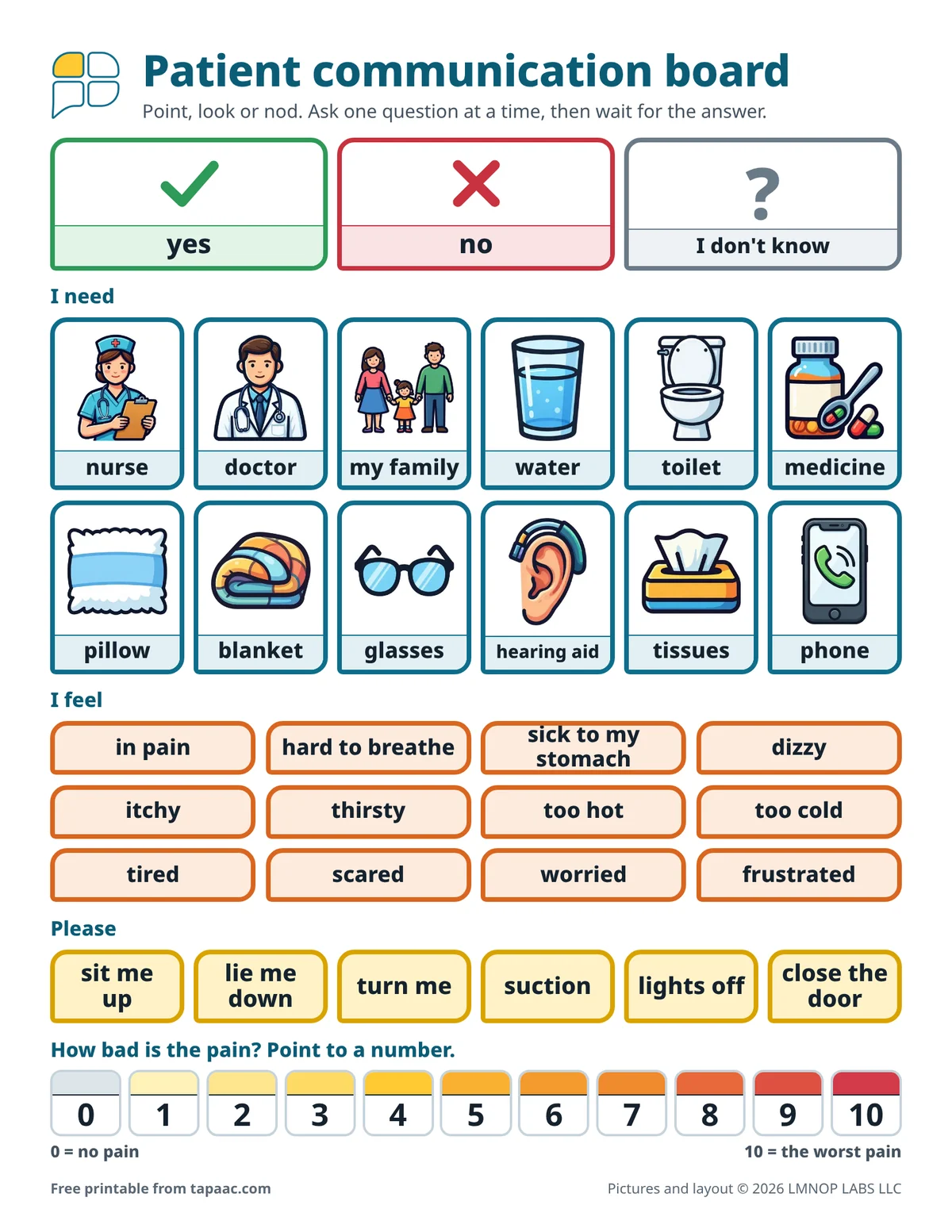
When a patient can’t speak, for example with a breathing tube, after a stroke, or when they are too weak to talk, a communication board lets them point to what they need. This free two-page board is made for adults: yes and no, needs like nurse, water and toilet, feelings, a 0 to 10 pain scale, and a letter page for spelling and common questions.
Download the free PDF US Letter, 2 pages, 436 KB
Portrait (tall page, 2 pages): US Letter PDF (436 KB) · A4 PDF (436 KB)
Landscape (wide page, 2 pages): US Letter PDF (437 KB) · A4 PDF (437 KB)
Edit this board in the free board maker: change the words and pictures, then print.
Have Tap AAC? Add to Tap AAC (.obz file, 333 KB) · How to add a board
- Free
- No sign-up
- Print as many as you need
In the hospital, if something seems wrong, press the call button or tell a nurse right away. At home, if someone may be badly hurt or very sick, call 911 or your local emergency number.
Who it’s for
Patients who are awake and can understand, but can’t speak or can’t be understood: with a breathing tube or a tracheostomy, after a stroke or a head injury, or with a voice too weak after surgery. The board is for the people at the bedside too. Family, nurses and other staff can all use the same board, so the patient doesn’t have to learn a new way for every visitor.
Before you start
- Find the yes and no. Ask the patient to show yes, then no: a nod, eyes up, a squeeze of the hand, a thumbs up. Pick one that is easy for them and easy for others to see.
- Check glasses and hearing aids. A patient who can’t see the board or hear the question can’t answer it.
- Write it down. The About me box on page 2 has space for the patient’s name, what they like to be called, and what their yes and no look like.
How to use the board at the bedside
- Hold the board where the patient can see and reach it. Ask what works: closer, higher, the other side.
- Ask one question at a time, and make it a yes-or-no question when you can: “Are you cold?”, not “How are you feeling?”
- Wait. A tired patient may need much longer to answer. Count to ten before you ask again.
- Let them point, look or signal. If pointing is hard, point to each part of the board yourself and wait for the yes signal.
- Read back what you saw. “You pointed to too cold. Do you want a blanket?” Then wait for yes.
- Talk to the patient, not about them. Keep them in the conversation, even when it’s slow.
Asking about pain
Ask first whether there is pain: “Are you in pain?” If the answer is yes, point to the scale and ask how bad: “Zero is no pain, ten is the worst.” Move your finger along the numbers slowly, and let the patient stop you at the right one. Then ask where: point to parts of your own body, or use the body outline on the where does it hurt board. Tell the nurse what the patient said, in their words: “She pointed to 7, in her back.” The nurse decides what happens next.
Spelling and questions
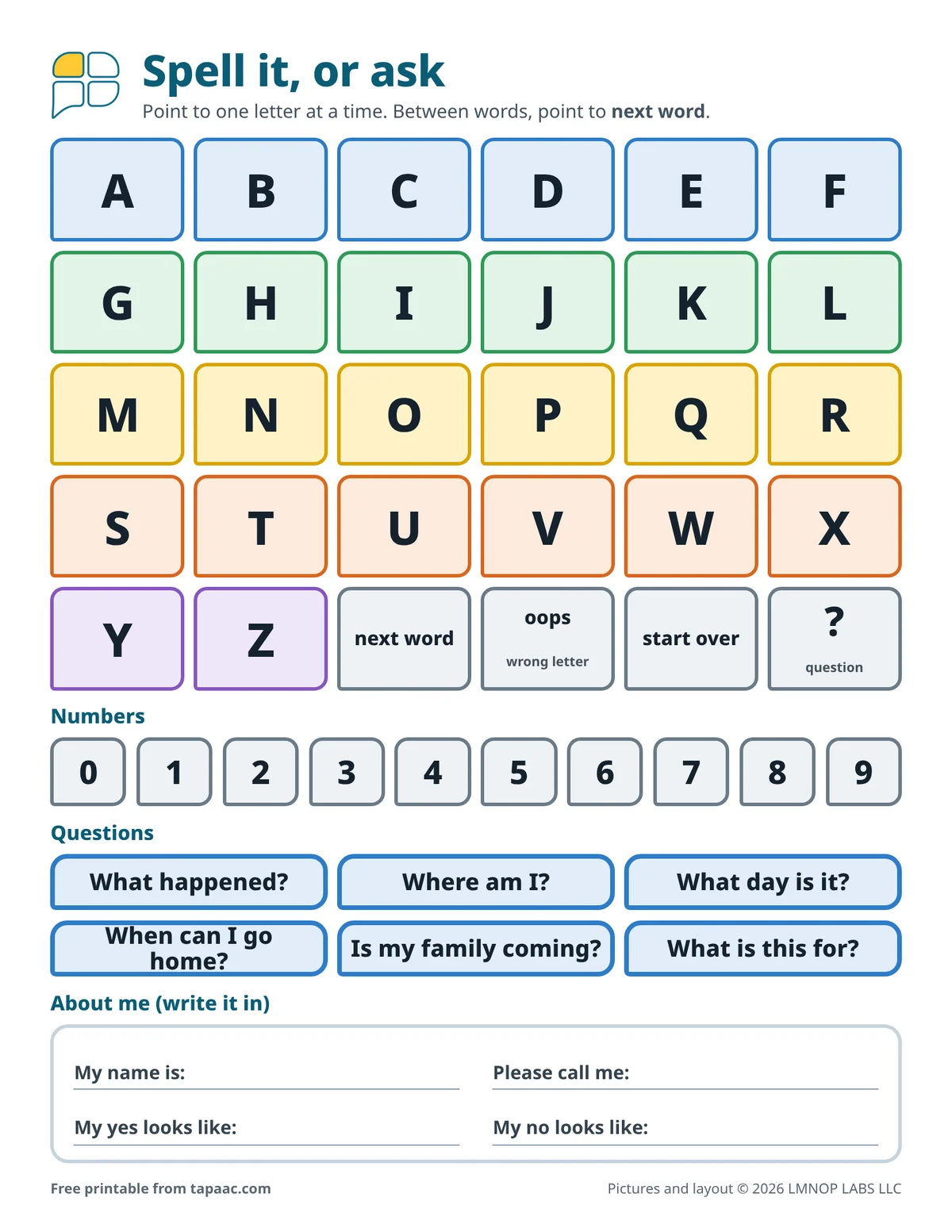
Page 2 has the alphabet in colored rows. A patient who can point spells a word letter by letter. A patient who can’t point can still spell with help: read out the rows one at a time (“blue row, green row…”) and wait for the yes signal, then read out the letters in that row. This is often called partner-assisted scanning. It’s slow, so say each letter as it’s chosen, guess the word as soon as you can, and let the patient tell you yes or no. The alphabet board has a keyboard layout too, for patients who type.
The question buttons on page 2 are ones that are hard to ask without a voice: What happened?, Where am I?, What day is it?, When can I go home?
Keep it at the bedside
- Leave the board within reach, near the call button if you can.
- Tell each new shift and each new visitor how the patient answers. A short note on the board helps.
- Ask whether a speech therapist can see the patient. They can help find the best way to communicate, and suggest other tools.
Nurses and care staff: how to communicate with nonverbal patients covers handover, patients who bring their own AAC, and what the research says.
Rosa can’t talk with the breathing tube in, and she’s restless. Her son brings the board. She points to too cold, then blanket. He asks a nurse, who brings a warm blanket. Then Rosa spells on the letter page: C, A, T. “The cat’s fine,” her son laughs. “The neighbor is feeding him.”
What’s on the board
I need
- nurse
- doctor
- my family
- water
- toilet
- medicine
- pillow
- blanket
- glasses
- hearing aid
- tissues
- phone
I feel
- in pain
- hard to breathe
- sick to my stomach
- dizzy
- itchy
- thirsty
- too hot
- too cold
- tired
- scared
- worried
- frustrated
Please
- sit me up
- lie me down
- turn me
- suction
- lights off
- close the door
Yes, no and I don’t know are across the top, with a check, a cross and a question mark instead of pictures. The feelings and requests are words only, in large print.
Printing and cleaning
- Print both pages and put them back to back in a sheet protector, or laminate them, so they can be wiped clean. Follow the hospital’s cleaning rules.
- Fill in the About me box with a dry-erase marker, so it can be updated.
- Bring a copy from home if the ward doesn’t have a board ready.
- For a patient who is very ill or drowsy, the ICU communication board has fewer, bigger choices.
More free boards
-
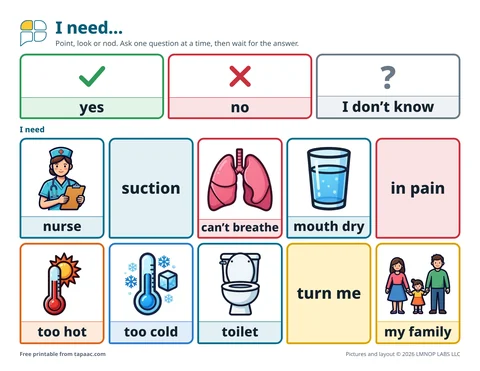 ICU communication boardLarge print for very sick patients: yes, no, ten big needs, a body outline and a pain scale.
-
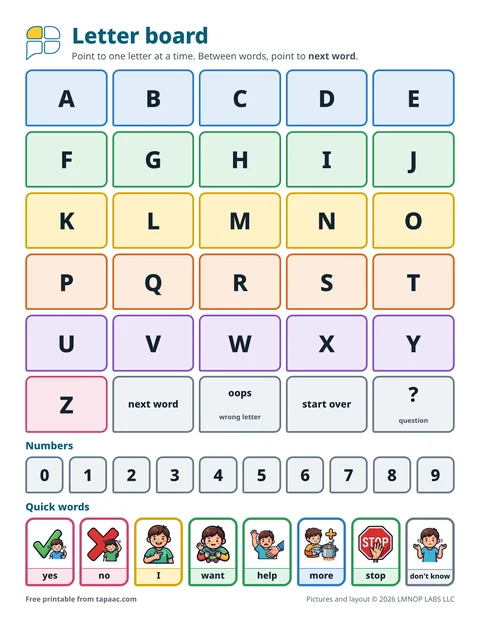 Alphabet boardA to Z for spelling, in alphabet order and keyboard order, with quick words.
-
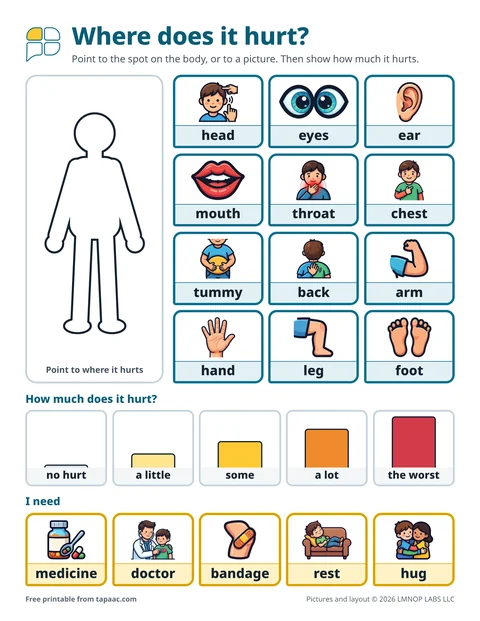 Where does it hurt boardA body outline, 12 body parts and a simple scale for how much it hurts.
-
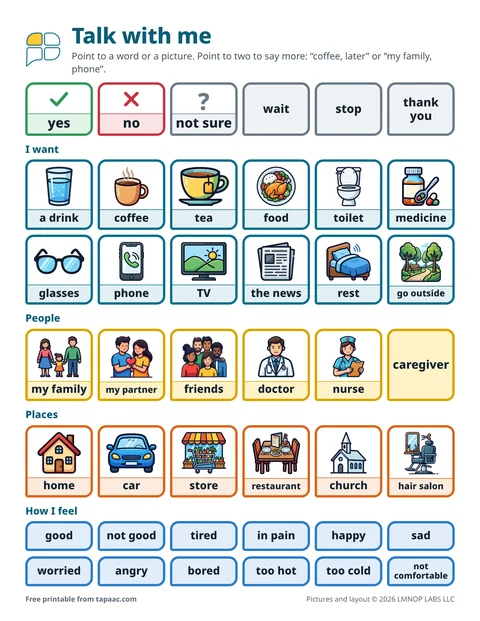 Communication board for adultsGrown-up pictures and plain words: wants, people, places, feelings, and a keyboard page for spelling.
Need a different board? Make your own with the free AAC board maker.
These boards and guides are general information, not therapy or medical advice, and they don’t replace a speech therapist. A speech therapist who knows the person can help choose the right words, pictures and layout. The boards are free to print and share; please don’t sell them (terms of use). Questions about the boards? Email support@lmnoplabs.fun.