 Tap AAC
When can a toddler start AAC?
Now. The professional guidance for speech-language pathologists says AAC should be considered as early as possible, and that there are no prerequisites for it.1 Children younger than three can start, and they don’t need to reach any thinking skills, test scores or other milestones first.2
Some families and professionals still believe young children aren’t ready for AAC until school age. The same guidance answers that early AAC use can help develop speech and language, and can increase vocabulary for children with developmental delays aged three and younger.1
AAC isn’t only for toddlers who say nothing. A child who has a few words but gets upset because nobody understands them may benefit too: some people use AAC alongside their speech, to help others understand it.2
If you’re worried about your toddler’s talking
You know your child best. If your child isn’t meeting the milestones for their age, or you think there could be a problem with the way they play, learn, speak, act or move, talk to your child’s doctor and share your concerns. The CDC’s advice is not to wait.3 You don’t need to wait for an appointment to start pointing to pictures at home, and what you notice gives you something to tell the therapist.
Will AAC stop my toddler from learning to talk?
The research with toddlers points the other way. In a 2010 trial, 68 toddlers with developmental delays who said fewer than 10 words were randomly assigned to one of three interventions in which parents were coached: two added augmented communication, and one worked on spoken words only. All the children in the two augmented groups used both augmented and spoken words for the words they were taught, while the spoken-only group said very few, and the augmented groups ended with much larger vocabularies. The authors concluded that augmented communication does not hinder, and actually aids, speech in young children with developmental delays.4
An earlier review of AAC with children aged three and under found 12 studies. Most looked at gestures and signs, and some also used pictures or devices. All of them reported that children’s communication improved, but only 7 of the 12 gave conclusive evidence.5 So the research is encouraging, not final. Our page on AAC myths and facts goes through the other common worries.
What AAC looks like for a toddler
- Gestures and signs: waving, pointing, reaching, a sign for more or all done.
- Pictures for one routine: a small board at the table, in the bath or by the toy box.
- An app or device that speaks: touch a picture and it says the word.
The US Department of Education lists AAC devices among the assistive technology that can help infants and toddlers say what they want and need, with pictures of activities or objects and a handheld tablet as examples.6 Many toddlers use a mix. An AAC system is designed around everything a child already uses: words, sounds and gestures.1
Screen-time worries don’t apply. Concerns about screen time for young children do not apply to screens used as part of an AAC system.1 A speech app is your child’s voice, not a video. It helps to keep it apart from games and cartoons, so that the tablet means talking.
Start with one routine
- Pick a routine your child enjoys and that happens every day: snack, bath, bubbles, a song, a favorite toy.
- Choose four to six words for it. Mix a few words that work everywhere, like more, help, open and all done, with one or two things, like cracker or bubbles. These everyday words are called core words.
- Make the pictures big, with the word on each one. How many pictures a child can use, and how big they need to be, depends on their eyes and hands;1 a speech-language pathologist can help you judge it.
- Put the board where the routine happens, where your child can see and reach it: the high chair tray, the side of the bath, the toy shelf.
- Use it yourself first. Point to the pictures as you talk, every time the routine comes round.
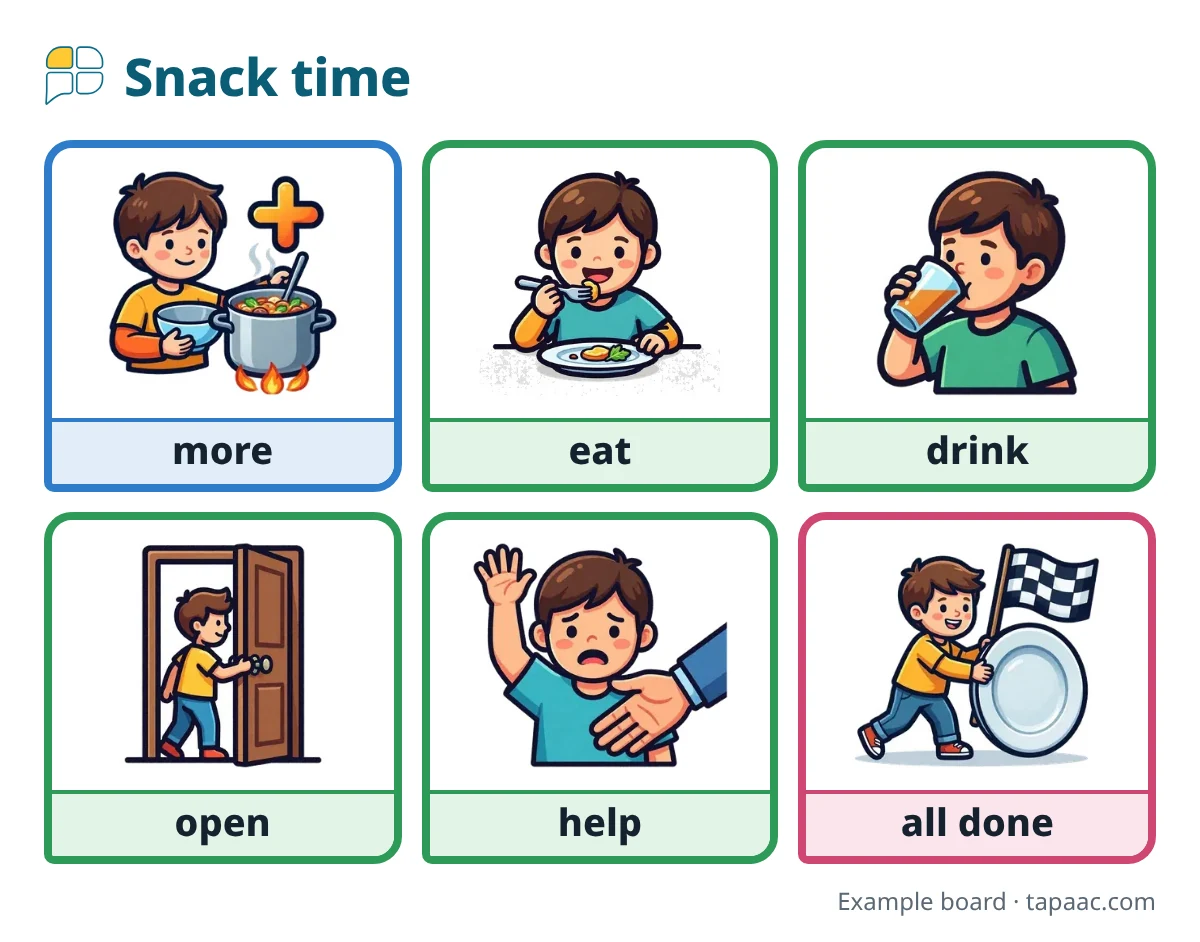
For a ready-made start, print the mealtime board or the playground board, and cut it down to the words your child needs most.
Show, don’t test: modeling with a toddler
Toddlers learn to talk by hearing words used all day long. A child learning AAC needs the same: people using AAC around them. Speech-language pathologists call it augmented input or aided language modeling: you point to the pictures while you talk.1 This approach can help young AAC users understand more symbols.1
What it can look like at snack time
You: “Time to eat.” (Point to eat.) “Let’s open it.” (Point to open, then open the box.)
(Give one cracker. Wait. Look at your child.)
(Your child reaches for the box.) You: “More? More crackers!” (Point to more, then give another.)
Later: “All gone. All done.” (Point to all done.)
- Get down to their level, so your child can see your face, your hand and the board together.
- Point to one key word in what you say, not every word.
- Pause and give your child time to look, reach, make a sound or touch a picture.
- Answer a look, a reach or a sound as if it was meant, and show the word that goes with it.
- Don’t make your child earn it. They don’t have to point before they get a cracker. Model, pause and carry on, so AAC feels like a way in, not a test.
The AAC modeling at home handout puts these habits on one page, and the core word of the week plans give you one word at a time, starting with the word more. For more depth, read how to teach a child to use AAC.
Early intervention: help before age three (US)
Every US state and territory has an early intervention program for babies and young children with developmental delays and disabilities. Services may include speech therapy, and they are free or at reduced cost for children who are eligible. Eligibility is based on an evaluation of the child’s skills.7
You can call the program yourself; you don’t need a doctor’s referral or a diagnosis. If your child is under three, contact your local early intervention program and ask for an evaluation. If your child is three or older, call your local public elementary school, even if your child doesn’t go there, and ask for an evaluation for preschool special education services.3
Under the Individuals with Disabilities Education Act (IDEA), assistive technology devices and services, which include AAC, count as early intervention services. If your child’s team decides your child needs one, it is written into the Individualized Family Service Plan (IFSP). When your child moves on to preschool, the team must consider assistive technology again, whether or not your child had it before. Every state also has an assistive technology program that serves all ages, babies and toddlers included: you can ask to see a device demonstrated, or borrow one for a short time.6
From preschool on, assistive technology goes in the IEP: see AAC and the IEP. This is general information, not legal advice. Outside the US, ask your child’s doctor or health visitor about local services.
Questions to ask the speech-language pathologist
- Which words should we start with, and in which routines?
- How big should the pictures be, and how many should go on a page?
- Should we use signs, pictures, a speech app, or a mix?
- Can we borrow or try a device before we decide?
- What should we write down between sessions, so you can see what’s working?
Try this today
- Pick one routine your child loves, and choose four words for it.
- Print or make a board for it, and put it where the routine happens.
- Each time the routine comes round, point to one word as you say it, without asking your child to copy you.
- If you’re worried, call your child’s doctor or, in the US, your early intervention program; no referral is needed.
More AAC guides
- AAC myths and facts: 10 common myths, and what the research saysTen things people believe about AAC, and what research and professional guidance say instead.
- What is AAC? A plain-language guide for familiesWhat the letters mean, the kinds of AAC, who uses it, and six first steps.
- Low-tech AAC: choosing and using boards, books and cardsBoards, books and cards with no batteries: which to choose, and how to use them every day.
- AAC and autism: answers to common parent questionsWill AAC stop my child from talking? Is my child ready? How do I start?
- AAC and Down syndrome: signs, pictures and speech appsUnderstanding more than they can say: signs, pictures and speech apps, and how to start.
Sources
We read each of these on October 12, 2026. Numbers in the text point to them.
- American Speech-Language-Hearing Association. Augmentative and Alternative Communication (Practice Portal). Professional guidance for speech-language pathologists. Accessed October 12, 2026.
- Communication Health Support Association, powered by the American Speech-Language-Hearing Association. Augmentative and Alternative Communication (AAC). Information for the public. Accessed October 12, 2026.
- Centers for Disease Control and Prevention (CDC), Learn the Signs. Act Early.. Concerned About Your Child’s Development?. Page dated February 17, 2026.
- Romski M, Sevcik RA, Adamson LB, Cheslock M, Smith A, Barker RM, Bakeman R (2010). Randomized comparison of augmented and nonaugmented language interventions for toddlers with developmental delays and their parents. Journal of Speech, Language, and Hearing Research, 53(2), 350–364. Abstract on PubMed.
- Branson D, Demchak M (2009). The use of augmentative and alternative communication methods with infants and toddlers with disabilities: a research review. Augmentative and Alternative Communication, 25(4), 274–286. Abstract on PubMed.
- U.S. Department of Education. Myths and Facts Surrounding Assistive Technology Devices and Services (PDF). January 2024.
- Centers for Disease Control and Prevention (CDC), Learn the Signs. Act Early.. Early Intervention. Updated February 17, 2026.
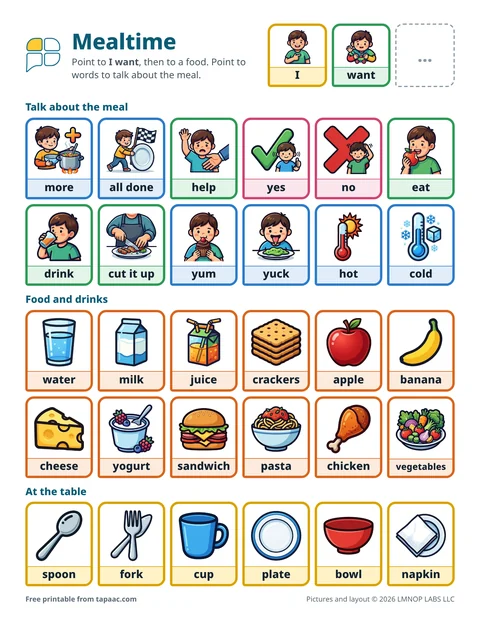 Mealtime communication board
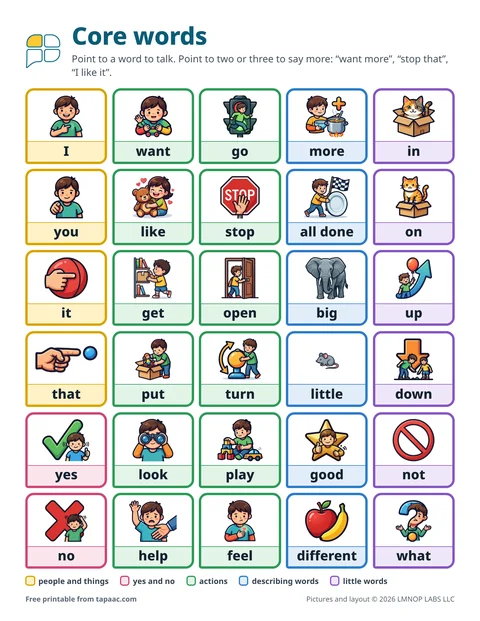 Core word board
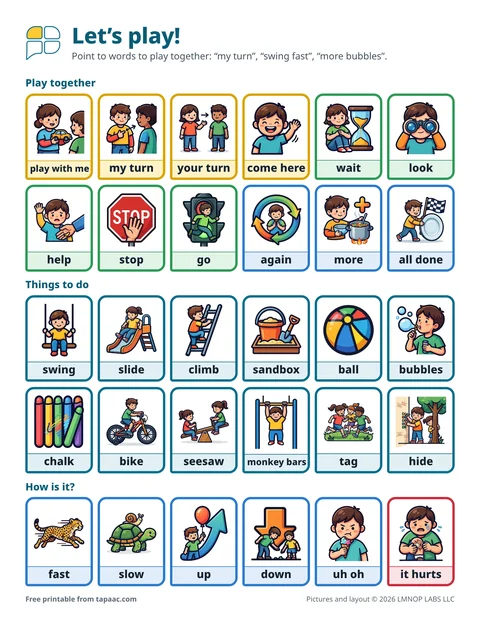 Playground communication board
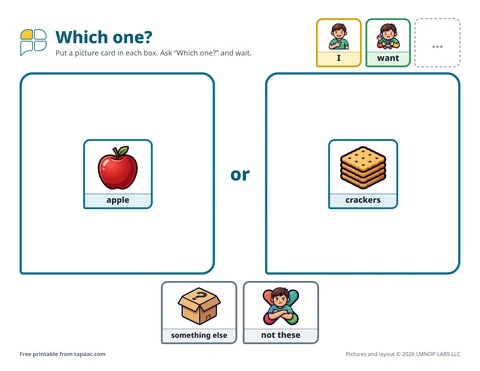 Choice boards