 Tap AAC
It’s a team job
At school, the speech-language pathologist (SLP) works with a team that typically includes general and special education teachers, paraprofessionals, occupational and physical therapists, administrators, nurses, case managers and the family. Implementing AAC is the responsibility of the whole school team.1
Two common problems are a lack of buy-in and AAC being used differently at home and at school. A structured plan with clear roles, and involving the student, parents, teachers and administrators from the start, can prevent them.1
At the start of the year
- Learn how the student says yes and no, and what they do when they need help or a break.
- Meet the SLP. Ask how the system is organized, which words the student uses already, and which words you should model.
- Agree who does what: charging, backups, adding words, and who to tell when something breaks.
- Make a one-page profile with the student and family, “How I communicate”, and share it with everyone who works with the student, including lunch staff, bus staff and substitute teachers.
- Have a paper backup for when the device is charging or can’t go somewhere, like the pool. Our free printable boards are a quick start.
Keep it with the student, all day
People who use AAC should always have access to their communication tools.1 A device that stays in a bag, or only comes out in therapy, can’t be used to talk. AAC depends on being used consistently: a device used only at home but not at school may not work as well as it could.1
The student’s vocabulary needs to cover the curriculum as well as social talk, everyday needs and growing language, in the classroom, the lunchroom, the hallways and at play.1
Model while you teach
Point to words on the student’s AAC as you talk to them and to the class. Speech-language pathologists call this augmented input or aided language modeling: the partner points to the AAC symbols while talking.1 A 2018 review of 48 studies found that interventions with this kind of modeling were generally effective at improving the expressive communication of students with complex communication needs.2
Pick two or three key words for each lesson and model them whenever they come up:
| Lesson | Words to model | For example |
|---|---|---|
| Morning meeting | who, here, not, like | “Who is here? Sam is not here today.” |
| Reading | what, next, look, like | “What happens next? Look at the picture.” |
| Math | more, same, different, big | “Which pile has more? These two are the same.” |
| Science | look, open, in, different | “Look! The seed looks different now.” |
| Art | help, my turn, finished, like | “I like your colors. Are you finished?” |
| Recess | go, stop, again, fun | “Ready, set, go! Let’s do it again.” |
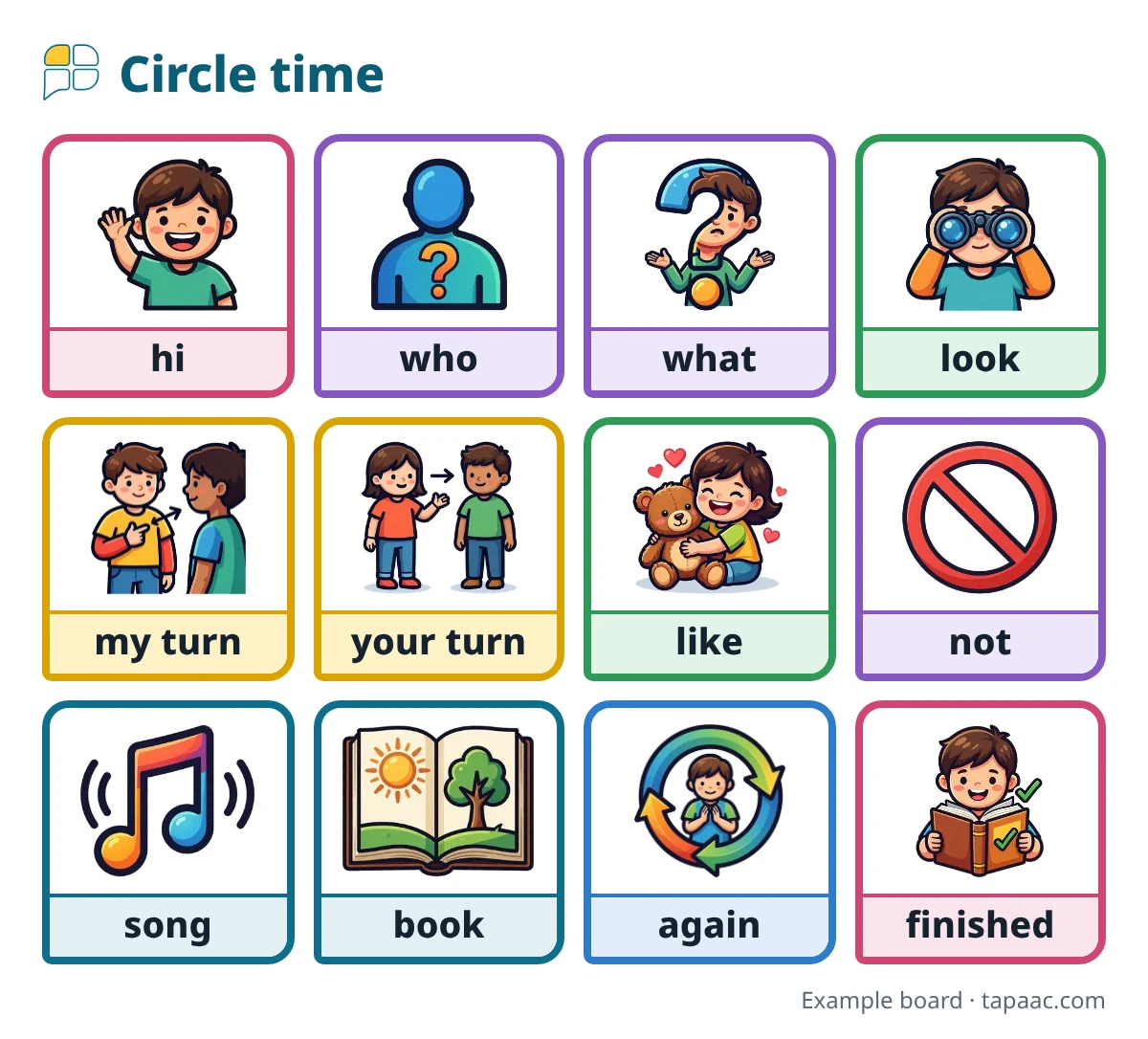
Model on the student’s own system whenever you can. For group times, a printed topic board on the easel or the table gives everyone something to point to; the free AAC board maker makes one in a few minutes, and the core word of the week plans give the class one word to focus on together.
Ask questions the student can answer
With children who use AAC, communication partners are more likely to ask yes-or-no questions instead of open questions, dominate the conversation, or miss the child’s attempts to communicate.1 Small changes help:
| Instead of | Try |
|---|---|
| “Did you like the story?” | “What did you think of the story?” Check that words like funny, scary, sad and boring are there to use. |
| Asking, then answering for them after two seconds | Asking, then waiting. Count to ten in your head. Longer wait time is a skill SLPs teach partners.1 |
| “Show me red.” | “I’m painting mine red. What color will you use?” |
| Calling on the student only for their goals | Calling on them like any other student, with time to answer |
| Finishing their message for them | Waiting for the whole message, then reading it back |
Plan the words before the lesson
- Send the SLP and the family next week’s topic words, so they can be added in time.
- Add a few words for talking about the topic, not only names of things: for a plants unit, grow, water, bigger, dead, alive.
- Make sure the student can give the answers in worksheets and quizzes, for example with multiple-choice answers they can point to.
- Ask the IEP team how the student will answer in tests, and which accommodations are in their plan.
Help classmates talk with the student
- With the student’s permission and help, show the class how their AAC works.
- Teach three rules: talk to the student, not their aide; wait for the whole message; ask real questions.
- Make sure the device has social words: greetings, jokes, my turn, that’s funny, come play.
- Plan for recess and lunch: a playground board or a mealtime board helps when the device can’t go outside or is charging.
AAC and the IEP (in the US)
Under the Individuals with Disabilities Education Act (IDEA):
- When developing a child’s IEP, the IEP team must consider the child’s communication needs and whether the child needs assistive technology devices and services.3
- Schools must make assistive technology available if a child needs it as part of their special education, related services, or supplementary aids and services.4
- On a case-by-case basis, a child must be able to use a school-purchased device at home or in other settings if the IEP team decides the child needs it to receive a free appropriate public education.4
- Assistive technology services include training or technical help for the child, for the family where appropriate, and for the professionals who work with the child.5
AAC goals and AAC use should be written into the student’s IEP.1 For families, our guide to AAC and the IEP covers evaluations, home use, training and what to ask at the meeting. This is general information, not legal advice. Outside the US the rules are different; ask your school or local education authority.
Try this today
- Ask the SLP for three words to model in your lessons this week.
- Put the student’s AAC on their desk, switched on, for the whole day.
- Model one key word in every lesson.
- After each question you ask the student, count to ten in your head.
More AAC guides
- AAC and the IEP: what parents can ask forWhat IDEA says about assistive technology, and what to ask about evaluations, goals, home use and training.
- AAC and autism: answers to common parent questionsWill AAC stop my child from talking? Is my child ready? How do I start?
- AAC and Down syndrome: signs, pictures and speech appsUnderstanding more than they can say: signs, pictures and speech apps, and how to start.
- AAC and childhood apraxia of speech: what parents should knowSpeech therapy first, AAC alongside it, and what to do when your child isn’t understood.
- Low-tech AAC: choosing and using boards, books and cardsBoards, books and cards with no batteries: which to choose, and how to use them every day.
- How to teach core words: a week-by-week planOne focus word at a time, modeled in real routines, with free word cards and weekly plans.
Sources
We read each of these on October 12, 2026. Numbers in the text point to them.
- American Speech-Language-Hearing Association. Augmentative and Alternative Communication (Practice Portal). Professional guidance for speech-language pathologists. Accessed October 12, 2026.
- Biggs EE, Carter EW, Gilson CB (2018). Systematic Review of Interventions Involving Aided AAC Modeling for Children With Complex Communication Needs. American Journal on Intellectual and Developmental Disabilities, 123(5), 443–473. Abstract on PubMed.
- U.S. Department of Education, IDEA regulations. 34 CFR §300.324: Development, review, and revision of IEP. Accessed October 12, 2026.
- U.S. Department of Education, IDEA regulations. 34 CFR §300.105: Assistive technology. Accessed October 12, 2026.
- U.S. Department of Education, IDEA regulations. 34 CFR §300.6: Assistive technology service. Accessed October 12, 2026.
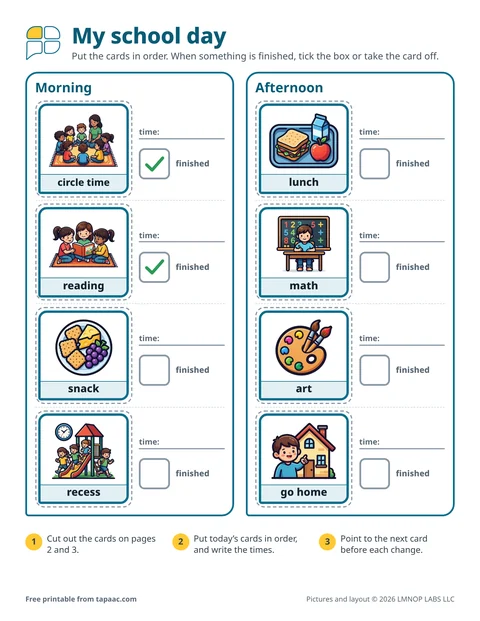 Classroom visual schedule
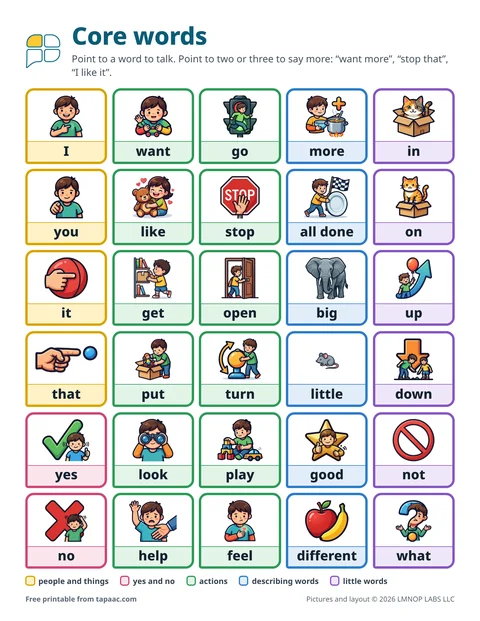 Core word board
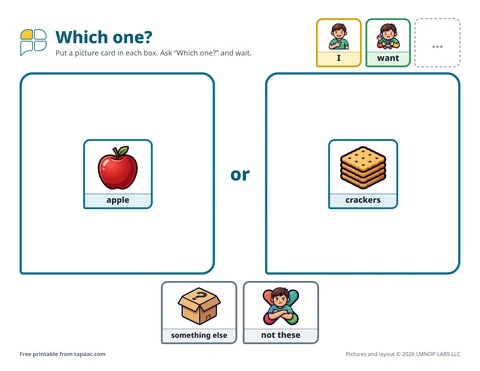 Choice boards
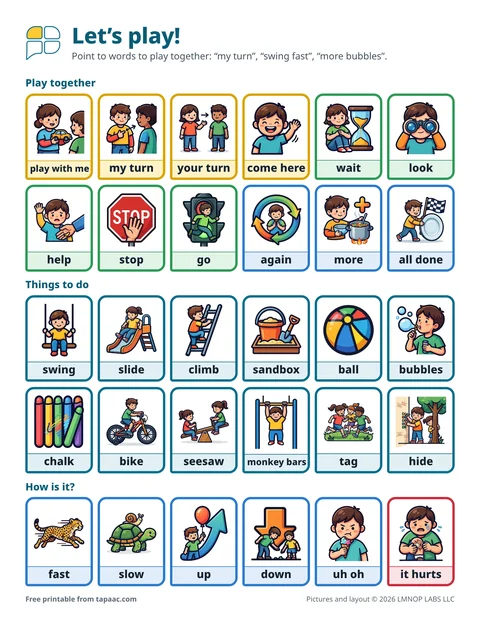 Playground communication board