 Tap AAC
Yes and no board: free printable with cards
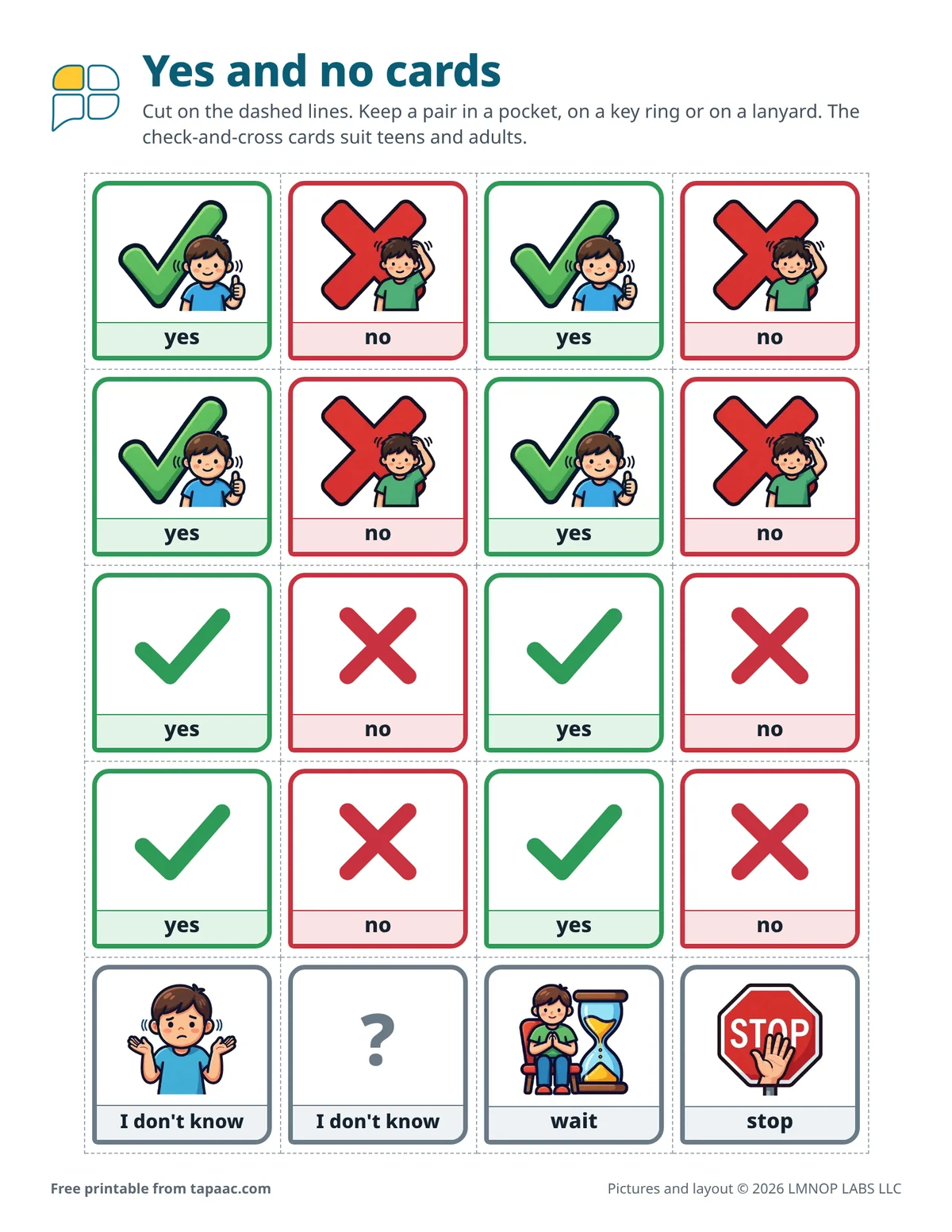
A yes and no board gives a person a clear way to answer a question without speech: they point to yes or no, look at one, or touch it. This free PDF has a big yes-and-no board to hold up, and a page of 20 cards to cut out, so a pair can go everywhere the person goes.
Download the free PDF US Letter, 2 pages, 254 KB
Printing on A4 paper? Download the A4 PDF (2 pages, 254 KB). Or pick one page shape for every page:
Portrait (tall page, 2 pages): US Letter PDF (254 KB) · A4 PDF (254 KB)
Landscape (wide page, 2 pages): US Letter PDF (257 KB) · A4 PDF (256 KB)
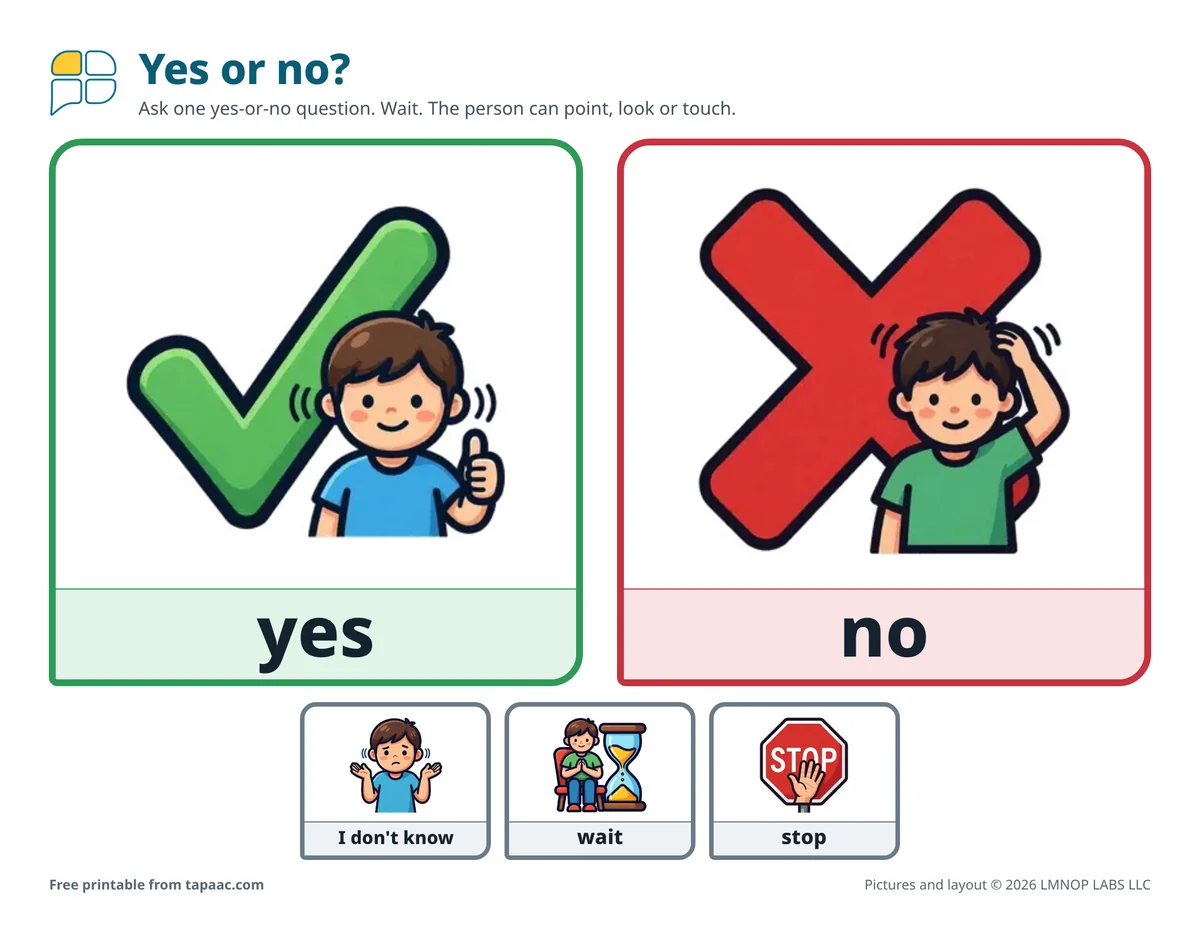
Edit this board in the free board maker: change the words and pictures, then print.
Have Tap AAC? Add to Tap AAC (.obz file, 178 KB) · How to add a board
- Free
- No sign-up
- Print as many as you need
How to use a yes and no board
- Ask about one thing. “Do you want juice?” works. “Juice or milk?” can’t be answered with yes or no; a choice board is the tool for that.
- Hold the board still. Keep it at the person’s eye level, with yes on the same side every time.
- Wait. Count to ten in your head before you ask again. Some people need longer to answer.
- Do what the answer says. When a “no” is listened to, the person sees that the board works.
- Check when you’re not sure. Ask it the other way round: “No juice?” If the answers don’t match, leave it and ask again later.
If the person can’t point
Hold the big board up between you, so the person can see both answers. Ask your question, then watch where their eyes go and stay. Say what you saw: “You looked at yes. Yes, juice.”
Some people answer with a touch, a kick, a blink or a sound instead. Any clear signal that the person can repeat will do. Write it down, so everyone who helps them uses the same one. For a hospital stay, the patient communication board has yes, no and I don’t know across the top, and a box to write in what the person’s yes and no look like.
Snack time. Dad holds up the board: “Do you want more crackers?” Maya looks at the board, then points to no. “No more crackers. Okay!” He puts them away. Next he asks, “Do you want to go outside?” She taps yes twice.
What’s on the PDF
- yes
- no
- I don’t know
- wait
- stop
Page 1 is the big board. Page 2 has 20 cards: yes and no with a picture, yes and no with only a check or a cross, two I don’t know cards, wait and stop. I don’t know and stop are real answers too, so treat them like any other answer.
Making the cards last
- Print on card stock, and laminate the sheet before you cut out the cards.
- Punch a hole in a corner and keep a yes and a no on a key ring or a lanyard.
- Tape a pair to a wheelchair tray, a high chair or a bedside table, so they are always in the same place.
- Teens and adults often prefer the check-and-cross cards, which have no cartoon child in them.
More free boards
-
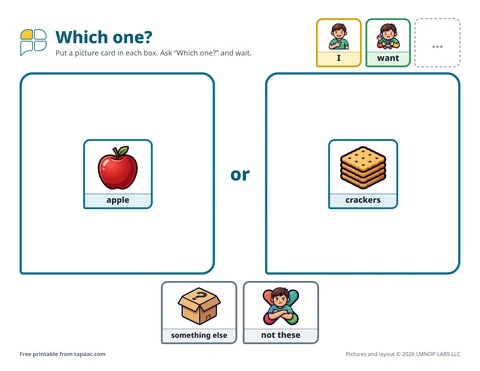 Choice boardsTwo-choice and four-choice boards, with 18 snack, drink and toy cards to cut out.
-
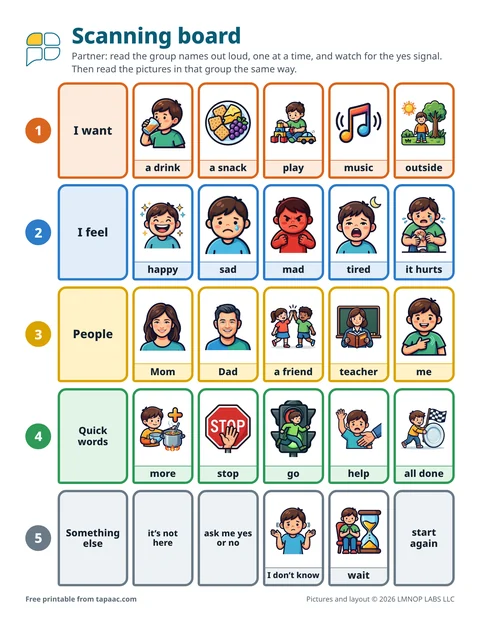 Partner-assisted scanning boardFive picture groups a partner reads out loud, with the partner’s steps and a blank board to make your own.
-
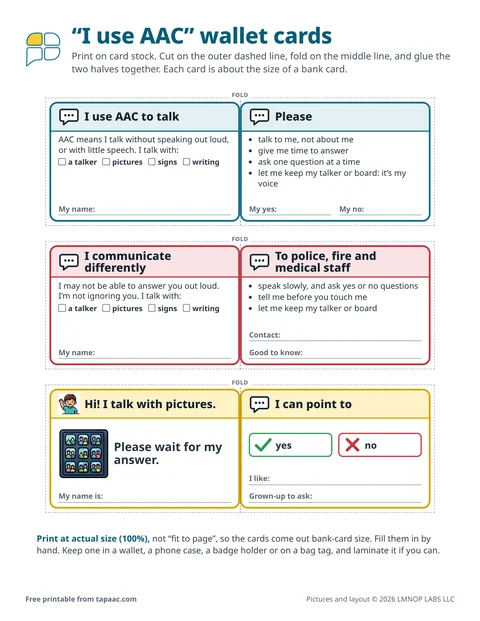 Nonverbal communication cardsFold-out “I use AAC” wallet cards for new people and first responders, and 14 quick cards for a key ring.
-
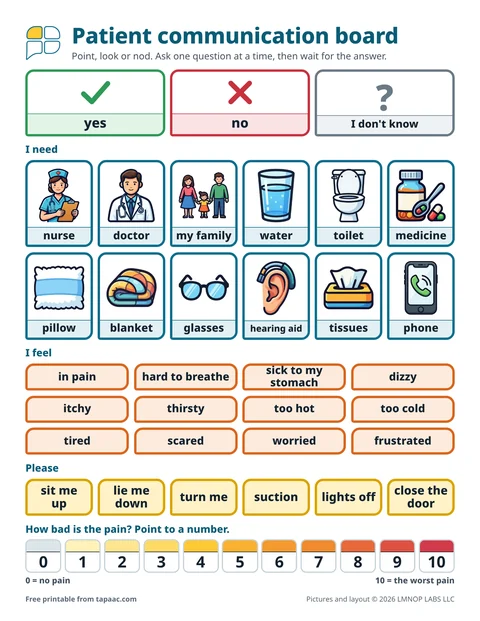 Hospital communication boardFor adult patients: needs, feelings, a 0 to 10 pain scale, letters and questions.
Need a different board? Make your own with the free AAC board maker.
These boards and guides are general information, not therapy or medical advice, and they don’t replace a speech therapist. A speech therapist who knows the person can help choose the right words, pictures and layout. The boards are free to print and share; please don’t sell them (terms of use). Questions about the boards? Email support@lmnoplabs.fun.