 Tap AAC
Choice board: free printable 2 and 4 choice boards
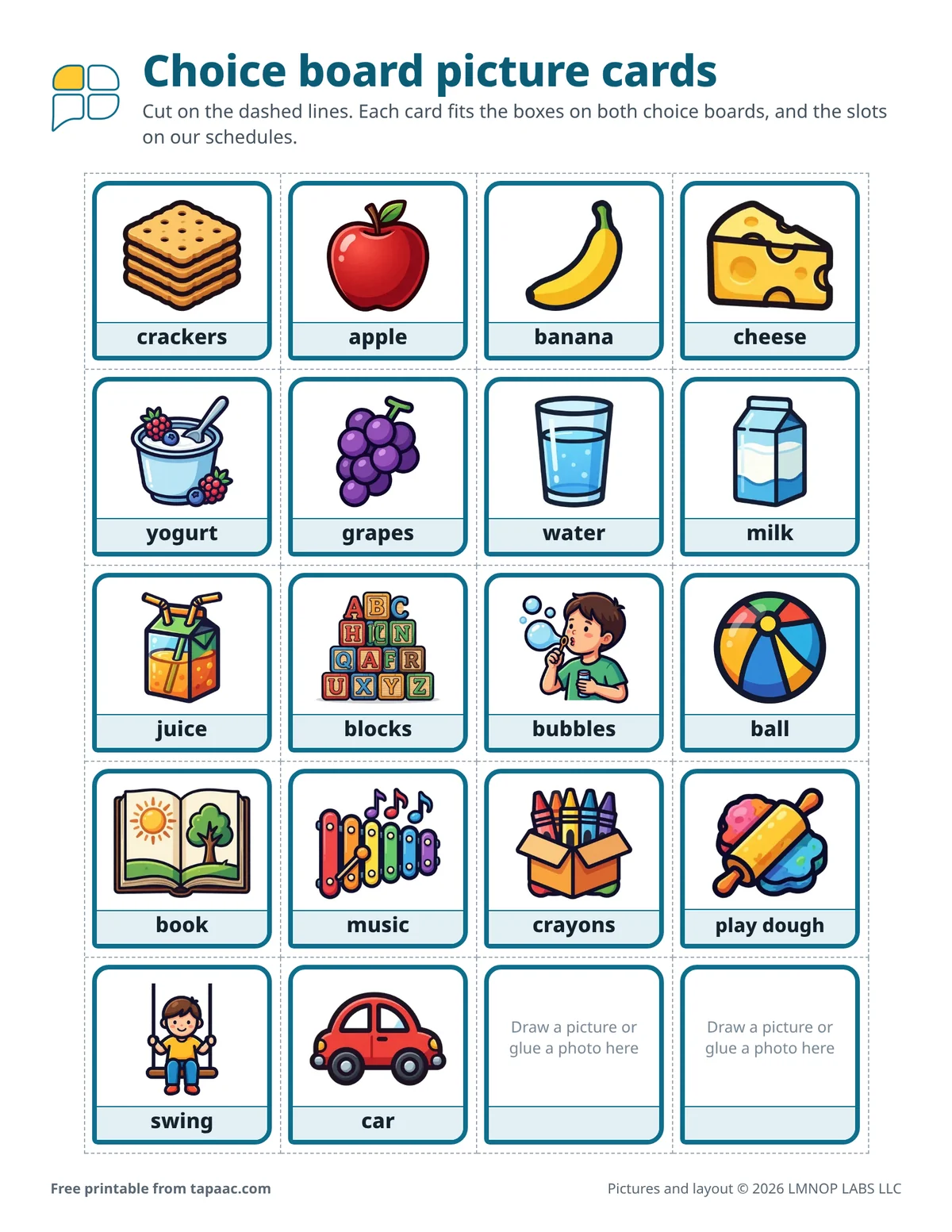
A choice board shows a few options as pictures, so a person can choose by pointing instead of saying the word. This free PDF has a two-choice board, a four-choice board and 18 picture cards to cut out (snacks, drinks and toys), plus two blank cards for your own photos.
Download the free PDF US Letter, 3 pages, 841 KB
Printing on A4 paper? Download the A4 PDF (3 pages, 841 KB). Or pick one page shape for every page:
Portrait (tall page, 3 pages): US Letter PDF (841 KB) · A4 PDF (842 KB)
Landscape (wide page, 3 pages): US Letter PDF (843 KB) · A4 PDF (844 KB)
Edit this board in the free board maker: change the words and pictures, then print.
Have Tap AAC? Add to Tap AAC (.obz file, 718 KB) · How to add a board
- Free
- No sign-up
- Print as many as you need
How to use a choice board
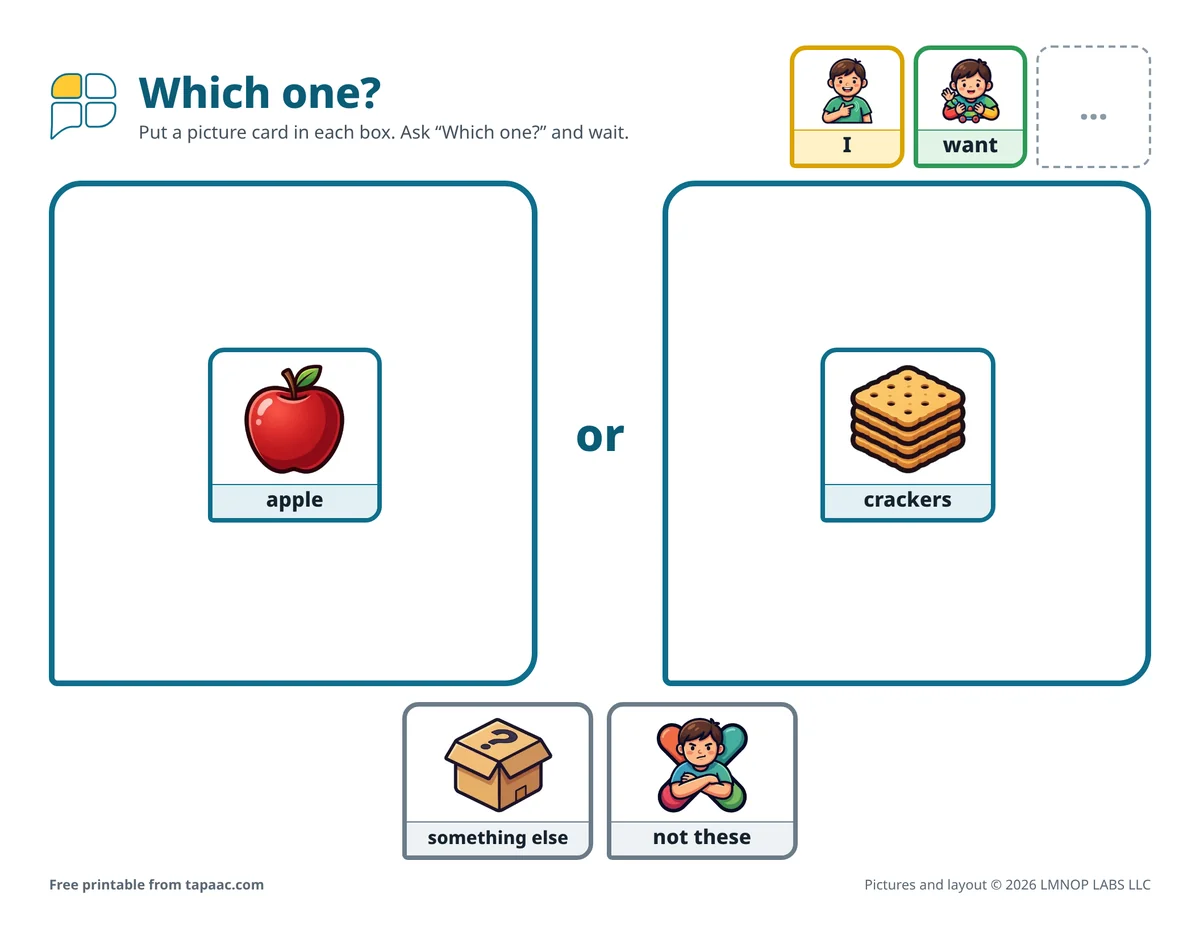
- Start with two. Put two real options on the board, both things you’re happy to give.
- Name them as you point. “Apple, or crackers?” Touch each card as you say it.
- Wait for a point. Then say the word back, “Crackers!”, and hand over the crackers straight away.
- Swap sides now and then. If the person always picks the card on the right, swap the cards and see whether the choice follows the picture.
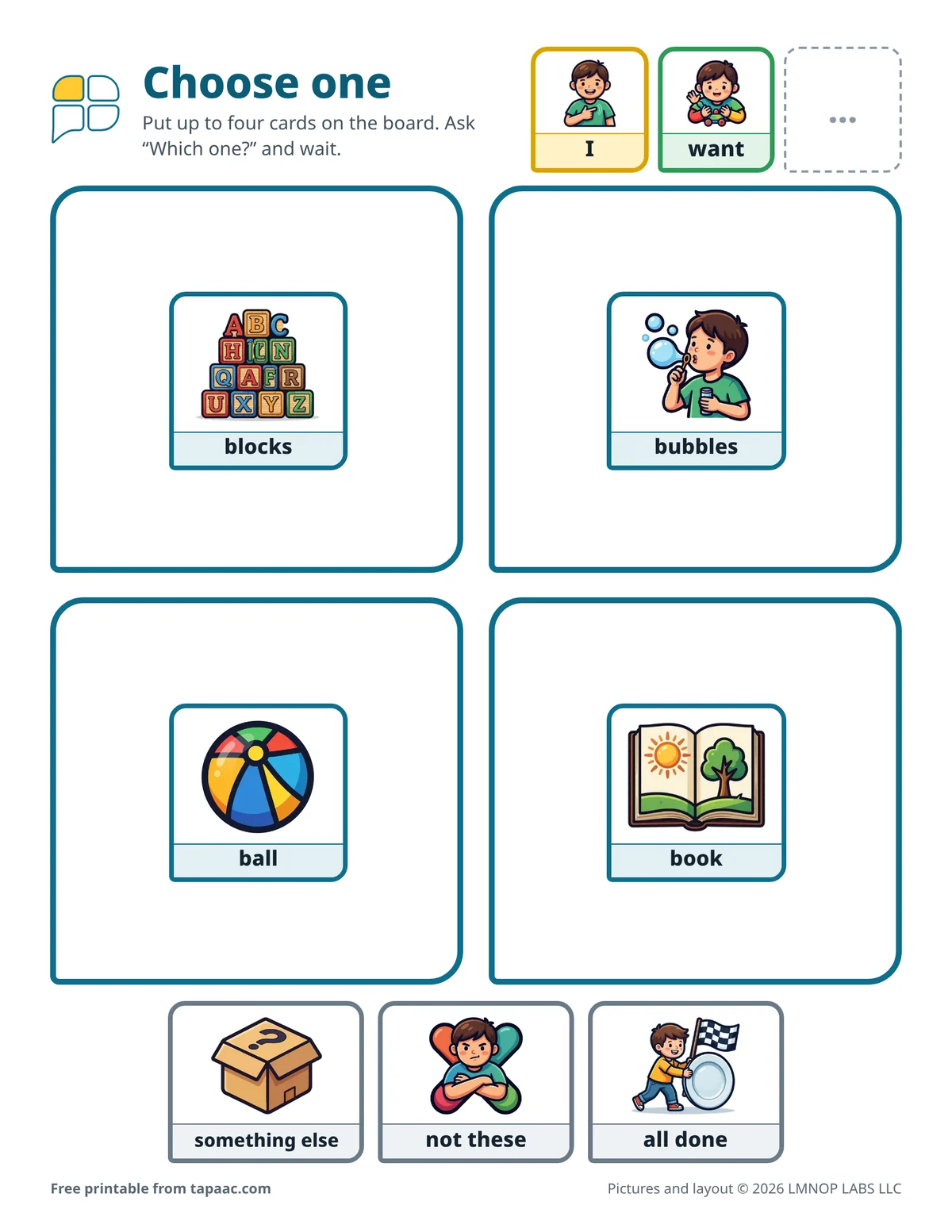
- Add more when two is easy. Move to the four-choice board, or mix snacks with toys.
Two choices or four?
Two is the place to start. It’s quick to look at, and it’s easy for you to see which one was picked. Four suits a person who already chooses from two with ease, or a moment with more on offer, like free play or the snack shelf. Beyond four, a board with fixed words, like the core word board, lets the person say more than “that one”.
When none of them will do
Both boards have something else and not these along the bottom. They matter: a board that only allows the options you picked isn’t really a choice. If the person points to something else, guess out loud or offer two new cards. The four-choice board also has all done, for when choosing is over.
Free play at school. The teacher puts blocks, bubbles, ball and book on the four-choice board. “What do you want to play?” Leo points to bubbles. “Bubbles! I want bubbles.” She points to I want and then bubbles as she says it, and blows the first bubble.
Cards on the sheet
- crackers
- apple
- banana
- cheese
- yogurt
- grapes
- water
- milk
- juice
- blocks
- bubbles
- ball
- book
- music
- crayons
- play dough
- swing
- car
- 2 blank cards
The cards are 1.6 inches (4 cm) square. They fit the boxes on both choice boards, and the slots on our routine schedules.
Printing tips
- Print all three pages on card stock if you have it.
- Laminate the pages, then cut out the cards. Put a hook-and-loop dot in the middle of each box and on the back of each card.
- Glue a photo of the person’s own cup or favorite toy onto a blank card. Some people understand a photo of the real thing more easily.
- Keep the cards in a zip bag clipped to the board, so they are there when you need them.
More free boards
-
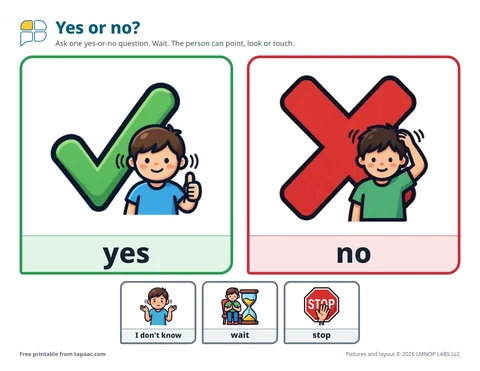 Yes and no boardA big yes and no to point to or look at, plus 20 cards to cut out.
-
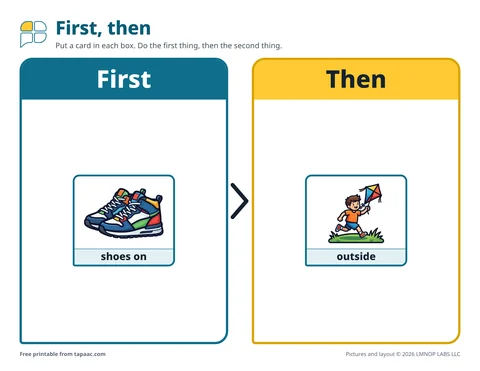 First-then boardShows what happens first and what comes next. With 12 picture cards to cut out.
-
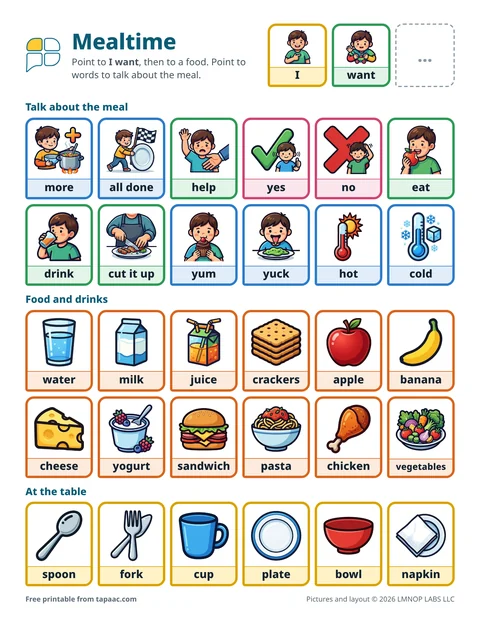 Mealtime communication boardMore, all done, yum, yuck, 12 foods and drinks, and the things on the table.
-
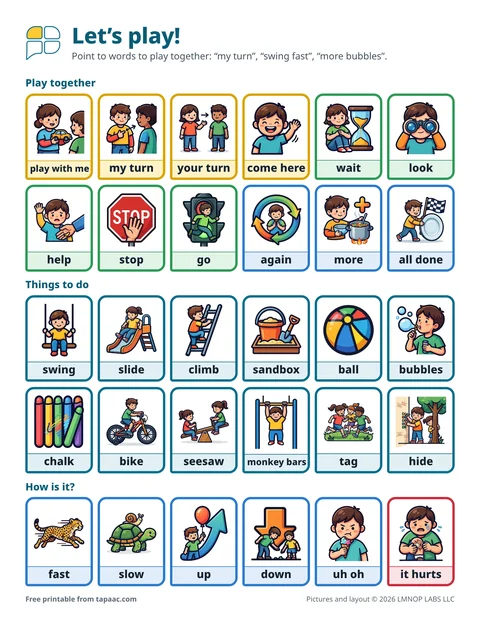 Playground communication boardMy turn, your turn, swing, slide, fast, again and more, for playing together.
Need a different board? Make your own with the free AAC board maker.
These boards and guides are general information, not therapy or medical advice, and they don’t replace a speech therapist. A speech therapist who knows the person can help choose the right words, pictures and layout. The boards are free to print and share; please don’t sell them (terms of use). Questions about the boards? Email support@lmnoplabs.fun.