 Tap AAC
Why adults need AAC
Many conditions that start in adult life can affect speech or language: a stroke or brain injury; conditions that progress, such as ALS, progressive supranuclear palsy and primary progressive aphasia; surgery such as removal of the tongue or the voice box; and short-term conditions, such as having a breathing tube in intensive care.1 Needs vary, and they change as a person recovers or as a disease progresses.1 For memory books, picture cards and labels for someone with dementia, see communication aids for dementia.
AAC for an adult should be made for an adult: words for medical care, work, hobbies and family, and the person’s own way of putting things. A speech-language pathologist also considers how comfortable the person is with technology, and how well they read and spell, before and after the illness.1
After a stroke or a brain injury
A stroke or a brain injury can affect communication in more than one way, and a person can have more than one of these at the same time:2
| Name | What it affects |
|---|---|
| Aphasia | Language: expressing and understanding it, and reading and writing3 |
| Apraxia of speech | Planning the movements of speech: the brain knows what it wants to say, but can’t plan the movements properly2 |
| Dysarthria | The speech muscles themselves, which are weak or paralyzed2 |
The difference matters for AAC. Aphasia can make reading and writing hard too,4 so spelling on an alphabet board may not work; written key words, choices, pictures and gestures are worth trying, and our guide to talking with someone who has aphasia has twelve tips. For severe apraxia of speech, the National Institute on Deafness and Other Communication Disorders suggests other ways to get the message across: formal or informal signs, a notebook of pictures or written words to point to, or a phone, tablet or laptop that writes or speaks.2 If you’re not sure which fits, try a letter board together and see what happens, and ask the speech-language pathologist.
Recovery takes time. Some people with apraxia of speech after a stroke recover some or all of their speech on their own,2 and most people with aphasia after a stroke improve with treatment, especially in the first few months.4 AAC during recovery is a way to take part now, not a sign of giving up on speech.
In the hospital and intensive care
A breathing tube in intensive care can leave a person unable to speak for a while, and AAC is one way to help them communicate until they can.1 A 2016 systematic review of 29 studies with conscious adults on ventilators found that communication boards improved communication and patient satisfaction, although they can be slow and limit what can be said; that electronic AAC devices also helped, with touch, eye or blink controls for people who can’t move much; and that a combination of methods is best. The evidence was limited, and the studies were of poor to moderate quality. The review also looked at talking tracheostomy tubes and electrolarynx devices, which are decisions for the medical team.5
In the hospital, communication can change from hour to hour with medicines, pain and tiredness, and the person may have to use AAC lying in bed. The words that matter most let them take part in their own care: basic needs, saying no, and saying what they would prefer.1
- Bring glasses and hearing aids, and put them on before you start.
- Agree on yes and no first. The bedside steps on our hospital communication board go through it step by step.
- Ask about pain with a scale, such as the one on the hospital communication board.
- Ask whether the hospital has a speech-language pathologist or communication boards. Many hospitals keep AAC tool kits for patients.1
- Keep the board within reach of the bed, not on a table across the room.
- Nurses and care staff: see how to communicate with nonverbal patients.
ALS (MND): plan early
ALS is a disease of the motor neurons, the nerve cells that control movement. It gets worse over time, and in the end affects walking, talking, chewing and breathing.6 Almost all people with ALS develop a motor speech disorder such as dysarthria, and at some point 80 to 95% can’t meet their daily communication needs with natural speech.7
Timing is the hard part. Once speech starts to become hard to understand, it often gets worse so quickly that there is little time to set up AAC, which is why the timing of a referral for an AAC assessment matters so much.7 The UK national guideline on motor neurone disease says a speech and language therapist should assess communication without delay, and that AAC equipment should be provided without delay; it lists both low-tech options, such as alphabet, word or picture boards, and tablet-based devices that speak.8 AAC use among people with ALS has grown, and many use it until the last weeks of life.7
Voice banking and message banking
While speech is still clear, two kinds of recording can keep the person’s own voice in their AAC:
- Voice banking: recording a large amount of speech to make a synthetic voice that sounds close to the person’s own. It should be done while the person still has the energy and the skill to speak clearly.1 People with ALS sometimes use it to keep their voice for a computer speech system later.6
- Message banking: recording words, phrases and sounds in the person’s own voice, with their own expression, to be played back on an AAC device:1 names, sayings, jokes, “I love you”, even a laugh.
As movement changes
The way a person uses AAC may need to change: from typing, to a switch, to the eyes. The professional guidance asks for access that can change as physical abilities change.1 Computer-based speech systems with eye tracking let people with ALS type and use the internet,6 and the UK guideline refers people to a specialist AAC service when complex equipment, such as eye gaze access, is needed.8 A paper eye gaze board is a backup that needs no power.
Paying for AAC (US)
Medicare treats speech-generating devices as durable medical equipment, covered for people with a severe speech impairment when its conditions are met. Ordinary computers and tablets generally are not, because they are useful without an illness or injury.9 Insurers usually need a speech-language pathologist to show that a device is medically necessary, and coverage of tablets, apps and computers varies by plan.1
Every US state and territory gets federal funding for an Assistive Technology Act program,1 and the national directory of these programs lists device loans and demonstrations, so you may be able to borrow a device before deciding.10 This is general information, not insurance advice. Our guide to getting an AAC device goes through Medicaid, Medicare, private insurance and the school, step by step.
For family and friends
- Have an introduction ready. A short message such as “I can hear you fine. I spell to talk. Please wait while I type” helps with new people; a ready-made introduction for unfamiliar listeners is one of the strategies the professional guidance describes.1
- Give time. AAC is slower than speech, and a slow rate of talking is one of the known barriers to using it.1
- Ask before you finish a sentence for the person; some welcome it, others don’t.
- Keep the AAC within reach and charged, with a paper backup: equipment breaking down is another known barrier.1
- Talk to the person, not about them, including at the doctor’s.
Try this today
- Put the person’s glasses and hearing aids within reach, and agree on a clear yes and no.
- Print a board made for adults, and keep it where the person spends the day.
- With ALS, ask the care team now for a speech-language pathologist who knows AAC, while speech is still clear.
- Record a few favorite phrases in the person’s own voice.
More AAC guides
- How to talk with someone who has aphasia: 12 tips for family and friendsTwelve tips for family and friends, easier questions, and what to do when you’re stuck.
- Communication aids for dementia: picture cards, boards, memory books and tipsPicture cards, memory books, labels and calendars, and tips for talking together.
- Using a communication board in the hospitalOn the hospital board’s page: yes and no, asking about pain, and spelling with a patient who can’t speak.
- Using an eye gaze boardOn the eye gaze board’s page: spelling with the eyes, and partner-assisted scanning, step by step.
- AAC myths and facts: 10 common myths, and what the research saysTen things people believe about AAC, and what research and professional guidance say instead.
Sources
We read each of these on October 12, 2026. Numbers in the text point to them.
- American Speech-Language-Hearing Association. Augmentative and Alternative Communication (Practice Portal). Professional guidance for speech-language pathologists. Accessed October 12, 2026.
- National Institute on Deafness and Other Communication Disorders (NIH). Apraxia of Speech. Last updated October 31, 2017.
- National Institute on Deafness and Other Communication Disorders (NIH). Aphasia. Last updated April 16, 2025.
- NHS (UK). Aphasia. Page last reviewed April 1, 2025.
- Ten Hoorn S, Elbers PW, Girbes AR, Tuinman PR (2016). Communicating with conscious and mechanically ventilated critically ill patients: a systematic review. Critical Care, 20(1), 333. Abstract on PubMed.
- National Institute of Neurological Disorders and Stroke (NIH). Amyotrophic Lateral Sclerosis (ALS). Last reviewed March 13, 2026.
- Beukelman D, Fager S, Nordness A (2011). Communication Support for People with ALS. Neurology Research International, 2011, 714693. Abstract on PubMed.
- National Institute for Health and Care Excellence (NICE, UK). Motor neurone disease: assessment and management (NG42), Recommendations. Published February 24, 2016, last updated July 23, 2019.
- Centers for Medicare & Medicaid Services (CMS). National Coverage Determination: Speech Generating Devices (50.1). Accessed October 12, 2026.
- National Assistive Technology Act Technical Assistance and Training (AT3) Center. AT Act Programs (directory of state and territory programs). Accessed October 12, 2026.
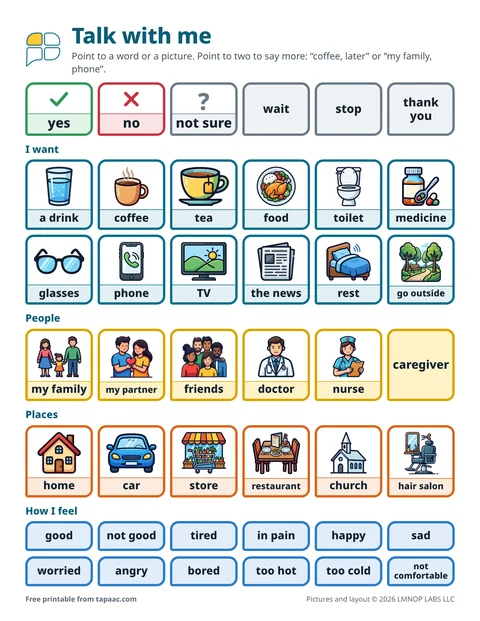 Communication board for adults
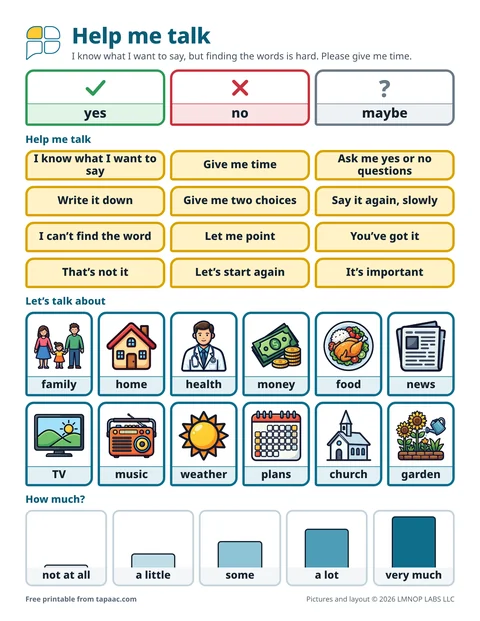 Aphasia communication board
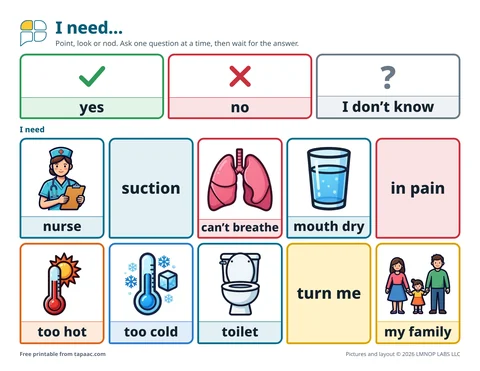 ICU communication board
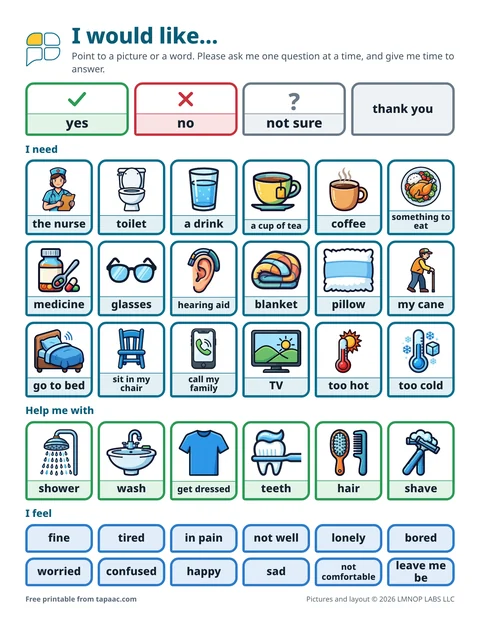 Care home communication board