 Tap AAC
How Down syndrome can affect communication
Down syndrome happens when a person has an extra copy of chromosome 21. People with Down syndrome often have developmental challenges, such as being slower to learn to speak, and hearing loss is one of the common health problems.1
Every person is different, but research describes a common pattern: understanding language is usually stronger than using it, with particular challenges in speech sounds and grammar.2 Studies consistently find that speech can be hard for listeners to understand,3 and childhood apraxia of speech is reported more often in people with Down syndrome.4
That gap matters. Speech that is hard to understand can hide a child’s real language skills, and that can lead people to seriously underestimate them. Researchers point to aided AAC as a way to bridge the gap.5
Will AAC hold back speech?
Research with young children with Down syndrome hasn’t found that it does. A 2023 analysis looked at 29 young children with Down syndrome from two randomized studies of parent-led interventions: some included a speech-generating device with pictures, others focused on spoken words. The device gave children a way to communicate, it didn’t hinder their spoken vocabulary, and the authors concluded that it can help young children with Down syndrome communicate while they are still learning to talk.6
Signing has long been part of early language help for children with Down syndrome; the newer interest is in speech-generating devices.6 Many families use both, and pictures too. More on this question in AAC myths and facts.
Signs, pictures and speech apps together
Preferred practice in AAC combines several ways of communicating, so the person can choose the one that suits the place, the listener and the message.7 Each has its strengths:
| Way | Good for | Watch out for |
|---|---|---|
| Signs | Always there, quick, and good in songs and play | Only people who know the signs can follow them |
| Pictures and boards | Anyone can read a picture with its word; cheap; fine in the bath or the pool | The listener has to be looking; only so many words fit on a page |
| A speech app or device | A clear voice that strangers understand, many words, and whole sentences | Needs charging, and someone to keep adding words |
Key word signing, where you sign the main words of what you say, is commonly used by children with Down syndrome in mainstream primary schools. A 2022 study from Ireland stresses that the signs a child needs must be available to everyone around them, not just the child: teachers, assistants and classmates.8
From single words to sentences
Grammar is often one of the hardest parts of language for people with Down syndrome,2 and word endings such as -ed and -s are hard to show with pictures.7 AAC can still help. In a 2025 randomized controlled trial, every family went to an AAC workshop and every child got a device; children who also had four months of twice-weekly, play-based AAC language sessions went on to make clearly longer messages on their devices than the others.5
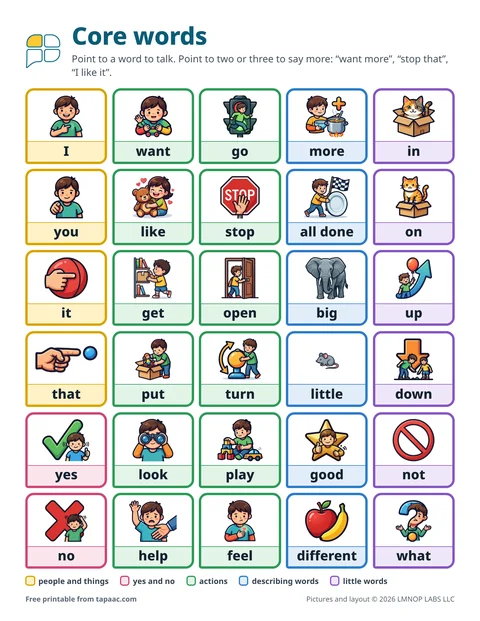
At home, that starts with modeling two words together, like “more bubbles”, “my turn” or “go outside”, then three. Core words such as more, go, not and want combine with almost anything. If the AAC has word endings, show them too: play, played, playing.
Reading and AAC
Reading opens up AAC: a person who can spell can say anything. Children who use AAC often get less exposure to reading and writing, so plan for it. Read together with the AAC within reach, so your child can join in and comment on the story.7 A 2021 review brought together the research supporting AAC during preschool for both language and literacy, for children with Down syndrome who have limited speech.9
Check hearing and vision
Hearing loss is one of the common health problems in Down syndrome,1 and hearing and vision both affect AAC: whether a person hears the spoken words and the voice output, and whether they can see the pictures. During an AAC assessment, hearing aids and glasses should be worn, and the speech-language pathologist should see recent hearing and vision results or refer for testing.7 Ask your doctor when they were last checked.
Helping new people understand
- Make an “About me” page: how I say yes and no, my signs, my favorite things to talk about.
- Teach a few key signs to teachers, sitters, coaches and grandparents.
- Ask for the topic first when you don’t understand. Our guide to AAC and apraxia of speech has steps that work for any speech that’s hard to follow.
- Talk to the person, not about them, at every age.
AAC isn’t only for young children. Teenagers and adults may need it for work, college and living more independently, and planning for it belongs in the move out of school.7
How to start
- Ask for a speech and language assessment that includes AAC. In the US, that’s early intervention before age three and the school district from three; see AAC for toddlers.
- Pick one routine and a few words, and sign, say and point together as you talk.
- Keep the AAC with your child all day, not just in therapy.
- Add the words your child cares about: family names, favorite foods, shows and jokes.
- Model two words together once single words are going well.
Try this today
- Write down the signs, sounds and words your child uses now, and share the list with everyone who helps.
- Pick one routine and point to two words together while you talk, like “more bubbles”.
- Read a book together with the AAC within reach, and pause so your child can comment.
- Ask when your child’s hearing and vision were last checked.
More AAC guides
- AAC for toddlers: when to start, and how to begin at homeStarting before your child talks: one routine, a few words, modeling and early intervention.
- AAC and childhood apraxia of speech: what parents should knowSpeech therapy first, AAC alongside it, and what to do when your child isn’t understood.
- AAC myths and facts: 10 common myths, and what the research saysTen things people believe about AAC, and what research and professional guidance say instead.
- AAC at school: how teachers can support a student who uses AACModeling in lessons, wait time, better questions, classmates, and the IEP.
Sources
We read each of these on October 12, 2026. Numbers in the text point to them.
- Centers for Disease Control and Prevention (CDC). About Down Syndrome. Page dated January 8, 2026.
- Martin GE, Klusek J, Estigarribia B, Roberts JE (2009). Language Characteristics of Individuals with Down Syndrome. Topics in Language Disorders, 29(2), 112–132. Abstract on PubMed.
- Kent RD, Vorperian HK (2013). Speech impairment in Down syndrome: a review. Journal of Speech, Language, and Hearing Research, 56(1), 178–210. Abstract on PubMed.
- American Speech-Language-Hearing Association. Childhood Apraxia of Speech (Practice Portal). Professional guidance for speech-language pathologists. Accessed October 12, 2026.
- Kent-Walsh J, Harrington N, Hahs-Vaughn D, Binger C (2025). Generative Language Intervention for Young Children With Down Syndrome Using Augmentative and Alternative Communication: A Randomized Controlled Trial. Language, Speech, and Hearing Services in Schools, 56(3), 542–564. Abstract on PubMed.
- Romski M, Sevcik RA, Barton-Hulsey A, Fisher E, King M, Albert P, Kaldes G, Walters C (2023). Parent-implemented augmented communication intervention and young children with Down syndrome: an exploratory report. Frontiers in Psychology, 14, 1168599. Abstract on PubMed.
- American Speech-Language-Hearing Association. Augmentative and Alternative Communication (Practice Portal). Professional guidance for speech-language pathologists. Accessed October 12, 2026.
- Frizelle P, Lyons C (2022). The development of a core key word signing vocabulary (Lámh) to facilitate communication with children with Down syndrome in the first year of mainstream primary school in Ireland. Augmentative and Alternative Communication, 38(1), 53–66. Abstract on PubMed.
- Barton-Hulsey A, Phinney S, Collins S (2021). Augmentative and Alternative Communication Supports for Language and Literacy in Preschool: Considerations for Down Syndrome and Autism Spectrum Disorder. Seminars in Speech and Language, 42(4), 345–362. Abstract on PubMed.
 Core word board
 Choice boards
 Feelings board
 First-then board