 Tap AAC
Alphabet board for communication: free printable
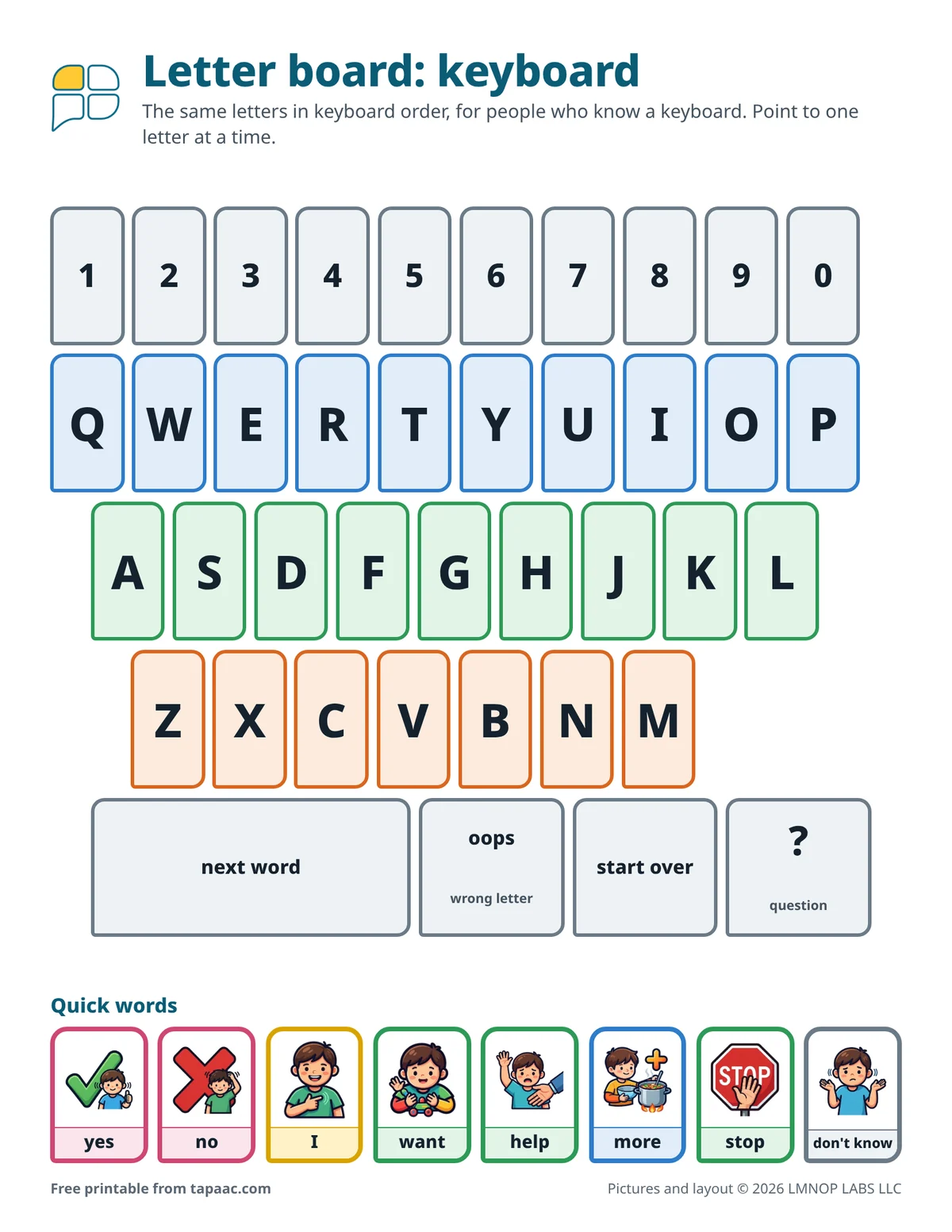
An alphabet board, also called a letter board or spelling board, lets a person who can spell, but can’t speak clearly, point to letters to spell out words. This free PDF has two layouts: A to Z in alphabet order with colored rows, and the same letters in keyboard order. Both have numbers, next word, oops, start over and quick words like yes, no and help.
Download the free PDF US Letter, 2 pages, 385 KB
Portrait (tall page, 2 pages): US Letter PDF (385 KB) · A4 PDF (385 KB)
Landscape (wide page, 2 pages): US Letter PDF (385 KB) · A4 PDF (386 KB)
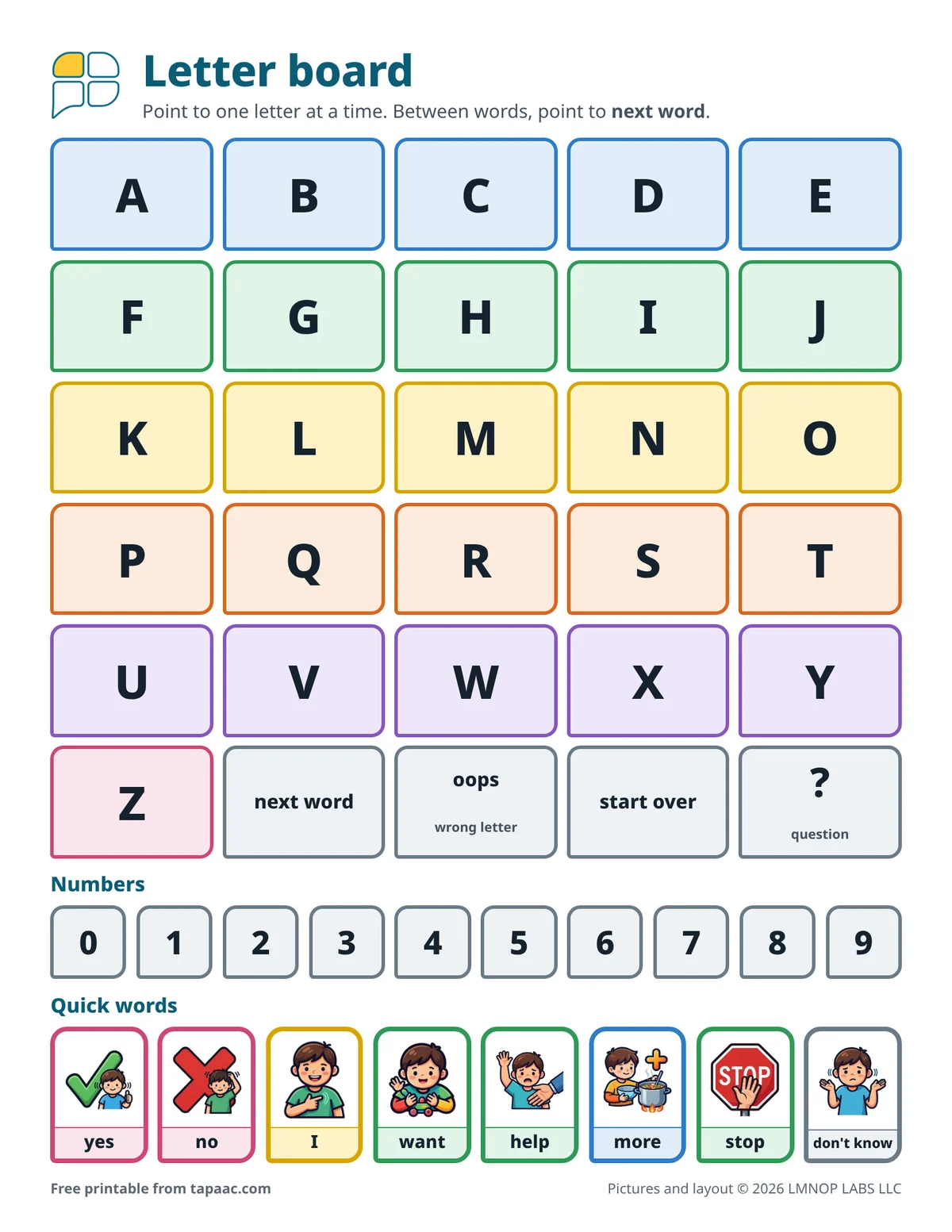
Edit this board in the free board maker: change the words and pictures, then print.
Have Tap AAC? Add to Tap AAC (.obz file, 282 KB) · How to add a board
- Free
- No sign-up
- Print as many as you need
How to use an alphabet board
- Agree on the signals first. How will the person show yes, no and “wrong letter”? Write it on the board.
- Say each letter out loud as it’s pointed to. Then say the word so far: “C… O… F… coffee?”
- Guess, and check. If you think you know the word, ask. The person can point to yes, or carry on spelling.
- Use next word and start over. They save a lot of mix-ups between words.
- Write it down. For a long message, jot the letters on paper, so nobody has to remember them.
If the person can’t point
The colored rows are there for this. You point to, or read out, one row at a time: “Blue row? Green row?” The person gives their yes signal at the right row. Then you go along that row, letter by letter, until they signal again. This is often called partner-assisted scanning. It is slower than pointing, so keep questions short and guess words early.
Alphabet order or keyboard order?
Someone who has typed for years may find letters faster in keyboard order. Alphabet order is easier to search for anyone who doesn’t know a keyboard, including children who are learning their letters. Print both pages and see which one the person reaches for.
Grandpa Joe’s speech is hard to understand today, but he can point. T, V. His granddaughter says it back, “TV?”, and he points to yes. Then L, O, U… “Louder?” she guesses. He laughs and points to yes again.
What’s on the board
Letters A to Z, numbers 0 to 9, next word, oops (wrong letter), start over and ? (it’s a question). Quick words with pictures:
- yes
- no
- I
- want
- help
- more
- stop
- don’t know
Printing tips
- Laminate it, so you can write the spelled words in the margin with a dry-erase marker and wipe them off.
- Print both pages and put them back to back in one sheet protector: alphabet on one side, keyboard on the other.
- Keep one copy by the bed or chair and one in the bag that goes out.
- For a hospital stay, the patient communication board has its own letter page, with questions for nurses and doctors.
More free boards
-
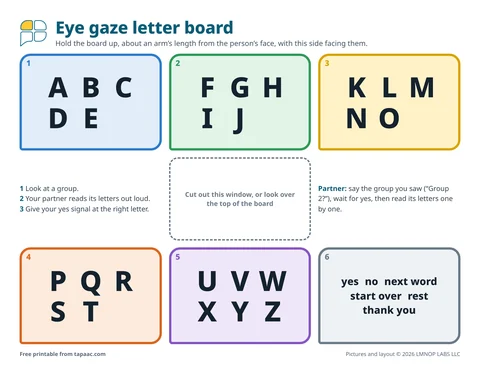 Eye gaze boardSpell with the eyes: a six-group letter board, and a partner scanning board for when looking is hard.
-
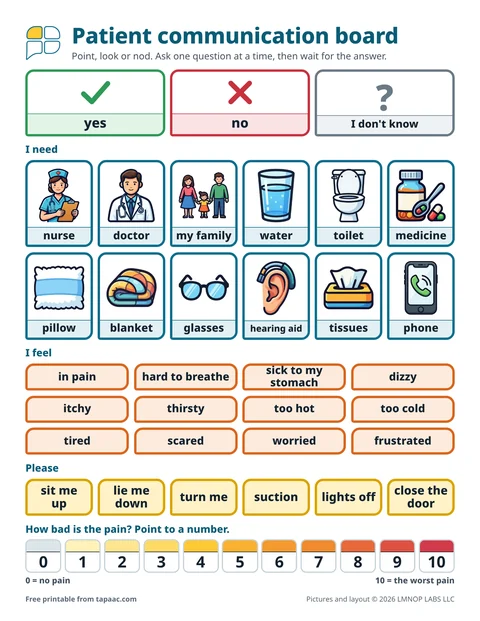 Hospital communication boardFor adult patients: needs, feelings, a 0 to 10 pain scale, letters and questions.
-
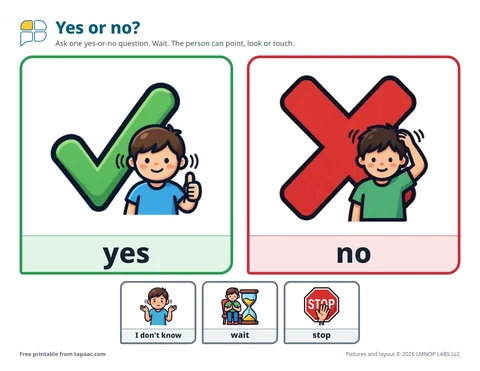 Yes and no boardA big yes and no to point to or look at, plus 20 cards to cut out.
-
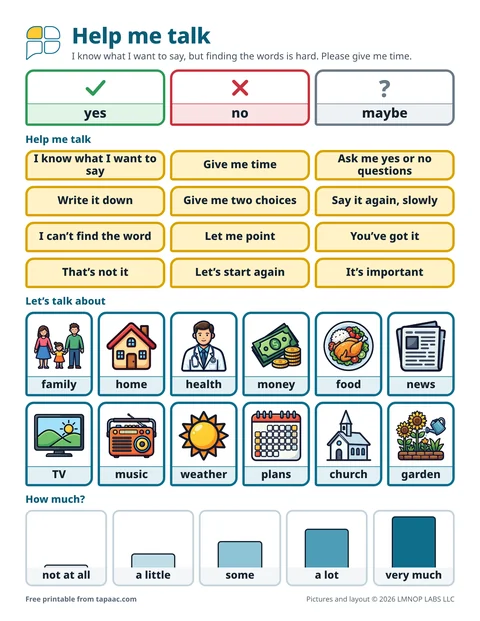 Aphasia communication boardHelp-me-talk phrases, topics and a how-much scale, plus a page for the conversation partner.
Need a different board? Make your own with the free AAC board maker.
These boards and guides are general information, not therapy or medical advice, and they don’t replace a speech therapist. A speech therapist who knows the person can help choose the right words, pictures and layout. The boards are free to print and share; please don’t sell them (terms of use). Questions about the boards? Email support@lmnoplabs.fun.