 Tap AAC
Eye gaze board: free printable letter boards for ALS
An eye gaze board lets a person who can’t speak or point spell words with their eyes. The partner holds the board up between them, the person looks at a colored group of letters, and the partner reads that group’s letters out loud until the person gives their yes signal at the right one. This free PDF has the eye gaze board and a partner-assisted scanning board for when looking is hard too: the partner reads the rows and letters aloud, and the person only has to signal yes.
Download the free PDF US Letter, 2 pages, 105 KB
Printing on A4 paper? Download the A4 PDF (2 pages, 105 KB). Or pick one page shape for every page:
Portrait (tall page, 2 pages): US Letter PDF (102 KB) · A4 PDF (102 KB)
Landscape (wide page, 2 pages): US Letter PDF (104 KB) · A4 PDF (104 KB)
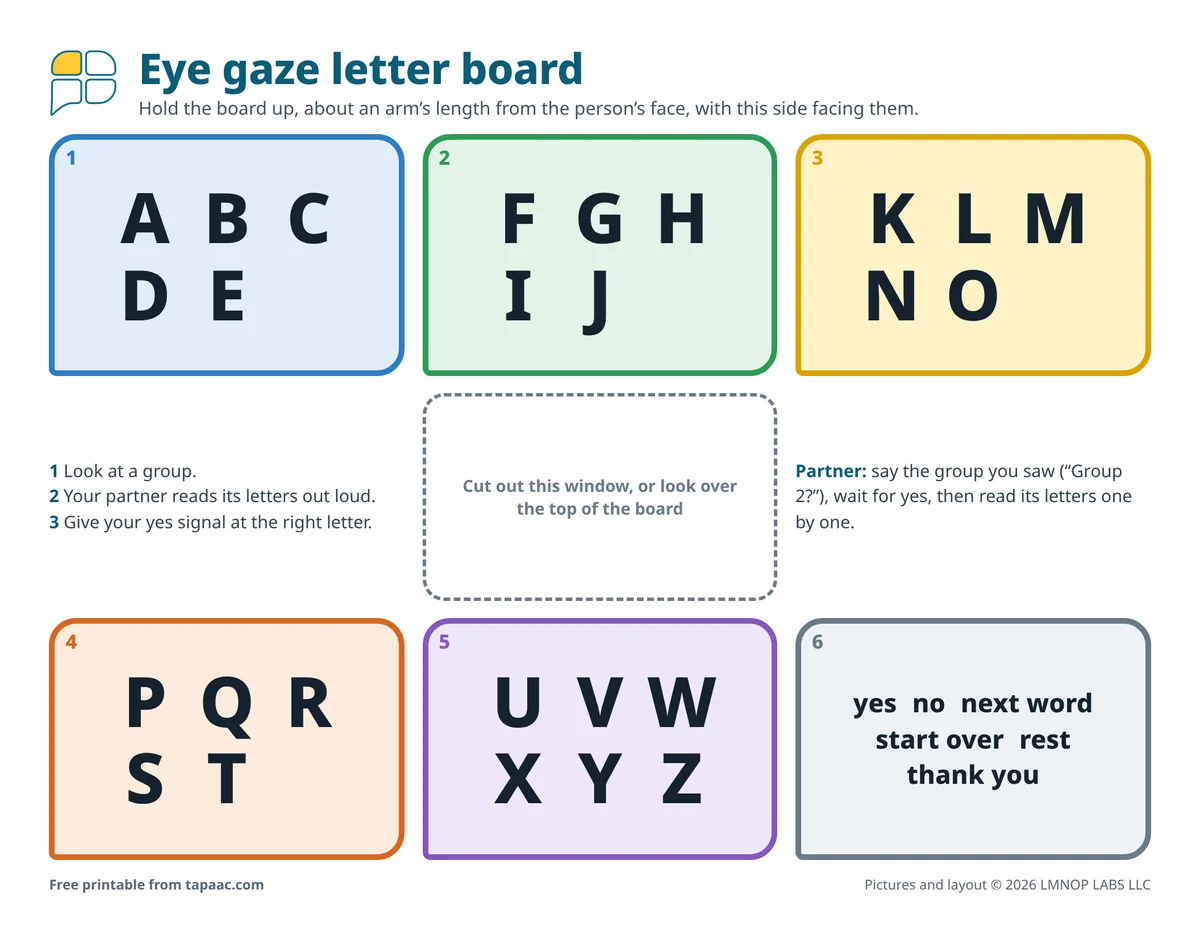
Edit this board in the free board maker: change the words and pictures, then print.
Have Tap AAC? Add to Tap AAC (.obz file, 2 KB) · How to add a board
- Free
- No sign-up
- Print as many as you need
In the hospital, if something seems wrong, press the call button or tell a nurse right away. At home, if someone may be badly hurt or very sick, call 911 or your local emergency number.
Who it’s for
People who can move their eyes on purpose, but can’t speak or use their hands well enough to point: for example with ALS (also called MND), after a brainstem stroke, or in intensive care. It’s also for the partner on the other side of the board: family, caregivers and nurses. The partner-assisted scanning board on page 2 works for anyone who has one reliable yes signal, even if looking is tiring or unclear.
Before you start
- Yes and no. Agree on two clear signals: a blink for yes and eyes closed for no, or eyes up for yes. Write them on page 2, where every visitor can see them, so every partner uses the same ones.
- Glasses and light. Glasses on, if the person wears them; light on the person’s face, and no bright window behind you.
- The board. Card stock or laminated, so it stays flat. Cut out the center window, so you can watch the person’s eyes through it.
- Pen and paper, to write down each letter as it’s chosen.
How to use the eye gaze board, step by step
- Hold the board up between you, about an arm’s length from the person’s face and at their eye level, with the letters facing them. Keep it at the same distance every time.
- The person looks at the group with their letter and holds the look. Say what you saw: “Green group?” Wait for yes. If the answer is no, ask about the next most likely group.
- Read that group’s letters out loud, one at a time, at a steady pace. “F… G… H…” The person signals yes at the right letter.
- Write each letter down, and say the word so far: “F, A… Fa?”
- Guess early, and check. “Fan? Do you want the fan?” A yes saves the rest of the word; a no costs only a moment.
- Use group 6 to move on. Next word between words, start over after a mix-up, rest when they’re tired.
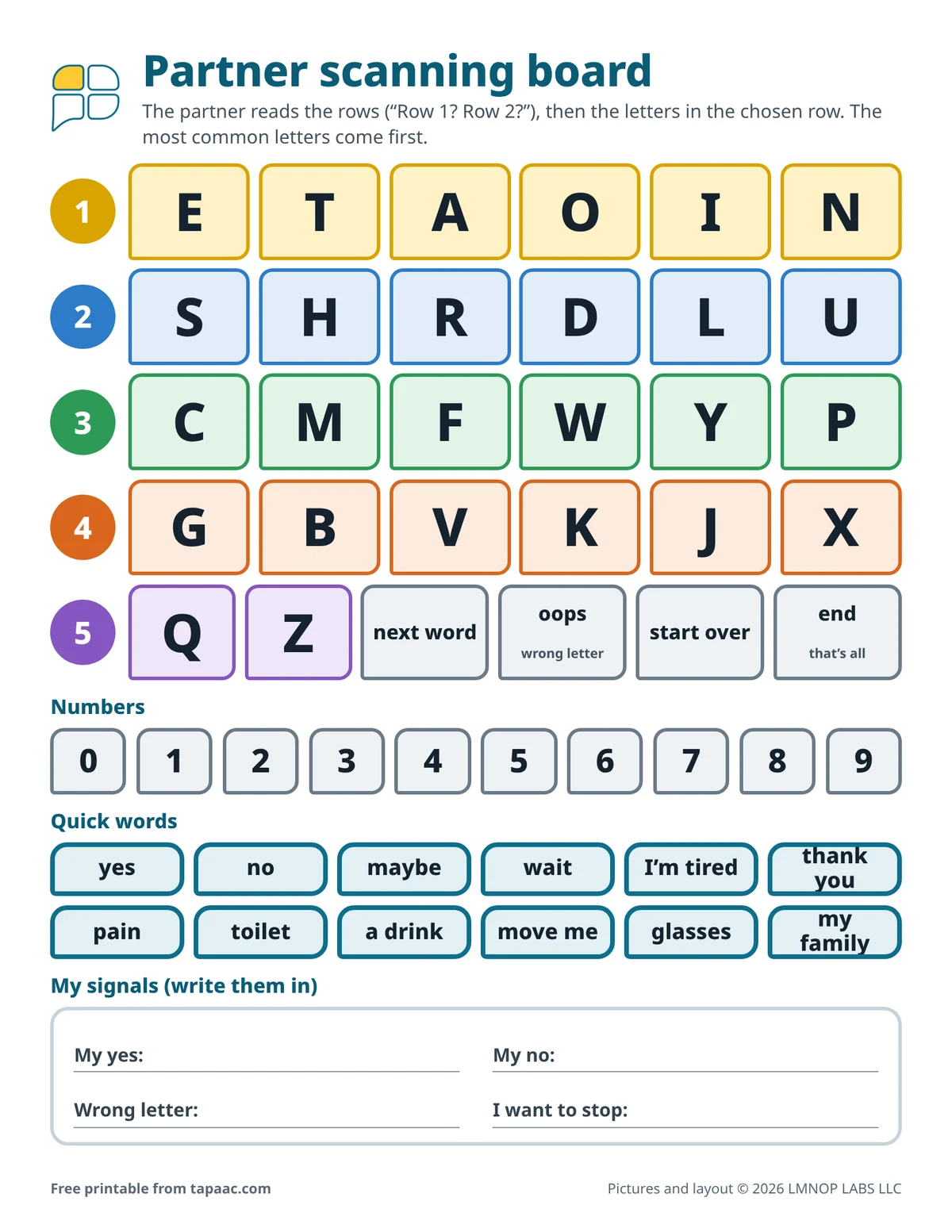
Partner-assisted scanning (page 2)
When looking at a group is too hard, the partner does the searching. Read the rows: “Row 1? Row 2?” When the person signals yes, read that row’s letters one at a time. The rows start with the letters used most in English (E, T, A, O, I, N), so most words take fewer steps. The person can listen with their eyes closed, which makes this work in a dark room or for someone with poor eyesight. For someone who doesn’t spell, use the partner-assisted scanning board with pictures instead.
When it’s hard going
| Problem | Try this |
|---|---|
| You can’t tell which group they looked at | Hold the board a little further away or higher, and ask them to look a little longer. Say what you think you saw, and wait for yes. |
| Mix-ups in long words | Write every letter down, and read the word back after each letter. |
| The person tires quickly | Keep sessions short, ask yes-or-no questions where you can, and stop when they choose rest. |
| Visitors don’t know how it works | Write the signals and the steps on the back of the board, or on page 2. |
| You keep guessing wrong | Ask the person to spell the first two letters before you guess again. |
Keep the board still while you read it: moving it makes the eyes harder to follow. Say every letter you think you saw. A wrong guess is quickly fixed; a silent mistake isn’t.
Keep the person in charge
Spelling with the eyes is slow, and it’s tempting to finish sentences. Ask before you guess the rest of a sentence, and accept no. Talk to the person, not about them, even when others are in the room. Some messages are private: ask whether they want visitors to step out.
Tom can’t speak or move his hands, but his eyes are quick. His wife holds the board up and watches through the window. He looks at the green group. “Green?” He blinks once: yes. “F…” Blink. Then the blue group: A. Then yellow: N. “Fan?” Blink. She switches the fan on, and he looks at group 6, at thank you.
What’s on the boards
Page 1, eye gaze board: group 1 A to E, group 2 F to J, group 3 K to O, group 4 P to T, group 5 U to Z, and group 6: yes, no, next word, start over, rest, thank you.
Page 2, partner scanning board: five rows of letters with the most common first, next word, oops, start over, end, the numbers 0 to 9, and 12 quick words:
- yes
- no
- maybe
- wait
- I’m tired
- thank you
- pain
- toilet
- a drink
- move me
- glasses
- my family
Printing tips
- Print page 1 on card stock, so it stays flat when you hold it up. Laminate it, then cut out the center window.
- Keep the scanning board at the bedside, with the signals written in, for nurses and visitors.
- For children and adults with cerebral palsy, read AAC and cerebral palsy: touch, switches and eye gaze.
When to look for more
A paper board is a reliable backup that never needs charging. A speech-language pathologist or an assistive technology team can help find the best way to communicate as needs change, including speech devices controlled by the eyes or by a switch. For a hospital stay, the ICU communication board and the hospital communication board add needs, pain and questions, and nurses and care staff can read how to communicate with nonverbal patients.
More free boards
-
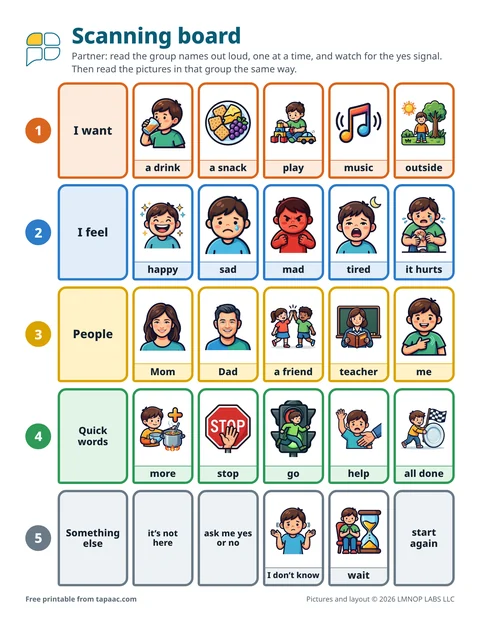 Partner-assisted scanning boardFive picture groups a partner reads out loud, with the partner’s steps and a blank board to make your own.
-
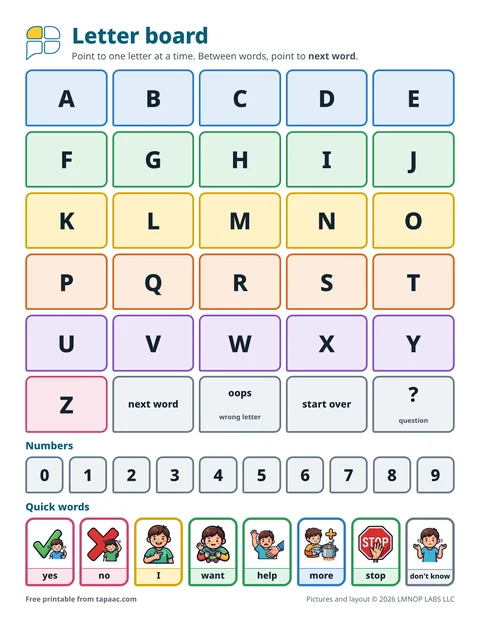 Alphabet boardA to Z for spelling, in alphabet order and keyboard order, with quick words.
-
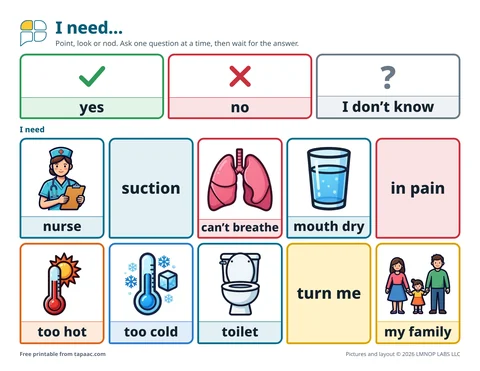 ICU communication boardLarge print for very sick patients: yes, no, ten big needs, a body outline and a pain scale.
-
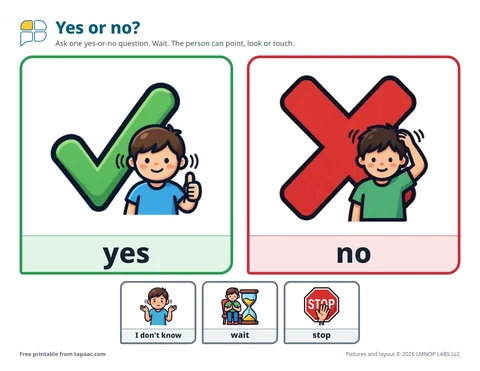 Yes and no boardA big yes and no to point to or look at, plus 20 cards to cut out.
Need a different board? Make your own with the free AAC board maker.
These boards and guides are general information, not therapy or medical advice, and they don’t replace a speech therapist. A speech therapist who knows the person can help choose the right words, pictures and layout. The boards are free to print and share; please don’t sell them (terms of use). Questions about the boards? Email support@lmnoplabs.fun.