 Tap AAC
This is the longer companion to our one-page AAC modeling at home handout, for parents, grandparents, teachers and aides. Ask your child’s speech-language pathologist which words to focus on, and how they would like you to help.
Why modeling comes first
When a partner points to symbols on a child’s AAC while talking, speech-language pathologists call it augmented input, aided language stimulation or aided language modeling. It is based on the idea that the language a child takes in is the model for the language they develop. It can lead to better understanding of symbols in young AAC users, and to better understanding and use of symbols.1
The research behind it is encouraging, though most of it comes from small studies that follow a few people closely:
- A 2018 meta-analysis pooled 26 single-case studies (88 participants) and 2 group studies (103 participants) of people with developmental disabilities who use AAC. Interventions that included aided AAC input were highly effective across ages, disabilities and language skills, for understanding as well as expression. They usually combined modeling with an expectant pause, prompts, responding to what the person did, and open questions. The authors concluded that partners should use aided AAC input.2
- A 2015 meta-analysis of 17 studies found that teaching communication partners was highly effective for the communication of the people who use AAC. Modeling on the AAC, an expectant pause and open questions were the partner skills taught most often.3
The three habits below come from that research.
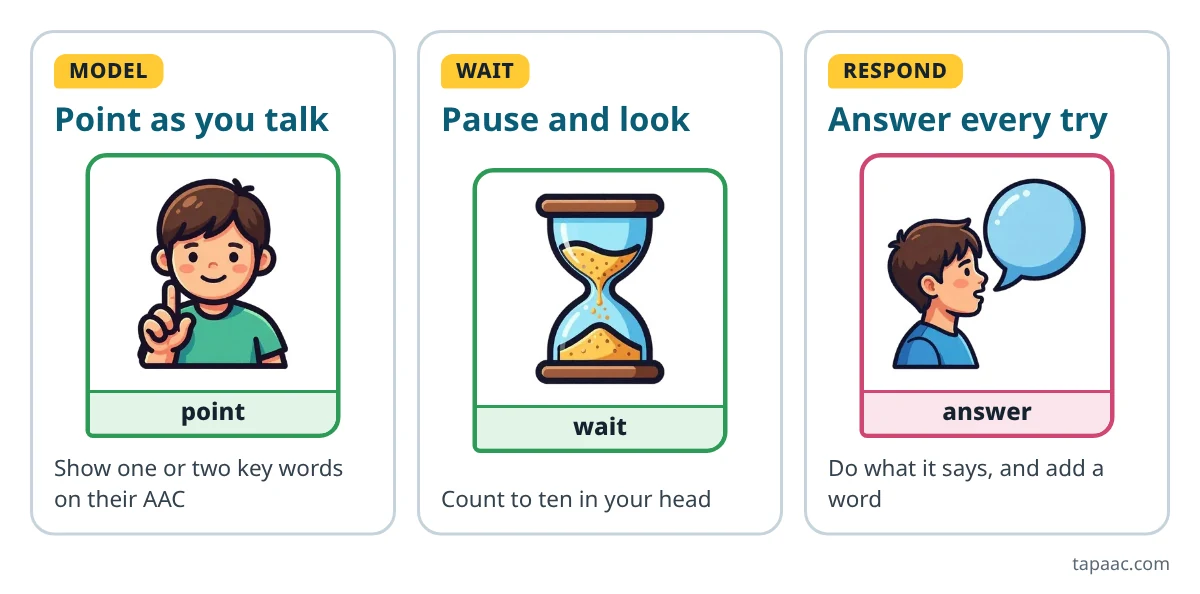
Step 1: Model
Talk the way you normally would, and point to one or two key words on your child’s AAC as you say them. You don’t have to model every word.
What to model
- More than requests. Model words for commenting (“I like it”, “look!”), for protesting (“not that one”, “stop”), for asking (“where is it?”) and for feelings. The mix of word types in a core vocabulary lets a person ask questions, request, reject, protest, comment and describe.1 The core word of the week plans give you one word at a time.
- One step ahead. If your child uses one word at a time, model two: “more bubbles”, “go up”. In one study, partners pointed to two symbols on each preschooler’s AAC and then said a complete sentence, during play. Four of the five children learned to combine symbols, kept doing it over time, and used combinations in new play routines too.4
- Your own thoughts. Model what you think and feel, not only what your child might say: “I’m tired.” “Uh oh, I don’t like that.”
- Mistakes and fixes. Press the wrong button now and then, and fix it out loud: “Oops, not eat. Drink.” It shows that mistakes are part of talking.
Where and when
- In everyday routines: meals, the bath, getting dressed, the car, play. Where possible, AAC is taught in natural settings, so that it carries over into daily life.1
- On your child’s own AAC. If you can’t reach it, use a printed copy of the same page.
- Without expectation. A model isn’t a turn your child has to take. Model, and carry on with what you were doing.
Step 2: Wait
After you model, stop talking. Look at your child with a friendly, expectant face, and wait. Increasing wait time is one of the skills speech-language pathologists teach communication partners,1 and an expectant pause was typically part of the interventions in the 2018 meta-analysis.2
- Count to ten in your head. Finding a word and moving a hand to it takes time, and a quick question can interrupt it.
- Look at your child, not at the device.
- Pause at the best moment: with the bubble wand in the air, halfway through a song, before the next push on the swing.
- If nothing happens, that’s fine. Model again, and carry on with the fun. Another chance will come.
Step 3: Respond
Treat anything your child does as communication: a look at the device, a reach, a sound, a touch on a word, even a touch that might have been an accident. Responding to what the person did was typically part of those interventions too.2 Partners of children who use AAC are more likely to miss their attempts to communicate,1 so watch closely.
- Do what it says. If your child touches stop, stop. If they touch eat in the middle of a game, ask “Eat? Are you hungry?” That is how a child learns that the words work.
- Say it back, and add a word. Your child touches more. You: “More bubbles! More bubbles, coming up.”
- Answer the message. If you understood, don’t ask your child to press it again “properly”.
- Let them explore. Pressing buttons to hear what they say is how children find out what the words do. Answer some of the presses as if they were meant, and model another word nearby.
What it can look like with toy cars
You line up two cars at the top of a ramp. “Ready, set...” (Point to go.) “Go!” (Let your car roll.)
(Hold the second car at the top. Look at your child. Wait.)
(Your child looks at the device, then touches go.) You: “Go! Your car is going!” (Let it roll.)
Your child touches go again, and again. You: “Go, fast! Your car goes fast.” (Point to go and fast.)
Set up chances to communicate
Some children get everything they need without asking. Gentle setups give them reasons to say something, built on what they enjoy. The professional guidance describes incidental teaching like this: opportunities that come up naturally, based on the person’s interests, where an expectant look and a pause may be enough to prompt them.1
- Put a favorite thing in sight but out of reach, or in a box that’s hard to open.
- Give a small amount, so there’s a reason to ask for more.
- Stop in the middle of a song, a tickle game or a ride on your knee.
- Do something silly: a sock on your hand, a cup upside down. Then wait for a not or an uh oh.
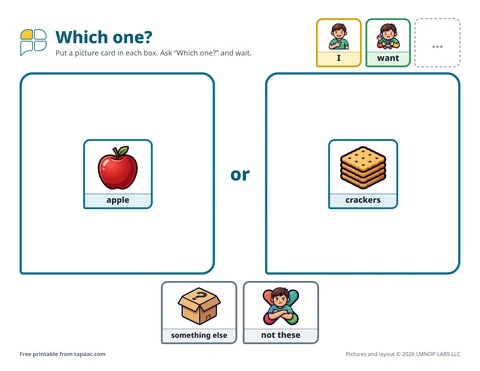
- Hold up two choices, and model each word as you show it.
Keep it kind. A setup is an invitation, not a test: if your child gets upset, help straight away, and model the words for them (“help, open”).
What to avoid
- Quizzing. “Show me dog” or “What color is it?”, when you already know the answer, turns talking into a test.
- Making your child earn things. Your child doesn’t have to press a button before they get a drink. Model, pause and carry on.
- Too many questions. Partners of children who use AAC are more likely to ask yes-or-no questions and to dominate the conversation.1 Comment more than you ask, and use open questions (“What happened?”) as well as yes-or-no ones.
- Moving your child’s hand. When you move their hand, the message is yours, not theirs. If your child needs physical help to reach or press, ask the speech-language pathologist and the occupational therapist how to give it and how to fade it: the professional guidance asks clinicians to plan the type and amount of prompting, including fading prompts so the person becomes independent.1
- Keeping it for therapy. AAC in a bag can’t be used. AAC at home covers where it should live.
What progress looks like
Progress doesn’t only mean touching a word on purpose. Notice, and write down:
- looking at the device or board when you model
- reaching for it, or bringing it to you
- exploring: pressing buttons to hear them
- touching the same word in the same situation more than once
- using a word somewhere new, or putting two words together
- starting a conversation: pressing a word without being asked
Share your notes with the speech-language pathologist. Compare your child with where they were a month ago, not with other children.
When it isn’t working
| What happens | Try this |
|---|---|
| Your child ignores the device | Model on it for yourself during their favorite activity, and keep it close but not in their face. |
| Your child pushes it away | That’s a message too. Say it for them (“All done?”), put the device down nearby, and try later. |
| Your child presses one button over and over | Answer it, then model a different word right next to it. |
| You keep forgetting to model | Stick a note with this week’s two words where the routine happens. |
| Only one person models | Share the modeling handout with everyone, and see helping the whole family. |
| Your child doesn’t want to use the device at all | Look for the reason with the team. The US Department of Education names disliking a device, feeling stigmatized and not understanding how it works as possible reasons, and expects the IEP team to look into it.5 |
Try this today
- Choose two words to model this week, like more and stop.
- Model each of them at least five times today, in routines you already do.
- After each model, wait while you count to ten in your head.
- Write down every look, reach or touch, and share the list with the speech-language pathologist.
More AAC guides
- AAC at home: setting up the house, and helping the whole familyWhere the device and boards live, room by room, and how siblings, grandparents and sitters can help.
- AAC and autism: answers to common parent questionsWill AAC stop my child from talking? Is my child ready? How do I start?
- AAC for toddlers: when to start, and how to begin at homeStarting before your child talks: one routine, a few words, modeling and early intervention.
- AAC modeling at homeFive habits for families, with a free one-page handout for the fridge.
- How to teach core words: a week-by-week planOne focus word at a time, modeled in real routines, with free word cards and weekly plans.
Sources
We read each of these on October 13, 2026. Numbers in the text point to them.
- American Speech-Language-Hearing Association. Augmentative and Alternative Communication (Practice Portal). Professional guidance for speech-language pathologists. Accessed October 12, 2026.
- O’Neill T, Light J, Pope L (2018). Effects of Interventions That Include Aided Augmentative and Alternative Communication Input on the Communication of Individuals With Complex Communication Needs: A Meta-Analysis. Journal of Speech, Language, and Hearing Research, 61(7), 1743–1765. Abstract on PubMed.
- Kent-Walsh J, Murza KA, Malani MD, Binger C (2015). Effects of Communication Partner Instruction on the Communication of Individuals using AAC: A Meta-Analysis. Augmentative and Alternative Communication, 31(4), 271–284. Abstract on PubMed.
- Binger C, Light J (2007). The effect of aided AAC modeling on the expression of multi-symbol messages by preschoolers who use AAC. Augmentative and Alternative Communication, 23(1), 30–43. Abstract on PubMed.
- U.S. Department of Education. Myths and Facts Surrounding Assistive Technology Devices and Services (PDF). January 2024.
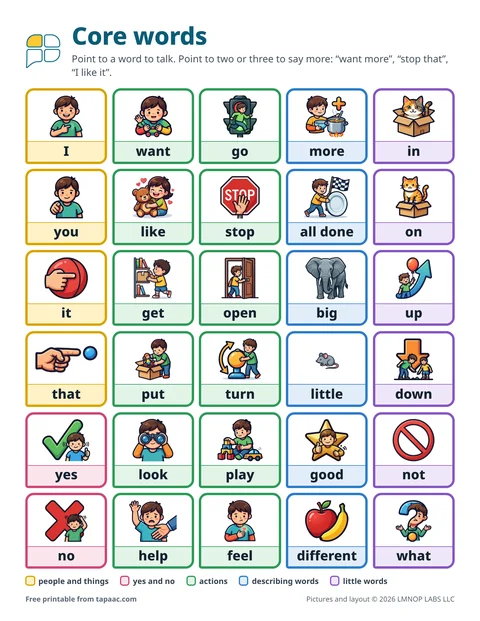 Core word board
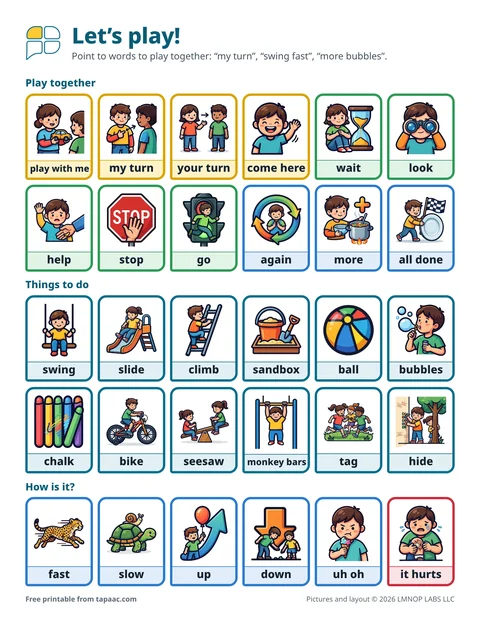 Playground communication board
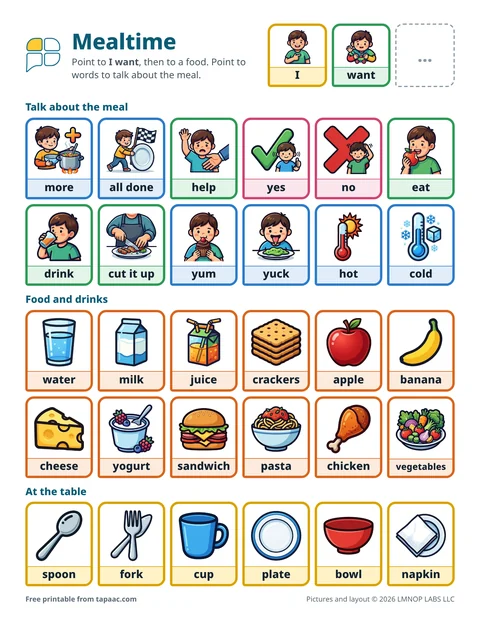 Mealtime communication board
 Choice boards