 Tap AAC
First-then board: free printable with picture cards
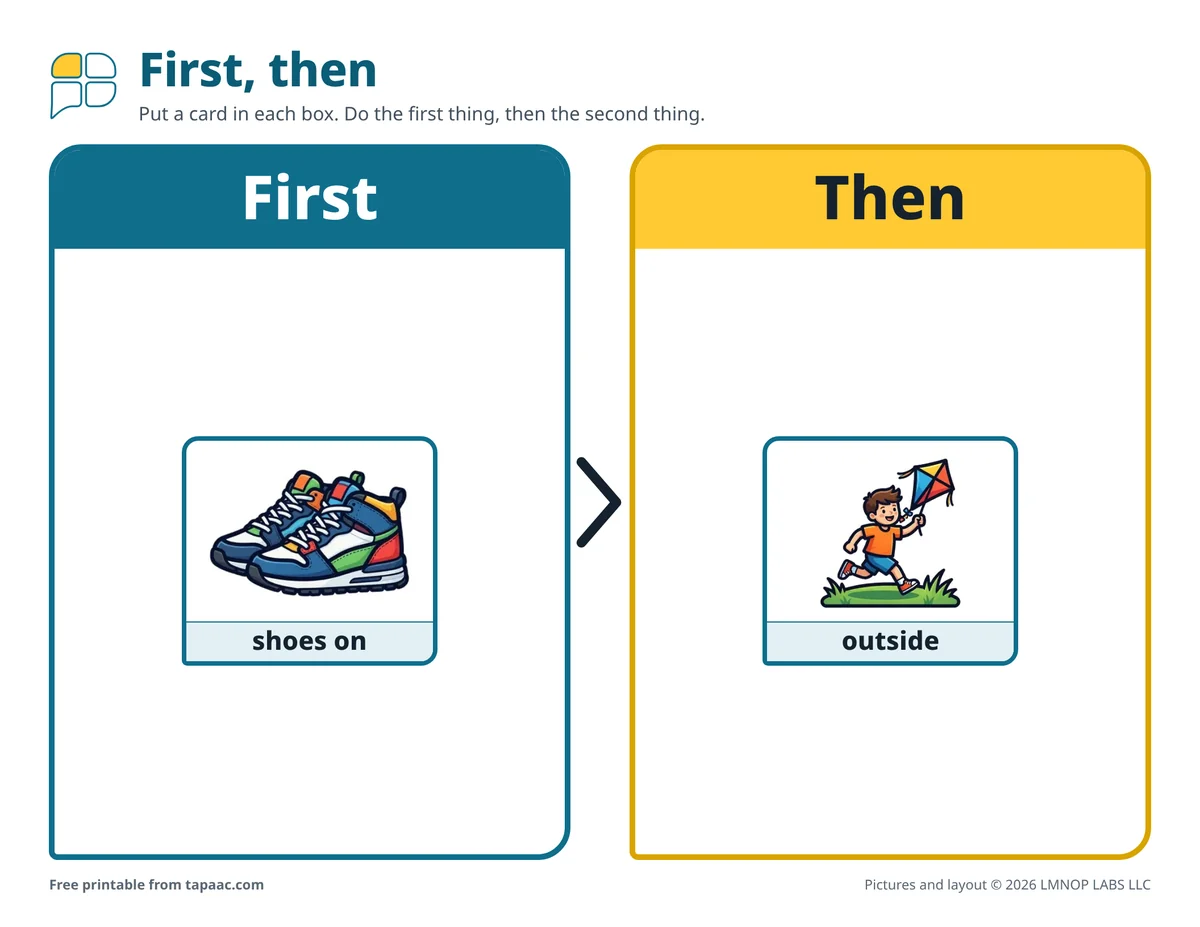
A first-then board shows two pictures: what happens first, and what comes next. “First shoes on, then outside.” It helps a person see that the thing they want is coming. This free PDF has the board and 12 picture cards to cut out, two of them blank for your own photos.
Download the free PDF US Letter, 2 pages, 456 KB
Portrait (tall page, 2 pages): US Letter PDF (451 KB) · A4 PDF (458 KB)
Landscape (wide page, 2 pages): US Letter PDF (456 KB) · A4 PDF (458 KB)
Edit this board in the free board maker: change the words and pictures, then print.
Have Tap AAC? Add to Tap AAC (.obz file, 355 KB) · How to add a board
- Free
- No sign-up
- Print as many as you need
Who it’s for
Children who do better when they can see what’s coming: a child who finds it hard to leave the park, to start homework, or to sit still for a haircut. It works with toddlers, with children who don’t speak or don’t speak much, and with older children who simply like to know the plan. Parents, teachers and therapists use it to make a hard step shorter and the reward easier to believe in.
Where it helps
- Getting out of the door: first shoes on, then outside.
- Jobs before fun: first clean up, then play; first work, then the swing.
- Waiting for a grown-up: first the baby’s feed, then a story. The new baby board has more words for big brothers and sisters.
- Places that take patience: first the haircut, then the park; first the church service, then the playground.
- Bathroom routines: first bathroom, then wash hands. For every step, use the potty visual schedule.
How to use it
- Put the task in First. Choose something short, like washing hands or putting shoes on.
- Put something the person wants in Then. A snack, a swing, a story: whatever they really want right now.
- Point and say it in a few words. “First wash hands, then snack.” Use the same words each time, and point to each card as you say it.
- Mark the first part done. Say “Done!” and take the card off.
- Give the Then right away. Keeping this promise is what makes the board work.
Choosing a good Then
The board works when the Then is something the person truly wants, and the First is short enough to finish. If the First is a long job, cut it down: first two pages, then a break. When you can, let the person pick the Then from two cards with a choice board. Keep the board a promise, never a threat: “first shoes, then swing”, not “shoes, or no swing”. For more help when it isn’t working, read how to use a first-then board, step by step.
Children and adults
First-then isn’t only for young children. For a teenager or an adult, use photos or plain words instead of cartoon-style cards (“first laundry, then coffee”), or write the two steps on a sticky note in the same First and Then boxes. Keep the tone the same as with any adult: it’s a reminder of the plan, not a reward chart.
Hannah is four, and she loves the swing. Leaving the house used to mean shoes being kicked off in the hall. Now her mom puts the shoes on card in First and the swing card in Then, and says, “First shoes, then swing.” Hannah pushes one foot in, then the other. Her mom takes the shoes card off: “Done!” At the park, the swing is the first stop, every time.
What’s on the PDF
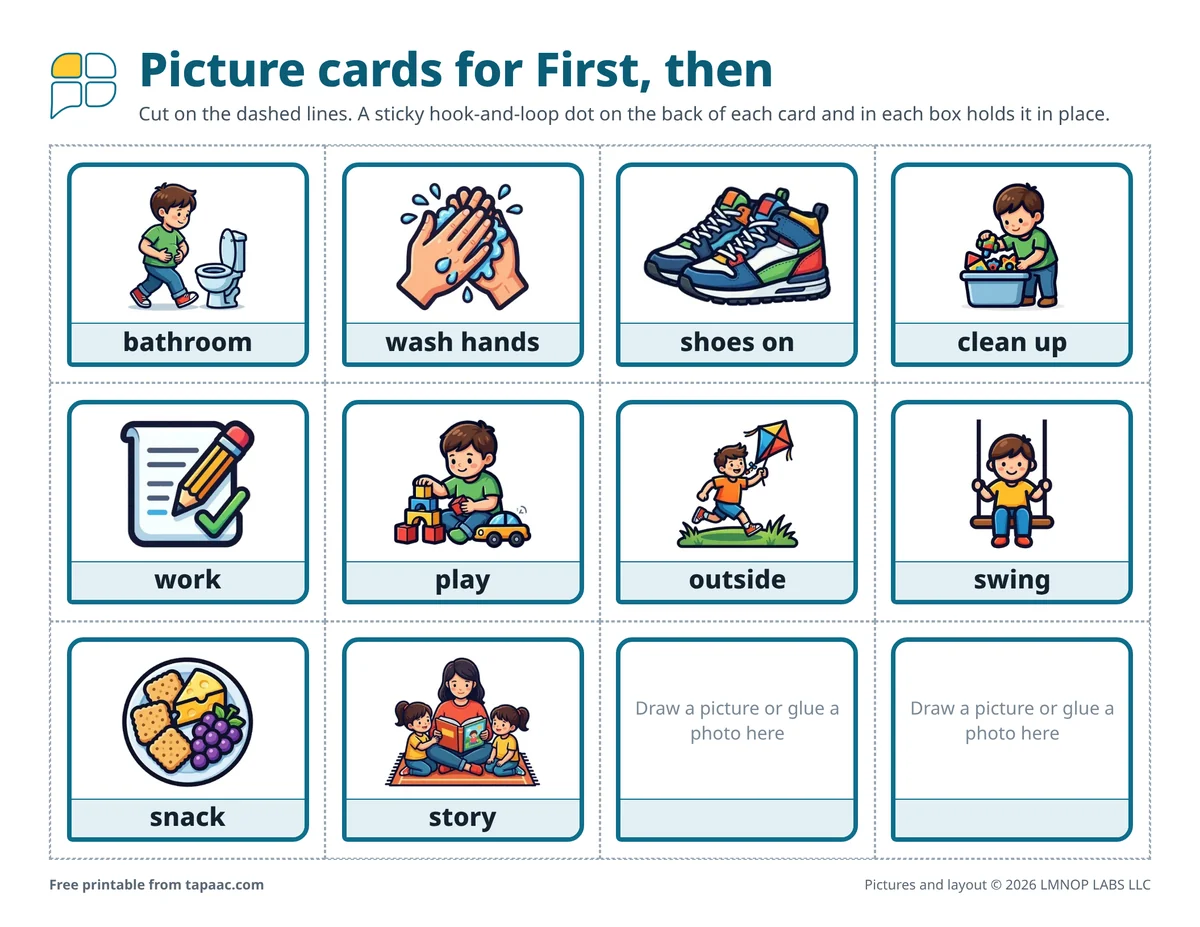
Page 1 is the board, printed sideways: a First box and a Then box with an arrow between them, each with space for a card. Page 2 has 12 cards to cut out:
Picture cards
- bathroom
- wash hands
- shoes on
- clean up
- work
- play
- outside
- swing
- snack
- story
- 2 blank cards
Making the board and cards
- Print both pages, on card stock if you have it.
- Laminate the sheets first, then cut out the cards. They last much longer.
- Stick a hook-and-loop dot in each box on the board, and the matching dot on the back of each card.
- Use the two blank cards for anything that isn’t on the sheet. A photo of the real place or the real toy works well.
- Ready for more than two steps? Try the morning routine chart, or make a schedule of your own in the free visual schedule maker.
More free boards
-
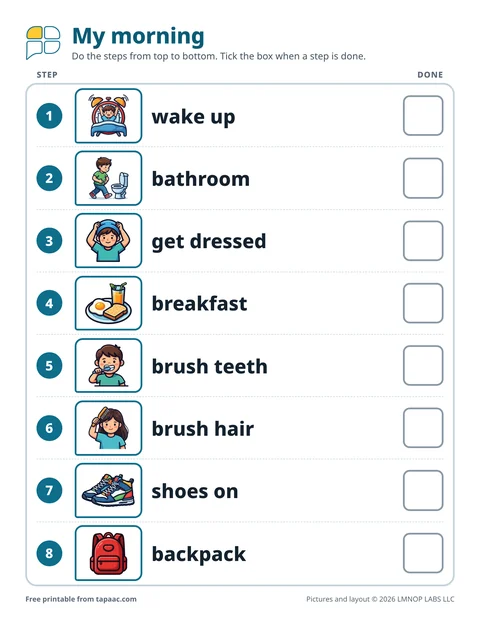 Morning routine chartEight steps from wake up to backpack, with picture cards and a make-your-own schedule.
-
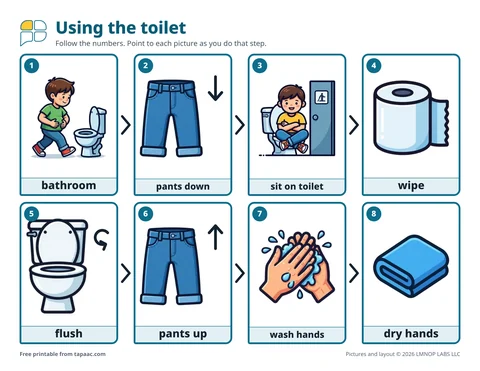 Potty visual scheduleEight toilet steps from bathroom to dry hands, to hang by the toilet.
-
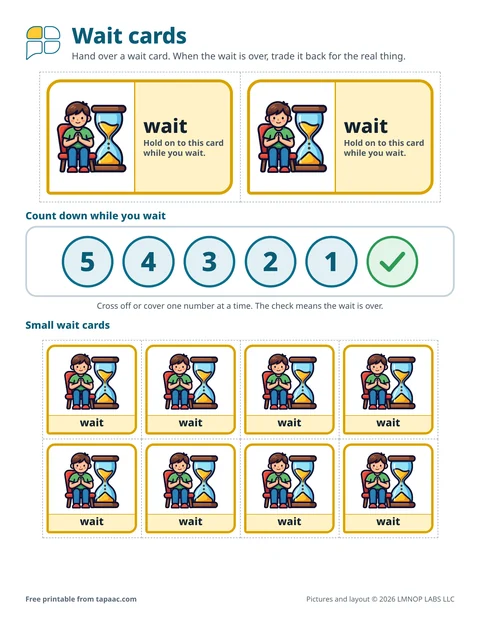 Wait cardsWait cards, a 5-to-1 countdown, and my turn and your turn cards with a Now and Next board.
-
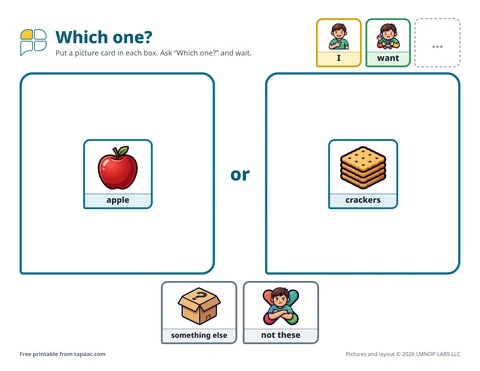 Choice boardsTwo-choice and four-choice boards, with 18 snack, drink and toy cards to cut out.
Need a different board? Make your own with the free AAC board maker.
Making a schedule? Use the free visual schedule maker: routines ready to open and change.
These boards and guides are general information, not therapy or medical advice, and they don’t replace a speech therapist. A speech therapist who knows the person can help choose the right words, pictures and layout. The boards are free to print and share; please don’t sell them (terms of use). Questions about the boards? Email support@lmnoplabs.fun.