 Tap AAC
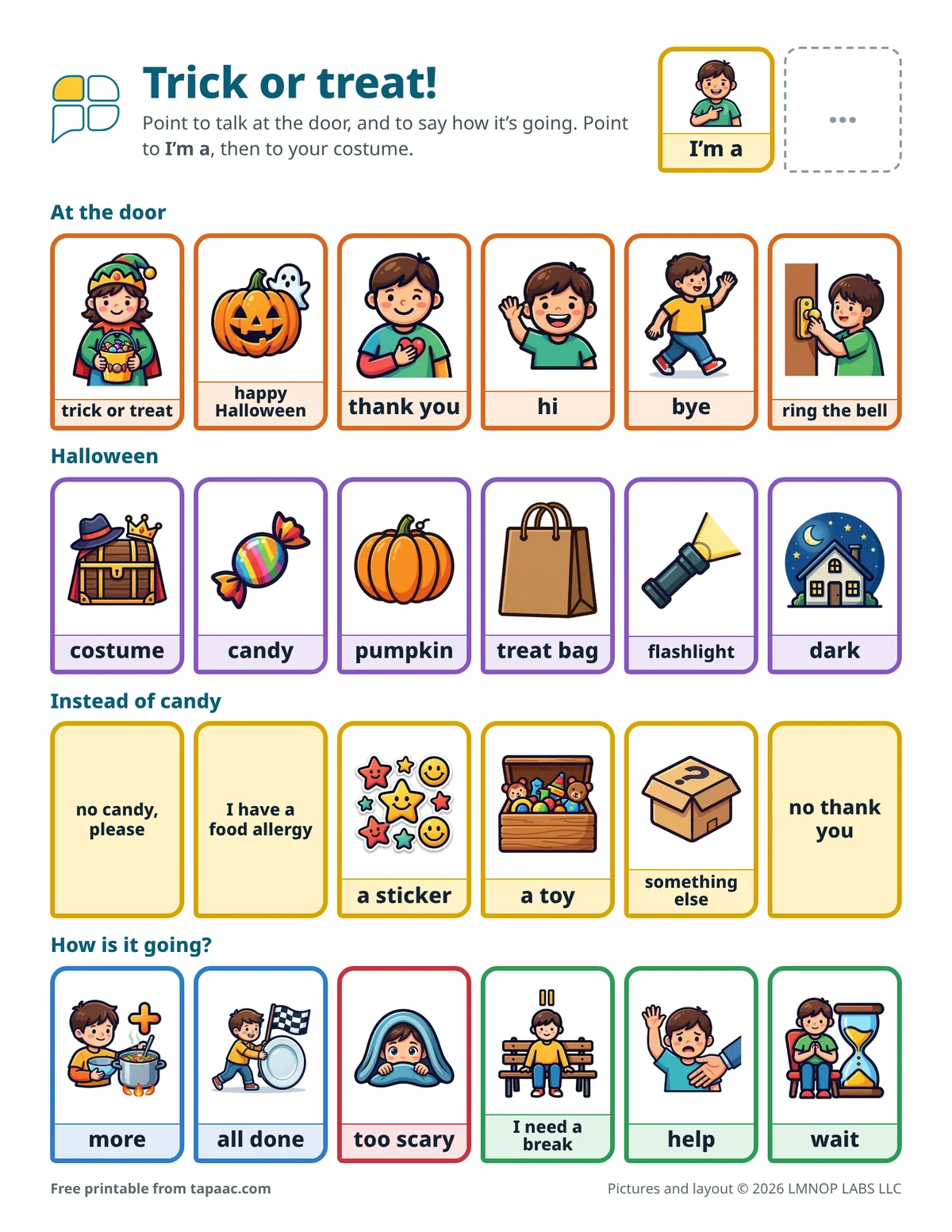
The free Halloween board, door cards and treat-bag strip
We made a free Halloween communication board for this one night. It prints on two pages, US Letter or A4, tall or wide:
- The board. I’m a and a box to write the costume in, then four rows of six words: at the door (trick or treat, thank you, ring the bell…), Halloween things (costume, pumpkin, flashlight, dark…), instead of candy (no candy, please, I have a food allergy, a sticker…) and How is it going? (more, all done, too scary, I need a break, help, wait).
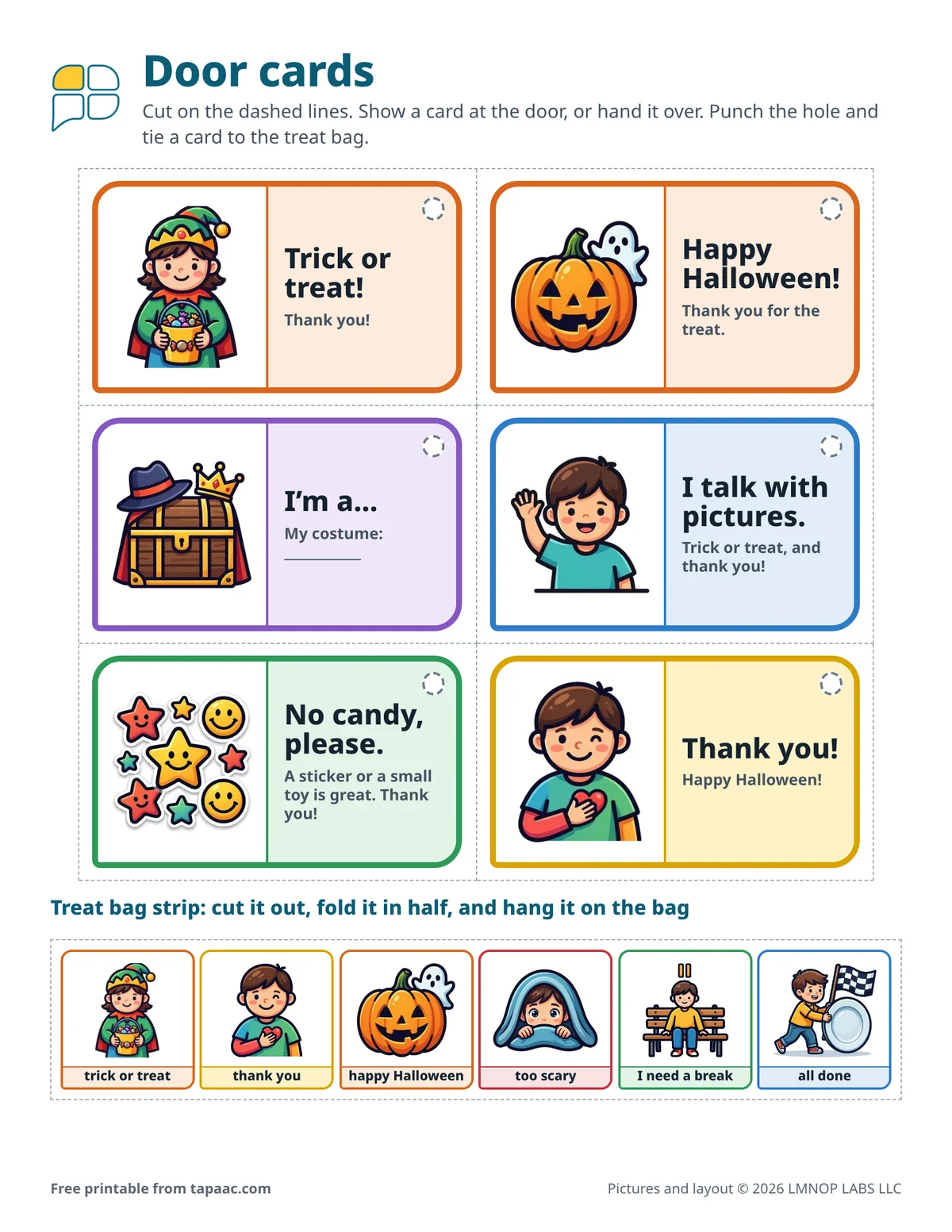
- Six door cards, each with a hole to punch: “Trick or treat!”, “Happy Halloween!”, “I’m a…” with a line for the costume, “I talk with pictures.”, “No candy, please.” and “Thank you!”. Each has a smaller second line, such as “Thank you for the treat.”
- A treat-bag strip to cut out, fold in half and hang on the handle, with the six words your child needs most on the street: trick or treat, thank you, happy Halloween, too scary, I need a break and all done.
Want other words? Open the board in the free board maker, change them, and print. If your child has Tap AAC, the board’s page also has an Add to Tap AAC file, which puts the same board in the app as a page that talks (how to add a board).
Practice at home in the days before
New places, noise and a change of routine are a lot for many children. The NHS suggests telling an autistic child about changes as soon as you can, introducing change slowly in a safe and familiar place, and planning ahead together to avoid things that may cause distress.1 For young children, the American Academy of Pediatrics suggests talking about what will happen, reading books about trick-or-treating and practicing in the costume before the big day.2 With AAC, practice is also when your child finds out where the Halloween words are.
- Play the door. Someone waits behind a bedroom door with a bowl. Your child knocks, holds up a card or points to trick or treat, takes a treat and points to thank you. Then swap roles, so your child opens the door and hands out the treats.
- Practice in the costume, with the treat bag, the board or device and the flashlight, to check at home that your child can still reach and point.
- Show the night as a schedule: costume, flashlight, three houses, home, look at the treats. The free visual schedule maker lets you change the steps and pictures, or use a first-then board: first three houses, then home.
- Walk the route in daylight, so the street is familiar before it is dark and busy.
- Tell a few neighbors. For children with food allergies, Food Allergy Research & Education (FARE) suggests taking goody bags to neighbors in advance and describing your child’s costume.3 The same visit works for AAC: tell them your child may hold up a card instead of saying the words, and the first houses of the night become easy ones.
At the door: a card, the board, or a device that talks
Holding up a card is saying “trick or treat”. Choose what fits your child, or use all three:
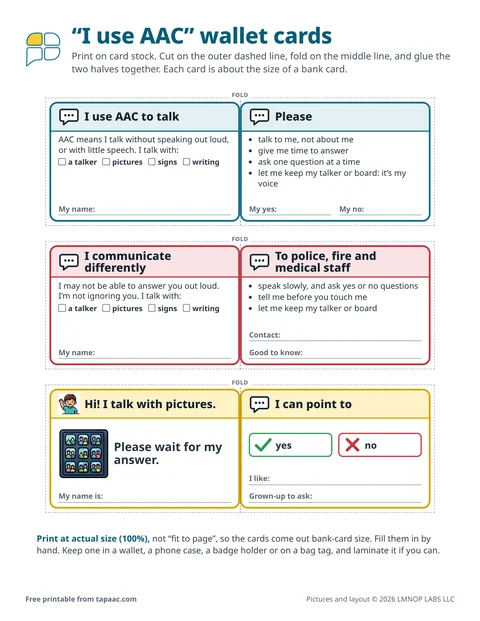
- A door card is the quickest: hold it up, or hand it over. “I talk with pictures.” explains things to a neighbor in a few seconds. The professional guidance for speech-language pathologists lists using a ready-made introductory message to explain AAC to people who don’t know it among the skills that help AAC users get their message across.4
- The board covers more than the doorstep: ring the bell, happy Halloween, I’m a and the costume, and the How is it going? row between houses.
- A device can say it out loud. Put “Trick or treat!”, “Thank you!”, “Happy Halloween!” and “I’m a dragon!” (or whatever your child is) one tap away, and turn the volume up for a noisy street. If your child’s speech-language pathologist sets up the device, ask them a week ahead to add the Halloween words.
You can add one short sentence for the neighbor, such as “He’s saying trick or treat!”, but let your child’s message come first, and don’t ask them to say it out loud as well. If a neighbor doesn’t wait, that isn’t your child’s fault: point to the card again, or move on to the next house.
Sam, seven, is a firefighter tonight, with his coat open so his arms are free and his talker on a strap across his chest. At the first door he taps Trick or treat!; his mom points to happy Halloween on the board as she says it, and the neighbor drops a toy in his bag. Sam taps thank you. Walking on, his mom points to more and all done: “More houses, or all done?” Sam points to more. Four houses later a hissing spider on a lawn makes him freeze, and he points to I need a break on the strip on his bag. They stand by the car for a minute. Then he points to all done, and they go home to hand out treats at their own door.
Sam and his mom are made up, to show the idea.
Model the words as you walk
Modeling means pointing to words on your child’s board or device while you say them. Speech-language pathologists call it aided language modeling or augmented input.4 A 2018 meta-analysis of studies of people with developmental disabilities who use AAC found that interventions including it were highly effective for understanding as well as expression, and concluded that communication partners should use it.5
Halloween gives you dozens of chances in one evening. You don’t need to ask your child to copy you:
- At each door, point to trick or treat while your child holds up the card, and to thank you as you say it.
- On the sidewalk, name what you both see: pumpkin, dark, flashlight, costume. One word and a point is plenty.
- Between houses, ask with the board: “More, or all done?” Then wait quietly, longer than feels natural, before you ask again.
- Model the hard words too: “That one is too scary. Let’s skip it.” Then your child knows those words are allowed.
More on modeling, waiting and answering in how to teach a child to use AAC, and on one page in the AAC modeling at home handout.
Too scary, too loud, all done
Masks, fog machines, cackling doorbells and crowds in the dark can be too much. The NHS advises making an autistic child’s surroundings as comfortable as possible, for example by managing light and noise, and starting slowly without forcing them into activities they’re uncomfortable with.1 For young children, the American Academy of Pediatrics says that if a child doesn’t want to take part, that is OK, and that a child who loses interest may prefer to answer the door and hand out the treats instead.2
Before you leave, agree on three messages and what each one means: too scary (we skip that house), I need a break (we stop somewhere quiet) and all done (we go home). All three are on the board and on the treat-bag strip. Then do what your child asked, straight away, even after one house. That is how your child learns that the words work.
- For a child who finds it hard to say how big a feeling is, the feelings thermometer goes from calm to too big, with what helps at each size, such as a break or headphones.
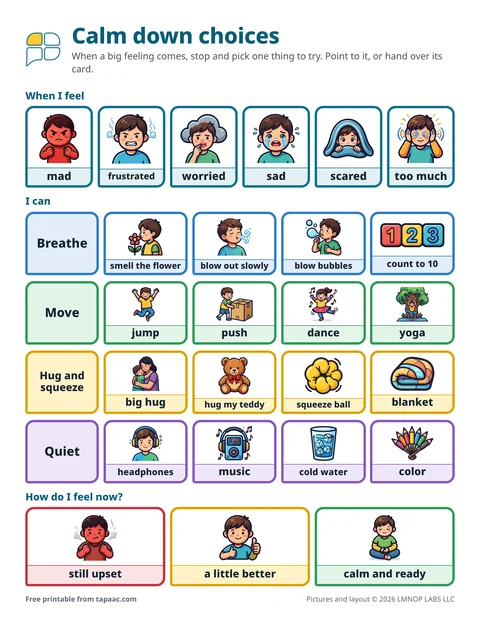
- Give the break a plan: a break card in a pocket, and two or three ideas from the calm down choices board, such as deep breaths, a squeeze or somewhere quiet. Teach a break card on calm days first: see how to teach a child to use a break card.
- Headphones, a flashlight your child holds, and a route that starts at the quietest houses can all make it easier.
- Staying home is a real choice too. Opening the door in costume and handing out treats uses the same words, from the other side of the door.
Food allergies, and treats that aren’t candy
Some children can’t have candy, or are better off with something else: children with food allergies, diabetes or celiac disease, children with feeding tubes, and any child on a special diet.6 Look for the Teal Pumpkin Project, which FARE adopted nationally in 2014: a teal pumpkin, or one of FARE’s printable signs, at a door means the house has non-food treats, and FARE asks those houses to keep them in a separate bowl from any candy. Families can add their house to FARE’s Teal Pumpkin Project map, so children looking for non-food treats can plan a route.7
Your child can say it at the door themselves. The board’s Instead of candy row has no candy, please, I have a food allergy, a sticker, a toy, something else and no thank you, and the “No candy, please.” door card adds “A sticker or a small toy is great. Thank you!”
If your child has a food allergy:
- No eating on the way. FARE suggests a “no eating while trick-or-treating” rule, so there is time to read every label,3 and the American Academy of Pediatrics says to wait until children are home to sort and check treats before eating them.8
- Read every label, every time. Mini and fun-size candies can have different ingredients from the full-size ones, and FARE suggests avoiding treats without an ingredient label.3 The FDA says a child with a food allergy shouldn’t eat home-baked goods they were given.9
- Keep a swap bag of safe treats or small toys at home, to trade for anything your child can’t have.3 Sorting the bag is a good time to model yes, no, like and more.
- Bring the medicine. If epinephrine has been prescribed, have it with you,3 and make sure every adult on the walk knows what to do in an emergency.8
Handing out treats yourself? The American Academy of Pediatrics suggests non-edible ones such as glow sticks, pencils, bubbles, bookmarks and stickers.8 FARE suggests choosing latex-free items, and notes that some brands of moldable clay contain wheat.6
Costumes that keep the AAC in reach
A costume can cover the very thing your child talks with. The American Academy of Pediatrics says to check that a child can see, breathe, walk and move their arms easily in a costume,2 and suggests non-toxic makeup and hats as safer than masks, as long as a hat doesn’t slide over the eyes.8 For a child who uses AAC, also think about:
- Free hands. Sleeves that stop at the wrist, no props to carry, and no gloves on the pointing hand if your child uses a touch screen.
- Nothing over the device. No cape across the screen or the speaker. A strap, a harness or a bag with a clear front keeps it reachable.
- AAC as part of the costume. A wheelchair can become a fire truck or a pirate ship, a device can be a robot’s control panel, and the board can hang from the treat bag like a sign.
- Light, charge and a backup. Charge the device that afternoon, turn the screen brightness up, and bring the paper board too: low-tech AAC never runs out of battery. A flashlight helps your child find the words on paper in the dark.
- Being seen. The American Academy of Pediatrics notes that child pedestrian injuries are more likely on Halloween than on any other night of the year, and suggests bright costumes, reflective tape on costumes and treat bags, flashlights after dark and going with young children on their rounds.8
School Halloween parties
A class party is Halloween in daylight: costumes, a parade, games, music, food and a lot of noise. For teachers and parents:
- Put it on the schedule a few days ahead, with a picture for the parade and the games. The professional guidance says visual supports that use the symbols of a student’s own AAC help them understand and anticipate routines, and make more chances to model words on that AAC.4 The classroom visual schedule or the visual schedule maker can show where the party fits in the day.
- Add the party words where the student can reach them: I’m a and the costume, look, my turn, too loud, all done. The Halloween board works in class too.
- Plan the parade. Agree where the student can watch from, and how they ask for a break: the same I need a break they use at home.
- Check the food. Ask families about allergies before the party, and think about non-food treats for the whole class.
- Model during the fun, and give real turns. Point to words on the class board while you talk about the costumes, and let the student choose the next game, pick a song with the song choice board, or tell the class what they are dressed as.
More in AAC in the classroom. If parties are hard every year, ask the student’s speech-language pathologist which words to add before the next one.
The day after
Talk about the night while it is fresh: the photos, the treat bag, the costume on the chair. Model short comments, such as like, scary, more and all done, and leave the board out for a few days so your child can bring Halloween up when they want to. Our core word pages have ideas for modeling like, modeling more and modeling all done all year round. The next holiday has a board too: the Thanksgiving board has words for the table and a turn to say thanks.
Try this today
- Print the Halloween board, and cut out the door cards and the treat-bag strip.
- Play the door at home once, then swap roles.
- Agree how your child will say too scary, I need a break and all done, and what you will do for each.
- Try the costume on with the board or device, and check your child can still point.
More AAC guides
- How to teach a child to use AAC: model, wait and respondModeling, waiting and responding in depth, with examples, and what to do when it isn’t working.
- Low-tech AAC: choosing and using boards, books and cardsBoards, books and cards with no batteries: which to choose, and how to use them every day.
- Visual supports for autism at home: schedules, choices and timersSchedules, first-then boards, choice boards, timers and labels, and how to start at home.
- AAC at home: setting up the house, and helping the whole familyWhere the device and boards live, room by room, and how siblings, grandparents and sitters can help.
- AAC at school: how teachers can support a student who uses AACModeling in lessons, wait time, better questions, classmates, and the IEP.
- How to teach a child to use a break cardPracticing when calm, and making it easy to come back.
Sources
We read each of these on October 29, 2026. Numbers in the text point to them.
- NHS (UK). Supporting an autistic child. Page last reviewed May 6, 2026.
- American Academy of Pediatrics (HealthyChildren.org). Easing Babies & Toddlers into Halloween Fun: 8 Tips for Parents. Last updated September 29, 2026.
- FARE (Food Allergy Research & Education). Tips for Trick-or-Treating With Food Allergy. Accessed October 29, 2026.
- American Speech-Language-Hearing Association. Augmentative and Alternative Communication (Practice Portal). Professional guidance for speech-language pathologists. Accessed October 12, 2026.
- O’Neill T, Light J, Pope L (2018). Effects of Interventions That Include Aided Augmentative and Alternative Communication Input on the Communication of Individuals With Complex Communication Needs: A Meta-Analysis. Journal of Speech, Language, and Hearing Research, 61(7), 1743–1765. Abstract on PubMed.
- FARE (Food Allergy Research & Education). About the Teal Pumpkin Project. Accessed October 29, 2026.
- FARE (Food Allergy Research & Education). Teal Pumpkin Project. Accessed October 29, 2026.
- American Academy of Pediatrics (HealthyChildren.org). Halloween Fun & Safety Tips for Kids of All Ages. Last updated September 29, 2026.
- U.S. Food and Drug Administration (FDA). Halloween Food Safety Tips for Parents. Content current as of March 5, 2024.
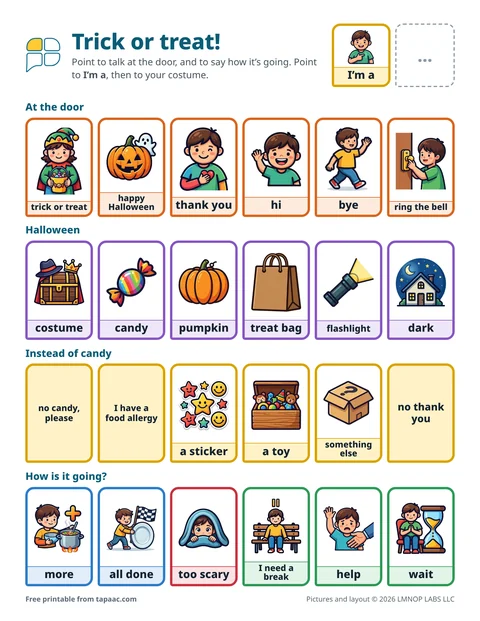 Halloween trick-or-treat board
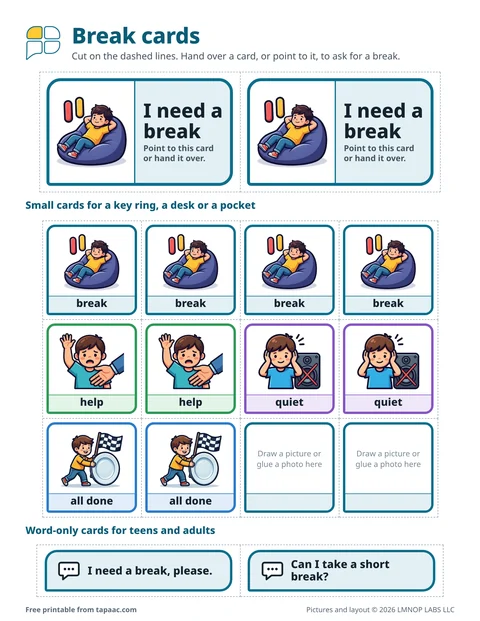 Break cards
 Calm down choices board
 Nonverbal communication cards