 Tap AAC
Song choice board: free printable with music class visuals
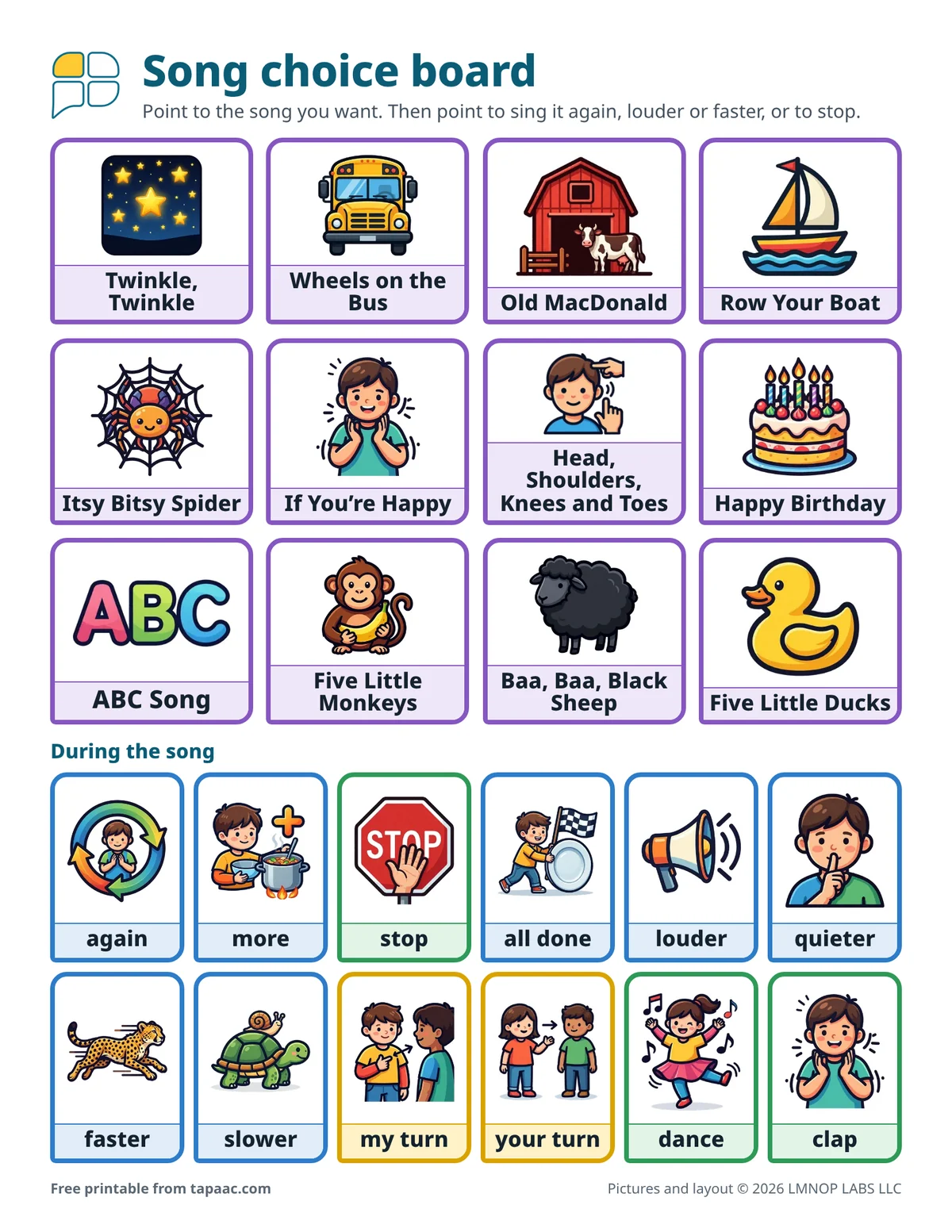
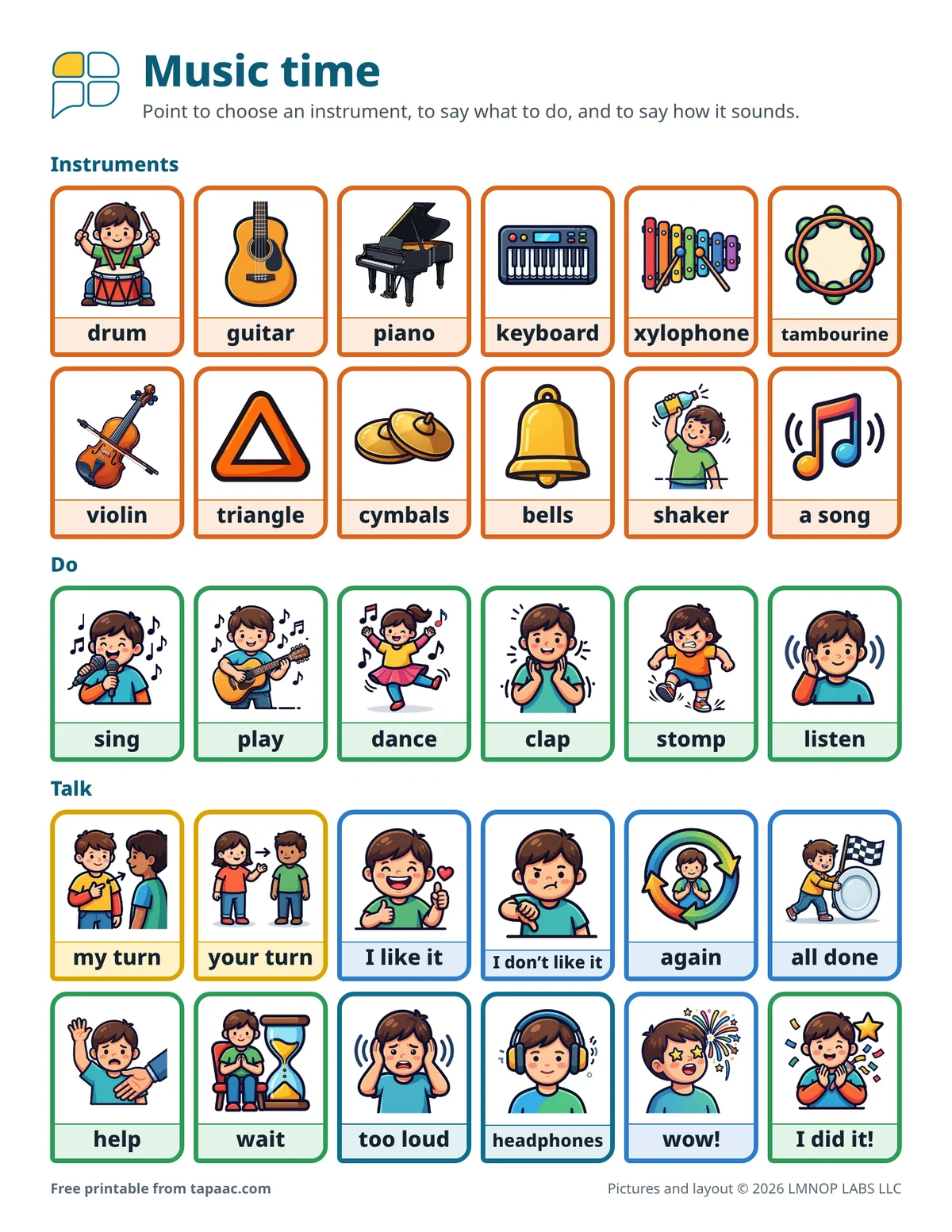
Songs are one of the easiest places to start making choices: point to a picture, and the song begins. This free song choice board has 12 songs, from Twinkle, Twinkle and Wheels on the Bus to Old MacDonald and Happy Birthday, and the words for changing a song while it happens: again, louder, faster, stop. Page 2 is a music time board with 12 instruments, and page 3 shows a music class from the hello song to the goodbye song.
Download the free PDF US Letter, 3 pages, 1,997 KB
Portrait (tall page, 3 pages): US Letter PDF (1,997 KB) · A4 PDF (1,998 KB)
Landscape (wide page, 3 pages): US Letter PDF (1,998 KB) · A4 PDF (1,999 KB)
Edit this board in the free board maker: change the words and pictures, then print.
Have Tap AAC? Add to Tap AAC (.obz file, 1,872 KB) · How to add a board
- Free
- No sign-up
- Print as many as you need
Why start with songs
A song is a quick, clear answer to a point: the child picks, and the singing starts. Songs repeat, so a child can ask for the same one again and again, and every time is practice. A song choice board suits toddlers and preschoolers, children just starting with pictures, and older children and adults who love music. It’s as useful in a music class or a therapy session as in the car or at bath time.
Choosing a song, step by step
- Start with two or three songs the child already knows. Cover the rest with paper, or fold the page.
- Point and sing: “Let’s sing… Row Your Boat,” pointing to the boat, then start singing.
- Next time, pause before the song and wait. A look, a reach or a point at a song is a choice: sing that one.
- Stop partway through a song the child loves, and wait. Point to again or more yourself, then carry on.
- Add songs as the first ones become easy, until all 12 are in play.
Pausing and waiting like this gives the child a reason to talk; more ideas in set up chances to communicate.
During the song: again, louder, stop
The bottom of page 1 changes a song while it’s happening: louder and quieter, faster and slower, my turn to do the actions, dance or clap, and stop or all done. Sing Wheels on the Bus very slowly, and wait for faster. Silly changes make the words worth asking for. When the child says stop, stop, even in the middle of a line: that’s how they learn the word works.
In a music class
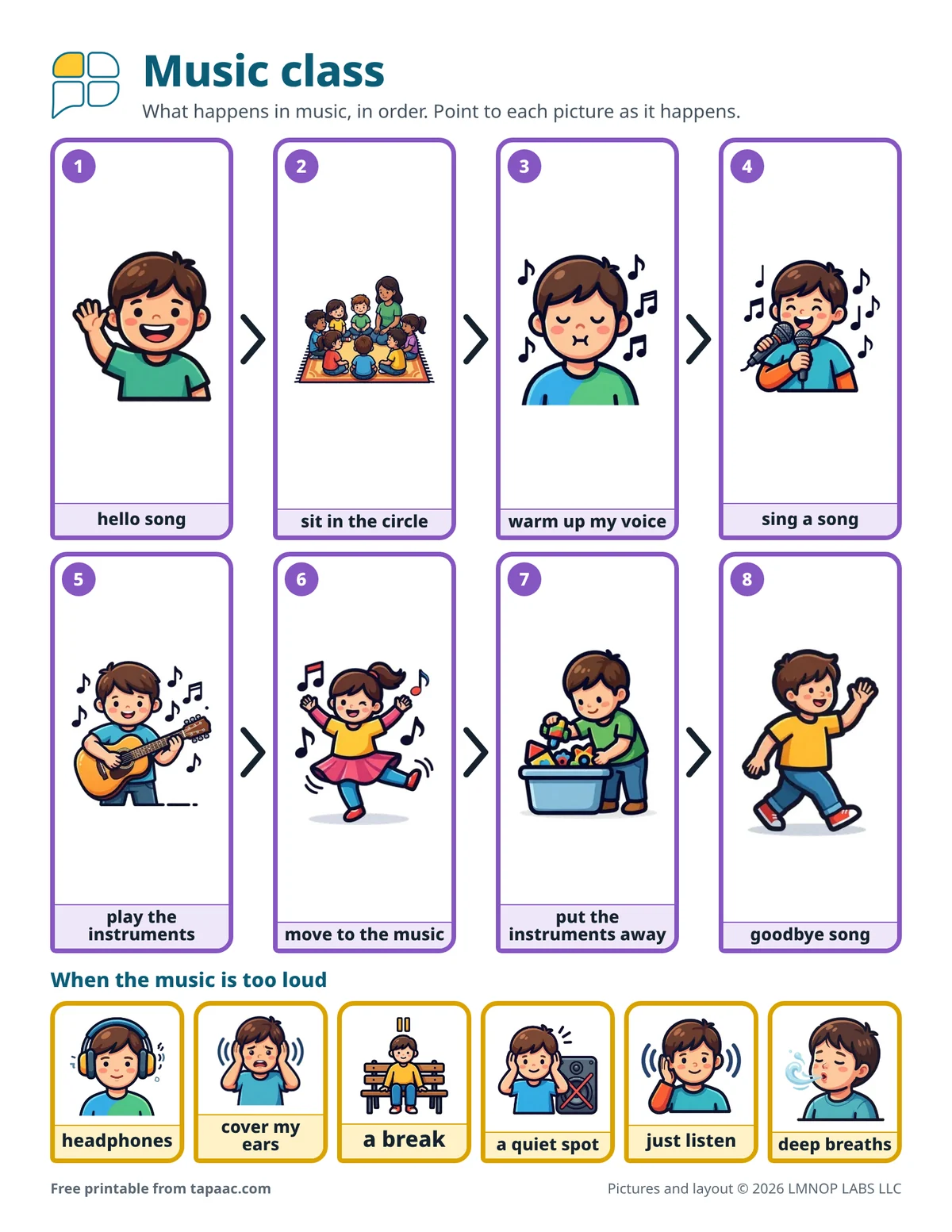
Page 3 shows a music class in order, from the hello song to the goodbye song, so a student knows when the instruments come out and when they go away. Page 2 has 12 instruments to choose from and the words for joining in. A music room can be loud: the row at the bottom of page 3 lets a student ask for headphones or a break, or choose just listen for a while, which is still taking part. A music teacher can keep a copy at the front, next to the instrument box.
Your own songs
The 12 songs are well-known children’s songs, but the best songs for this board are the ones your family sings. Open the board in the free board maker and swap in songs from home, school, a place of worship or the radio, with a photo the child knows on each. Older children and adults deserve songs for their age: a board of pop songs or old favorites works the same way.
Ruby is three. Her mom started with three songs, the bus, the spider and the stars, and sang a line of each while pointing to it. On the second day Ruby slapped the spider. Her mom sang it, stopped before the end, and pointed to again. A week later Ruby points to again herself, then faster, and laughs as the spider climbs the spout at top speed.
Every word on the sheets
Songs
- Twinkle, Twinkle
- Wheels on the Bus
- Old MacDonald
- Row Your Boat
- Itsy Bitsy Spider
- If You’re Happy
- Head, Shoulders, Knees and Toes
- Happy Birthday
- ABC Song
- Five Little Monkeys
- Baa, Baa, Black Sheep
- Five Little Ducks
During the song
- again
- more
- stop
- all done
- louder
- quieter
- faster
- slower
- my turn
- your turn
- dance
- clap
Instruments
- drum
- guitar
- piano
- keyboard
- xylophone
- tambourine
- violin
- triangle
- cymbals
- bells
- shaker
- a song
Do
- sing
- play
- dance
- clap
- stomp
- listen
Talk
- my turn
- your turn
- I like it
- I don’t like it
- again
- all done
- help
- wait
- too loud
- headphones
- wow!
- I did it!
Music class
- hello song
- sit in the circle
- warm up my voice
- sing a song
- play the instruments
- move to the music
- put the instruments away
- goodbye song
When the music is too loud
- headphones
- cover my ears
- a break
- a quiet spot
- just listen
- deep breaths
Printing tips
- Print two copies of page 1 and cut one into song cards, for a child who does better with two choices at a time; the choice board has a two-choice layout to put them on.
- Keep a laminated copy in the car, where songs are the main event.
- For art time, the art communication board; for the rest of the school day, the classroom visual schedule.
- With a toddler, start with one routine: a few songs a day is a good one.
More free boards
-
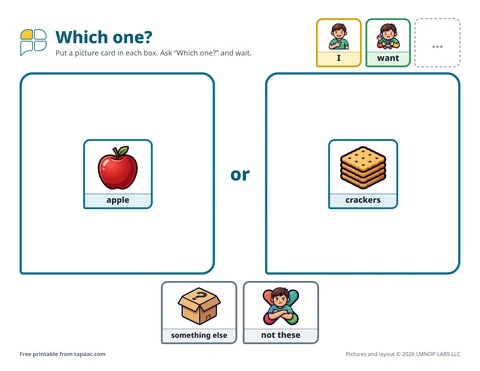 Choice boardsTwo-choice and four-choice boards, with 18 snack, drink and toy cards to cut out.
-
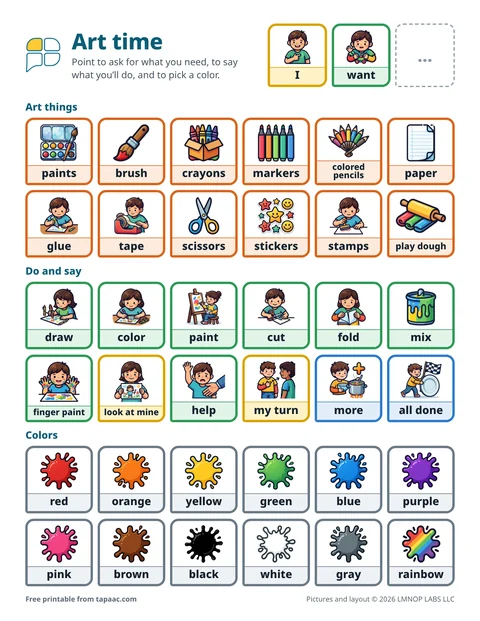 Art communication boardArt things, 12 colors and words for art time, plus art time steps and words for messy hands.
-
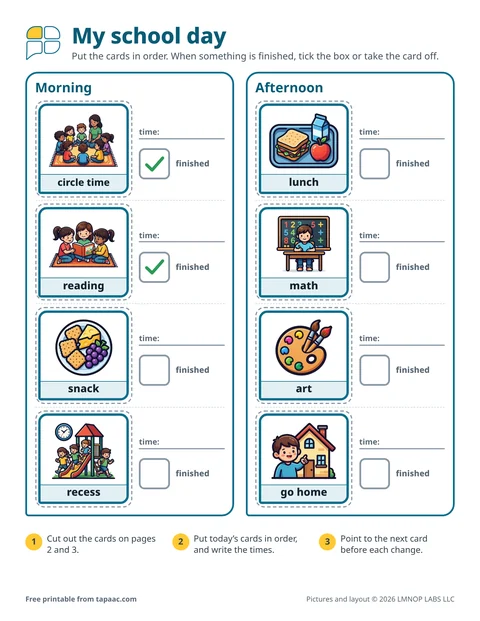 Classroom visual scheduleA school day schedule with times and tick boxes, and 38 picture cards from circle time to go home.
-
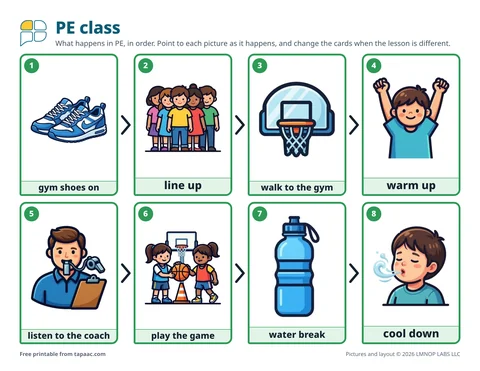 PE visual scheduleThe steps of a PE class, words for moving, taking turns and asking for a break, and a sports board.
Need a different board? Make your own with the free AAC board maker.
More boards on this topic: toy and play communication boards.
These boards and guides are general information, not therapy or medical advice, and they don’t replace a speech therapist. A speech therapist who knows the person can help choose the right words, pictures and layout. The boards are free to print and share; please don’t sell them (terms of use). Questions about the boards? Email support@lmnoplabs.fun.