 Tap AAC
This guide is about visual supports at home for autistic children. Every child is different; for decisions about your own child, talk to their speech-language pathologist, occupational therapist or teacher.
What visual supports are
Activity schedules and visual supports are objects, photographs, drawings or written words that act as cues or prompts. They can help a person get through a sequence of tasks, pay attention to a task, move from one activity to another, or stay calm in different settings.1
The UK national guideline on supporting autistic children and young people lists visual supports, such as words, pictures or symbols that are meaningful for the child, among the ways to adapt the places where children are supported and cared for.2
What the research says
A 2011 review of 23 studies found activity schedules effective in helping people with autism and other intellectual disabilities do things more independently and manage their own schedules. The result reported most often was more engagement and time on task, followed by starting tasks or moving between them without help, and making their own schedules. The studies support using schedules at school and in group homes; the authors pointed out that few studies had family members or other caregivers using them.3
Research can’t tell you which support your own child needs. It does suggest that visual supports are worth trying, and worth teaching properly.
Five visual supports to use at home
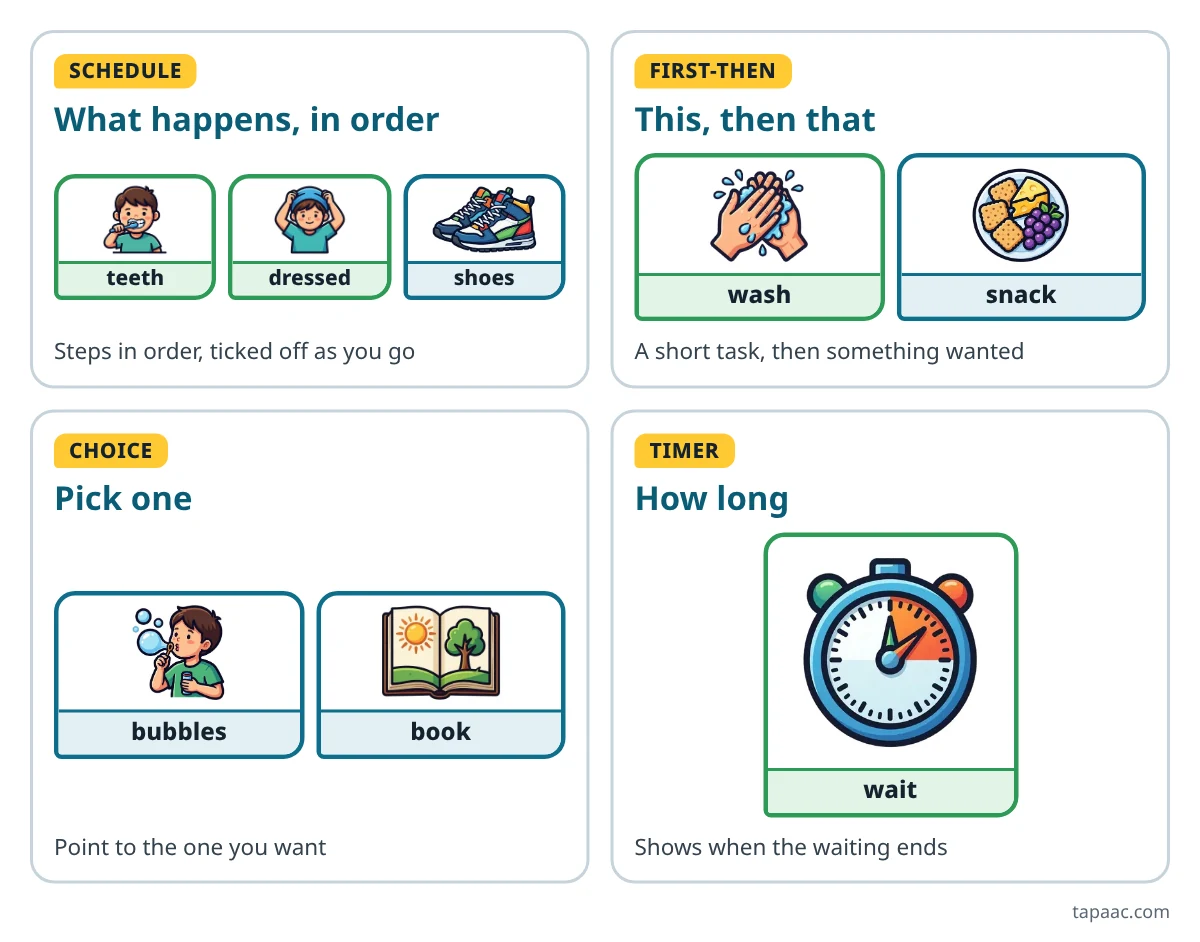
1. A visual schedule
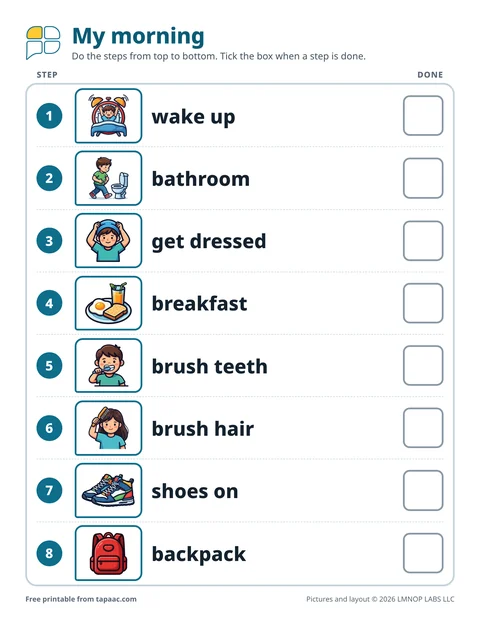
A visual schedule shows the steps of one routine, or the parts of a day, as pictures in order, across or down the page.4 The professional guidance for speech-language pathologists lists what schedules can do: help people understand routines and expectations, stay engaged for longer, move between activities more easily, make choices, and have more control over their own day.4
Start with the routine that is hardest right now. Our guide on how to make a visual schedule goes step by step. The free visual schedule maker opens 11 ready-made routines to change and print, and there are free printable schedules for the morning, bedtime, getting dressed and the toilet.
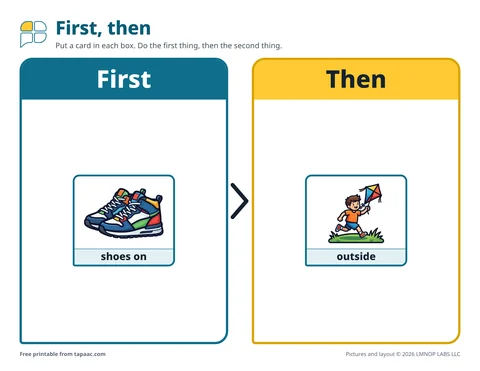
2. A first-then board
Two boxes: what happens now, and what comes next. Keep the first thing short, make the second something your child really wants, and always keep the promise. See how to use a first-then board, and print the first-then board with its picture cards.
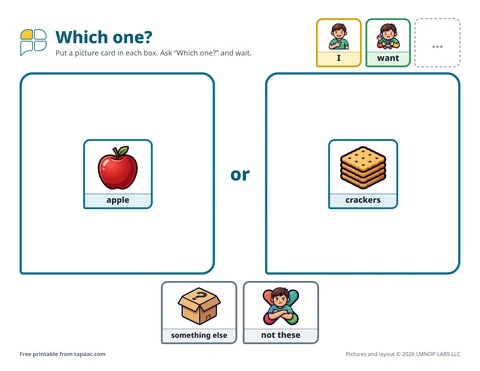
3. A choice board
Two to four pictures of real options: which snack, which toy, which park. Choices give your child a say in their own day. In one small study, three autistic adults at work were much more engaged when they chose the order of their own tasks than when staff chose it for them.5 Print the choice board, and only offer choices you can give.
4. A timer or a wait card
“Five more minutes” and “wait” are hard to understand when you can’t see them. A sand timer, a kitchen timer with a dial, or a countdown card shows how long, and when the waiting ends. Our wait cards have a 5-to-1 countdown and a Now and Next board.
5. Picture labels around the house
A picture on the toy box, the snack drawer, the bathroom door and the shoe basket shows where things live and where they go back. A picture at the front door can show where you are going today: the park, Grandma’s, the doctor.
Low-tech supports like these can count at school too: the US Department of Education names visual schedules and calendars as examples of assistive technology that isn’t electronic.6 See AAC and the IEP.
Ideas for everyday routines
| Moment | Visual support to try | Free printable |
|---|---|---|
| Getting out the door | A morning schedule, ending with a picture of where you’re going | Morning routine chart |
| Meals and snacks | A choice board for the snack; a first-then card for “first wash hands, then eat” | Choice board, hand washing steps |
| Bath time | The steps in a sheet protector on the wall, and a timer for “out soon” | Bath time schedule |
| Ending something fun | A timer your child can see, then a first-then card for what comes next | Wait cards |
| Appointments and outings | A picture schedule of the visit, looked at together beforehand | Doctor visit, haircut |
| Bedtime | A schedule that ends with the same calm step every night | Bedtime routine chart |
| Big feelings | A break card, and a board of calm-down choices | Break card, calm down choices |
Getting ready for changes
The NHS suggests keeping to routines an autistic child is familiar with, telling them about changes as soon as you can, introducing change slowly in a safe and familiar place, and planning ahead with them to avoid things that may cause distress.7 Visual supports make that easier:
- Show a change on the schedule before it happens: swap the picture, and talk about it together.
- Keep one “change” card, so a change of plan always looks the same.
- Before somewhere new, look at pictures of it and go through a picture schedule of the visit. The dentist and getting a shot schedules are a start.
How to introduce a visual support
- Pick one support for one hard moment. Not five at once.
- Teach it when your child is calm. Walk through it together on an easy day, before you need it on a hard one.
- Point, and say less. Point to the picture as you say a few words: “First shoes. Then outside.” Then let the picture do the talking.
- Use it every time. The same pictures in the same place, used by everyone at home.
- Let your child take part. They can move a card to Done, choose the order of steps where order doesn’t matter, or pick what comes at the end.
- Change one thing at a time, and give it time before deciding it doesn’t work.
Visual supports and AAC
Visual supports mostly help a child understand: what is happening, what comes next, what the choices are. AAC gives your child a way to tell you things: what they want and don’t want, how they feel, and what they think. A child may need both. Using the same pictures for both helps: the professional guidance says visual supports that use the same symbols as a person’s AAC can help them understand, anticipate and talk about daily routines, and can create more chances to model words on their AAC.4
Read AAC and autism for answers to common parent questions, and how to teach a child to use AAC for modeling. The core word of the week plans give you one word to model at a time.
Supports, not rules
A visual support is there to make the day easier to understand for your child, not to make them do more. The NHS advises not trying to change how an autistic child behaves unless it is harmful to them or others, and making their surroundings as comfortable as possible, for example by managing light and noise.7 If a schedule turns into a battle, make it shorter, add something your child enjoys, or ask your child’s team for ideas.
Try this today
- Pick the one routine that is hardest right now.
- Print or make a schedule for it, with one picture per step.
- Walk through it together once, on a calm day.
- Put a picture label on one place things live, like the toy box or the snack drawer.
More AAC guides
- AAC and autism: answers to common parent questionsWill AAC stop my child from talking? Is my child ready? How do I start?
- How to make and use a visual scheduleSeven steps, from choosing a routine to teaching it and marking each step done.
- How to use a first-then boardSeven simple steps, and what to try when it isn’t working.
- How to teach a child to use AAC: model, wait and respondModeling, waiting and responding in depth, with examples, and what to do when it isn’t working.
- AAC at home: setting up the house, and helping the whole familyWhere the device and boards live, room by room, and how siblings, grandparents and sitters can help.
Sources
We read each of these on October 13, 2026. Numbers in the text point to them.
- American Speech-Language-Hearing Association. Autism (Practice Portal). Professional guidance for speech-language pathologists. Accessed October 13, 2026.
- National Institute for Health and Care Excellence (NICE, UK). Autism spectrum disorder in under 19s: support and management (CG170), Recommendations. Published August 28, 2013, last updated June 14, 2021.
- Koyama T, Wang HT (2011). Use of activity schedule to promote independent performance of individuals with autism and other intellectual disabilities: a review. Research in Developmental Disabilities, 32(6), 2235–2242. Abstract on PubMed.
- American Speech-Language-Hearing Association. Augmentative and Alternative Communication (Practice Portal). Professional guidance for speech-language pathologists. Accessed October 12, 2026.
- Watanabe M, Sturmey P (2003). The effect of choice-making opportunities during activity schedules on task engagement of adults with autism. Journal of Autism and Developmental Disorders, 33(5), 535–538. Abstract on PubMed.
- U.S. Department of Education. Myths and Facts Surrounding Assistive Technology Devices and Services (PDF). January 2024.
- NHS (UK). Supporting an autistic child. Page last reviewed May 6, 2026.
 Morning routine chart
 First-then board
 Choice boards
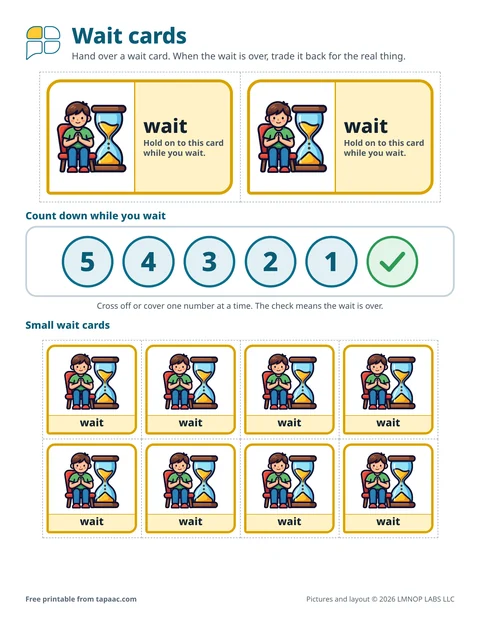 Wait cards