 Tap AAC
Nonverbal communication cards and “I use AAC” wallet cards
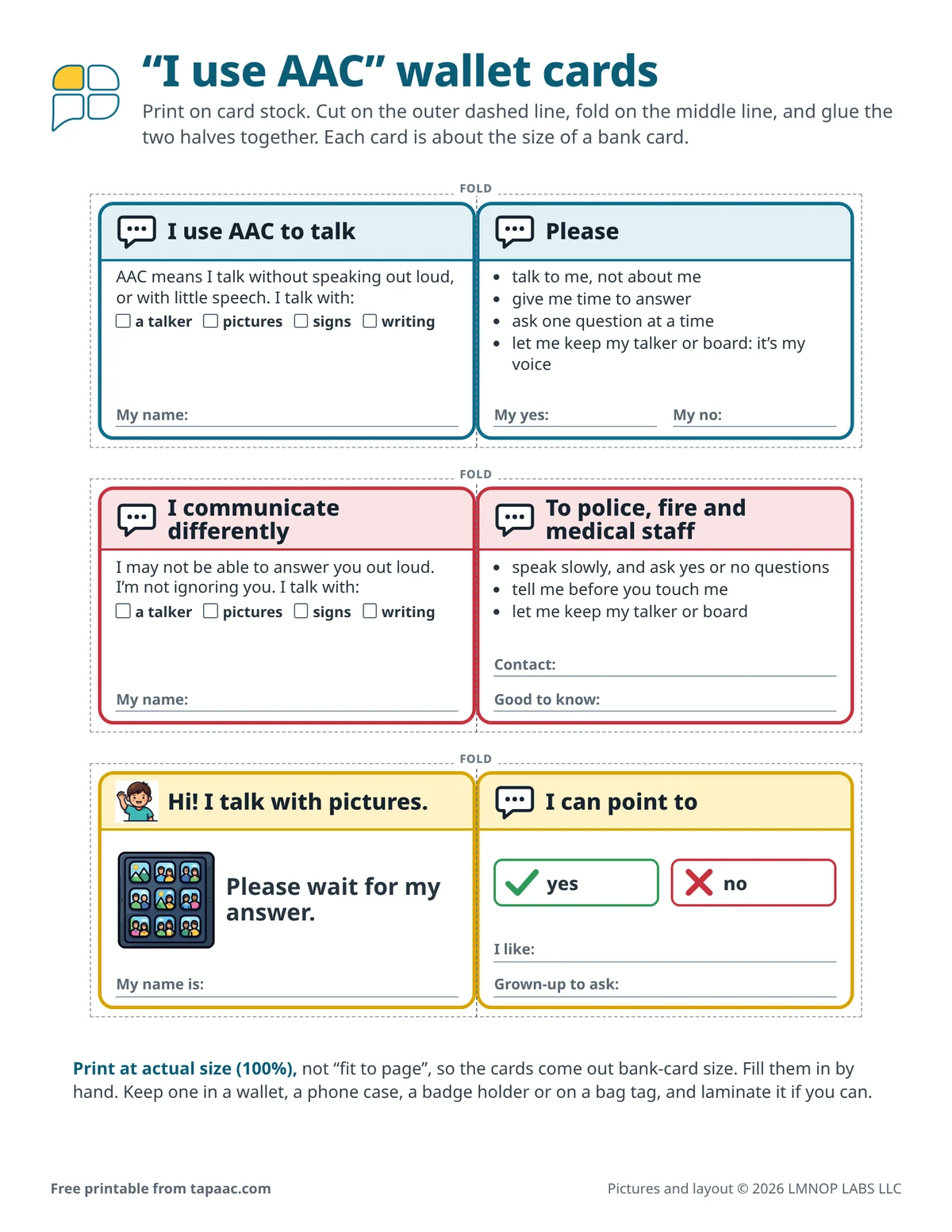
An “I use AAC” card tells a new person, in a few seconds, that you communicate without speech, how you do it, and what helps: give me time, ask yes or no questions, let me keep my talker. This free PDF has three fold-out wallet cards (one for everyday, one for police, fire and medical staff, and one for children) and 14 quick cards for a key ring, like Please wait. I’m typing my answer. and Please write it down. You fill everything in by hand.
Download the free PDF US Letter, 2 pages, 229 KB
Portrait (tall page, 2 pages): US Letter PDF (229 KB) · A4 PDF (229 KB)
Landscape (wide page, 2 pages): US Letter PDF (230 KB) · A4 PDF (230 KB)
Edit this board in the free board maker: change the words and pictures, then print.
Have Tap AAC? Add to Tap AAC (.obz file, 14 KB) · How to add a board
- Free
- No sign-up
- Print as many as you need
Who it’s for
Teens and adults who don’t speak, don’t speak much, or lose their speech when stressed, and children who use AAC, with the grown-ups who support them. It helps whenever there’s a new person to explain things to: a cashier, a bus driver, a new teacher, a doctor, a police officer.
How to make the wallet cards
- Print at actual size (100%, not “fit to page”) on card stock.
- Fill them in together, by hand: the name, how the person talks, what their yes and no look like. Let the person decide what goes on.
- Cut, fold and glue. Cut on the outer dashed line, fold on the middle line, and glue the halves back to back. Laminate the card, or slip it into a card sleeve.
- Keep it in the same place every day: a wallet, a phone case, a badge holder, a zip pocket on a backpack.
- Practice showing it. Play shopkeeper or new neighbor at home, so taking the card out becomes easy.
The card for police, fire and medical staff
The red card is for the moments when a stranger expects a quick spoken answer. It says it plainly: I may not be able to answer you out loud. I’m not ignoring you. Inside, it asks responders to speak slowly, ask yes or no questions, say before they touch, and let the person keep their talker or board. Use Good to know for one short line, like “Loud sirens upset me” or “I understand what you say.” Use Contact for someone who knows the person well. Put only what you’re happy for a stranger to read. In an emergency, call 911 or your local emergency number.
Quick cards for a key ring
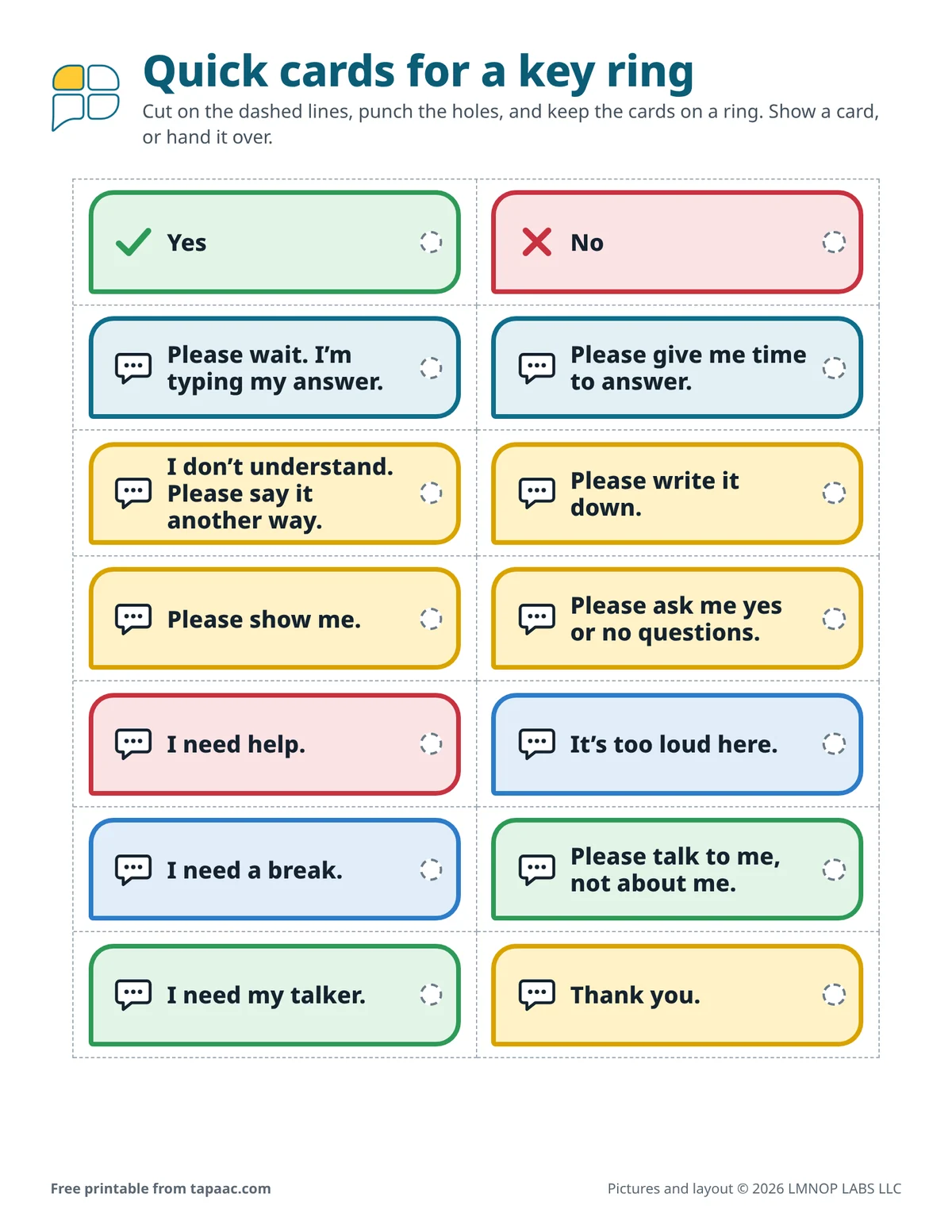
Some messages come up again and again: in shops, at school, at appointments. The 14 cards on page 2 hold the common ones, ready to show. Please wait. I’m typing my answer. buys time for a person typing on a device. Please write it down. and Please show me. ask for another way to explain. Punch the holes and put the cards on a binder ring, clipped to a bag or a belt loop, and write your own on the back of a card.
Nothing to sign up for
The cards are a PDF: you print them and write on them with a pen. Nothing you write goes into this website or anywhere else.
Jordan is 19 and uses a talker. At the bank, the teller asks a question, and Jordan starts typing. The teller asks again, louder. Jordan holds up a card from his key ring: Please wait. I’m typing my answer. The teller nods and waits. The next week, a bus driver asks Jordan where he’s going. Jordan shows his wallet card, and the driver says, “Got it. Take your time.”
What’s on the cards
Wallet cards (each folds in half)
- I use AAC to talk
- I communicate differently
- Hi! I talk with pictures.
Key ring cards
- Yes
- No
- Please wait. I’m typing my answer.
- Please give me time to answer.
- I don’t understand. Please say it another way.
- Please write it down.
- Please show me.
- Please ask me yes or no questions.
- I need help.
- It’s too loud here.
- I need a break.
- Please talk to me, not about me.
- I need my talker.
- Thank you.
Printing tips
- Check the size: a folded card should measure about 3.4 by 2.1 inches (85 by 54 mm), like a bank card.
- Make two: one for the wallet or bag, one for the talker’s case.
- ID badge holders for lanyards fit the wallet cards, and keep them dry.
- For quick answers at home and school, see the yes and no board; for saying hello and chatting, the greetings and conversation board.
- A wallet card is part of an emergency plan too: show it to responders straight away. AAC in an emergency covers what else to carry, contacting 911 when you can’t speak, and what to tell responders.
More free boards
-
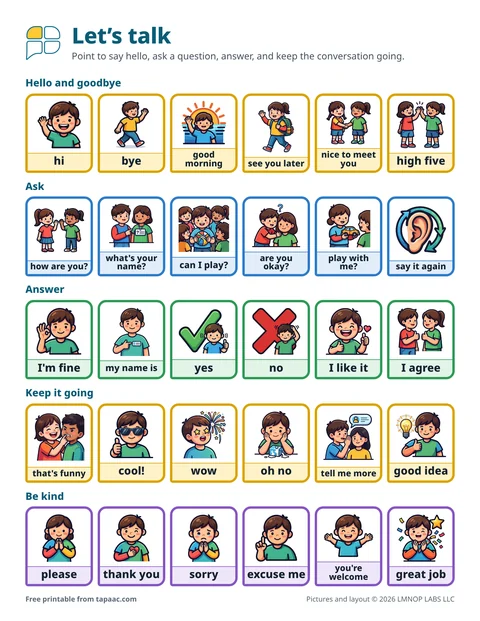 Greetings and conversation boardHello, questions, answers and kind words, plus 12 conversation starter cards.
-
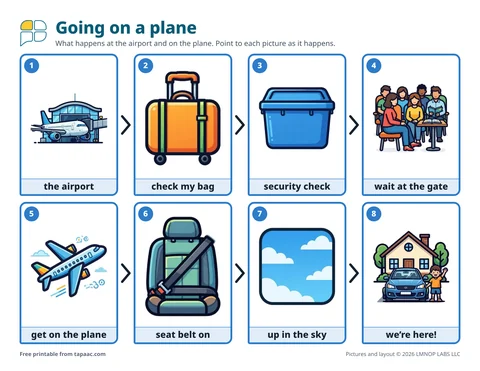 Airport visual scheduleThe steps of a plane trip, a board for the flight, and a travel bag list with pictures to tick.
-
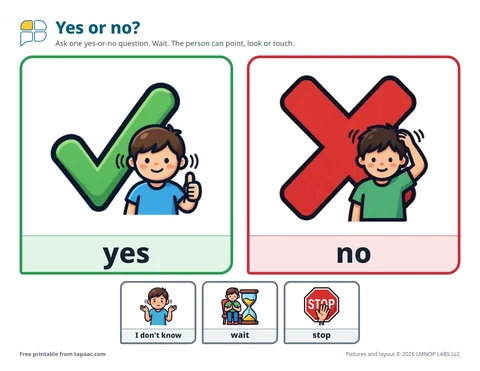 Yes and no boardA big yes and no to point to or look at, plus 20 cards to cut out.
-
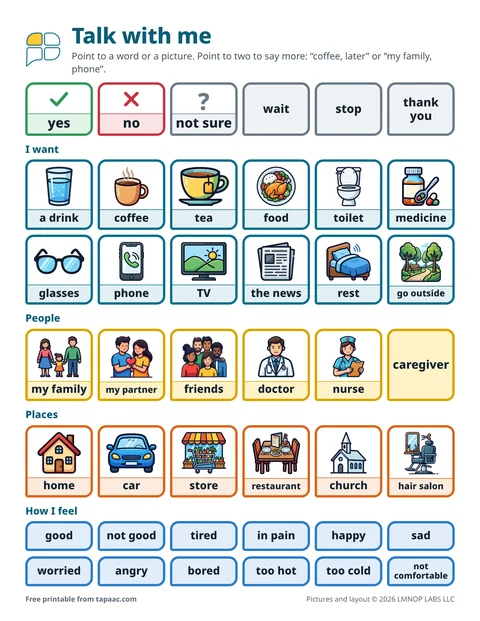 Communication board for adultsGrown-up pictures and plain words: wants, people, places, feelings, and a keyboard page for spelling.
Need a different board? Make your own with the free AAC board maker.
These boards and guides are general information, not therapy or medical advice, and they don’t replace a speech therapist. A speech therapist who knows the person can help choose the right words, pictures and layout. The boards are free to print and share; please don’t sell them (terms of use). Questions about the boards? Email support@lmnoplabs.fun.