 Tap AAC
Why home matters
Meals, baths, bedtime and car rides are full of things to say, and AAC can only be used if it is there. People who use AAC should always have access to their communication tools, and a device may not work as well as it could if it is used in one place but not in the others.1
The family matters as much as the device. Family, friends and caregivers bring a unique understanding of the person, and AAC can be partly or completely abandoned when their input isn’t considered.1 A 2019 review of 43 articles of low-tech and unaided AAC found that the most prominent things helping or holding back AAC use were in the person’s surroundings: above all, the attitudes and support of professionals, family members and society.2
Give the device a home
- A home base. One spot where the device lives and charges at night, the same spot every day.
- A charging routine. Plug it in at the same time every evening, so it is full in the morning. Charging and storing the device are among the things partners are taught.1
- Within reach, switched on. On the table at meals, next to your child on the sofa, in the car. Not on a high shelf.
- A case and a strap, so it can travel and survive a drop.
- A backup. Back up the words and settings, and keep a paper copy of the main page. Equipment breaking down is one of the known barriers to AAC use.1
- Talking first. If the tablet also has games and videos, ask the speech-language pathologist whether the AAC app should have a tablet of its own, or whether to lock the tablet to the app while it’s being used for talking.
Room by room
Put a paper board where each routine happens, as a backup and for places a device can’t go. Pick two or three words to model in each.
| Where | Board to keep there | Words to model |
|---|---|---|
| Kitchen table | Mealtime board, choice board | more, all done, eat, drink, help |
| Bathroom | Bath time, tooth brushing and hand washing steps, in sheet protectors | in, out, hot, cold, wash |
| Bedroom | Bedtime routine chart, getting dressed steps | on, off, read, sleep, again |
| Play area | Core word board | go, stop, my turn, look, like |
| Front door | Morning routine chart | go, outside, shoes, where |
| Car | A car board you make yourself (see the example) | go, stop, music, look |
Keep words in the same places on every copy, so a word found on the bath board is in the same spot on the kitchen board, and on the device if you can. If a board you need isn’t there, make it in the free board maker. The core word of the week plans give the whole house one focus word at a time.
Fit it into the day you already have
Teaching AAC doesn’t need a lesson at the table. Choose one routine your child enjoys, model the same few words every time it comes round, and add a second routine when the first feels natural. Our guide on how to teach a child to use AAC covers modeling, waiting and responding, and the one-page AAC modeling at home handout sums it up for the fridge.
Helping the whole family
Everyone who talks with your child is a communication partner: parents, brothers and sisters, grandparents, babysitters, coaches. Partner training works: a 2015 meta-analysis found that teaching communication partners was highly effective for the communication of the people who use AAC. The training most often included a short explanation, the trainer showing the skill, guided practice and role play.3 You can do the same at home: explain, show, then practice together.
A one-page “how I communicate” sheet
Write down how your child says yes and no, asks for help and shows they need a break; what their AAC is and where it lives; and two or three things to do. Keep it on the fridge, and give a copy to every new sitter, relative and coach.
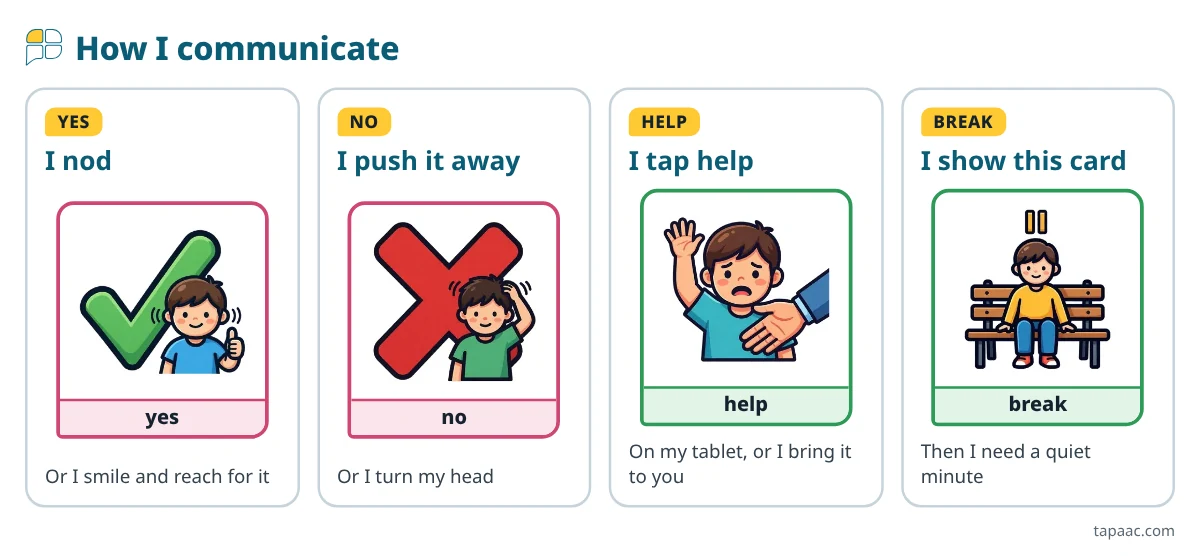
Out and about, the free “I use AAC” wallet cards do the same job with new people. Explaining AAC to an unfamiliar listener with a short, ready-made message is one of the skills the professional guidance lists under strategic competence.1
Brothers and sisters
- Show them how the AAC works, and let them model on it in games: my turn, your turn, go, stop.
- Give them small jobs they can choose to do, not jobs they must do.
- Agree on family rules: nobody hides the device, uses it to tease, or answers for their sibling without asking.
- Make time that is just theirs, and room to say when it’s hard.
Grandparents, babysitters and visitors
- Give them the modeling handout and your “how I communicate” sheet.
- If someone worries that AAC will stop your child talking, the one-page AAC myths and facts handout answers that worry.
- Teach three rules: talk to your child, not about them; wait for the whole message; answer what the AAC says.
- If the speech-language pathologist agrees, invite a grandparent or sitter to a therapy session.
Out and about
- Pack the AAC like the house keys: it goes wherever your child goes.
- Keep a small paper board for the park, the pool and the store: see the playground, swimming and grocery store boards.
- Before somewhere new, look at a picture schedule of the visit together. See visual supports at home.
- Have a plan for emergencies: a card for responders, a charged device and a paper backup. See AAC in an emergency.
Home and school, working together
Inconsistent use of AAC at home and at school is a known challenge, and so is a lack of buy-in. Involving students, parents, teachers and administrators from the start, with a plan that sets out who does what, can prevent both.1
- Use the same device, the same pages and the same pictures in both places.
- Agree how new words get added, and who tells whom.
- Send one line each way each day: one thing your child said.
In US public schools, a school-bought device can come home: if the IEP team decides your child needs it at home to receive a free appropriate public education, the school must allow it, case by case.4 Assistive technology services can include training for the family, where appropriate.5 More in AAC and the IEP.
Look after yourself
You don’t have to model all day. A few good moments in each routine add up. If the plan feels like too much, tell the speech-language pathologist: it should fit your family. The professional guidance says barriers to AAC use are lower when timelines for progress are realistic, and when the person and the family get thorough training once a device arrives.1
Try this today
- Choose a home base for the device, and set a charging time every evening.
- Put one paper board where your family eats.
- Write a “how I communicate” sheet and stick it on the fridge.
- Show one other family member how to model one word.
More AAC guides
- How to teach a child to use AAC: model, wait and respondModeling, waiting and responding in depth, with examples, and what to do when it isn’t working.
- Visual supports for autism at home: schedules, choices and timersSchedules, first-then boards, choice boards, timers and labels, and how to start at home.
- AAC at school: how teachers can support a student who uses AACModeling in lessons, wait time, better questions, classmates, and the IEP.
- AAC and the IEP: what parents can ask forWhat IDEA says about assistive technology, and what to ask about evaluations, goals, home use and training.
- AAC modeling at homeFive habits for families, with a free one-page handout for the fridge.
Sources
We read each of these on October 13, 2026. Numbers in the text point to them.
- American Speech-Language-Hearing Association. Augmentative and Alternative Communication (Practice Portal). Professional guidance for speech-language pathologists. Accessed October 12, 2026.
- Moorcroft A, Scarinci N, Meyer C (2019). A systematic review of the barriers and facilitators to the provision and use of low-tech and unaided AAC systems for people with complex communication needs and their families. Disability and Rehabilitation: Assistive Technology, 14(7), 710–731. Abstract on PubMed.
- Kent-Walsh J, Murza KA, Malani MD, Binger C (2015). Effects of Communication Partner Instruction on the Communication of Individuals using AAC: A Meta-Analysis. Augmentative and Alternative Communication, 31(4), 271–284. Abstract on PubMed.
- U.S. Department of Education, IDEA regulations. 34 CFR §300.105: Assistive technology. Accessed October 12, 2026.
- U.S. Department of Education, IDEA regulations. 34 CFR §300.6: Assistive technology service. Accessed October 12, 2026.
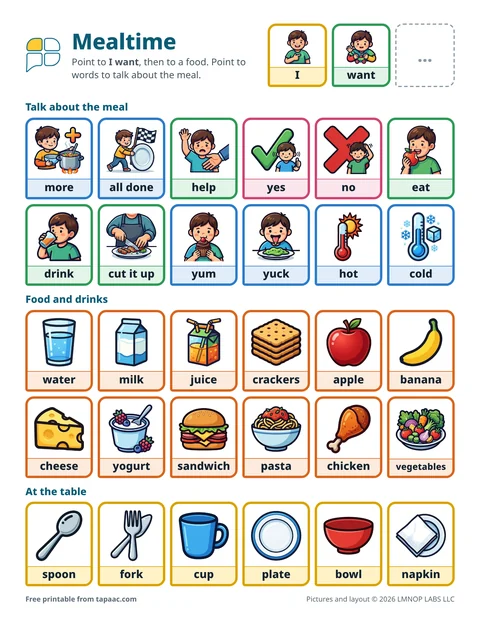 Mealtime communication board
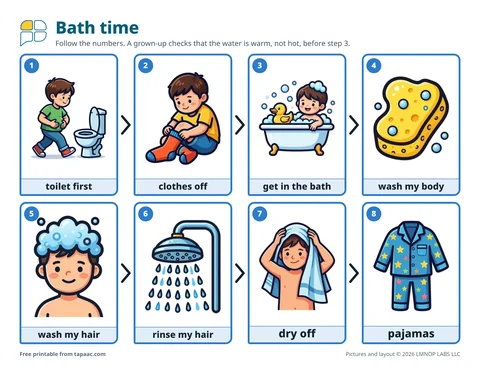 Bath time visual schedule
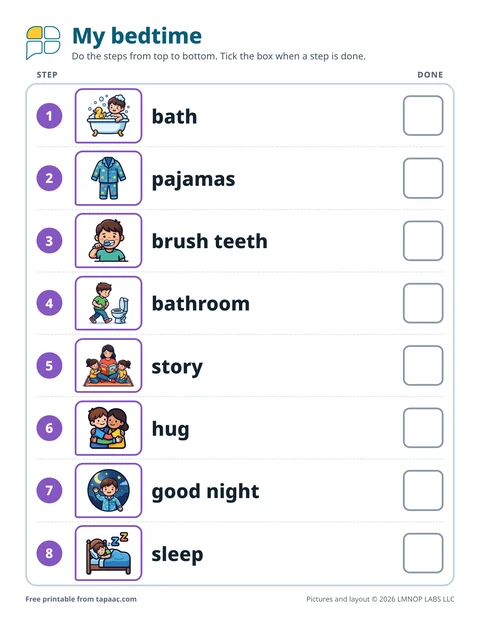 Bedtime routine chart
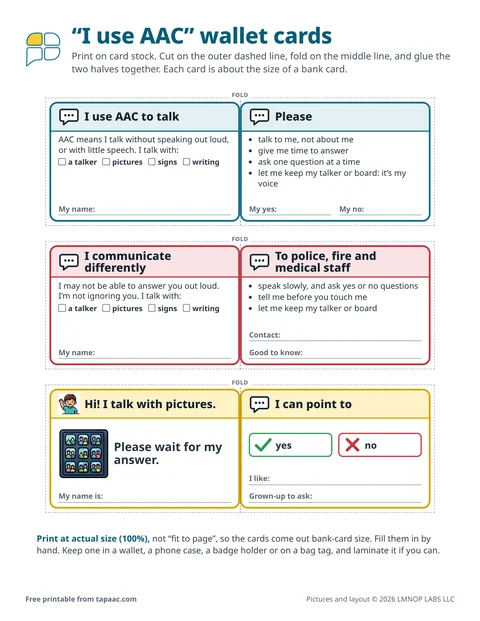 Nonverbal communication cards